


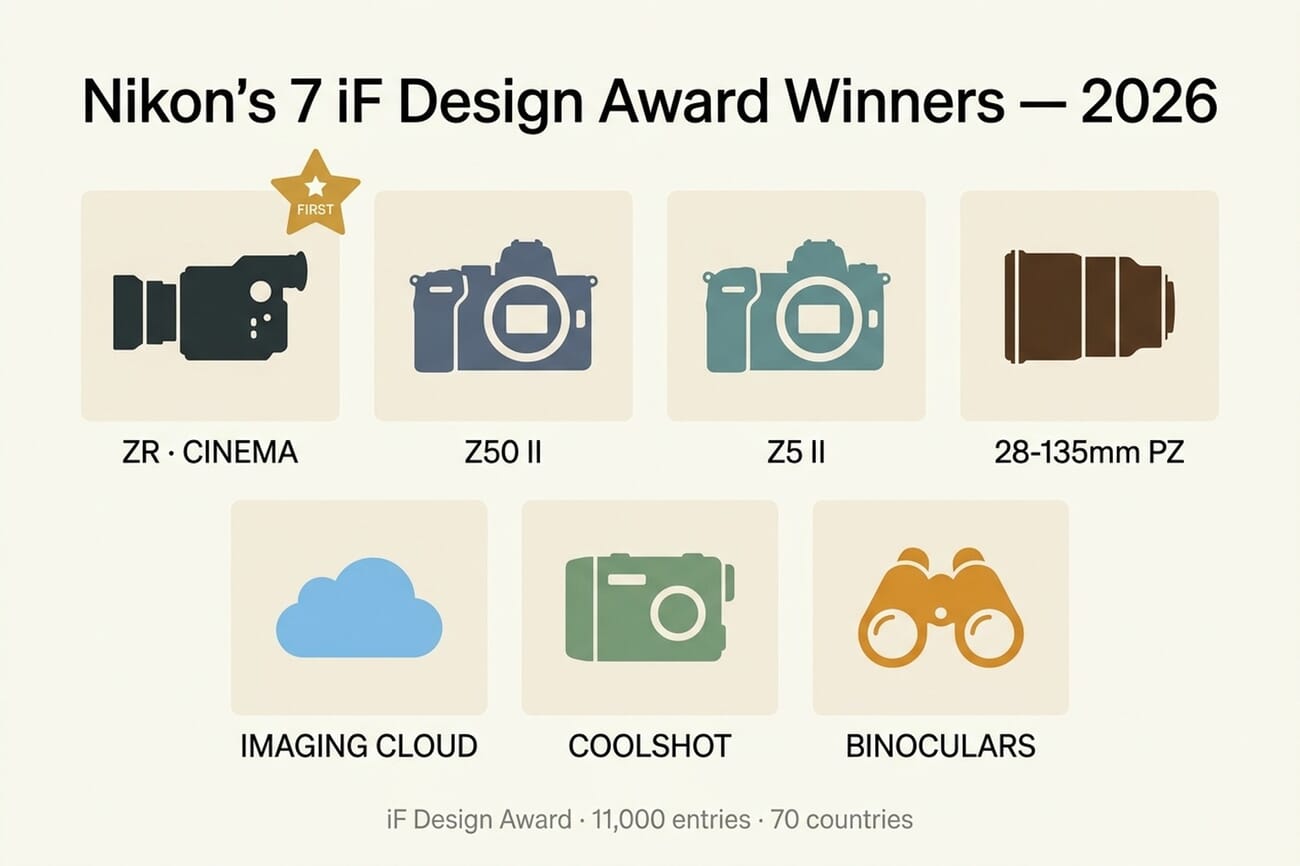
- Nikon won seven 2026 iF Design Awards on May 1 — across cameras, lenses, software, and optics. The iF Design Award draws ~11,000 entries from ~70 countries each year.
- The headline winner is the Nikon ZR — the company’s first-ever cinema camera, born from Nikon’s 2024 acquisition of RED Digital Cinema.
- Other winners: Z50 II (DX mirrorless), Z5 II (full-frame mirrorless), NIKKOR Z 28-135mm f/4 PZ (8K-capable power-zoom), Imaging Cloud, plus Coolshot rangefinders and stabilized binoculars.
- Coming one day after Sigma’s BF won Red Dot: Best of the Best 2026, the camera industry now has back-to-back recognition from the world’s two most prestigious product-design juries — within 48 hours.
- What it means: design is now a real buying axis for cameras in 2026, alongside specs and price. Nikon and Sigma are the most-recognised players in this lane right now.
Nikon won seven 2026 iF Design Awards on May 1 — a sweep that runs across the company’s full product line. Cameras, lenses, software, and optics all picked up wins from the international design jury, with the headline going to the Nikon ZR — the company’s first-ever cinema camera. Digital Camera World broke the news; Nikon’s own announcement followed shortly after.
The timing matters. Twenty-four hours earlier, Sigma’s BF won the Red Dot: Best of the Best 2026 with a perfect score of 100/100. The camera industry now has back-to-back recognition from the world’s two most prestigious product-design juries — within 48 hours. Two different manufacturers, two different award bodies, two different visual languages, but the same underlying signal: design is now a real buying axis for cameras in 2026, sitting alongside specs and price.
This guide covers Nikon’s seven winners, the cinema-camera angle that ties them together, what the iF Design Award actually means, and what it signals for the broader camera industry going forward.
The Nikon ZR Is the Headline — and Not Just Because It’s First
Of the seven winners, the Nikon ZR is the one that matters most editorially. It’s Nikon’s first dedicated cinema camera, the inaugural model of the new “Z CINEMA” series, and the first product born from Nikon’s 2024 acquisition of RED Digital Cinema. The iF jury called it out specifically: “Disrupting conventional constraints in film production, the ZR liberates cinematic expression for all creators.”
Two things make this win unusual. First, cinema cameras almost never take design awards — the category is dominated by furniture, lighting, mobility, and consumer electronics. The traditional cinema cameras that do get attention (ARRI’s Alexa, Sony’s Venice, RED’s V-Raptor) are large, modular, accessory-heavy bodies that look like industrial gear. The ZR sits in a much smaller form factor — closer to a hybrid stills body than a Hollywood-grade production camera — and the jury rewarded that compactness as the design innovation.
Second, this is the design industry validating Nikon’s cinema strategy in real time. Nikon acquired RED in 2024 for ~$85 million, an unusual move for a company historically known as a stills brand. Nikon’s Q3 2026 financials confirmed cinema as a strategic priority, not a side experiment. The iF win three months later is the signal that the broader design world sees Nikon’s cinema move as legitimate — not just a logo swap on existing products.
All Seven Nikon Winners — and Why They Won
Beyond the ZR, the wins span Nikon’s full 2025-2026 product lineup. Each one had a specific design argument the iF jury rewarded:
- Nikon ZR — full-frame cinema camera, ~$2,199, 6K RAW with RED color science. The first Z CINEMA-series body. Won for compactness + cinematic capability in a previously bulky category.
- Nikon Z50 II — DX-format mirrorless, the entry into Nikon’s APS-C lineup. Won for “Imaging Recipes” — the in-camera preset system that lets users adopt the visual look of specific creators with one selection. The jury called it out as making expressive shooting accessible.
- Nikon Z5 II — full-frame mirrorless, the second-generation entry-level full-frame body. Won for inheriting advanced shooting features from higher-end Nikon models in a body designed for first-time full-frame buyers.
- NIKKOR Z 28-135mm f/4 PZ — 8K-capable power-zoom lens, optimised for video. Won for combining stills-grade optical performance with smooth zoom operation suited to filmmaking. Pairs naturally with the ZR.
- Nikon Imaging Cloud — cloud service for connected camera workflow. Won for streamlining the post-shoot process; less hardware, more system thinking.
- Coolshot Pro III Stabilized / Coolshot 50i GII — golf rangefinders. Outside Nikon’s photo-camera business, but worth noting that a single design language is winning iF recognition across product lines.
- Stabilized 10×25 S / 12×25 S Binoculars — image-stabilized binoculars. Same point: Nikon’s optics design vocabulary is consistent enough that the jury rewarded it across categories, not just on cameras.
The pattern across all seven: Nikon isn’t winning on individual feature spikes. It’s winning on coherent product-design language — the way the bodies feel in hand, the consistency of control layouts, the quality of typography on the dials, the proportional logic of the lens barrels. None of which shows up on a spec sheet, all of which shows up when you pick up the products.
Explore the Awarded Products on PhotoWorkout
Four of the seven Nikon iF Design Award winners have full pages in PhotoWorkout’s camera and lens database — with specs, current pricing, and (where available) sample photo galleries:
- 📷 Nikon ZR — full-frame cinema camera, ~$2,199 with RED color science. The ZR’s database page covers full specs and recent firmware updates.
- 📷 Nikon Z50 II — DX-format mirrorless with the “Imaging Recipes” preset system the iF jury called out specifically.
- 📷 Nikon Z5 II — second-generation entry-level full-frame body, the most accessible winner in the lineup.
- 🔭 NIKKOR Z 28-135mm f/4 PZ — the 8K-capable power-zoom lens designed to pair with the ZR for video work.
The Imaging Cloud, Coolshot rangefinders, and stabilized binoculars sit outside our database scope (we only track interchangeable-lens cameras and L-mount/Z/RF/E lenses). For those, Nikon’s official product pages are linked in the section above.
Two other 2026 cameras worth bookmarking on the same design-aware axis — both directly mentioned in this article:
- 📷 Sigma BF — won Red Dot: Best of the Best 2026 with a perfect 100/100 the day before Nikon’s iF sweep. Also took an iF Gold Award earlier in 2026.
- 📷 Canon EOS R6 V — Canon’s response to the same design trend. Cinema-first chassis with active cooling, customisable dial caps, ships May 13. Same 32.5MP sensor as the R6 Mark III.
What an iF Design Award Actually Means
The iF Design Award is one of the two most prestigious international product-design competitions, alongside the Red Dot Award. Established in 1953 by Industrie Forum Design Hannover, it now draws roughly 11,000 entries from around 70 countries each year. The 2026 jury was 129 designers from 21 countries, judging products on design quality, workmanship, choice of materials, degree of innovation, environmental impact, functionality, ergonomics, visualization of intended use, safety, and brand value.
The award has tiers. Most products that pass the jury get a standard iF Design Award. The top ~75 designs each year — across all categories — get the iF Gold Award. Coverage of Nikon’s seven 2026 wins didn’t specify Gold tier for any of them, so they’re presumed standard awards (still meaningful — only a fraction of the ~11,000 entries are recognized at all).
For comparison, Sigma’s BF won an iF Gold Award earlier in 2026 (announced March), in addition to the Red Dot: Best of the Best (April 30). That’s the rarer combination — top-tier recognition from both juries on the same product.
Two Wins in Two Days — and Why That Matters
The 48-hour gap between Sigma’s Red Dot win and Nikon’s iF sweep is genuinely unusual for the camera industry. Cameras as a product category rarely take prizes at this level — both Red Dot and iF lean heavily toward furniture, lighting, mobility, and consumer electronics where mature design language has decades to refine. Two camera makers winning back-to-back is the kind of pattern that says something about where the category is heading.
The two wins read differently. Sigma’s recognition is about depth — one camera (the BF) winning two of the most prestigious individual design honors in 2026. The BF makes the design argument by subtraction: three buttons, one dial, a true unibody aluminum chassis. The award validates a single radical product.
Nikon’s recognition is about breadth — seven different products across cameras, lenses, software, and optics, all winning in the same year. No single Nikon product is doing what the BF does. Instead, the win validates a coherent design language across a portfolio. The signal is that Nikon’s industrial design team has settled into a recognisable house style — and the international design community is rewarding it.
Both routes work. Sigma is the indie design auteur; Nikon is the systematic enterprise. What they share is a willingness to put design considerations on equal footing with engineering ones — and that’s the bigger story.
Design Is Now a Buying Axis — Not Just a Spec Race
Three forces are pushing camera design recognition into the foreground in 2026:
- Spec parity has flattened. Every full-frame body north of $1,500 now does 4K well, focuses on eyes accurately, and shoots fast enough. Differentiation has to come from somewhere else, and design is the cleanest place left.
- The Fujifilm X100 / Sigma fp effect. Both products proved that design-led cameras sell — to a real audience, at premium prices, with multi-year waiting lists. Manufacturers paying attention have updated their roadmaps accordingly.
- Generational shift in buyers. Photographers who grew up with smartphones don’t have decades of muscle memory for 30-button DSLR layouts. Cleaner interfaces aren’t a compromise to them — they’re the default expectation.
The implications cut across the rest of the industry. Canon’s EOS R6 V, shipping May 13, doubles down on cinema-first ergonomics with active cooling and customisable dial caps. Panasonic’s recent S5 II and S9 launches lean into the Lumix red-dot heritage as a design touchpoint. Even Sony — historically the “specs over feel” brand — has been moving in this direction with the simplified A7C series.
For buyers in 2026, the practical takeaway is that “best camera for X” is no longer answered just by reading spec tables. Two cameras with identical megapixel counts and similar autofocus ratings can produce wildly different shooting experiences depending on how their bodies are designed. That’s why design awards from Red Dot and iF are starting to matter to camera shoppers — they’re a credibility signal that the industrial design team got it right, not just the engineering team.
Frequently Asked Questions
When was the iF Design Award 2026 announced?
The iF Design Award 2026 winners were announced earlier in 2026 in tiers. Nikon’s official announcement of its seven wins landed on May 1, 2026 — one day after Sigma’s BF won the Red Dot: Best of the Best 2026 (April 30).
Is the Nikon ZR really Nikon’s first cinema camera?
Yes — the ZR is the inaugural model in Nikon’s “Z CINEMA” series. Nikon has shipped video-capable mirrorless bodies for years (the Z9, Z8, Zf), but those are hybrid still-and-video cameras. The ZR is the first body specifically engineered for cinema work, with RED color science integrated, RAW recording, and cinema-first ergonomics. It’s also the first product born from Nikon’s 2024 acquisition of RED Digital Cinema.
How many products win iF Design Awards each year?
The iF Design Award draws around 11,000 entries from approximately 70 countries each year. A fraction of those receive standard iF Design Awards; the top 75 designs across all categories each year receive the iF Gold Award. Nikon’s seven 2026 wins are at the standard tier (Gold tier wasn’t specified in coverage), which is still significant — most submissions don’t get any recognition.
How does the iF Design Award compare to Red Dot?
iF and Red Dot are the two most prestigious international product-design competitions and are commonly seen as peers. Red Dot has three tiers (Red Dot, Red Dot: Best of the Best, Red Dot: Honourable Mention). iF has standard awards plus the iF Gold Award. Both juries are international and judge across all product categories. Many manufacturers submit to both — it’s not unusual for a single product to win both, like Sigma’s BF in 2026.
Should I factor design awards into a camera purchase?
For most buyers in 2026, yes — but as one signal among several, not as the deciding factor. Design awards correlate well with build quality, ergonomics, and long-term satisfaction; they correlate weakly with image quality, autofocus performance, or video specs. Use them to choose between two products that already meet your technical requirements, not to override them.
The Bottom Line
Two days, two of the world’s most prestigious design juries, two different camera makers winning. The pattern is hard to dismiss: design is now a real, recognised competitive axis in the camera industry, sitting alongside megapixels and autofocus speed. Sigma is the indie auteur; Nikon is the systematic enterprise; both are pushing the same trend.
For Nikon specifically, the ZR’s iF win is the more strategically important data point. The cinema move was risky — the company’s first foray into a category dominated by ARRI, Sony, and RED, in a year when camera-industry margins are tight. Validation from the international design world this early in the product’s lifecycle suggests Nikon got the strategy right, not just the camera.
Whether the ZR sells in volume — and whether the rest of Nikon’s lineup keeps the design momentum going — will be the test through the rest of 2026. But on May 1, 2026, the camera maker most identified with conservative engineering excellence just got told by 129 international designers that it’s also worth recognising for its design.

Image credits: Featured image is an editorial illustration by PhotoWorkout, built on Nikon’s official ZR press photography (Nikon Z 24-120mm f/4 lens). Infographic and Pinterest pin generated in-house.
Primary sources for this guide:
Award announcement
- Digital Camera World — Nikon's seven iF Design Awards 2026 – Initial breakdown of the seven Nikon products that won, with quotes pulled from Nikon's announcement.
- iF Design — Award home – Official iF Design Award site — covers the 2026 award process, jury composition, and entry statistics.
Nikon ZR & cinema strategy
- Nikon — Official ZR announcement (Sept 2025) – Official Nikon press release announcing the ZR as the first model in the “Z CINEMA” series, born from Nikon's synergy with RED Digital Cinema.
- Y.M.Cinema — Nikon Q3 2026 financials confirm cinema is core – Analysis of Nikon's recent financials showing cinema is now a strategic priority, not a side bet.
- Newsshooter — Nikon ZR & NIKKOR ZCINEMA at NAB 2026 – Coverage of Nikon's expanded cine-lens line and ZR firmware updates announced at NAB 2026.
- Wikipedia — Nikon ZR – Reference page with the ZR's specs, release date, and RED-collaboration context.
Image Sources
- Nikon — Official ZR press image – Featured image is built on Nikon's official ZR press photography (with the Z 24-120mm f/4 lens) plus an editorial gold-halo overlay added by PhotoWorkout.
- PhotoWorkout — editorial illustrations – 7-winner infographic and Pinterest pin generated in-house. Stylized icons; not real Nikon product imagery beyond the press shot in the featured image.