


- Sigma’s BF won the Red Dot: Best of the Best 2026 — the highest distinction in the Red Dot Award: Product Design — with a perfect 100 from the international jury.
- It’s Sigma’s third camera to win Best of the Best, after the sd Quattro (2017) and fp (2020). Cameras don’t usually take this prize at all — Sigma is now the only camera maker to win it three times.
- The BF is a 24.6MP full-frame L-Mount body with 3 buttons, 1 dial, and a unibody aluminum chassis machined from a single block over seven hours.
- Zero outlet coverage as of April 30 — the news broke directly via Sigma’s announcement channels and hasn’t crossed the English-language camera press yet.
- What it means: design is now a real buying axis for cameras in 2026 — not just specs.
Sigma’s BF just won the highest distinction in product design. The Red Dot Award: Product Design 2026 jury awarded the BF the Red Dot: Best of the Best with a perfect 100/100 score — a prize reserved for the most outstanding designs across every category, not just cameras.
It’s the third Best of the Best in Sigma’s camera history — after the sd Quattro in 2017 and the fp in 2020. No other camera maker has taken this prize three times. And it confirms what the photography press has been circling for months: in 2026, design is now a real buying axis, not just a marketing line.
The Red Dot announcement landed April 29. As of writing on April 30, no English-language outlet has covered it yet — only Japanese wire services (ASCII, Jiji) have run the story. PhotoWorkout caught it directly from Sigma’s announcement channels.
What “Best of the Best” Actually Means
The Red Dot Award: Product Design has three tiers. Most products that pass the jury get a Red Dot. A smaller share — products with truly exceptional quality — get Red Dot: Best of the Best. And then there’s Honourable Mention for designs that show a particularly successful detail.
Best of the Best is the top distinction. The international jury — 40+ design experts who judge anonymously over several days — only hands it to designs they consider pioneering. Submissions came from 61 countries this year. The criteria: design quality, functionality, usability, and degree of innovation. The BF scored 100 on every axis.
For context: cameras as a category rarely take Best of the Best. The 2026 winner list is dominated by furniture, lighting, mobility, and consumer electronics — categories where design language matures over decades. A camera body winning at this level means the jury saw something genuinely new, not just well-executed.
Sigma’s Third Best of the Best in Nine Years
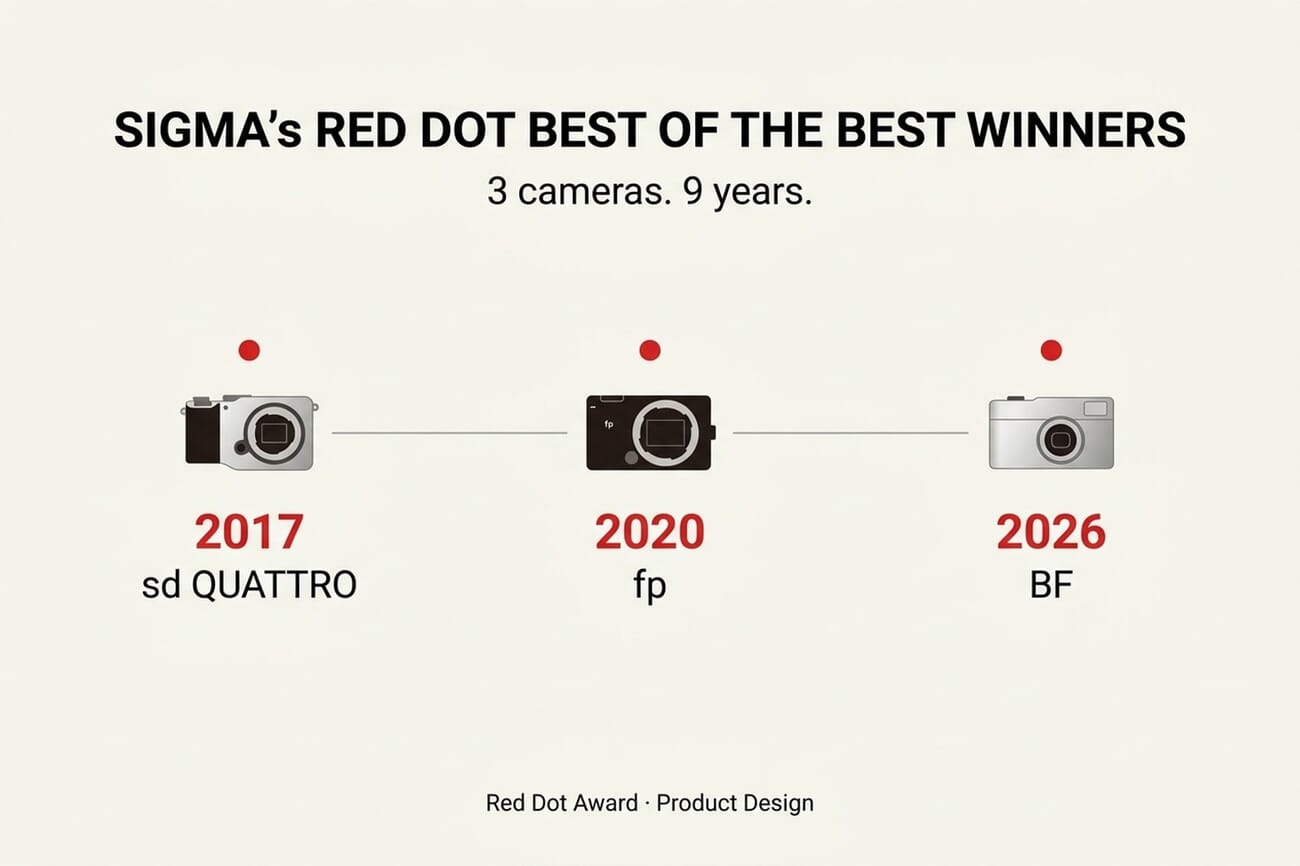
This isn’t Sigma’s first rodeo with the Red Dot jury. The pattern is striking:
- 2017 — sd Quattro. The asymmetric APS-C Foveon body that no one knew where to put. Boxy, awkward, instantly recognisable. The jury called out its courage to be visually unfamiliar.
- 2020 — fp. The world’s smallest full-frame mirrorless at the time. A modular video-photo hybrid stripped down to almost nothing. Became a cult favourite among filmmakers — the camera Mr. Robot, John Wick: Chapter 4, and Everything Everywhere All At Once all used.
- 2026 — BF. The first camera with a true unibody aluminum chassis, machined from a single ingot over seven hours. Three buttons, one dial, no memory card slot — 230GB of internal SSD instead.
What ties them together isn’t a visual style. The sd Quattro looks nothing like the fp, and the fp looks nothing like the BF. What ties them is willingness to subtract. Every Sigma Best of the Best winner has stripped a category convention out of the body and asked whether anyone really missed it. The answer, three times running, is no.
Why the BF Won — and Why a $1,999 Camera Beat Everything
Most cameras are designed by accretion. Each new model adds buttons, modes, and weather seals on top of the previous body. Decades of this and you end up with the modern flagship: 30+ controls, 800 menu options, three customisable function buttons, and a manual the size of a paperback novel.
The BF goes the other direction. Three buttons. One dial. One shutter release. That’s the entire physical interface. The aluminum body is machined from a single block over seven hours — Sigma calls it a true unibody, the only one in the camera world. There’s no memory card slot because the BF carries 230GB of internal SSD storage instead. A single haptic dial replaces the front and rear control wheels you’d expect at this price.
The trade-offs are real. No EVF. No mechanical shutter. No second card slot — actually, no card slot at all. Reviewers are split: DPReview called it “inspiringly simple”, while TechRadar called it “brilliantly flawed.” Both reviews are correct. That’s the point.
The Red Dot jury isn’t reviewing the BF as a working tool. It’s evaluating the design argument: can a camera in 2026 be radically less, and still be a camera? Sigma’s answer is yes, and the jury agreed unanimously.
Design Is Now a Buying Axis — Not Just Specs
This is the real story behind the award. For most of the digital era, cameras competed on benchmarks: pixel count, autofocus speed, burst rate, ISO range, video bitrate. Reviews led with spec tables. Buyers compared columns.
That’s changing — and the BF winning Best of the Best is the cleanest data point yet. In 2025-2026, three trends collided:
- Spec parity. Every full-frame body north of $1,500 now does 4K well, focuses on eyes accurately, and shoots fast enough. The benchmarks have flattened. Differentiation has to come from somewhere else.
- The fp / X100 effect. Sigma’s fp and Fujifilm’s X100 series proved that design-led cameras sell — to a real audience, at premium prices, with multi-year waiting lists. The X100 VI is still backordered four years after launch.
- A generational shift. Photographers who grew up with smartphones don’t have the muscle memory for 30 buttons. Simpler interfaces aren’t a compromise to them — they’re the default.
Other manufacturers are noticing. TTartisan’s new Neo lens series is built on the same principle — strip the rings, ship the essentials. Canon’s R6 V, announced for May 13, lets you swap dial caps to personalise the body. Even the heavyweights are starting to think about how a camera feels, not just what it does.
The BF winning Best of the Best gives this trend institutional cover. When the world’s most prestigious product-design jury says “yes, this is the highest expression of camera design in 2026,” it pulls every other manufacturer’s design team toward the same questions: what can we cut, what can we simplify, what’s actually essential.
L-Mount Just Got Its Halo Body
The L-Mount Alliance — Sigma, Panasonic, Leica, and now DJI, Samyang, and others — has been positioning itself as the design-led mount for years. Leica’s M-line set the visual language; Panasonic’s S-series brought the engineering chops; Sigma’s been the experimental wing.
The BF is now the halo body for the entire alliance. It’s the camera that proves L-Mount isn’t “Sony alternative number four” — it’s a system with its own aesthetic identity. That matters as the L-Mount lens lineup expands fast: Samyang’s 14-24mm f/2.8 launched on L-Mount yesterday, Sigma’s own Art II 35mm f/1.4 and Cine 28-105mm shipped earlier this month, and DJI joined the alliance in November.
For shoppers eyeing a switch from Sony or Canon, the BF’s award is a credibility marker. L-Mount isn’t a smaller ecosystem fighting for scraps — it’s the ecosystem the design world just crowned.
FAQ
What is Red Dot: Best of the Best?
Best of the Best is the highest distinction in the Red Dot Award: Product Design — given to the most outstanding designs in each category. The Red Dot Award has run since 1955 and is organised by the North Rhine-Westphalia Design Center. The 2026 jury evaluated submissions from 61 countries.
When was the Red Dot 2026 winner announced?
The Red Dot Award: Product Design 2026 laureates were announced on April 29, 2026. Sigma’s official announcement followed on April 30 (May 1 JST). Award ceremony in Essen, Germany, follows later in the year.
How much does the Sigma BF cost?
The Sigma BF is $1,999 USD body-only and ships in silver and black. It’s available now from authorised L-Mount retailers.
What other cameras have won Red Dot: Best of the Best?
Cameras winning Best of the Best are rare. Sigma is now the only camera maker to win three times — sd Quattro (2017), fp (2020), and BF (2026). Leica has won several times in the broader Red Dot tier (not always Best of the Best). Most camera manufacturers — Canon, Nikon, Sony — have won Red Dot at the standard tier but not Best of the Best.
Did the BF win any other 2026 design awards?
Yes — the BF also won an iF Gold Award in 2026 (announced March), the iF Design Award’s top tier. Only 75 designs out of more than 10,000 entries received Gold. Combined with the Red Dot: Best of the Best, the BF holds the two most prestigious product-design honours of 2026.
The Takeaway
A camera with three buttons just beat thousands of products to win design’s highest honour. That’s the headline. The deeper story is that the rules of camera competition are shifting underneath the industry’s feet — and Sigma is several steps ahead of everyone else in noticing.
Whether the BF is the right camera for any specific photographer is a separate question. The Red Dot jury isn’t telling anyone what to buy. It’s saying: in a year of 4,000 product entries from 61 countries, this is what world-class camera design looks like in 2026. Manufacturers paying attention will spend the next 12 months retooling their next-generation bodies around that benchmark.
The category is changing. Sigma already changed it.
Image credits: Featured image is an editorial illustration by PhotoWorkout, built on Sigma’s official BF press photography. Timeline and Pinterest infographics by PhotoWorkout.
Award announcements
- Red Dot Award: Product Design 2026 — Laureates Announced – Official Red Dot press release for the 2026 Product Design laureates (April 29, 2026).
- Sigma — Sigma BF wins Red Dot: Best of the Best 2026 (Japanese) – ASCII Japan announcement covering Sigma's third Red Dot Best of the Best win.
- Sigma BF wins iF Gold Award 2026 – Sigma BF's parallel iF Gold win — context on the camera's broader design recognition.
Sigma BF specifications & reviews
- Sigma — official BF camera page – Official spec sheet, design philosophy, and product gallery.
- DPReview — Sigma BF review – Full hands-on review of the BF's interface and image quality.
- TechRadar — Sigma BF review – Counter-perspective: “brilliantly flawed.”
- Newsshooter — Sigma BF: 6K, L-Log, unibody construction – Technical breakdown of the unibody machining process and video specs.
Past Sigma Red Dot wins
- SIGMA fp — Red Dot Best of the Best 2020 – Sigma's previous Best of the Best announcement (March 2020).
Image Sources
- Sigma — official BF press photography – Source for the camera body in the featured editorial illustration.
Explore the Sigma BF on PhotoWorkout
The BF has a full page in PhotoWorkout’s camera database — with specs, current pricing, and (once shoots roll in) a SampleShots gallery of real-world photos taken on it:
- 📷 Sigma BF — radically minimalist full-frame mirrorless, $1,999, unibody aluminum chassis machined from a single block. Winner of the Red Dot: Best of the Best 2026 plus an iF Gold Award.