


- GoPro announces Mission 1 series: three cinema-grade cameras built around a new 50MP 1-inch sensor and GP3 processor.
- Mission 1 Pro shoots 8K at 60fps, 4K at 240fps, and 1080p at 960fps — the fastest frame rates in any action camera.
- Mission 1 Pro ILS adds a Micro Four Thirds lens mount, putting GoPro in direct competition with interchangeable-lens cameras.
- NAB 2026 pricing confirmed: Mission 1 at $599, Mission 1 Pro and Pro ILS at $699 each (GoPro Premium subscribers save $100). Pre-orders open May 21, shipping May 28. ILS model ships Q3 2026.
- The launch comes weeks after GoPro cut 23% of its workforce, signaling an all-in bet on the premium market.
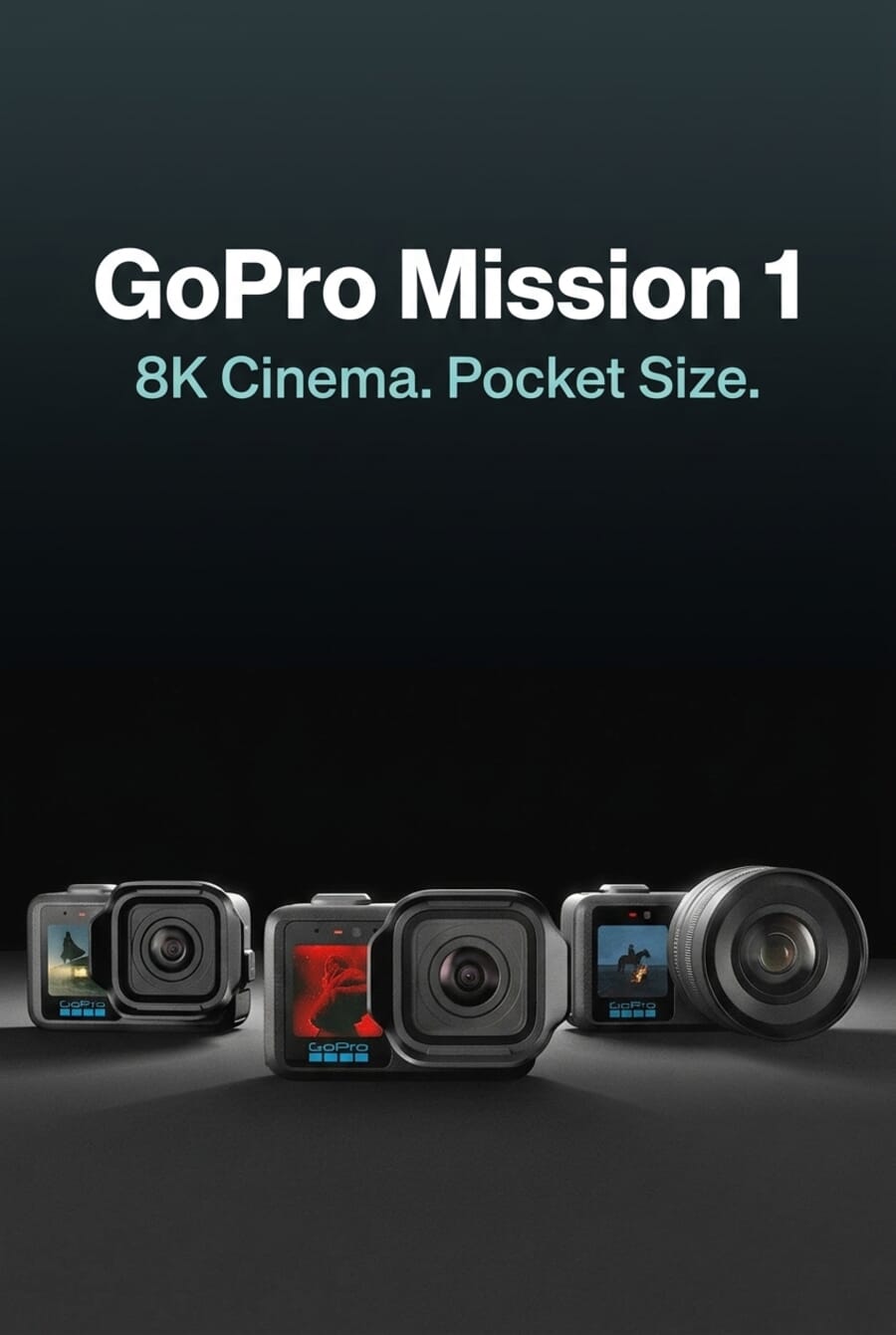
GoPro just made the biggest product bet in its history. The company unveiled the Mission 1 series — three compact cameras that ditch the action-camera playbook entirely and target filmmakers, creators, and cinema professionals.
Built around a new 50-megapixel 1-inch sensor and GoPro’s in-house GP3 processor, the Mission 1 lineup shoots up to 8K at 60fps, captures 50MP stills, and — in its most ambitious form — accepts interchangeable Micro Four Thirds lenses. It’s a dramatic departure for a brand synonymous with helmet-mounted action cams.
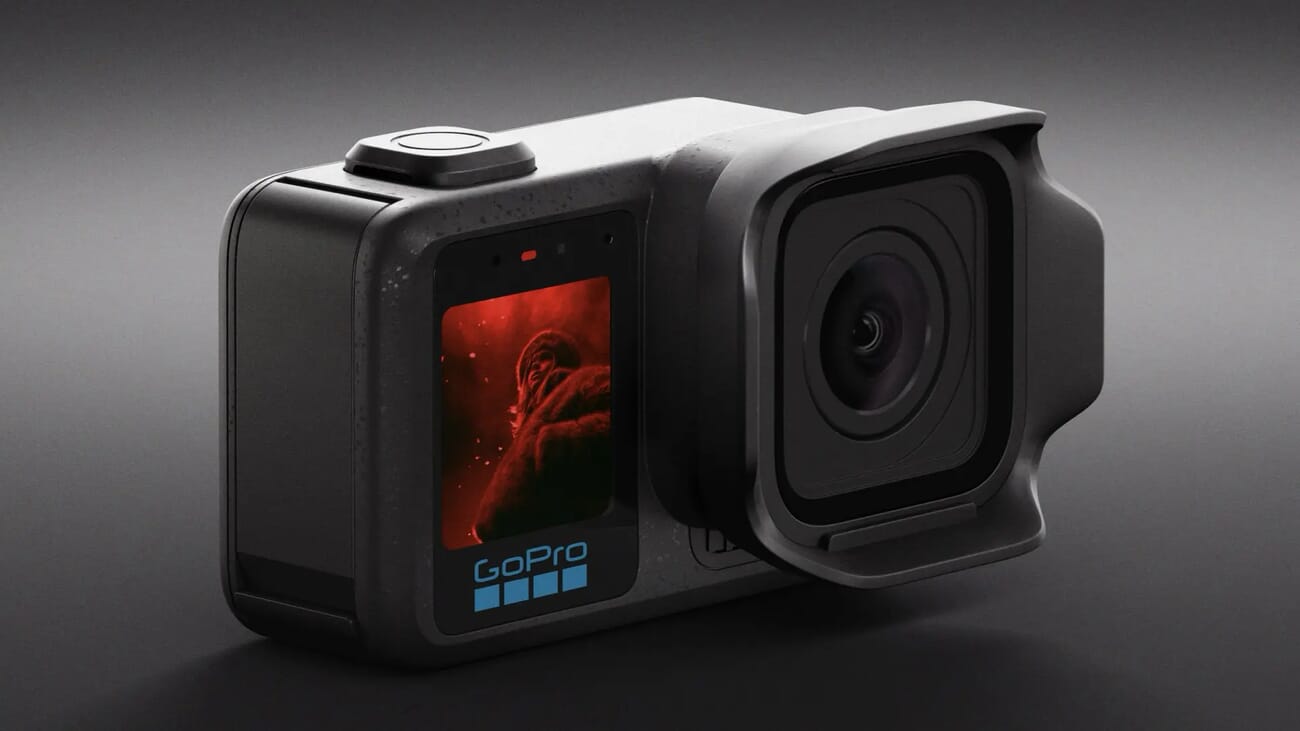
The timing is hard to ignore. GoPro announced the Mission 1 series just days after cutting 23% of its workforce — roughly 230 employees. CEO Nicholas Woodman framed the layoffs as a “reset” to focus resources on what comes next. This is what comes next.
Three Models, One Sensor
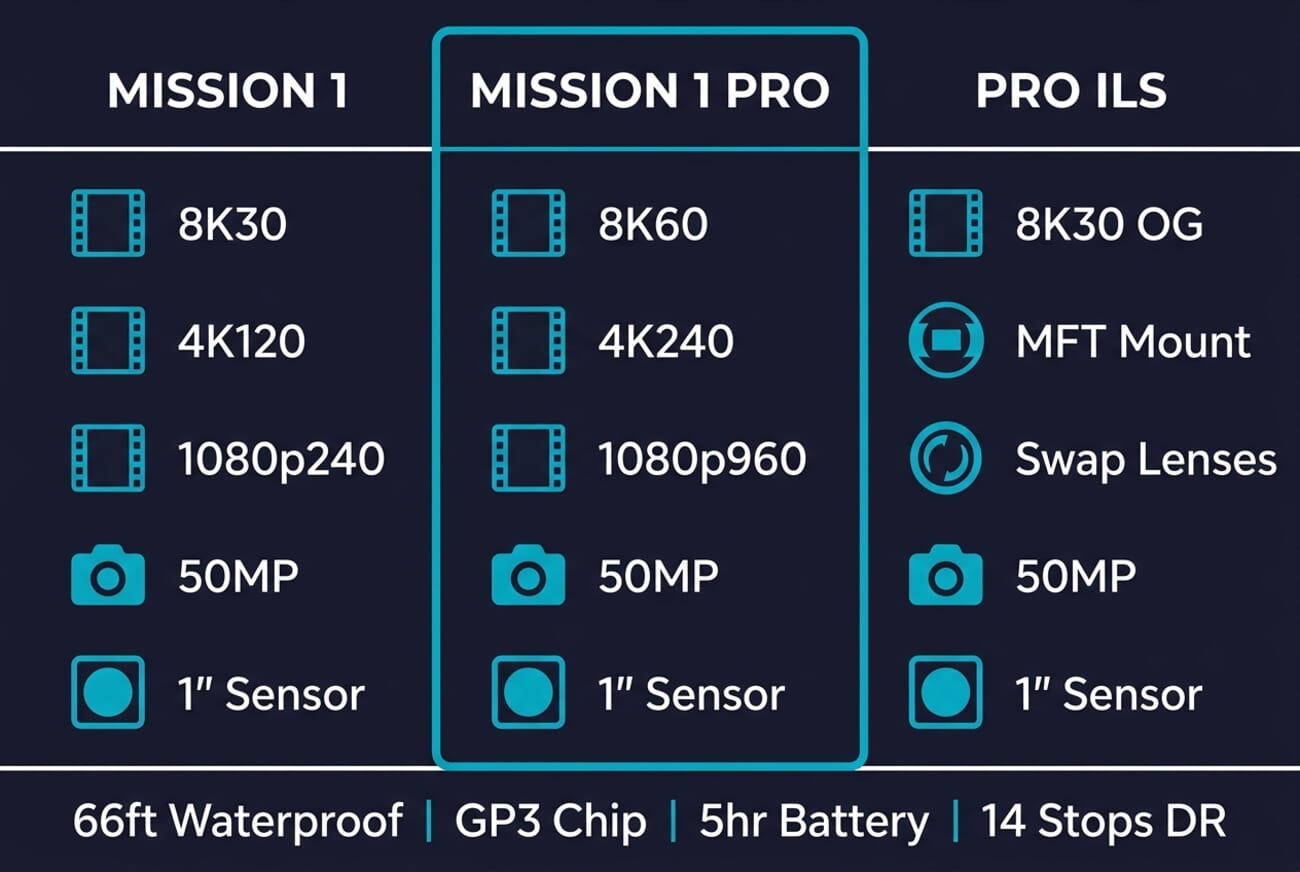
All three Mission 1 cameras share the same core: a 1-inch Type 4:3 sensor with 1.6µm native pixels (3.2µm when fused at 4K), paired with the GP3 processor — a 5nm chip GoPro revealed back in March. The company claims 14 stops of dynamic range at the sensor level, 10-bit color with GP-Log2 and HLG HDR, and dramatically improved low-light performance compared to previous generations.
Where the models diverge is in speed and capability:
Mission 1 — The entry point. Shoots 8K at 30fps, 4K at 120fps (including Open Gate), and 1080p at 240fps. Same sensor and build quality as the Pro, but without the ultra-high frame rates.
Mission 1 Pro — The flagship. Pushes the GP3 to its limits: 8K at 60fps, 4K at 240fps, and 1080p at an eye-watering 960fps. Open Gate recording at 8K/30 and 4K/120 gives filmmakers a full 4:3 canvas to crop in post.
Mission 1 Pro ILS — The wild card. Identical sensor and processor to the Pro, but with a Micro Four Thirds (MFT) lens mount that lets users swap lenses. Manual focus only for now, though GoPro says autofocus support is being explored. This model puts GoPro in direct competition with established interchangeable-lens cameras — a category it has never touched.
Sensor and Image Quality
GoPro is making a pointed case against its direct competitors with this sensor. The 1-inch chip is 25.4% larger than the DJI Osmo Action 6’s sensor and 43.8% larger than the Insta360 Ace Pro 2’s. At 8K, each pixel measures 1.6µm — GoPro claims that’s 77% more light-gathering area per pixel than competing action cameras running smaller sensors at similar resolutions.
At 4K, the camera fuses pixels to an effective 3.2µm pitch, which should produce noticeably cleaner footage in low light compared to any previous GoPro. Combined with 10-bit GP-Log2 capture and 14 stops of claimed dynamic range, this is a camera built for color grading, not just quick social-media exports.
The ILS Model: GoPro’s Biggest Gamble
The Mission 1 Pro ILS is the model that will raise the most eyebrows. By adopting the Micro Four Thirds mount — the same system used by Panasonic Lumix cameras and some Blackmagic cinema cameras — GoPro is inviting users to attach everything from fast primes to vintage glass.
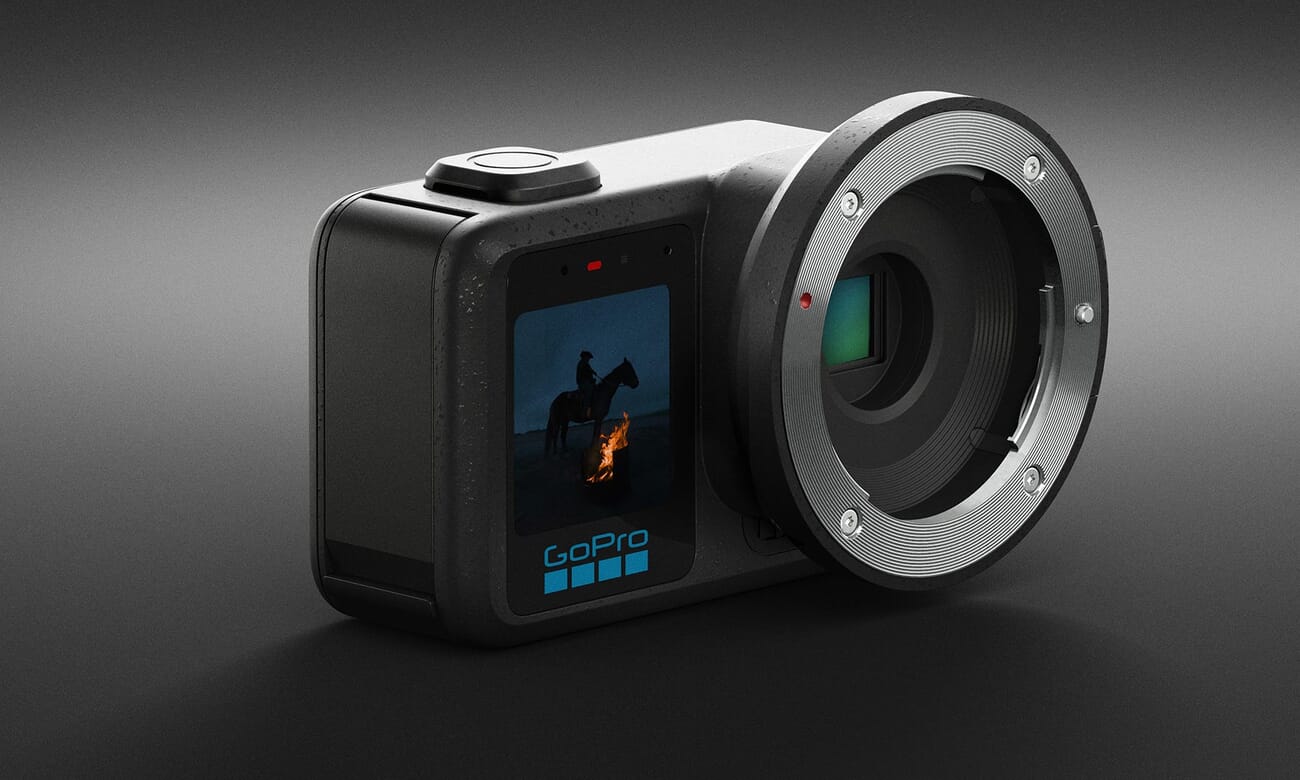
The trade-off: no autofocus at launch. Manual focus only. GoPro says AF support is “being explored,” which suggests firmware updates could add it later — but for now, the ILS model is best suited for pre-rigged cinema setups, controlled environments, or shooters who pull focus manually. It’s not a run-and-gun solution yet.
Still, the concept is compelling. A waterproof, pocket-sized body that accepts MFT glass opens creative possibilities that no other camera in this form factor offers. Whether the market is ready for a GoPro with interchangeable lenses is the billion-dollar question.
Battery Life and Build
GoPro’s new Enduro 2 battery (2,150mAh) is rated for 5+ hours at 1080p/30fps — a significant bump. More realistic runtime numbers for demanding modes:
- 4K/30 Open Gate: ~188 minutes
- 4K/120: ~101 minutes
- 8K/30 Open Gate: ~96 minutes
- 8K/60: ~74 minutes (with airflow) / ~37 minutes (without)
- 4K/240: ~74 minutes (with airflow) / ~35 minutes (without)
Thermal management is clearly a factor at the top-end modes. GoPro’s spec sheet distinguishes between “with airflow” and “without” for the most demanding resolutions, suggesting that the Mission 1 Pro will throttle in sealed or static setups. The optional Volta 2 Battery Grip (5,800mAh) extends 4K/30 runtime to a claimed 9 hours.
The body itself retains GoPro’s signature ruggedness: waterproof to 66 feet (196 feet with the protective housing), hydrophobic lens coating, raised buttons for gloved use, and three mounting options — magnetic latch, traditional GoPro fingers, and standard 1/4-20 threading.
Audio and Accessories
Four built-in microphones with wind noise reduction handle basic audio. The optional Media Mod adds a 3-mic array, 32-bit float recording, 3.5mm ports, micro-HDMI output, and timecode sync for multi-camera shoots. A new Wireless Mic Kit offers 24-bit/48kHz sampling with 150-meter range and 6.5 hours of runtime.
Other accessories include an ND Filter 4-pack (essential for shooting wide open in daylight), a Light Mod 2 at 200 lumens, and the Volta 2 grip mentioned above. The full accessory lineup rolls out between May and Q3 2026.
Pricing and Availability
Update, April 19, 2026: GoPro unveiled final pricing at NAB 2026 — and the numbers are more aggressive than most analysts predicted. Here’s the full US lineup:
| Model | List Price | Subscriber Price | Ships |
|---|---|---|---|
| Mission 1 | $599 | $499 | May 28, 2026 |
| Mission 1 Pro | $699 | $599 | May 28, 2026 |
| Mission 1 Pro ILS | $699 | $599 | Q3 2026 |
| Mission 1 Pro Grip Edition | TBD | TBD | May 28, 2026 |
| Mission 1 Pro Creator Edition | TBD | TBD | Q3 2026 |
| Mission 1 Pro Ultimate Creator Edition | TBD | TBD | Q3 2026 |
Pre-orders open May 21 and include a free Point-and-Shoot Grip plus a one-year GoPro Premium subscription. UK, Canada, and Australia pricing lands roughly in line with US figures once converted: the Mission 1 is £529 / CA$819 / AU$949, and the Pro and Pro ILS sit at £599 / CA$949 / AU$1,099. International subscribers get proportional discounts.
The Ultimate Creator Edition — bundling the Pro body with GoPro’s new Fluid Pro AI gimbal, Wireless Mic Complete Kit, Light Mod 2, and Media Mod — is the only variant likely to push close to the $2,000 mark once GoPro confirms bundle pricing later this year.
Value Breakdown: Is It Actually Worth It?
Now that pricing is on the table, the Mission 1 lineup can be measured against the cameras it’s actually targeting. The short version: at $599, the base Mission 1 is aggressively priced; at $699, the Pro is a bargain next to full-frame vlog bodies; and the Pro ILS at the same $699 may be the most surprising value in the whole announcement.
Mission 1 ($599) vs GoPro Hero 13 Black ($399)
For an extra $200, the Mission 1 gives you a 1-inch sensor (vs the Hero 13’s smaller 1/1.9-inch chip), a 50MP stills mode (vs 27MP), 8K video (vs 5.3K), and 10-bit GP-Log2 capture for color grading. The Hero 13 remains the better choice for pure action use — lighter, more universally mountable, and cheaper — but anyone already shooting in a hybrid photo-and-video workflow will find the Mission 1’s sensor jump worth the premium. At the $499 subscriber price, the gap narrows to just $100 over the Hero 13 Black’s $399 MSRP. That’s remarkable value.
Mission 1 Pro ($699) vs Sony ZV-E1 (~$1,699)
The ZV-E1 is Sony’s full-frame vlogging flagship, and it still costs more than twice as much as the Mission 1 Pro. The ZV-E1 wins on sensor size (full-frame vs 1-inch) and low-light performance. But the Mission 1 Pro counters with 8K60 (vs ZV-E1’s 4K60), 4K240 and 1080p960 slow-motion (the ZV-E1 tops out at 4K120), and a waterproof, rugged body the Sony cannot match without a third-party housing. For run-and-gun video work where you need both cinema resolution and physical durability, the Pro’s $699 price is hard to argue with.
Mission 1 Pro ILS ($699) vs Micro Four Thirds cinema cameras
This is where the math gets interesting. A used Panasonic GH6 body runs $1,200+. The Blackmagic PYXIS 6K starts at $2,695. Even the entry-level Panasonic Lumix G9 II sits at $1,899. The Pro ILS at $699 undercuts every MFT cinema camera on the market by a wide margin — and adds waterproofing to 66 feet, which none of them offer. The trade-off is manual focus only at launch; if autofocus arrives via firmware, this becomes the de facto budget MFT cinema body. A camera this cheap with an MFT mount simply did not exist before.
The verdict
At these prices, the Mission 1 lineup is not a premium gamble — it’s a pricing attack. GoPro chose to compete on the dollar, not just the spec sheet, and the $699 ceiling on the Pro ILS is the announcement’s biggest surprise. The one honest caveat: these are list prices at launch. Whether the real-world value holds up depends on image quality under load, thermal behavior at 8K60, and how quickly autofocus lands on the ILS. If those boxes check, GoPro just reset the budget cinema-camera market.
What It Means for GoPro
The Mission 1 series is, in every measurable way, GoPro’s attempt to move upmarket and escape the price wars that have defined the action camera space for the last three years. DJI and Insta360 have squeezed margins on the mid-range models that GoPro once owned. Rather than match them feature-for-feature at shrinking price points, GoPro is trying to redefine what its cameras are for.
As DroneDJ put it: “GoPro is no longer just an action camera company.” The Mission 1 lineup is designed for filmmakers, documentary shooters, and content creators who need cinema-grade specs in a body they can mount, submerge, or stuff in a jacket pocket. The ILS model goes even further, planting a flag in interchangeable-lens territory that GoPro has never occupied.
The risk is real. GoPro is betting the company’s future on a market it hasn’t proven it can serve — with 23% fewer employees to execute the plan. But if the image quality and pricing align, the Mission 1 could be the most interesting camera launch of 2026.
FAQ
When can you buy the GoPro Mission 1?
Pre-orders for the Mission 1 and Mission 1 Pro open May 21, 2026, with retail availability on May 28. The Mission 1 Pro ILS ships later in Q3 2026.
How much does the GoPro Mission 1 cost?
At NAB 2026, GoPro confirmed pricing: Mission 1 at $599, Mission 1 Pro at $699, and Mission 1 Pro ILS at $699. GoPro Premium subscribers save $100 on each, dropping the entry price to $499. Pre-orders open May 21 and include a complimentary Point-and-Shoot Grip plus a one-year GoPro Premium subscription.
What lenses work with the GoPro Mission 1 Pro ILS?
The Pro ILS uses a Micro Four Thirds (MFT) lens mount, compatible with lenses from Panasonic, Olympus, Sigma, and other MFT manufacturers. At launch, only manual focus is supported — autofocus may be added via a firmware update later.
Is the GoPro Mission 1 waterproof?
All Mission 1 models are waterproof to 66 feet (20 meters) without a housing. The optional Protective Housing extends that to 196 feet (60 meters).
Image credit: GoPro
Sources for this article:
Official Sources
- GoPro Official Announcement – Official press release
- GoPro Press Release (PR Newswire) – Full spec sheet and executive quotes
Coverage
- PetaPixel – Detailed specs and battery life analysis
- DroneDJ – Strategic pivot analysis
- Newsshooter – Pro video perspective and accessory details
- Y.M.Cinema – Cinema industry analysis
- Digital Camera World — Pricing Reveal – Final NAB 2026 pricing reaction
- Photo Rumors — US Pricing – Complete US pricing list
- Y.M.Cinema — Which Model to Buy – Post-reveal buying guide
Image Sources
- GoPro (product images) – Official product photography via Y.M.Cinema and Popular Science
- RedShark News (family shot) – Mission 1 lineup product photo