


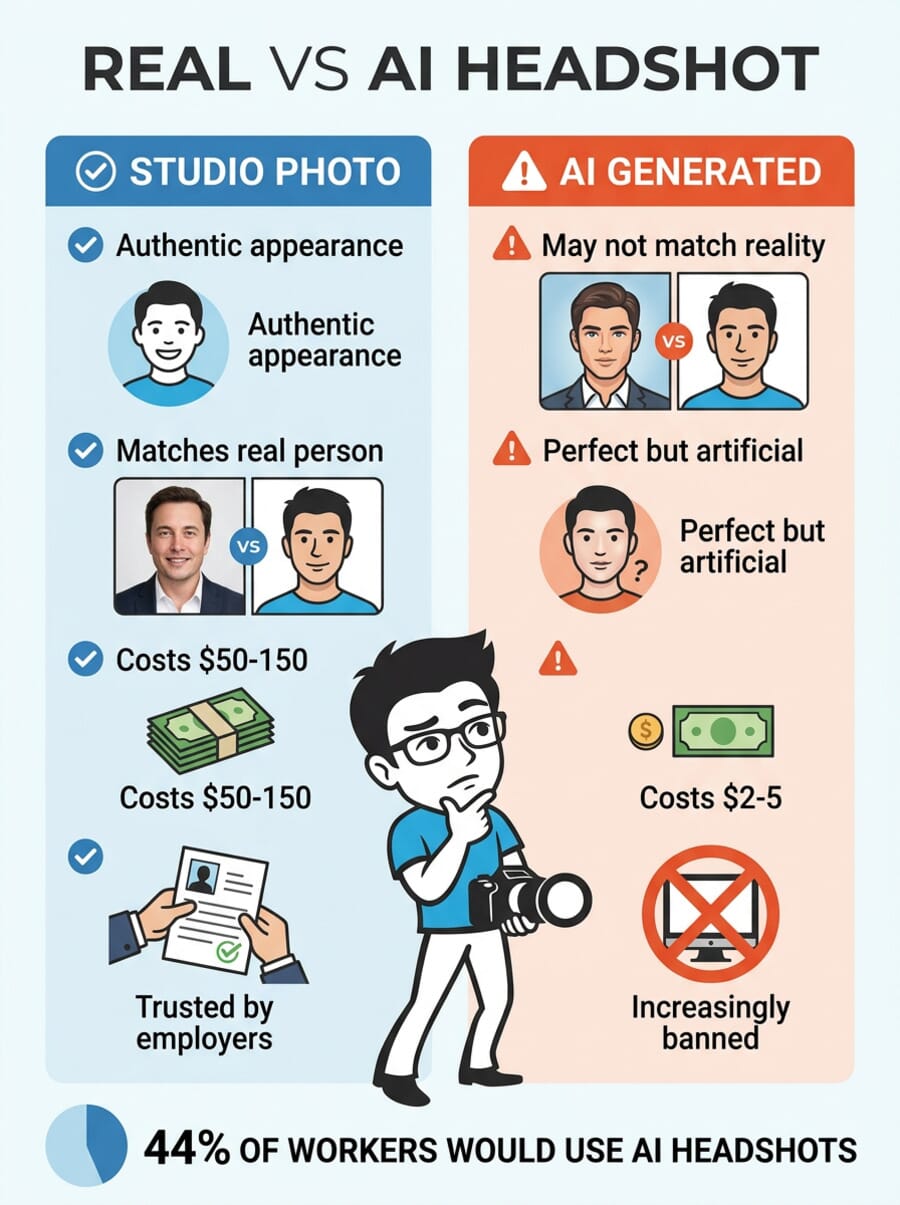
- AI-generated headshots are disrupting South Korea’s job market — applicants pay $2 instead of $100 for studio portraits, and employers can’t tell the difference.
- Some companies have started banning AI photos in job applications, while others reportedly use AI detection tools to screen them out.
- The trend is global: 44% of U.S. workers would consider using AI headshots, putting direct pressure on portrait and headshot photographers.
In South Korea, job applicants are expected to submit formal portrait photos with their resumes. A professional studio session costs around $100. An AI headshot app costs $2. Guess which one is winning.
According to Seoul Economic Daily, AI-generated headshots have become so common in the Korean job market that they’re causing real problems — candidates showing up to interviews looking different from their photos, companies adding “AI photos prohibited” to job listings, and a growing crisis of trust in professional imagery that should concern every portrait photographer.
What’s Happening in South Korea
South Korea’s job market has a strong culture of formal resume photos. Applicants traditionally visit photography studios to get polished, professional images that convey competence and professionalism. It’s a significant market for portrait photographers — and AI is eating it alive.
Job seekers are turning to AI photo apps that can generate a “professional” headshot from a single selfie. One worker named Lee, who found a job at a marketing firm, told Seoul Economic Daily: “Resume photos are small anyway, and I didn’t notice much difference between heavily retouched studio photos and AI-generated ones.”
Another applicant said he passed several document screenings using an AI-generated profile photo. A 27-year-old named Kang summed up the attitude: “The purpose of a job photo is to convey a neat impression, and AI does this most efficiently.”
The apps are remarkably cheap. One candidate noted that “a 3,000-won [$2] AI app even composited a suit, and it looked perfect.”
When AI Headshots Go Wrong
The fundamental problem with AI headshots is simple: they don’t look like you. AI tools generate a new image that resembles the source photo but adds, removes, or alters features. Skin is smoothed beyond reality. Facial structure can shift. Lighting and backgrounds are fabricated.
This is already causing real-world friction. Candidates have arrived at interviews looking noticeably different from their submitted photos, creating awkward situations and undermining trust before the conversation even starts.
Major news outlets learned a similar lesson when several aired an AI-enhanced photo of Minnesota shooting victim Alex Pretti — the image looked professional but wasn’t an accurate representation of the person. In high-stakes contexts like hiring and journalism, that gap between AI image and reality matters enormously.
Companies Are Fighting Back
Some Korean companies have started adding explicit “AI-generated photos prohibited” notices to their job listings. Others are reportedly using AI detection tools to screen out synthetic images during the application process.
This has spooked some job hunters. Lee, who initially used an AI photo successfully, eventually rebooked a studio session after seeing online posts claiming “AI photos are filtered out during screening.”
The reliability of AI image detectors remains questionable, though. Current detection tools produce frequent false positives and negatives, meaning legitimate studio photos could be flagged while sophisticated AI images slip through. It’s an arms race with no clear winner.
Should Portrait Photographers Be Worried?
Yes — but not panicked. The numbers tell a clear story: a survey of 2,000 U.S. adults found that 44% would consider using an AI headshot for professional purposes. That’s not a niche trend. It’s nearly half the market.
This follows a broader pattern. The AOP survey showing 58% of photographers have lost work to AI already documented the financial impact across the industry. Headshot and portrait photography is simply the latest segment to feel it directly.
But there’s a crucial nuance: the jobs most vulnerable to AI replacement are the ones that were already commoditized. A basic corporate headshot against a white background — the kind where the goal is just to “look professional” — is exactly what AI does well enough. The $2 app replaces the $50 mall studio, not the $500 portrait session with custom lighting and creative direction.
What AI Headshots Still Can’t Do
Portrait photographers who understand their value proposition have less to fear. AI headshots fall short in several areas that matter to discerning clients:
- Authenticity. An AI headshot is a fabrication. A real photograph captures the actual person. For roles where trust matters — executives, public figures, healthcare providers — authenticity isn’t optional.
- Consistency across uses. A professional portrait session produces dozens of images that all look like the same person. AI generates a single idealized image that may not match other photos of you online.
- Creative direction. Professional headshot photographers know how to coach expressions, direct posture, and use lighting to convey specific brand messages. AI applies a generic “professional” filter.
- The in-person experience. Many clients value the experience of a professional session — the confidence boost, the wardrobe guidance, the personal attention. AI can’t replicate that.
How Portrait Photographers Can Adapt
The photographers who will thrive are the ones who move upmarket and emphasize what AI can’t deliver:
- Sell the experience, not just the file. Position sessions as personal branding experiences, not just photo production. Include wardrobe consultation, multiple looks, and brand strategy.
- Emphasize authenticity as a feature. As AI photos become more common, “real photography” becomes a differentiator. Market the fact that your images are genuine and will match the real person.
- Target clients who need trust. Executives, attorneys, doctors, real estate agents — professionals in trust-dependent fields will increasingly need to prove their photos are real.
- Offer packages AI can’t match. Team photos, environmental portraits, behind-the-scenes brand content — these require a real photographer in a real space. For headshot-specific techniques, understanding lighting and posing fundamentals becomes your competitive moat.
The Bigger Picture
South Korea’s hiring market is a preview of what’s coming everywhere. The rise of AI photo editing tools and generators is compressing the bottom of the photography market across every genre. Stock photography, basic product shots, simple headshots — these are all becoming commodities that AI can produce at near-zero cost.
The question isn’t whether AI will take some headshot work away from photographers. It already has. The question is whether photographers will adapt by moving toward work that demands human skill, human judgment, and human connection — or whether they’ll try to compete with a $2 app on price.
The answer, for anyone who wants to stay in business, should be obvious.
Are AI headshots legal to use on resumes?
In most countries, yes — there’s no law against using AI-generated photos on a resume. However, some employers explicitly prohibit them, and using an AI photo that doesn’t accurately represent your appearance could be considered misleading, especially for roles requiring photo ID verification.
Can employers detect AI-generated headshots?
Some employers claim to use AI detection tools, but current technology is unreliable — producing both false positives and false negatives. As AI image quality improves, detection will become even harder. The technology arms race favors generators over detectors.
How much do professional headshots cost vs AI?
Professional studio headshots typically cost $50-300 depending on location and photographer experience. AI headshot apps charge $2-30. However, AI images may not accurately represent your appearance, which can create problems at in-person meetings or interviews.
Will AI replace portrait photographers?
AI is replacing the lowest-cost, most commoditized headshot work. However, professional portrait photography that involves creative direction, custom lighting, brand strategy, and the human experience of a photo session remains difficult for AI to replicate. Photographers who differentiate on quality and experience will continue to find clients.
Sources used for this article:
Featured image: Photo by Md Ishak Raman on Unsplash.
Related Posts
Get the Weekly Photography News Digest
Join photographers who get our top stories delivered every Monday morning. No spam, unsubscribe anytime.