

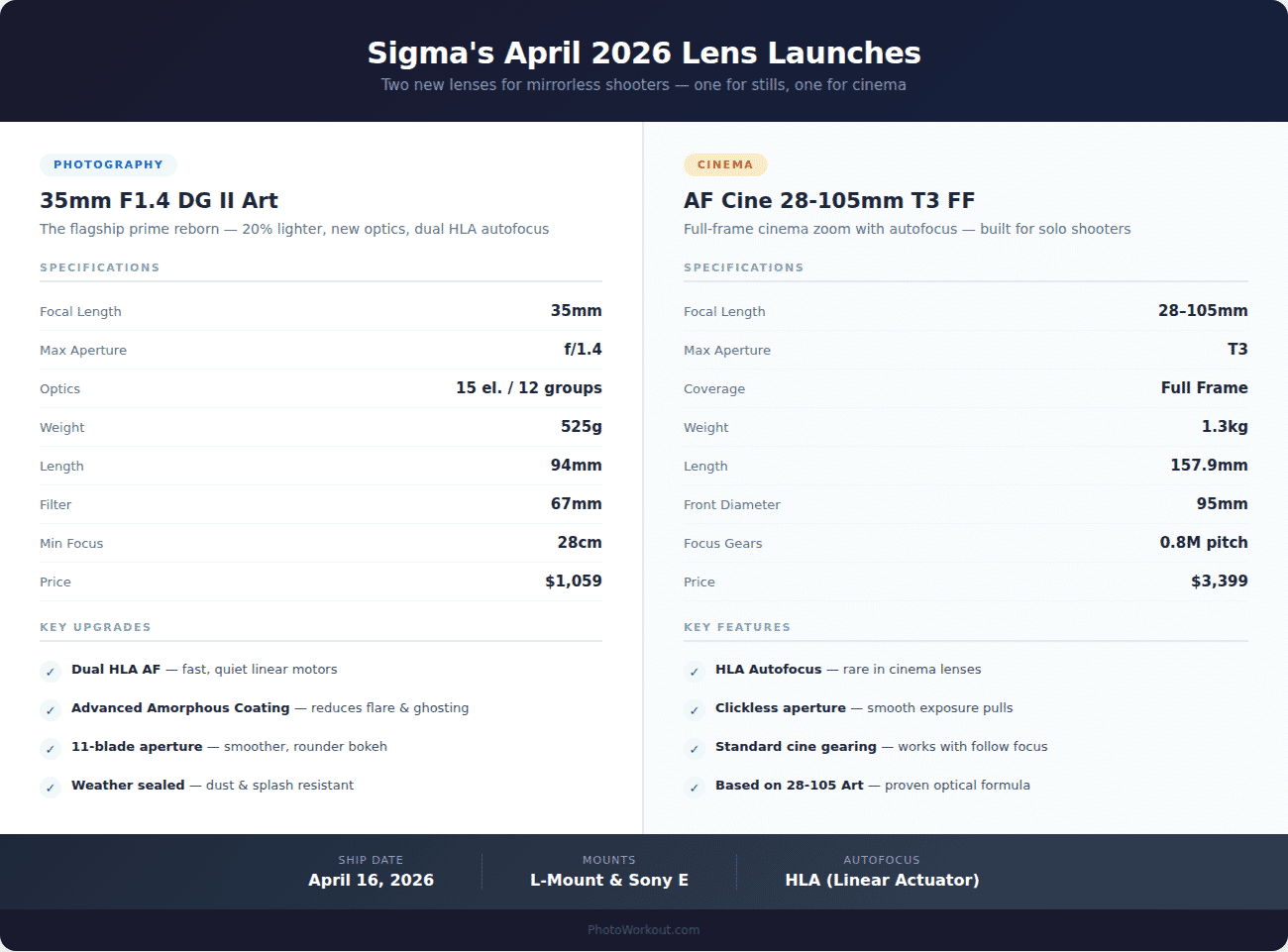
- Sigma unveils the 35mm F1.4 DG II Art, a ground-up redesign that is 20% lighter and 14% shorter than the original, priced at $1,059.
- The AF Cine 28-105mm T3 FF is the second lens in Sigma autofocus cinema line, a full-frame zoom built for solo shooters at $3,399.
- Both lenses ship April 16, 2026 in L-Mount and Sony E-mount.
- The 35mm Art II features a new dual HLA autofocus system and Advanced Amorphous Coating to combat flare and ghosting.
Sigma has announced two significant additions to its lens lineup: a completely redesigned 35mm F1.4 DG II Art prime and the AF Cine 28-105mm T3 FF autofocus cinema zoom. Both lenses are set to ship on April 16, 2026.
The 35mm Art II is a revision of what many consider the lens that launched Sigma’s modern reputation — the original 35mm F1.4 Art from 2012. The cinema zoom, meanwhile, is the second entry in Sigma’s growing AF Cine line, designed for filmmakers who need autofocus without sacrificing traditional cine lens features.
Sigma 35mm F1.4 DG II Art: The Flagship Reborn
The original Sigma 35mm F1.4 Art was a landmark lens — it proved that a third-party manufacturer could match or exceed the optical quality of first-party glass at a fraction of the price. Over a decade later, Sigma has gone back to the drawing board with a completely new optical formula and modernized construction.
The headline numbers: the 35mm Art II is 20% lighter (525g vs. 665g) and 14% shorter (~94mm vs. 109mm) than its predecessor, while delivering what Sigma calls a significant step forward in optical performance.
35mm F1.4 DG II Art — Key Specifications
- Focal length: 35mm (full frame)
- Maximum aperture: f/1.4
- Optical construction: 15 elements in 12 groups (4 aspherical, 2 SLD glass)
- Diaphragm: 11-blade rounded aperture
- Minimum focus distance: 28cm
- Filter diameter: 67mm
- Dimensions: 72mm (diameter) × 94mm (length)
- Weight: 525–530g
- Autofocus: Dual HLA (High-response Linear Actuator)
- Mounts: L-Mount, Sony E-mount
- Price: $1,059
What’s New in the Art II
Beyond the size and weight reduction, Sigma has made several meaningful upgrades:
Advanced Amorphous Coating (AAC): A newly developed coating with a low refractive index that Sigma says dramatically reduces internal reflections, cutting down on ghosting and flare — a known weakness of fast wide-angle primes when shooting into light.
Dual HLA autofocus: The lens uses two High-response Linear Actuators for fast, quiet, and precise focusing. This should make the Art II a strong performer for both stills and video, with minimal focus breathing.
Improved bokeh: The 11-blade rounded diaphragm, combined with what Sigma describes as advanced surface accuracy in the optical elements, produces rounder highlight bokeh balls — addressing a criticism some users had of the original Art’s sometimes busy rendering.
Weather sealing: Dust- and splash-resistant construction with water- and oil-repellent coatings on the front element.
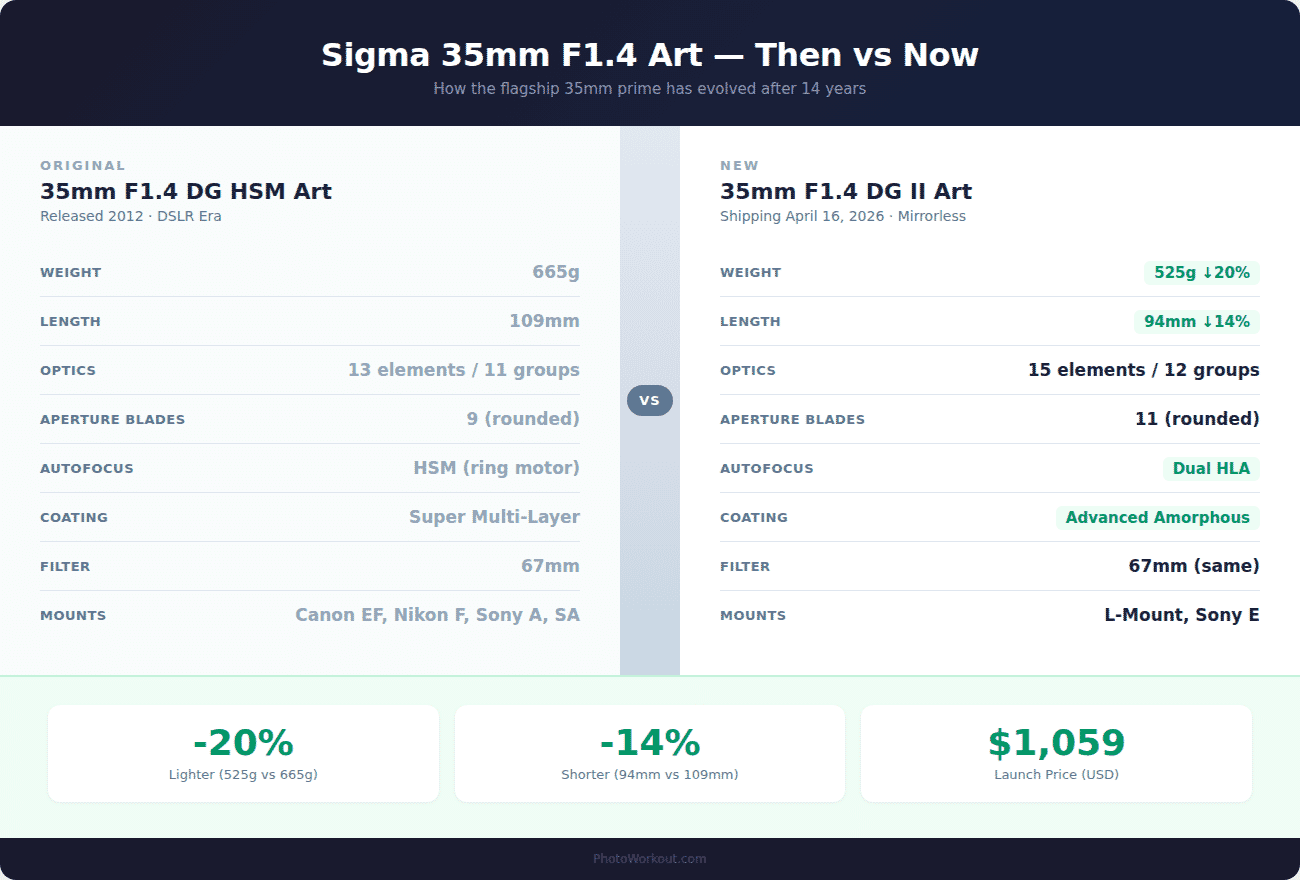
35mm Art II vs. Original 35mm Art
| Feature | 35mm F1.4 DG II Art | 35mm F1.4 DG HSM Art (Original) |
|---|---|---|
| Optical Formula | 15 elements / 12 groups | 13 elements / 11 groups |
| Weight | 525–530g | 665g |
| Length | ~94mm | ~109mm |
| Filter Size | 67mm | 67mm |
| Aperture Blades | 11 (rounded) | 9 (rounded) |
| AF System | Dual HLA | HSM |
| Coating | Advanced Amorphous Coating | Super Multi-Layer Coating |
| Mounts | L-Mount, Sony E | Canon EF, Nikon F, Sony A, Sigma SA |
Notable: the Art II is mirrorless-only, dropping DSLR mount support entirely. The filter size stays at 67mm, so existing filters will carry over.
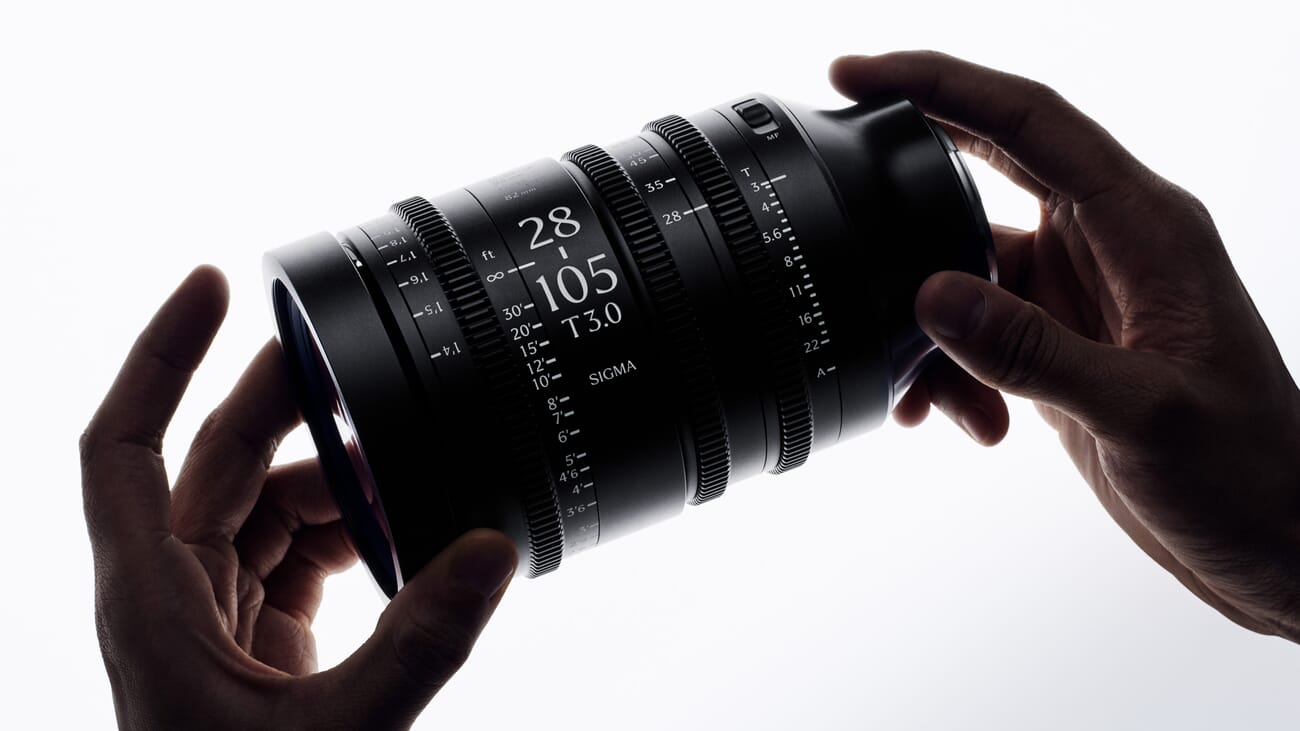
Sigma AF Cine 28-105mm T3 FF: Autofocus Cinema Zoom
The AF Cine 28-105mm T3 FF is the second lens in Sigma’s autofocus cinema line, following the AF Cine 18-35mm T2. It’s built on the optical formula of Sigma’s well-regarded 28-105mm F2.8 DG DN Art stills lens, rehoused with cinema-specific features.
This lens targets a growing segment of the market: solo operators and small production teams who need reliable autofocus but don’t want to give up the tactile, precise controls that cinema lenses provide.
AF Cine 28-105mm T3 FF — Key Specifications
- Focal length: 28–105mm (full frame)
- Maximum aperture: T3
- Front diameter: 95mm
- Length: 157.9mm (6.3 inches)
- Weight: 1.3kg (2.8 lb)
- Focus ring: Limited-rotation with 0.8M pitch gears
- Aperture ring: Clickless, industry-standard gearing
- Autofocus: Linear motor HLA (High-response Linear Actuator)
- Mounts: L-Mount, Sony E-mount
- Price: $3,399
Why It Matters for Filmmakers
The 28-105mm zoom range covers the most commonly used focal lengths in narrative and documentary filmmaking — from establishing shots to medium close-ups — in a single lens. Combined with autofocus, this makes it particularly appealing for run-and-gun shooting where lens changes aren’t practical.
The cinema-specific touches matter here: the 0.8M pitch gears are compatible with standard follow focus systems, the clickless aperture ring allows smooth exposure pulls during takes, and the limited-rotation focus ring gives repeatable focus marks — features that distinguish it from simply using a stills lens for video.
At $3,399, the AF Cine 28-105mm T3 FF significantly undercuts comparable cinema zooms from manufacturers like Canon (CN-E), Sony (CineAlta), and Zeiss — most of which don’t offer autofocus at all.
Pricing and Availability
Both lenses ship on April 16, 2026:
- Sigma 35mm F1.4 DG II Art: $1,059 — available at authorized Sigma retailers
- Sigma AF Cine 28-105mm T3 FF: $3,399 — available at authorized Sigma Cine dealers
Both are available in L-Mount and Sony E-mount. No Canon RF or Nikon Z versions have been announced.
The Bottom Line
With the 35mm Art II, Sigma is updating the lens that put its Art line on the map — making it smaller, lighter, and optically more refined without a dramatic price increase. For photographers who’ve been holding off on the original due to its size, the Art II addresses that concern directly.
The AF Cine 28-105mm T3 FF, meanwhile, continues Sigma’s push into cinema glass with autofocus — a feature set that’s still rare in the cine lens world. At $3,399, it offers a compelling value proposition for filmmakers who want cinema-grade build quality and controls without the five-figure price tags of traditional cine zooms.
Both lenses arrive on April 16 — just over a week away.
Frequently Asked Questions
Will the Sigma 35mm Art II be available for Canon RF or Nikon Z?
Not at launch. Sigma has announced L-Mount and Sony E-mount versions only. Given Sigma’s ongoing licensing arrangements, Canon RF and Nikon Z versions may follow, but no timeline has been confirmed.
Is the 35mm Art II compatible with Sigma’s USB Dock for calibration?
The USB Dock was designed for DSLR-era lenses with Sigma SA, Canon EF, and Nikon F mounts. Since the Art II is mirrorless-only (L-Mount and Sony E), the USB Dock is not applicable — mirrorless AF calibration is handled in-camera.
Can the AF Cine 28-105mm T3 FF be used for stills photography?
Technically yes — it uses the same mount and sensor coverage as Sigma’s stills lenses. However, cinema lenses are optimized for video workflows, and the clickless aperture and T-stop markings (rather than f-stops) make it less practical for dedicated stills use. The 28-105mm F2.8 DG DN Art is the better choice for photographers.
How does the AF Cine 28-105mm compare to Sigma’s first AF Cine lens?
The first lens in the AF Cine line was the 18-35mm T2, which covers a wider but shorter zoom range at a faster aperture. The 28-105mm T3 covers a more versatile range for general-purpose filmmaking. Together, the two lenses give filmmakers continuous coverage from 18mm to 105mm with autofocus.
Sources used for this article:
Get the Weekly Photography News Digest
Join photographers who get our top stories delivered every Monday morning. No spam, unsubscribe anytime.