


- Samyang is announcing its first ultra-wide zoom for L-Mount on April 30, 2026 — confirmed by L-Rumors, Leica Rumors, and Photo Rumors.
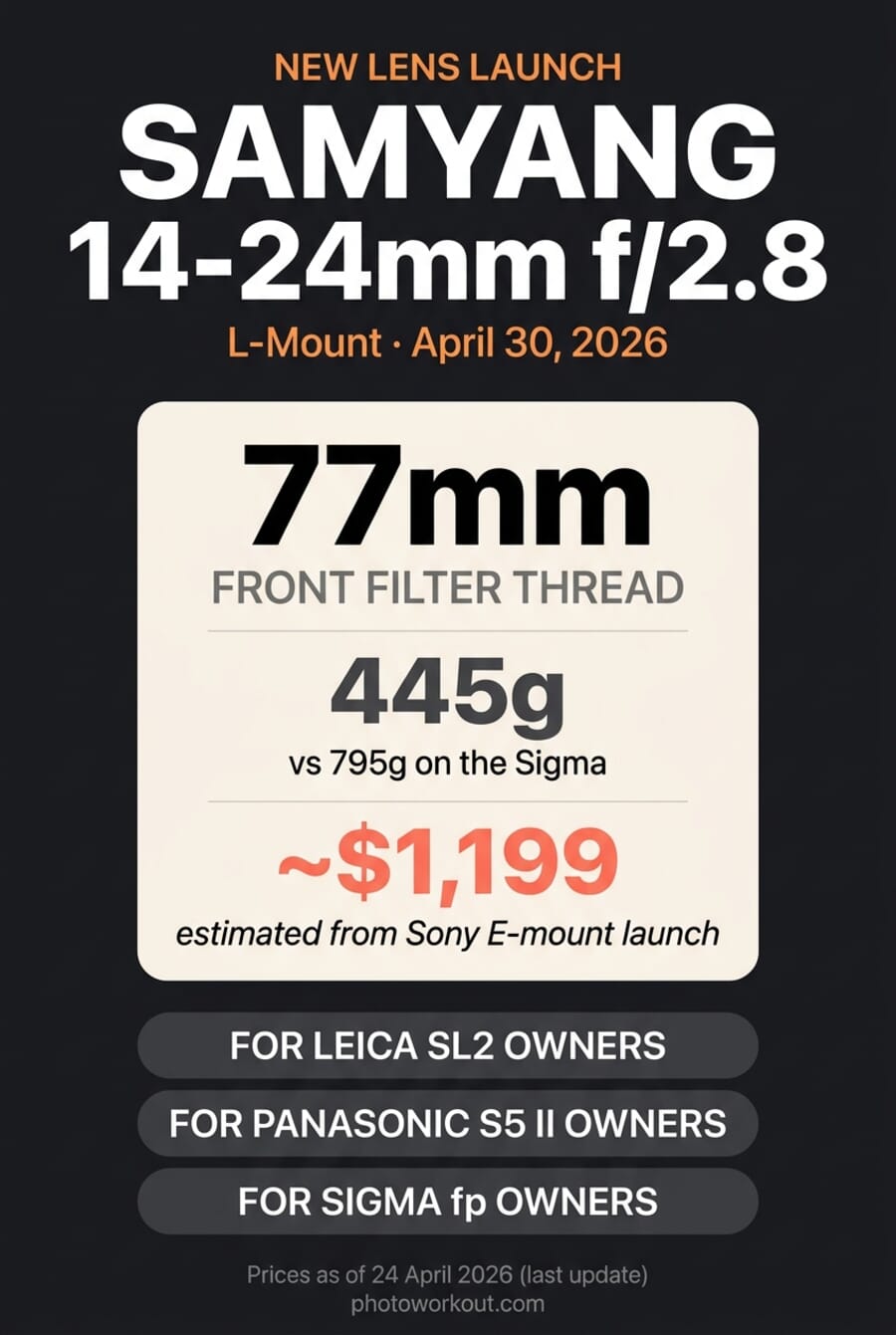
- The 14-24mm f/2.8 is the same optical design Samyang launched on Sony E-mount last April at €1,199. Expect similar US pricing around $1,199.
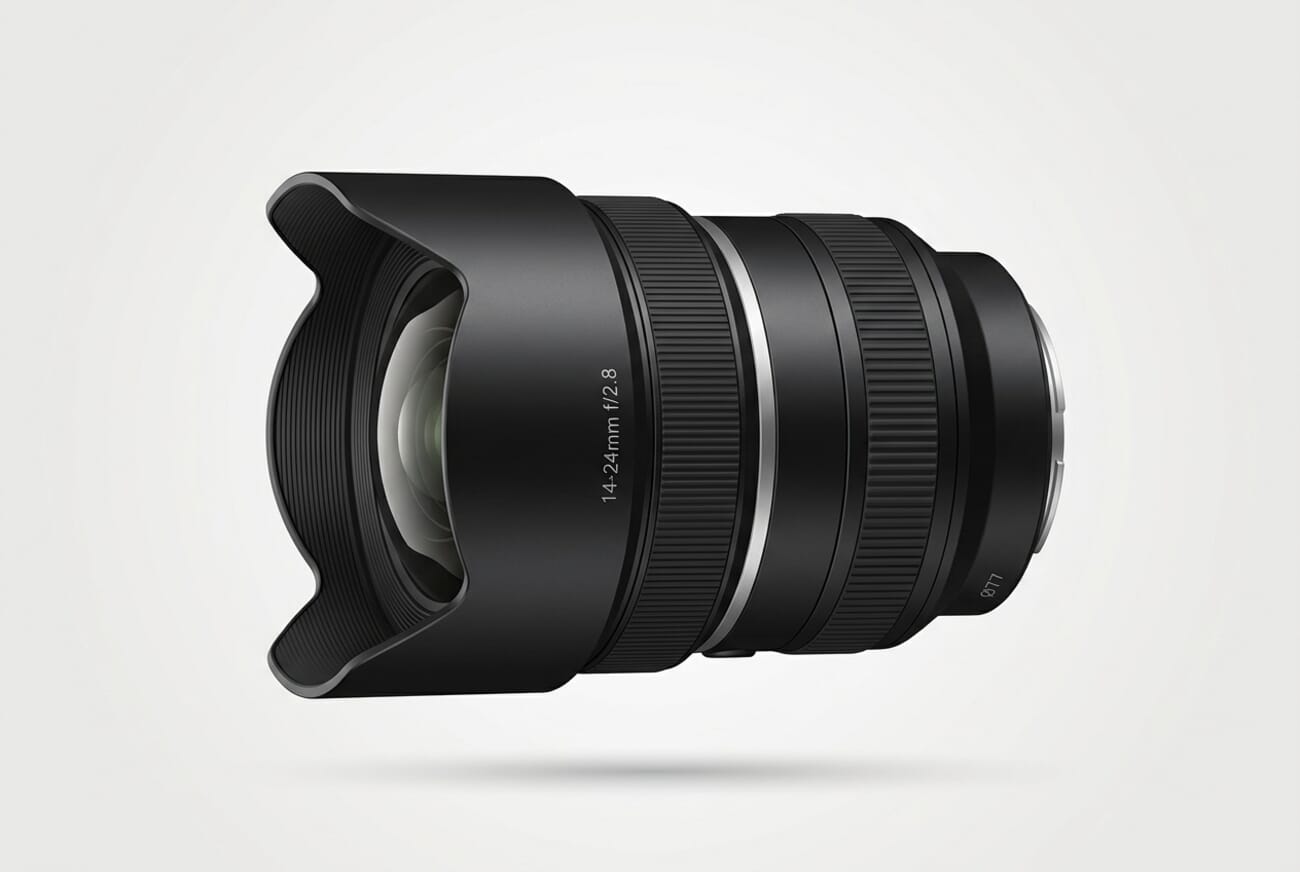
- The headline spec: 77mm front filter threads on a 14mm f/2.8 zoom. No existing 14mm f/2.8 ultra-wide takes screw-in front filters — not Sigma’s, not Sony’s, not Nikon’s.
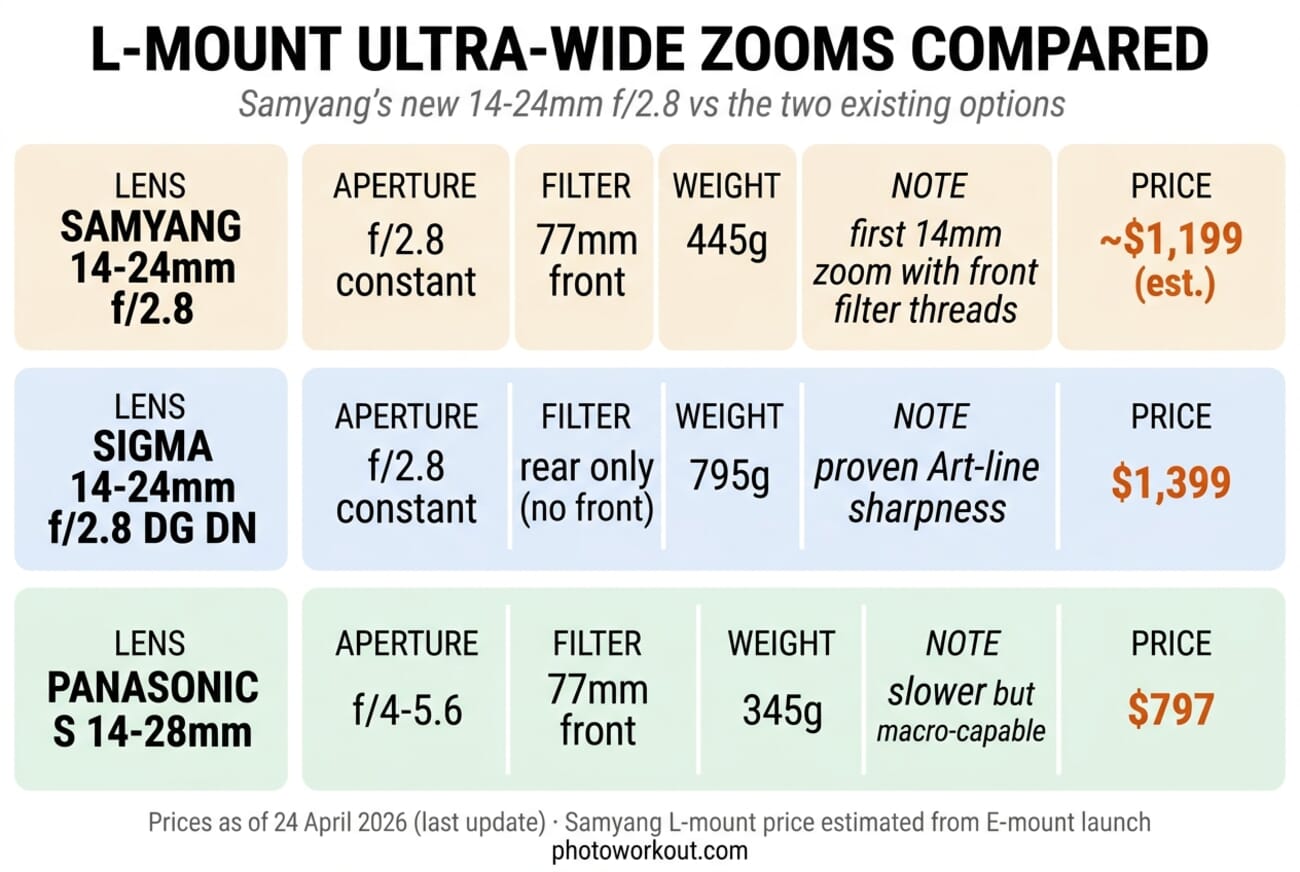
- At 445g, it is 44% lighter than the Sigma 14-24mm f/2.8 DG DN Art (795g). For Leica SL2, Panasonic S5 II, and Sigma fp owners, this changes the travel calculus.
- The L-Mount Alliance now has three 14-ish ultra-wides: this Samyang, the Sigma 14-24mm f/2.8 DG DN Art ($1,399), and the Panasonic Lumix S 14-28mm f/4-5.6 Macro ($797).
Samyang confirmed on April 23 that a new ultra-wide zoom lens for L-Mount arrived on L-Mount on April 30, 2026, and is set to ship in June. L-Rumors, Leica Rumors, and Photo Rumors all agree on the model: the 14-24mm f/2.8 that first appeared on Sony E-mount at CP+ 2025. It is Samyang’s first ultra-wide zoom for L-Mount since joining the L-Mount Alliance last year, and it lands in a category where choice has been limited and expensive.
For Leica SL2, Panasonic S5 II, and Sigma fp owners, this matters for one unusual reason. It is the only 14mm f/2.8 ultra-wide zoom on any mount that accepts a normal 77mm screw-in front filter. Every comparable lens — the Sigma 14-24mm f/2.8 DG DN Art, Sony’s 12-24 f/2.8 GM, Nikon’s 14-24 f/2.8 S — has a bulbous front element that forces landscape and astro shooters to use $300+ square-filter bracket systems. Samyang bypassed that problem. For outdoor L-Mount shooters, that single decision probably matters more than the optics.
What Samyang Announced on April 30
The L-mount version is not a new optical design. Samyang (now branded LK Samyang after its partnership with Schneider-Kreuznach) already launched this lens on Sony E-mount in April 2025 at €1,199. What changes on April 30 is the mount. The rest of the specs should carry across:
- Focal range: 14-24mm — a classic ultra-wide zoom range matched to Sigma and Sony’s f/2.8 offerings
- Aperture: f/2.8 constant across the zoom range
- Filter thread: 77mm front (the headline feature)
- Minimum focus distance: 18cm
- Dimensions: 88.8mm diameter × 84.0mm length
- Weight: 445g
- Autofocus: linear stepping motor, designed to work with L-Mount hybrid AF
Expect the L-Mount price to land close to the E-mount €1,199. Samyang tends to price consistently across mounts, and L-Mount Alliance rivals Sigma and Panasonic have their own options at $1,399 and $797 respectively, so Samyang has room to undercut without going to a premium tier.
Why the 77mm Filter Thread Is the Real Story
Ultra-wide zooms are landscape lenses. Landscape lenses need filters — polarizers for water and skies, graduated NDs for high-contrast scenes, solid NDs for long exposures. The standard way to do that on a 14-24mm f/2.8 has been to buy a NiSi V7 or Haida M10 filter holder system for $300 to $500, plus adapters for the bulbous front element. Some photographers skip filters entirely on their ultra-wide because the hassle is not worth it.
A 77mm screw-in thread changes that. Circular polarizers in 77mm cost $80 for a decent Hoya, $150 for a B+W Kaesemann, and the filter stacks with the rest of a photographer’s 77mm kit. For an L-Mount shooter whose 24-70mm and 70-200mm zooms already use 77mm or 82mm filters, the Samyang slots into the same ecosystem. That is something Sigma’s 14-24mm f/2.8 DG DN Art cannot offer.
The engineering catch: achieving 14mm on full-frame with a standard filter thread requires a smaller front element, which usually means compromises in edge sharpness and vignetting. Reviews of the Sony E-mount version praised center sharpness but flagged soft corners at 14mm wide open. The tradeoff is the tradeoff. Whether it matters depends on what gets photographed — astro at f/2.8 stresses corners, landscape at f/8 does not.
What This Means for Each L-Mount Body
Leica SL2 and SL3 Shooters
Leica’s own native ultra-wide is the Super-Vario-Elmar-SL 16-35mm f/3.5-4.5 ASPH at $5,295. That is the context. Most SL shooters who want an ultra-wide zoom already own the Sigma 14-24mm f/2.8 DG DN Art, not the Leica. A Samyang that matches Sigma’s aperture, beats it on weight, and adds front filter threads for around $200 less is a genuinely interesting option — especially for traveling SL shooters who are already carrying 1.8kg of camera and accessories.
Panasonic S5 II and S5 IIX Shooters
The S5 II is Panasonic’s most-sold full-frame body, and many S5 II owners picked the Panasonic Lumix S 14-28mm f/4-5.6 Macro ($797) as their ultra-wide because it was the affordable option. The Samyang is twice the price but two stops faster at 14mm. For the S5 II video shooter who already owns the 14-28mm Macro, the Samyang is not a replacement — the macro lens has its own niche. For the S5 II photographer shooting astro, interiors, or dim architectural work, the extra two stops at f/2.8 are the whole reason to upgrade.
Sigma fp and fp L Shooters
The fp’s entire design philosophy is small and light. Pairing the 420g fp with the 795g Sigma 14-24mm f/2.8 DG DN makes the body feel like a hood ornament on the lens. The 445g Samyang keeps the kit under a kilo — about the same total weight as the fp with the 24-70mm f/2.8 DG DN II. For street and documentary shooters using the fp as the point of the fp, this is the ultra-wide that fits the body’s intent.
Samyang vs Sigma: Should L-Mount Shooters Wait?
For anyone considering the Sigma 14-24mm f/2.8 DG DN Art right now, the answer is: wait the six days. Announcement is April 30, hands-on reviews follow within a week, and actual shipping for Samyang L-Mount lenses typically runs 3-6 weeks after announcement. Sigma has been on sale at $1,399 since 2020 — it will still be $1,399 in June, and often less via B&H Instant Savings or Sigma’s own rebates. No downside to waiting.
The case for buying Sigma anyway: proven optical quality (DxOmark rates it the sharpest 14-24mm f/2.8 ever tested), two years of review consensus, and the 11-blade aperture that renders sunstars better than most competitors. Samyang’s earlier L-Mount lens (the 35-150mm f/2-2.8 AF) earned decent but not exceptional reviews. If demanding edge-to-edge sharpness for commercial architecture work is the requirement, Sigma is still the safer bet.
The case for the Samyang: front filters, half the weight, likely $200 cheaper, and for most non-professional use, more than sharp enough. The lens many L-Mount landscape shooters have wanted for five years.
Context: Samyang’s L-Mount Roadmap
Samyang joined the L-Mount Alliance in 2025. The 35-150mm f/2-2.8 AF was its first L-Mount lens. The 14-24mm f/2.8 makes it two. Leica Rumors reports that Samyang’s near-term L-Mount roadmap includes a 24-60mm f/2.8, 28-135mm f/2.8, 60-180mm f/2.8, and primes at 20-50mm f/2 and 28-85mm f/2 — an entire zoom and prime lineup being ported from E-mount. The L-Mount ecosystem that looked anemic against Sony E-mount two years ago now has Sigma, Panasonic, Samyang, and Viltrox building native glass in parallel.
That matters for body sales too. The Panasonic S1R II, S5 II, and Sigma BF now have a native third-party lens selection competitive with Sony alpha systems in the 14mm to 200mm range. Panasonic’s recent European market-share record happened in the same quarter. The two trends are related.
What to Do Right Now
- Wait six days. The announcement is April 30. Reviews follow the week of May 5.
- Check E-mount reviews for an early read. The L-Mount version is the same optical formula as the Sony E-mount launched in 2025 — review impressions from the Sony version will be relevant.
- If pre-ordering matters: B&H and Adorama typically open pre-orders within 24 hours of announcement. Shipping usually lands in early June based on the E-mount timeline.
- If buying the Sigma was already on the calendar: wait. The comparison becomes clearer once Samyang posts official price and hands-on reviewers publish side-by-side tests.
Frequently Asked Questions
When does the Samyang 14-24mm f/2.8 L-Mount ship?
Announcement is April 30, 2026. Based on Samyang’s E-mount launch cadence for the same lens (announced at CP+ 2025 in February, shipped in April 2025), L-Mount shipping should arrive in early-to-mid June 2026.
How much will the Samyang 14-24mm f/2.8 L-Mount cost?
The Sony E-mount version launched at €1,199. US pricing for the L-Mount version has not been announced. Based on Samyang’s historical cross-mount pricing, expect $1,199 to $1,299 MSRP — around $100 to $200 below the Sigma 14-24mm f/2.8 DG DN Art at $1,399.
Will the Samyang 14-24mm f/2.8 be sold as Rokinon in the US?
Samyang has historically sold some models under the Rokinon brand at B&H and Amazon in the US. Recent AF lenses have launched under the Samyang name only. The L-Mount version is expected to follow the recent pattern and be sold as Samyang.
Is the Samyang 14-24mm f/2.8 sharper than the Sigma 14-24mm f/2.8 DG DN Art?
Short answer: no, and it was not designed to be. The Sigma is the reference for ultra-wide zoom sharpness on full-frame mirrorless — DxOmark’s highest-rated 14-24mm f/2.8 in the category. The Samyang trades some corner sharpness for a smaller front element and 77mm filter threads. For landscape at f/8 and f/11, the difference is invisible. For astro at f/2.8, Sigma has an edge.
Does the Panasonic Lumix S 14-28mm f/4-5.6 Macro still make sense?
Yes, for video shooters and macro photographers. The Panasonic is $797, the lightest (345g), and adds half-macro close-focus capability. For stills shooters who want f/2.8 for astro, interiors, or indoor architecture work, the Samyang is the better choice.
Image credits: Featured graphic and comparison infographic by PhotoWorkout. Rumor sources: L-Rumors, Leica Rumors, Photo Rumors.
All sources verified on April 24, 2026. Samyang 14-24mm L-mount pricing is an estimate derived from the published Sony E-mount launch price (€1,199).
L-mount announcement coverage
- Leica Rumors — Samyang to announce a new ultra-wide zoom lens for L-mount on April 30th – April 23, 2026 — Confirms the April 30 announcement date and lists Samyang's upcoming L-mount lens roadmap.
- L-Rumors — New Samyang 14-24mm f/2.8 L-mount lens will be announced soon – February 11, 2026 — First confirmation that the E-mount 14-24mm f/2.8 was being ported to L-mount, teased at CP+ 2026.
- Cameraegg — Samyang 14-24mm f/2.8 L Lens announced with constant f/2.8 aperture – CP+ 2026 floor photos of the L-mount prototype on a Sigma BF body with visible "AF 14-24 2.8 L" barrel marking.
Sony E-mount launch (same optical design)
- Photo Rumors — Schneider-Kreuznach × LK Samyang 14-24mm f/2.8 lens for Sony E-mount officially announced – Full specs: 77mm filter thread, 18cm MFD, 88.8 x 84.0mm, 445g, €1,199 launch price.
- PetaPixel — Samyang and Schneider-Kreuznach Announce Samyang 14-24mm f/2.8 FE – CP+ 2025 debut of the Schneider-Kreuznach × LK Samyang collaboration.
Competitor reference pages
- B&H Photo Video — Sigma 14-24mm f/2.8 DG DN Art for Leica L – Current US MSRP and full specs for the competing L-mount ultra-wide zoom.
- B&H Photo Video — Panasonic Lumix S 14-28mm f/4-5.6 MACRO – Current US MSRP and specs for the budget L-mount ultra-wide zoom alternative.