


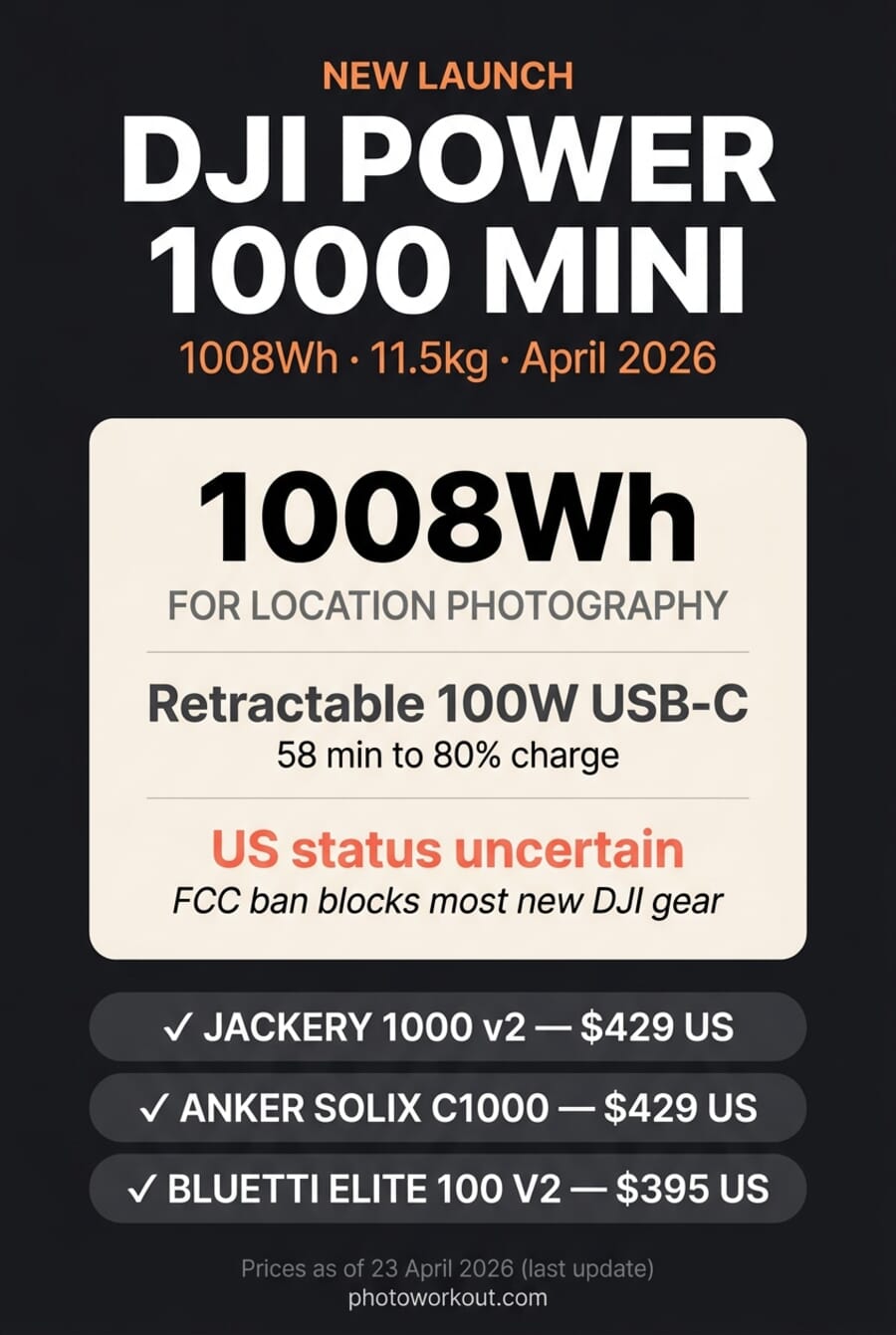
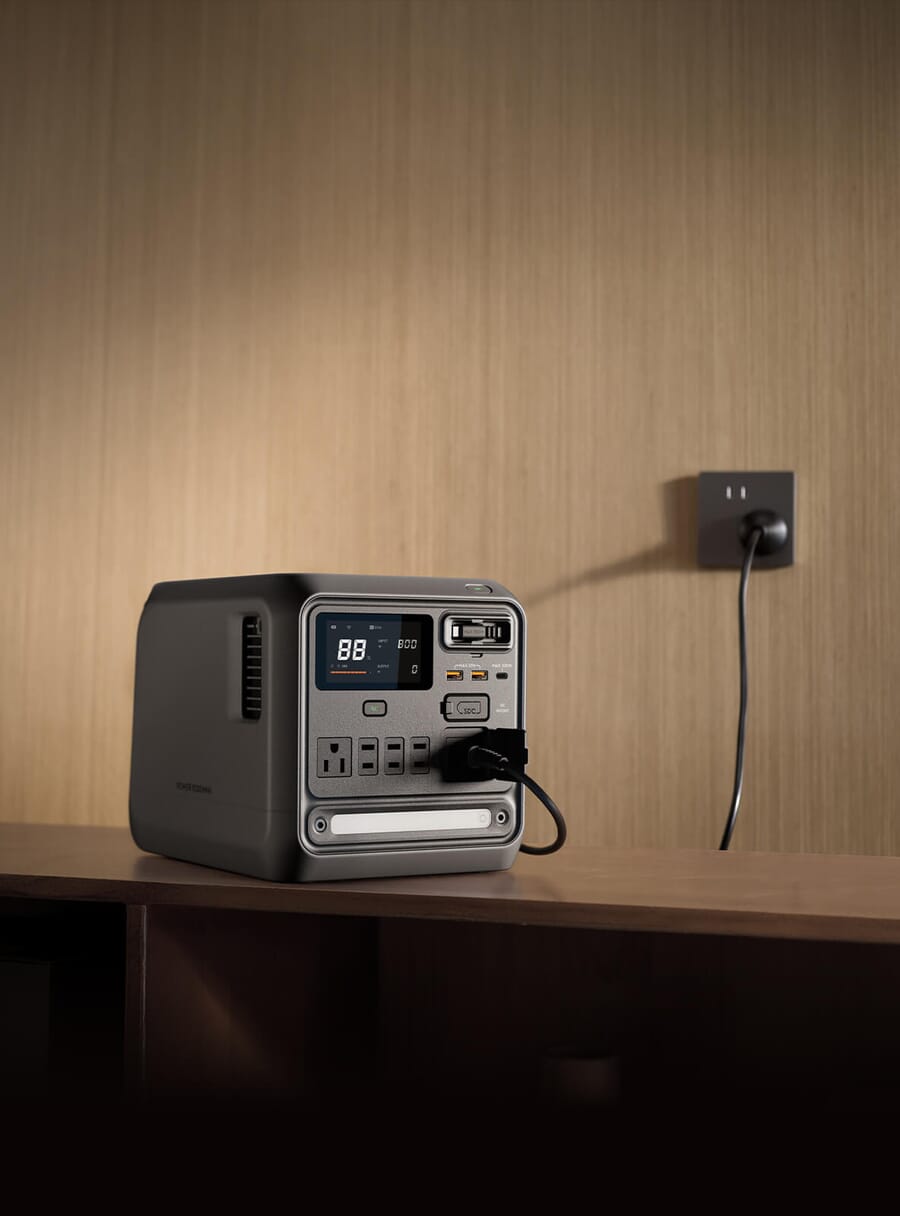
- DJI announced the Power 1000 Mini on April 20, 2026 — 1008Wh capacity, 1000W output, 11.5kg, with a built-in retractable 100W USB-C cable and 400W MPPT solar input.
- UK price £599 (~AU$799). US pricing and availability not yet announced. Per Digital Camera World’s review, the Mini’s US launch is uncertain — likely blocked by the FCC Covered List restrictions we covered yesterday.
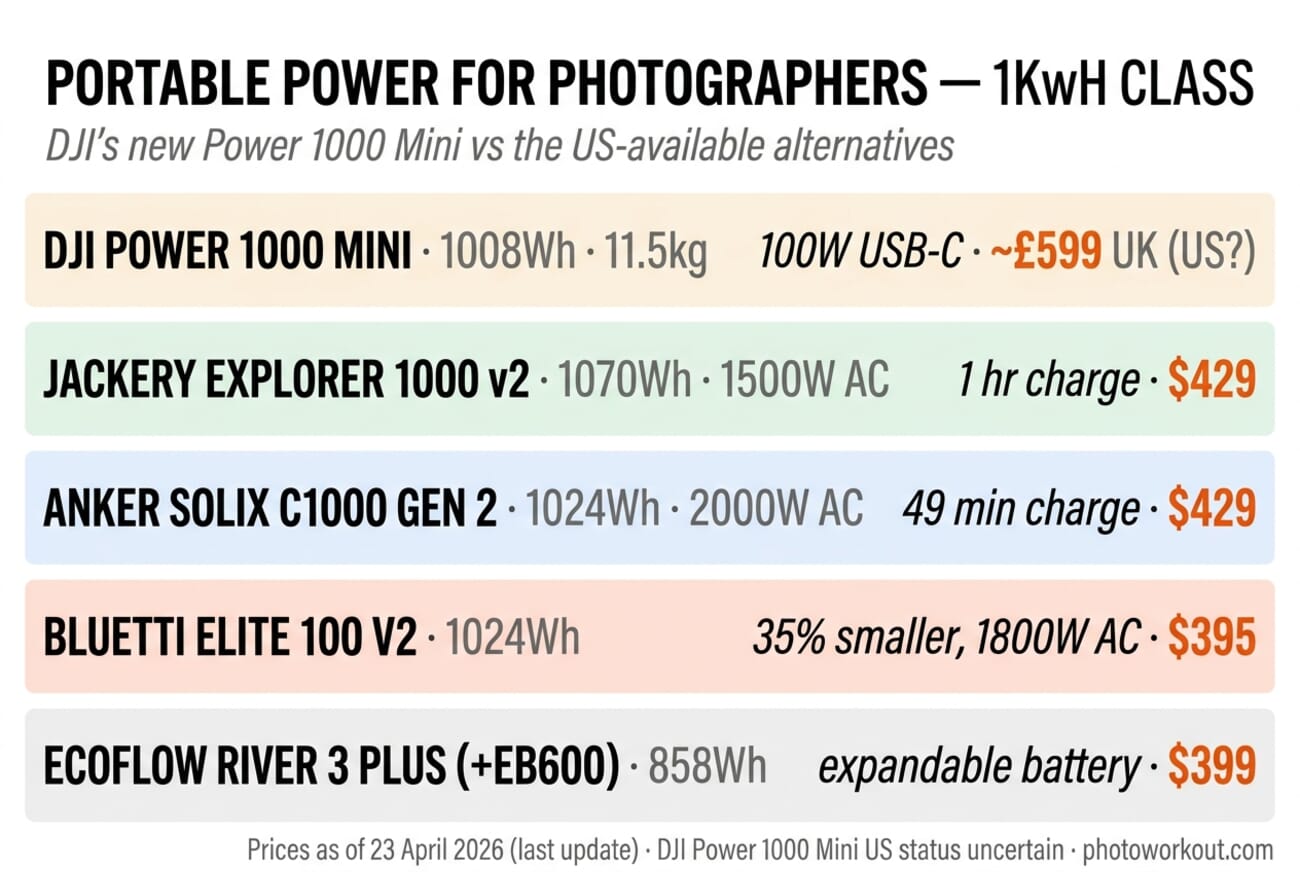
- For US photographers who need the same capability today: Jackery Explorer 1000 v2 ($429) and Anker SOLIX C1000 Gen 2 ($429) are the closest equivalents, both LiFePO4 with similar charge times.
- Most compact US option: Bluetti Elite 100 V2 ($395) — 35% smaller than average competitors with identical 1024Wh capacity.
- Modular option: EcoFlow River 3 Plus with EB600 battery ($399) for shooters who want expandable capacity on long trips.
DJI announced the Power 1000 Mini on April 20, 2026 — a 1008-watt-hour portable power station in an 11.5kg body, roughly 3kg lighter than the original DJI Power 1000 it replaces. Imaging Resource and Digital Camera World both flagged it as the most portable 1kWh power station DJI has shipped — and the kind of unit that matters for location photographers running strobes, LED panels, a laptop, and a camera charger off a single battery all day.
There’s a catch for US-based shooters. DJI’s US launch timing is unclear, and — given the FCC Covered List restrictions blocking 25 new DJI launches in 2026 — the Power 1000 Mini is unlikely to ship in the US this year. Here’s what the Mini offers, and the three US-legal alternatives that photographers should actually buy.
DJI Power 1000 Mini: What DJI Actually Announced
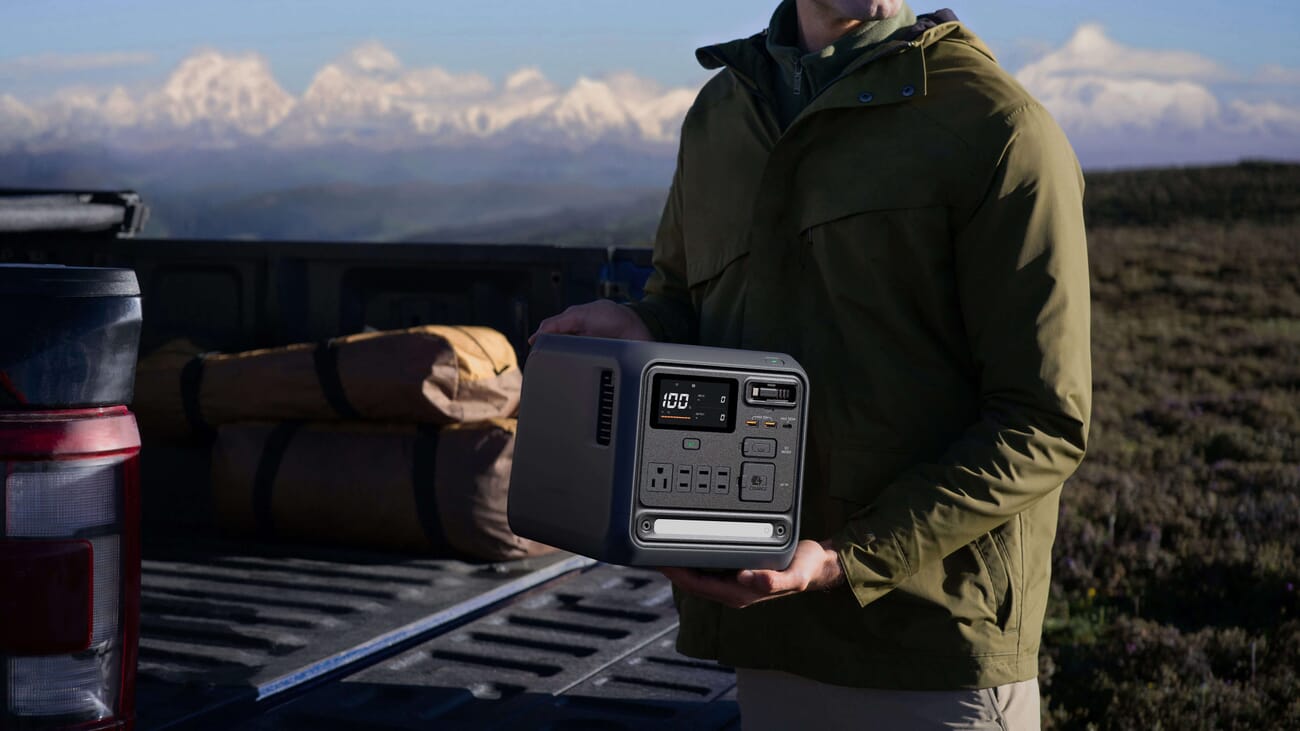
- Battery: 1008Wh LiFePO4 (lithium iron phosphate — safer and longer-cycle than older lithium-ion packs)
- Output: 1000W continuous AC, 1500W peak. Two AC outlets, two USB-C (100W max), two USB-A, one SDC port for DJI accessories.
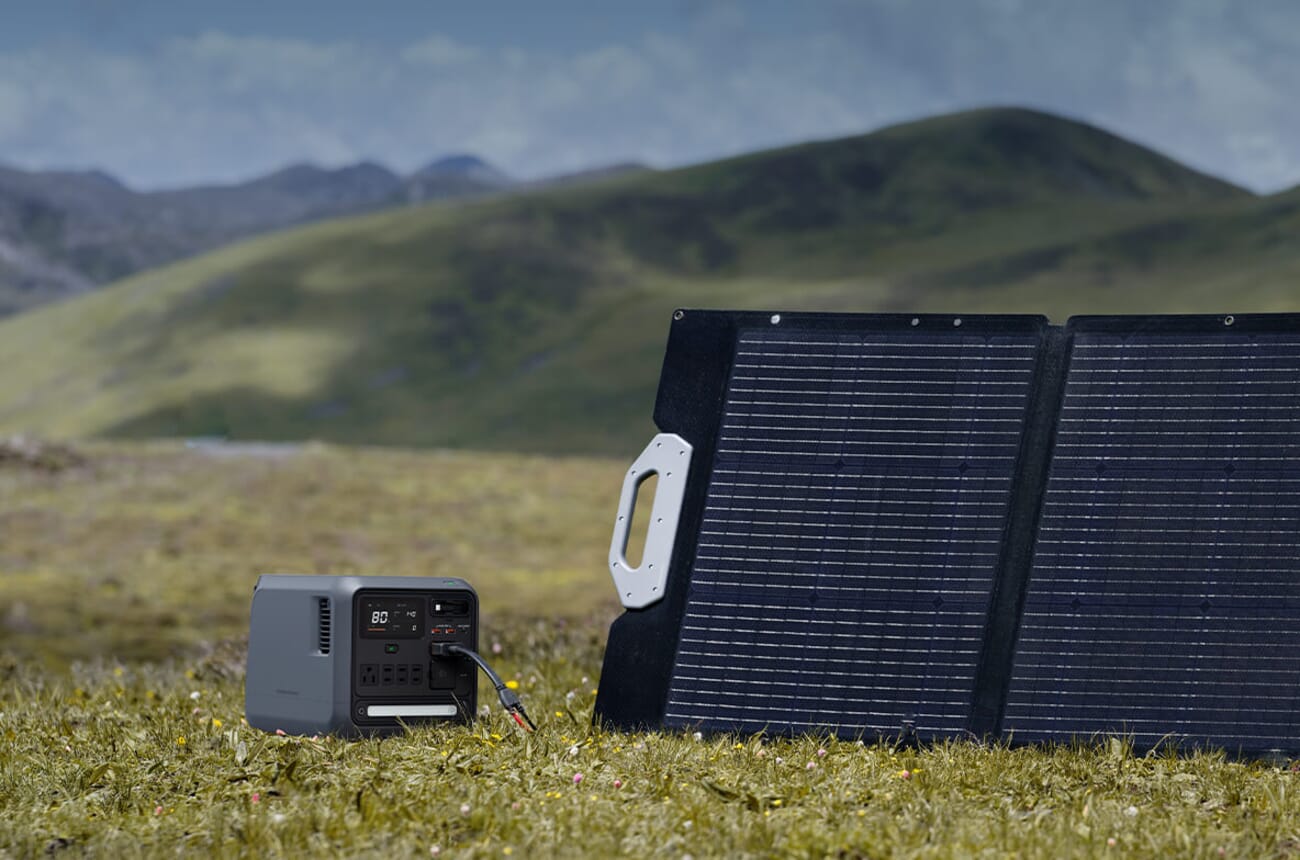
- Input: Up to 1500W AC fast-charge (58 minutes to 80%, 75 minutes to 100%), 400W car charging, 400W MPPT solar input
- Size: 314 × 212 × 216 mm, 11.5 kg — 3 kg lighter than the original DJI Power 1000
- Standout: retractable 100W USB-C cable built into the body — no loose cable to bring or lose
- App: iOS + Android with Bluetooth + Wi-Fi, full battery monitoring and output control
Digital Camera World’s hands-on called the retractable cable “the killer feature” — location photographers who’ve struggled with tangled cables in camera bags will get it immediately. The 400W MPPT solar input also matters for multi-day outdoor shoots where wall power isn’t an option.
Why Location Photographers Need Serious Portable Power
Camera gear alone doesn’t burn much battery. A day of stills shooting on an R5 Mark II runs through two LP-E6 batteries at most. But as soon as the workflow adds anything beyond the camera, power starts to matter fast:
- Strobes and flashes: Godox AD600 Pro runs ~500 full-power flashes per charge — refill from a 1kWh pack, get 5,000+ flashes across a wedding day
- LED continuous lights: a 150W COB LED runs ~6 hours off a 1kWh station at full brightness, all day at 50%
- Laptops for tethered shooting: MacBook Pro 16 uses 30-50W during tethered sessions; a 1kWh station runs it 15-30 hours
- Drone charging in the field: DJI Mavic 4 Pro batteries take ~60Wh each — a 1kWh pack gives you 14 fresh batteries
- Wi-Fi backups: travel router + external SSD array can pull 20-40W; a full day of on-location backup workflow is ~250Wh
The typical location shooter is running 2-3 of these systems simultaneously. 500Wh is the floor for a half-day shoot; 1000Wh is the sweet spot for a full day. Above 1500Wh you start paying disproportionate weight tax.
The Best US-Legal Alternatives (Available Today)
Jackery Explorer 1000 v2 — Best Overall US Alternative ($429)
The Jackery Explorer 1000 v2 is the closest match to the DJI Power 1000 Mini on specs — 1070Wh LiFePO4 battery, 1500W AC output (higher than DJI’s 1000W), 100W USB-C, and 1-hour fast charging. 3,100+ Amazon ratings at 4.7★. It’s also the most-tested option in this list: Jackery has been shipping updated versions for five years, and the v2 resolved the older Explorer line’s complaint about cycle life by moving to LFP chemistry.
Best for: wedding photographers, event shooters, and anyone who wants the safest-bet option with thousands of existing reviews. The weight is similar to the DJI Mini, and the AC output is actually higher — useful for running monolights at full power.
Anker SOLIX C1000 Gen 2 — Fastest Charging ($429)
The Anker SOLIX C1000 Gen 2 matches the Jackery on price and capacity (1024Wh LFP) but pushes further on two specs: 2000W continuous AC output (3000W peak surge — enough to run a small hair dryer or a coffee grinder in the studio) and 49-minute full charge, significantly faster than the DJI Mini’s 75 minutes.
Best for: studio-on-location shoots where you need to run higher-watt appliances (espresso machine for crew, high-power continuous lights) in addition to photo gear. Also the pick if you’re doing rapid reshoots and need to top up the battery between days.
Bluetti Elite 100 V2 — Most Compact ($395)
The Bluetti Elite 100 V2 trades a bit of the Jackery’s proven reputation for the physically smallest body in this class — Bluetti claims it’s 35% smaller than competing 1000Wh stations. 1024Wh LFP, four 1800W AC ports (3600W surge), 4.5★ with 370 reviews. At $395 it’s also the cheapest here.
Best for: travel photographers flying with checked luggage (power stations under 100Wh can fly carry-on; anything 1kWh class ships checked or ground, where dimensions matter more than raw weight). Also the pick if you’re storing it in a tight gear cupboard rather than a studio corner.
EcoFlow River 3 Plus + EB600 — Most Modular ($399)
The EcoFlow River 3 Plus with EB600 battery bundle is the only pick on this list that expands — 286Wh base plus a 572Wh EB600 attached gives 858Wh combined, and additional batteries take it to 2.6kWh for multi-day shoots. The base unit alone is smaller and lighter than the others; you add capacity as needed.
Best for: travel and workshop photographers whose power needs vary week-to-week. Pay for what you need today, add an EB600 later. Not the right pick for anyone who wants a single fixed solution at full capacity — the Jackery or Anker are simpler purchases.
Which to Choose
- UK, EU, or Australia? DJI Power 1000 Mini is your first stop — the retractable cable alone is worth the premium over local alternatives. £599 / AU$799.
- US, want safest bet with thousands of reviews? Jackery Explorer 1000 v2 at $429.
- US, need high peak output for heavy studio gear? Anker SOLIX C1000 Gen 2 at $429 (2000W continuous, 3000W peak).
- US, travel or small space constraints? Bluetti Elite 100 V2 at $395 — 35% smaller body.
- US, variable weekly power needs? EcoFlow River 3 Plus with EB600 at $399 — add more batteries as jobs demand.
All four US picks use LiFePO4 chemistry, which is the right choice for gear that’ll see thousands of partial charges over its lifetime. The difference between them is less about raw capability and more about workflow preference — the core 1kWh specs are within 5% of each other.
Frequently Asked Questions
When will the DJI Power 1000 Mini launch in the US?
DJI hasn’t announced US availability. The FCC Covered List restrictions in effect since December 22, 2025 block new authorization for most DJI products in the US. The original DJI Power 1000 got its authorization before the cutoff and remains sellable; the Power 1000 Mini, announced April 2026, is almost certainly blocked from the US market under current rules.
Can I import a DJI Power 1000 Mini from the UK to the US?
Technically possible for personal use, but comes with several problems: UK socket shape doesn’t match US outlets (so you’d need an adapter), warranty won’t apply in the US, FCC authorization isn’t present (so no lawful resale), and international shipping on an 11.5kg lithium battery is expensive and restricted. For practical purposes: no.
Is 1000Wh enough for a wedding day?
Yes, with margin. A typical wedding day runs ~600-800Wh: strobe packs (200-300Wh), laptop for tethering (50-150Wh), miscellaneous chargers (50-100Wh), LED video light (200-300Wh). 1000Wh gives you a comfortable 20-30% buffer. For two-day destination weddings or studio-style productions, a 1500Wh+ station or the EcoFlow expandable setup makes more sense.
What’s LiFePO4 and why does it matter?
Lithium iron phosphate — safer, longer-cycling battery chemistry than older lithium-ion (NMC). LiFePO4 batteries handle 3,000-6,000 full cycles before hitting 80% capacity, versus 500-1,000 for older NMC chemistry. For gear you’ll use 2-3 times a week for years, LiFePO4 is the only chemistry worth buying. All four US picks and the DJI Power 1000 Mini are LiFePO4.
Can I fly with a portable power station?
Not as carry-on. FAA and international aviation rules cap lithium batteries at 100Wh for carry-on. Anything above 100Wh must be checked — but most 1kWh power stations are also prohibited from checked luggage under most airlines’ hazmat policies. In practice, these stations travel by ground (car, rental van) or get shipped ahead by freight. For carry-on-friendly power, look at 100Wh USB-C power banks and chain multiple together.
What about AC generators instead?
Quieter and cleaner than gas generators, no exhaust or noise. But AC generators with comparable all-day 1kWh capacity are 2-3× heavier than lithium power stations, require maintenance, and can’t be used indoors. For photography use cases (studio-on-location, weddings, commercial shoots), lithium is the answer. AC generators make sense only for construction-adjacent work where noise and fumes are already present.
Which is the best overall pick for US photographers in 2026?
Jackery Explorer 1000 v2 at $429. Highest review count (3,100+ at 4.7★), highest AC output vs DJI Mini, mature product line with five-year support history. Pick the Anker if you need 2000W+ peak output; pick the Bluetti for absolute smallest size. Everyone else should pick the Jackery.
Featured graphic, 1kWh comparison chart, and Pinterest pin by PhotoWorkout editorial. Power station data sourced from DJI’s April 20, 2026 announcement, Digital Camera World’s hands-on review, and current Amazon US listings (verified 23 April 2026).
All sources verified on April 23, 2026. US Amazon pricing current at time of publication.
DJI Power 1000 Mini announcement
- DJI — Power 1000 Mini official product page – Official DJI product page with full specs and availability status.
- Digital Camera World — DJI Power 1000 Mini review – Hands-on review with UK/AU pricing and notes on US availability uncertainty.
- DroneDJ — DJI Power 1000 Mini drone workflow angle – Coverage focused on drone-battery use case for the 1008Wh capacity.
- Gizmochina — DJI Power 1000 Mini technical launch – Full spec summary and solar-input / fast-charge technical details.
US FCC context
- PhotoWorkout — DJI FCC Crackdown Coverage – Our April 22, 2026 report on the 25 DJI products blocked from US launch by FCC authorization restrictions.
This post contains affiliate links. If you buy through them, PhotoWorkout may earn a commission at no extra cost to you.