


- NASA released 12,217 raw, unedited photos from the Artemis II mission on May 3, 2026 — accessible via the Gateway to Astronaut Photography of Earth website.
- Cameras aboard: Nikon D5 SLRs (the workhorse), a Nikon Z9 fitted as the Handheld Universal Lunar Camera (HULC) with a thermal blanket, and an iPhone 17 for quick captures.
- The Z9 was a last-minute addition to test radiation-hardening for Artemis III’s planned lunar surface missions. It came back intact — high-quality images, no detectable sensor degradation.
- Notable categories in the archive: solar eclipse from Orion’s vantage, multiple “Earthsets,” 80–400mm lunar terrain close-ups at 200mm, crew portraits, and long-exposure star trails.
- Each photo is unattributed per the crew’s own decision — Wiseman, Glover, Koch, and Hansen claim collective ownership of the archive rather than individual credit.
On May 3, 2026, NASA quietly opened up the full Artemis II photo archive — 12,217 raw, unedited frames shot during the crew’s lunar flyby. For photographers, this is the first comprehensive crewed lunar archive since Apollo, and the first ever to mix DSLR, mirrorless, and smartphone captures across the same mission.
The release also closes a loop on a story that ran through the spring: AI-generated fake Artemis II images fooled millions while the crew was still in transit. Now the real images are out, and they’re available for anyone to download — no paywall, no Getty license, no AI prompt required.
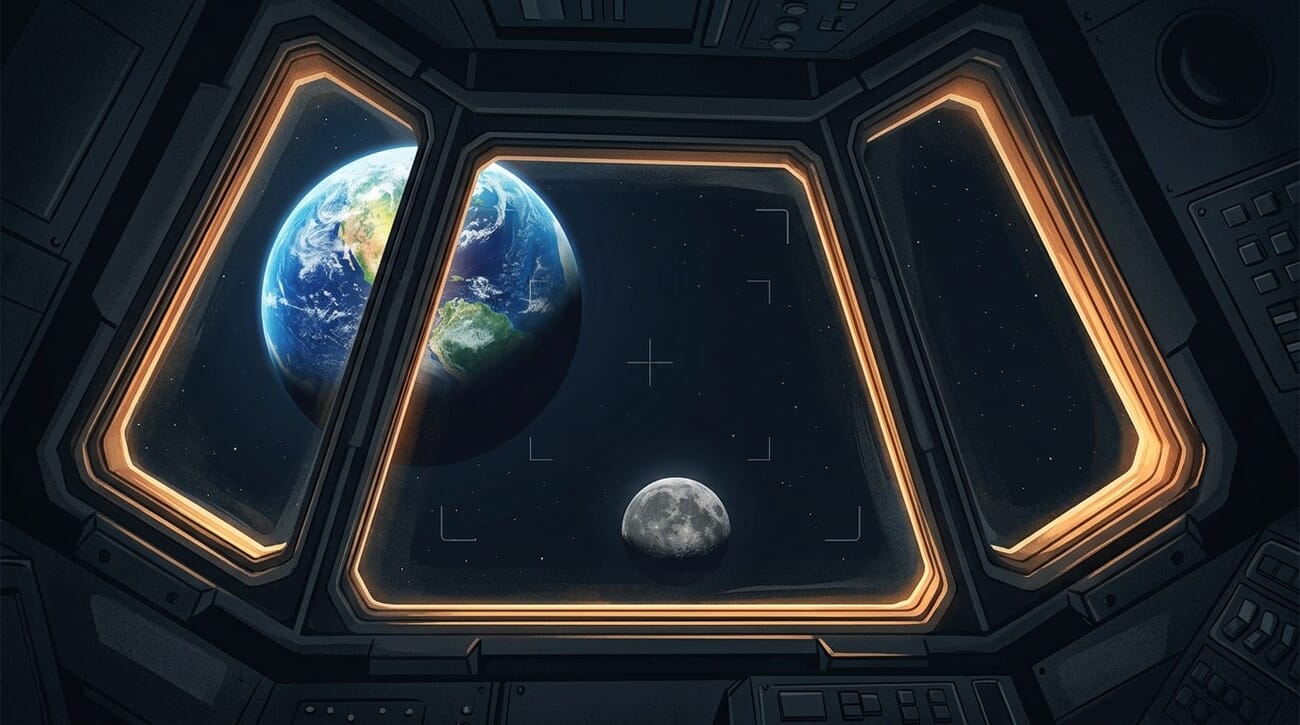
What’s in the archive — and where to find it
The 12,217 photos cover the full 10-day mission timeline: launch on April 1, the translunar injection burn the day after, three days of inbound coast, the lunar flyby on April 6, return cruise, and the April 10 splashdown in the Pacific near San Diego. They’re hosted on NASA’s Gateway to Astronaut Photography of Earth (yes, that’s the public name — same archive that holds every Apollo, Skylab, and ISS photo back to 1962).
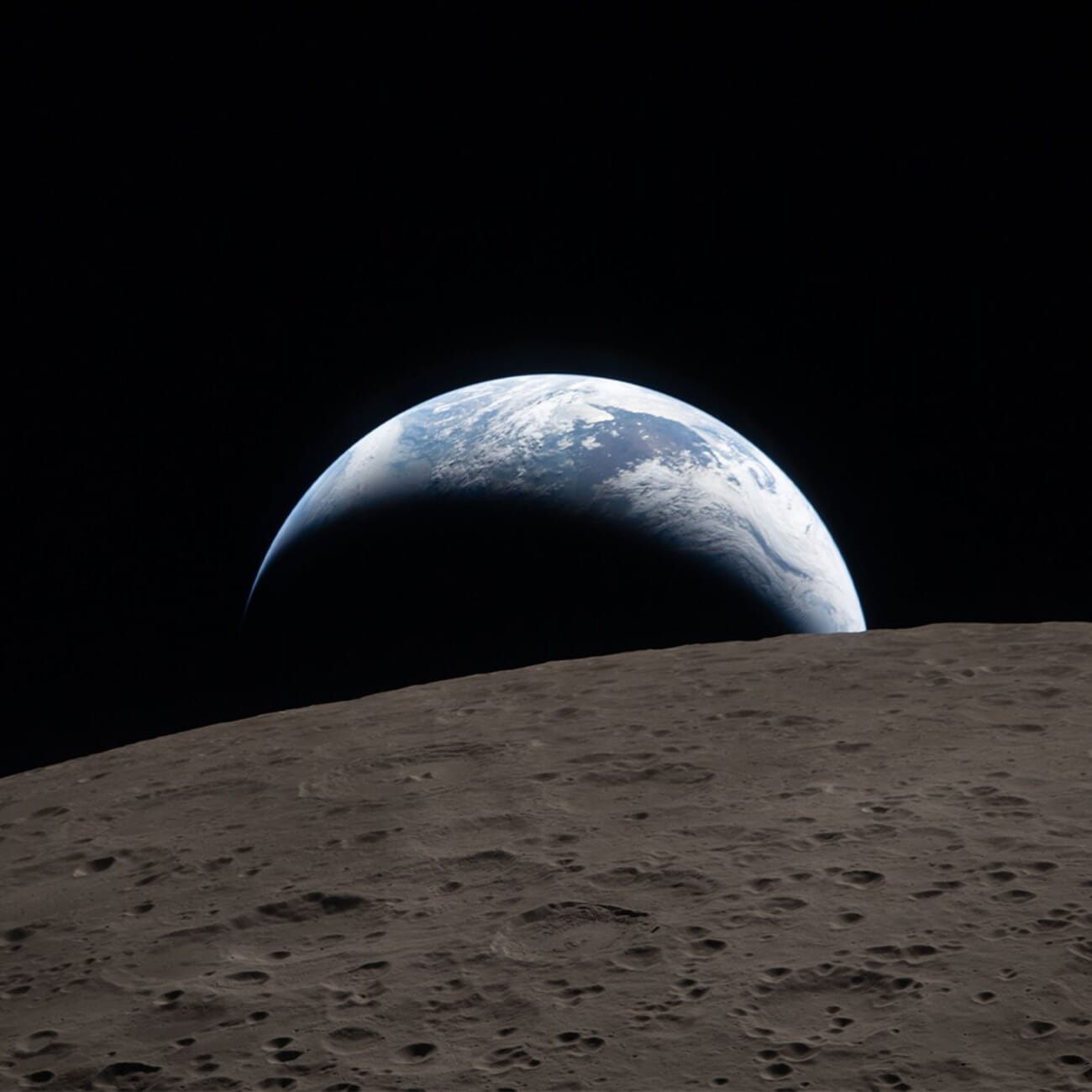
Notable image categories the archive contains:
- Earthsets. The crew framed multiple Earth-disappearing-behind-the-lunar-limb sequences. The visual mirror of Apollo 8’s 1968 Earthrise — but with 60 years of sensor improvement.
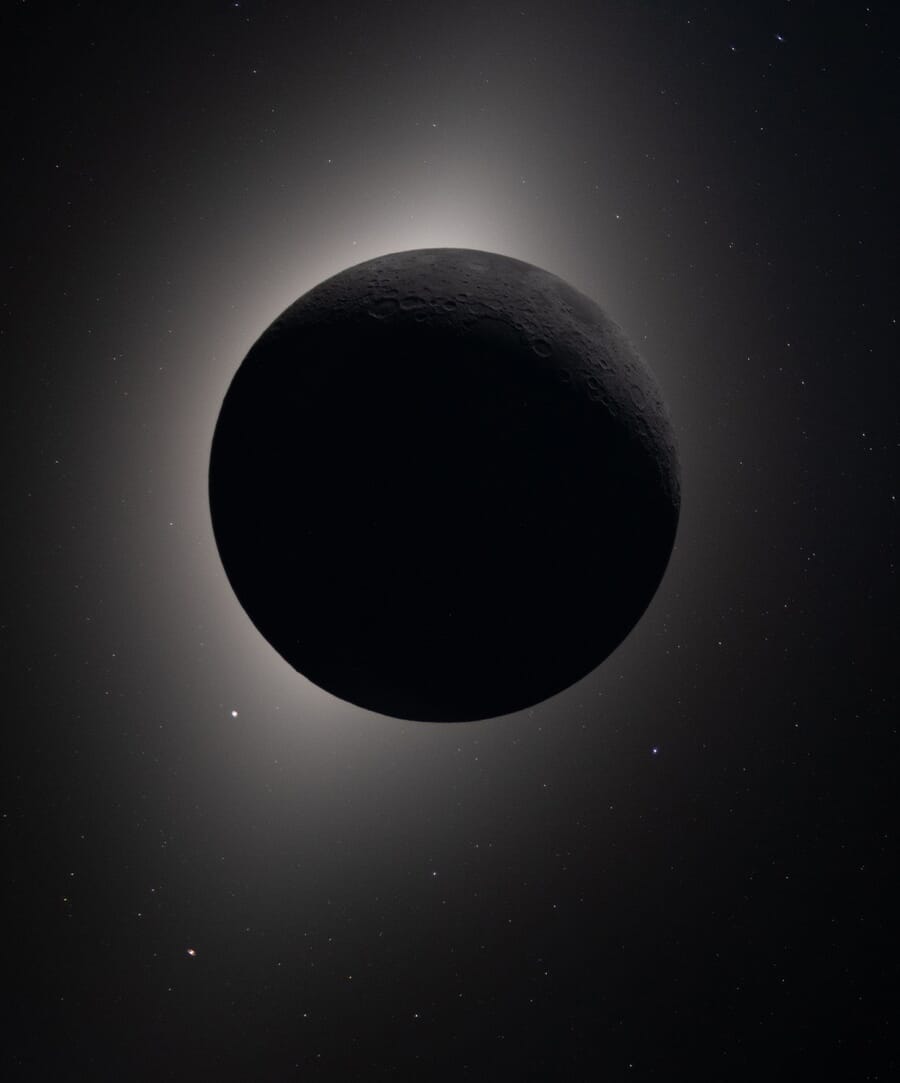
- Solar eclipse from Orion. A geometry the crew stumbled into during cislunar coast — Earth temporarily obscuring the Sun from their angle, captured at high shutter speed.
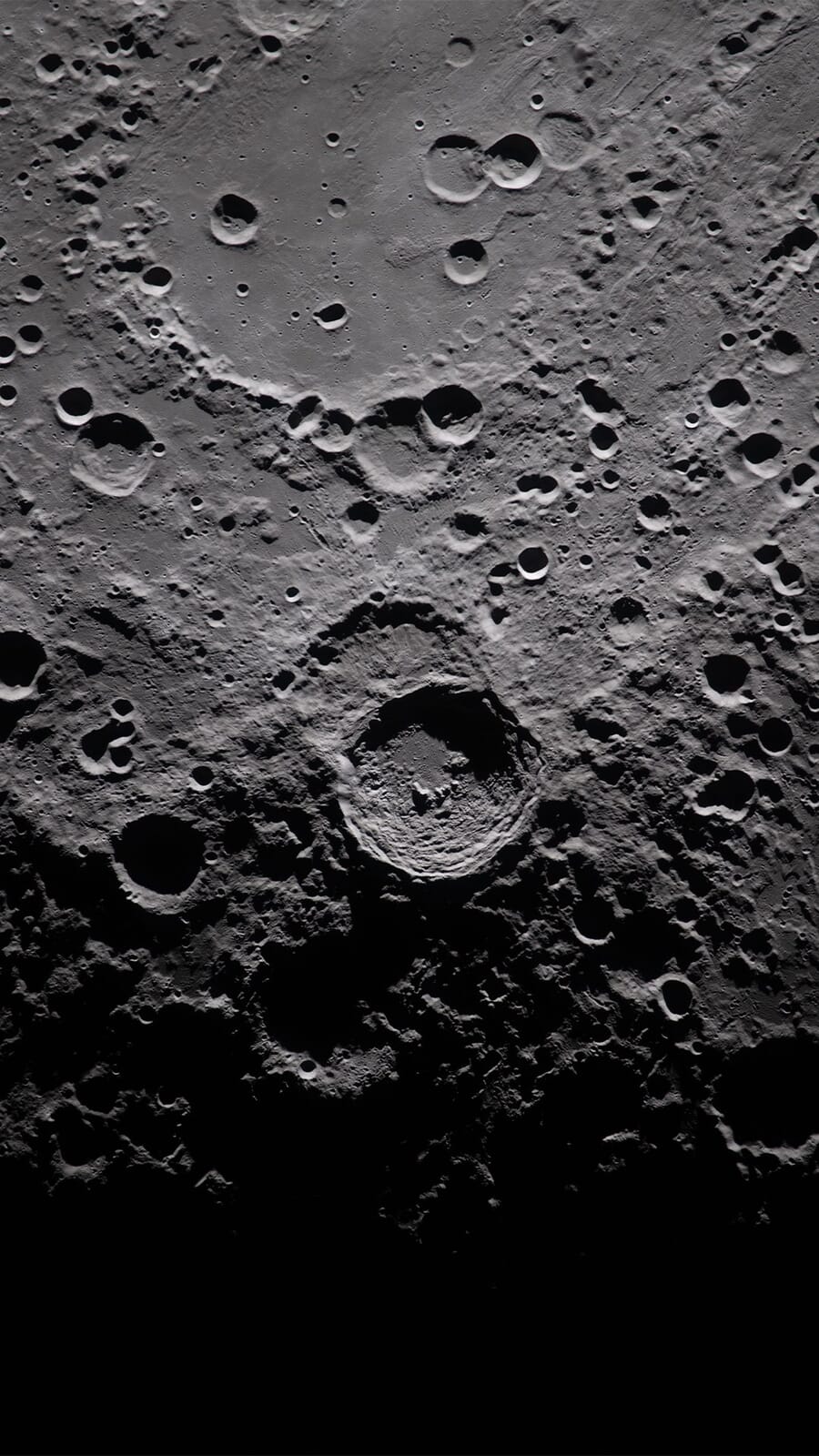
- Lunar surface close-ups. Shot at 200mm on the Nikon D5 with the 80–400mm zoom. Resolution sharp enough to read crater walls.
- Cabin and crew portraits. Christina Koch posed with a crescent Earth in the background; Reid Wiseman framed by the Orion windows. Wide-angle work with the 14–24mm at 24mm.
- Star trails. Long-exposure frames captured during quiet cruise periods — astronomical photography from a moving spacecraft, possible because Orion’s drift is slow and predictable.
The cameras: D5 SLR, Z9 HULC, iPhone 17
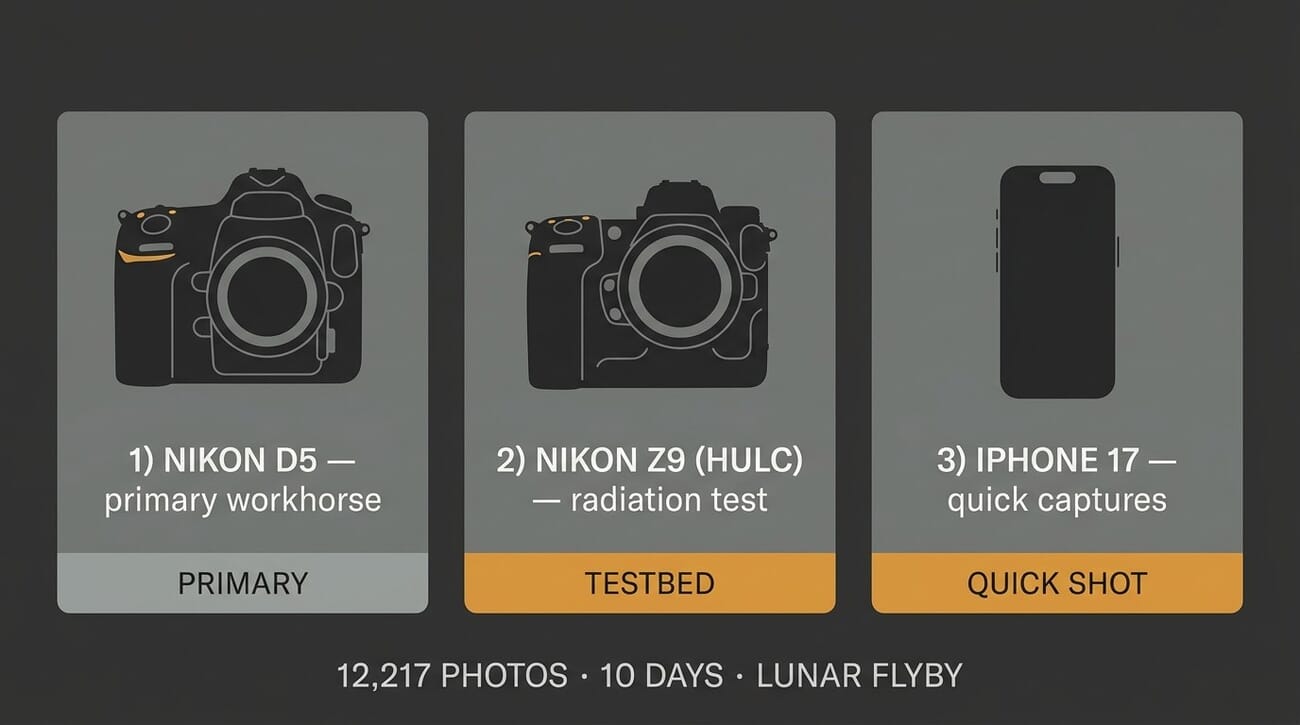
The crew shot primarily with Nikon D5 bodies — the same 10-year-old DSLR PhotoWorkout flagged back in February as the deliberate choice for the mission. The reasoning held: optical viewfinder works without electricity, mechanical shutter has no sensitive electronics in the light path, and a decade of NASA modifications (radiation-hardened firmware, simplified controls for gloved hands, custom thermal jackets) make it the most flight-tested digital camera in service.
The lens kit visible in caption metadata: a Nikon 14–24mm f/2.8 for cabin and wide Earth views, a 35mm prime on the Z9 for tighter portraits, and the 80–400mm for the lunar surface work — mostly shot at 200mm where the moon fills roughly the same frame area a 600mm gives you from Earth.
The iPhone 17 entered the manifest as the crew’s personal-use device. NASA didn’t commission space-mission photography from it, but the crew used it freely. The release archive includes a handful of iPhone-tagged frames, mostly cabin moments and POV captures from the windows. Image quality holds up surprisingly well next to the D5 frames — the smartphone’s computational pipeline does what its sensor alone can’t.
The Nikon Z9 radiation test — what NASA learned
The most consequential camera on the mission wasn’t the D5. It was the modified Z9 — designated the Handheld Universal Lunar Camera (HULC) — wrapped in a custom thermal space blanket and added to the manifest at the last minute over operational concerns about radiation tolerance.
The fear was simple: cosmic rays and energetic particles in cislunar space can damage CMOS sensors, manifesting as hot pixels, banding, or in worst cases full sensor failure. NASA had previously validated the Z9 in March 2025 at the GSI/FAIR particle accelerator in Germany, subjecting the body to heavy-ion irradiation. The lab test passed. But lab-controlled and 10-day mission-realistic are different beasts.
The verdict from the archive: the Z9 came back clean. No hot-pixel cluster, no banding artifacts, no read-noise creep visible across the mission timeline. For NASA, this is the green light for Artemis III — the planned lunar-surface mission where the HULC platform is intended to actually walk the Moon. For Nikon (and by extension the rest of the mirrorless industry), it’s validation that current-generation stacked-CMOS sensors can survive deep-space exposure — a category of testing the major manufacturers had been guessing at for years.
Real photos vs the AI fakes
During the mission, social media filled with stunningly photoreal “Artemis II” images — all generated by AI, none from the actual crew. The fakes were technically more dramatic than reality: super-saturated Earth blues, impossibly framed crew portraits, a kind of polished cinematic feel that real spaceflight rarely produces.
The release archive is a study in opposite-direction artistry. Real Artemis II photos look like the work of careful photographers under brutal constraints — high contrast between sunlit Earth and inky black space (no atmospheric haze to soften the transition), occasional internal reflections from the Orion window glass, frames with motion blur from microgravity-shifted handholding, and the unfussed honesty of an unedited RAW. They’re less polished than the AI fakes. They’re also, obviously, the only ones that count.
What terrestrial photographers can take from it
Beyond the mission story, the archive is an unusual reference for anyone shooting high-contrast scenes:
- Underexposing for the highlights is not a backup plan, it’s the plan. The crew’s D5 frames consistently sit 1.5–2 stops below “normal” to preserve the lunar surface highlights and the sunlit Earth limb. Shadow recovery in post handles the rest.
- Wide aperture has no friends in space. Most frames sit at f/8–f/14 — depth-of-field is essentially infinite at lunar distances anyway, and the smaller aperture buys sharpness across the field plus tighter star points on long exposures.
- Optical viewfinders earn their keep. Behind a window with internal reflections, the D5’s optical finder showed exactly what the lens saw — no LCD lag, no battery-dependent EVF, no mirror lockup vibrations to worry about. A reminder that a tool’s simplicity is sometimes its biggest advantage.
- RAW + native lens combos beat post-processing every time. The release archive is unedited. Every dramatic frame you’ll see was captured, not painted in.
Frequently Asked Questions
Where exactly can I download the Artemis II archive?
NASA’s public-domain Gateway to Astronaut Photography of Earth at eol.jsc.nasa.gov. The archive is browseable in lightbox or table view; full-resolution downloads are free and unrestricted (NASA imagery is public domain unless explicitly stated).
Why didn’t NASA use the Z9 as the primary camera?
Trust. The D5 has a decade of flight history with NASA’s ISS imagery program — it’s been irradiated, frozen, baked, jostled, and dropped, and they know exactly how it behaves. The Z9 was new to the program and went up specifically to start that flight-history database for the mirrorless generation. For Artemis III and beyond, that’s expected to flip.
Are the photos available in RAW?
The Gateway archive serves them as JPEG-derivatives at full resolution. RAW files go through a longer NASA pipeline and are typically released months later via the JSC Image Archive in NEF format. Worth checking back in 6–9 months for the full RAW set.
Is the iPhone 17 footage going to be released too?
Yes — the iPhone-tagged frames are mixed into the same archive, identifiable by EXIF camera-make metadata. They’re a smaller subset (a few hundred frames) compared to the D5/Z9 captures.
Did the cameras come back working?
All three did. NASA’s post-mission inspection found no functional degradation on either Nikon body. The Z9 in particular passed the sensor-noise comparison against pre-flight calibration data — meaning the radiation it absorbed in cislunar space did not measurably affect image quality. That’s a meaningful signal for any future deep-space mission planning to carry digital imaging gear.
Image credits: PhotoWorkout editorial illustrations.
Browse the Full Artemis II Archive
Below is a live browser that pulls from NASA’s public Image Library API in real time — no NASA login or download required. Search by keyword, paginate through the full 2,000+ in-flight images, and click any photo to open the high-resolution version with credits and download link.
Primary Coverage
- PetaPixel — NASA Releases Thousands of Unseen Artemis II Photos – Original coverage of the May 3 release, including the camera lineup, lens identification, and first-look highlights.
- NASA — Artemis II Multimedia – Official NASA hub for Artemis II imagery, video, and mission highlights.
- Gateway to Astronaut Photography of Earth — Artemis II Query – The 12,217-image searchable archive on NASA's public-domain photography portal.
- Starlust — NASA Releases Over 12,000 Images Taken During Artemis II Mission – Independent coverage of the archive release with mission timeline and equipment context.
- NASA NTRS — Applied Science with the Artemis Baseline Camera (Nikon Z9) – Technical paper documenting the HULC variant Z9, including the GSI/FAIR particle accelerator radiation tests.
Image Sources
- NASA — Artemis II Mobile Wallpapers – Earthset, Vavilov Crater, and solar-eclipse photos used in this post are from NASA's public-domain Artemis II wallpapers gallery. NASA imagery is public domain unless explicitly stated.