


- American Airlines capped power banks at 2 per passenger, each under 100 Wh, effective May 1, 2026 — must stay accessible (not in overhead bins), no in-flight charging.
- Camera batteries are mostly unaffected — AA still allows up to 4 Li-ion batteries under 100 Wh plus 2 between 100-160 Wh in carry-on.
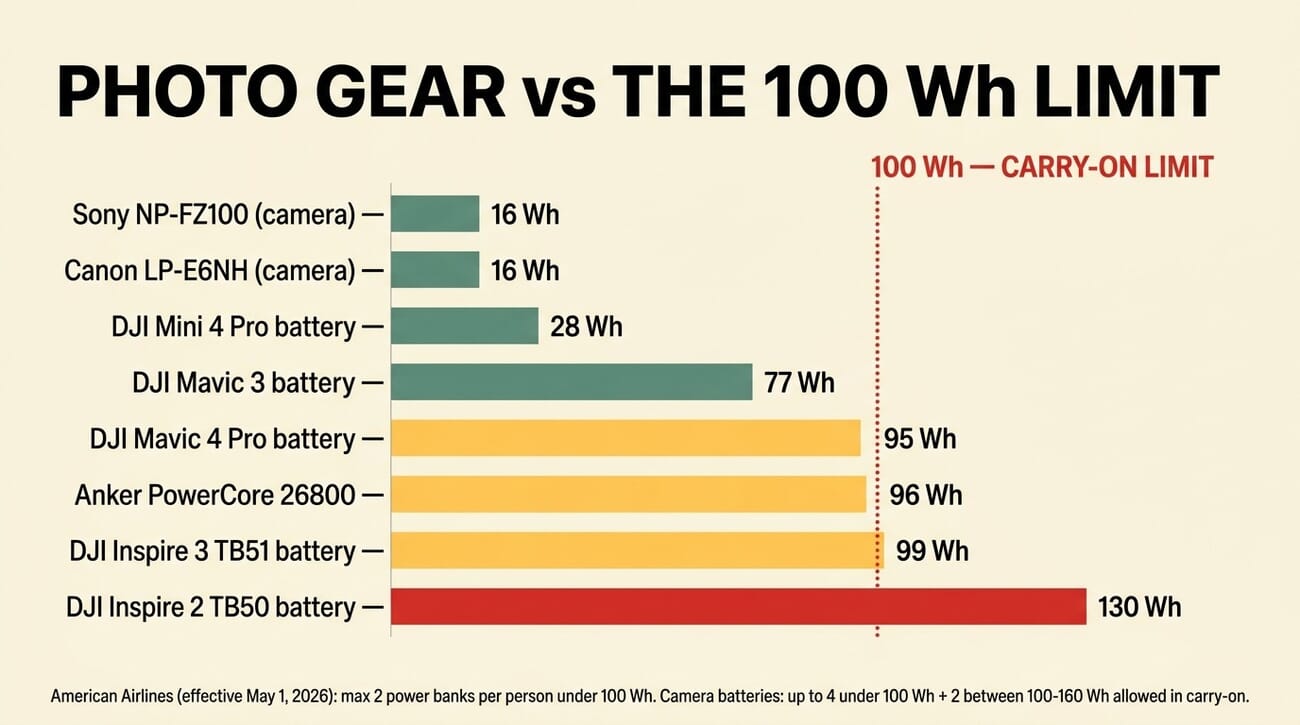
- Most photography gear sits well under the 100 Wh cap: a Sony NP-FZ100 is ~16 Wh; a DJI Mavic 4 Pro flight battery is ~95 Wh; a typical 26,800 mAh power bank is ~96 Wh.
- Drones with 100-160 Wh batteries (e.g., DJI Inspire 2 TB50 at 130 Wh) need airline approval; anything over 160 Wh can’t fly at all on AA.
- Other US airlines have not (yet) matched AA, so policies still vary by carrier. Confirm specifically before each flight.
American Airlines’ new lithium-battery policy went into effect May 1, 2026, and it’s already causing a small wave of confusion at TSA checkpoints. The headline change: a two-power-bank cap per passenger, each under 100 watt-hours, kept accessible in carry-on (no overhead bins, no in-flight charging). Those rules came after the FAA logged 97 lithium-battery incidents on US aircraft in 2025, mostly cheap power banks overheating mid-flight.
For photographers, videographers, and drone pilots, the practical question is whether your usual carry-on kit still flies. The short answer for most working photographers: yes, almost unchanged. The longer answer depends on what kind of drone you’re hauling, and whether your newer USB-C camera batteries are going to confuse a TSA agent into treating them as power banks.
What American Just Changed (and What Stayed the Same)
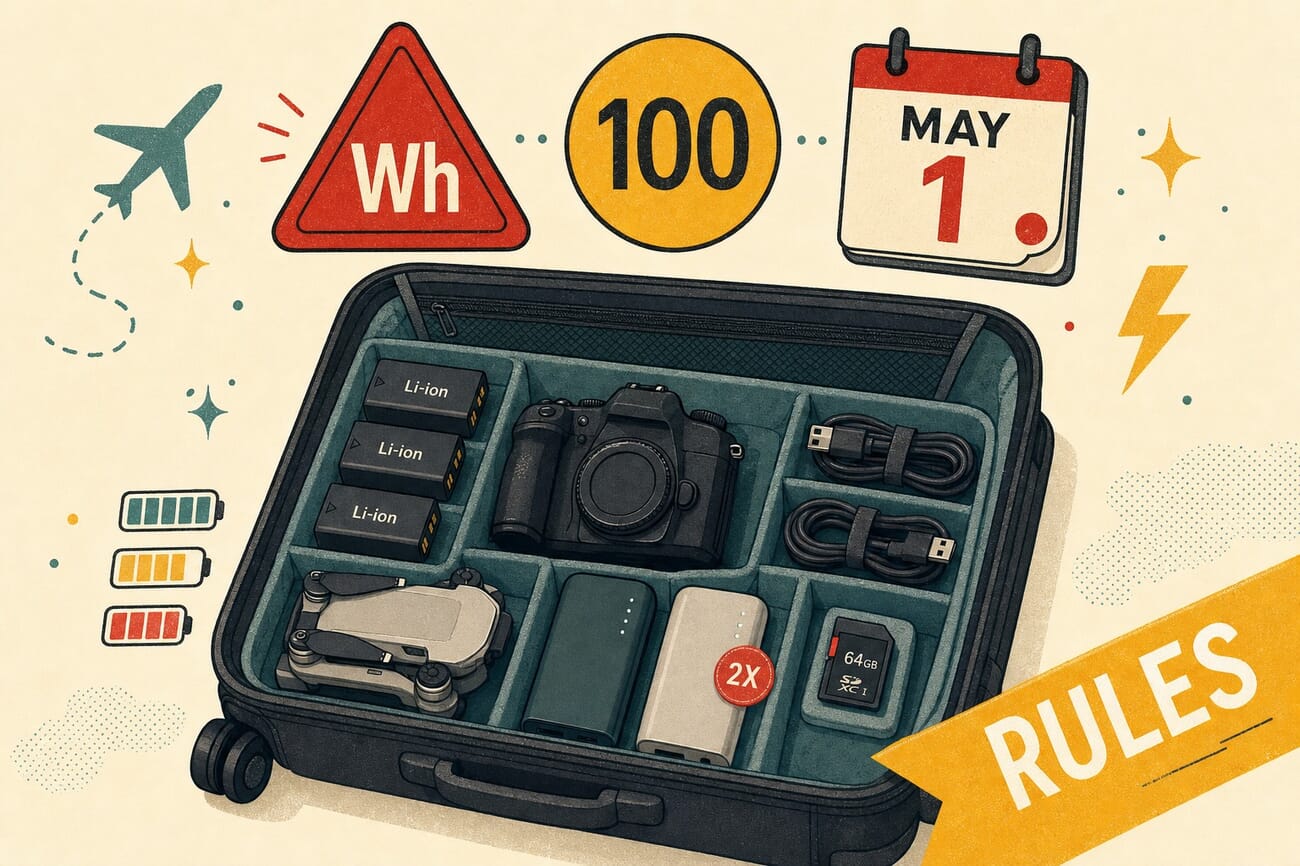
American Airlines published its updated Restricted Items policy on May 1. The new rule is narrowly scoped — it targets spare lithium-ion power banks, not camera or drone batteries. The four practical points:
- Maximum 2 power banks per passenger — both under 100 Wh.
- Carry-on only — no checked baggage, no overhead bin.
- Must remain accessible — under the seat in front of you, not buried in the bin above.
- No in-flight charging from a power bank — even at your seat. Use the airline’s outlet if you need to charge.
What didn’t change is just as important. American still permits, in carry-on:
- Up to 4 spare lithium-ion batteries under 100 Wh — covers basically every camera battery on the market and most consumer drone packs.
- Up to 2 spare batteries between 100-160 Wh — with airline approval. This is the bracket pro drone pilots care about.
- Anything over 160 Wh: prohibited. Some cinema-grade drone and gimbal batteries fall here; you’ll need to ship them or rent on location.
Camera Batteries: You’re Almost Certainly Fine
Every modern mirrorless and DSLR battery sits at a small fraction of the 100 Wh cap. A few reference points (calculated as Wh = mAh × V ÷ 1000):
- Sony NP-FZ100 (a7 IV, a7R V, a1, FX3): 2,280 mAh × 7.2 V = ~16.4 Wh
- Canon LP-E6NH (R5, R5 II, R6, R6 II): 2,130 mAh × 7.2 V = ~15.3 Wh
- Nikon EN-EL15c (Z6 III, Z7 II, Z8): 2,280 mAh × 7.0 V = ~16.0 Wh
- Fujifilm NP-W235 (X-T5, X-H2, GFX100 II): 2,200 mAh × 7.2 V = ~15.8 Wh
- Panasonic DMW-BLK22 (S5 II, GH7): 2,200 mAh × 7.2 V = ~15.8 Wh
Pack four spares, you’re still at ~64 Wh — well inside the limit. Tape the contacts, keep them in the original cases or in zip-lock bags so terminals don’t short against keys, coins, or other batteries. That’s the part the FAA actually cares about.
There’s one caveat to flag: USB-C-charging camera batteries (some newer Sony, Canon, and Insta360 packs) sometimes get mistaken for power banks at security. The fix is documentation — keep the battery in a labelled case showing the Wh rating, or carry a printout of the manufacturer spec sheet. If a TSA agent escalates, the rule that applies is the spare-battery rule (4 under 100 Wh allowed), not the power-bank rule.
Drone Pilots: It Depends Which Drone
Every consumer DJI drone except the Inspire 2 sits at or below the 100 Wh cap. DJI’s official battery spec table has the canonical figures:
- Mini 4 Pro / Mini 3 Pro: ~28 Wh (standard), ~47 Wh (Plus). Two spares = trivial.
- Air 3S: ~57 Wh. Pack 3-4, you’re still in the green zone.
- Mavic 3 / Mavic 3 Pro: ~77 Wh. Each one is fine; just stay under 4 spares.
- Mavic 4 Pro: ~95 Wh. Right at the line — fine, but only under the 100 Wh cap by ~5 Wh, so don’t mix in a 99 Wh+ accessory.
- Inspire 3 (TB51): ~99 Wh. Effectively at the line; one battery counts as a “100 Wh” item under most agents’ interpretation. Pack 2-3, declare them.
- Inspire 2 (TB50): ~130 Wh. Falls into the 100-160 Wh “approval required” bracket. Limit 2, get airline confirmation in writing before boarding.
- Matrice 30 / 350 (TB60): ~274 Wh. Cannot fly. Ship via certified hazmat or rent on location.
For FPV and DIY pilots flying LiPo packs from Tattu, CNHL, or similar: most 4S 1300-1800 mAh racing packs are 20-30 Wh, and 6S 1800-2200 mAh freestyle packs are 40-50 Wh — comfortably under. The danger zone is 6S/8S long-range packs (3,500+ mAh) which can hit 100 Wh+. Calculate before you pack: Wh = mAh × V_nominal ÷ 1000. The nominal voltage is 3.7 V per cell for standard LiPo, so a 6S pack is 22.2 V nominal.
Power Banks: This Is Where It Tightens
The 2-power-bank cap is the headline change, and the limit applies cumulatively — not per bag, per passenger. Most everyday models are well under 100 Wh, but the convenient point is that 100 Wh ≈ 27,000 mAh at 3.7 V (the nominal voltage on most power banks). So:
- Anker PowerCore 26,800 (PD): ~96.5 Wh — fine.
- Anker 737 Power Bank (24,000 mAh, 140 W PD): ~88.6 Wh — fine.
- Zendure SuperTank Pro (26,800 mAh, 100 W PD): ~96.5 Wh — fine.
- Generic “30,000 mAh” cheap models: usually 100-110 Wh once measured honestly. Risky — and exactly the category the FAA flagged. Don’t bring this.
- Goal Zero Sherpa 100 PD: 94.7 Wh — fine.
- Anything labelled “100,000 mAh” / “200,000 mAh”: portable power stations, not power banks. These are 300+ Wh and don’t fly under any rule.
For travel video and extended location work where one power bank isn’t enough, the pivot is to portable power stations and checked-bag-permitted shipping for spare cells. Or split larger jobs into rented gear at the destination. Note that the rules apply to spare batteries — batteries installed in equipment (a laptop, a powered gimbal) aren’t counted against your spare-battery quota, though they still need to be under 100 Wh.
Carry-On Packing Checklist for Photographers
A clean carry-on for a typical photo or video assignment, sized to AA’s May 1 rules:
- ✅ Camera body in carry-on (with installed battery — installed batteries don’t count against the spare quota).
- ✅ Up to 4 spare camera batteries, each under 100 Wh — every consumer/pro mirrorless battery qualifies. Tape contacts or use original cases.
- ✅ Up to 2 power banks, each under 100 Wh — kept under-seat, not in the overhead.
- ✅ Drone in carry-on, batteries removed. Pack drone batteries separately, ideally in a dedicated LiPo-safe pouch.
- ✅ Drone batteries: same 4-under-100 / 2-between-100-and-160 limit. Get airline approval in writing for the 100-160 Wh bracket.
- ✅ Documentation: screenshot of the manufacturer’s Wh rating for any battery TSA might question (especially USB-C cells).
- ❌ Don’t check any spare batteries — every airline still bans this for fire-safety reasons.
- ❌ Don’t bring “30,000+ mAh” cheap power banks — the highest-risk category and very likely to be confiscated.
- ❌ Don’t charge devices from a power bank in flight on AA — even at your seat. Use the seat outlet.
Are Other US Airlines Following?
Not yet. Delta, United, and Southwest still operate under the older FAA framework that allows up to 20 spare batteries under 100 Wh per passenger and doesn’t cap power banks specifically. JetBlue and Alaska have not posted updates either. The pattern after similar AA changes (2017’s laptop-in-checked-bag ban) was a staggered industry response over 6-12 months — expect at least one or two carriers to mirror AA’s rule by autumn 2026.
International carriers are a different story. Most European and Asian airlines already enforce the IATA rule of 2 spare batteries 100-160 Wh + unrestricted under 100 Wh, so the AA change effectively brings US-domestic policy closer to international norms. The 100 Wh cap on power banks specifically is more aggressive than IATA, though, so don’t assume an EU or Asian carrier will be similarly strict on the power-bank count.
Frequently Asked Questions
Does the 100 Wh limit apply to camera batteries too?
Yes, but no consumer or pro camera battery is anywhere near 100 Wh. Every common Sony, Canon, Nikon, Fujifilm, and Panasonic battery is in the 14-17 Wh range. The 100 Wh number matters for power banks and pro drone packs, not camera batteries.
Can I check a drone battery in my luggage?
No. Spare lithium batteries — including drone batteries — are prohibited from checked baggage on every US and international airline, regardless of Wh rating. Always pack them in carry-on with terminals protected.
What if my drone battery is exactly 100 Wh?
“Under 100 Wh” generally means strictly less than 100, so a 99 Wh battery is fine and a 101 Wh battery falls into the 100-160 Wh “airline approval required” bracket. The DJI Inspire 3 TB51 at 99.9 Wh sits right at this edge — practical experience says it passes as a sub-100 Wh battery, but agents have discretion. For the AA approval-required bracket, file a request via aa.com/i18n/travel-info/special-assistance/dangerous-goods at least 48 hours before your flight.
Can I bring a portable power station like the DJI Power 1000 or Anker 757?
No. Anything over 160 Wh — and most power stations are 300-1,000+ Wh — cannot fly on any commercial flight. Portable power stations like the DJI Power 1000 Mini and Anker 757 have to be shipped via certified hazmat or rented at your destination.
Why did American change the rule on May 1?
The FAA reported 97 lithium-battery incidents on aircraft in 2025, with 82 of those on passenger planes and a significant share involving cheap power banks overheating. AA’s policy targets the highest-risk category (loose power banks, especially generic high-capacity ones) without restricting the working-photographer use case (camera batteries, named-brand power banks, consumer drones).
How do I calculate the Wh of a battery if it’s only listed in mAh?
Wh = mAh × V ÷ 1000. So a 20,000 mAh power bank at 3.7 V nominal = 74 Wh. A 26,800 mAh power bank at 3.7 V = 99.2 Wh. A 6S LiPo at 1,800 mAh nominal 22.2 V = 39.96 Wh. Use the nominal voltage, not the peak charge voltage, for the calculation.
Image credits: PhotoWorkout editorial illustrations. Battery Wh figures cross-referenced with manufacturer spec sheets (Sony, Canon, Nikon, Fujifilm, Panasonic, DJI).
Primary Coverage
- Newsshooter — Is it getting harder to fly with batteries? – First outlet to surface the AA policy change for the photo/video community; broke the May 1 effective date.
Official Policies & Data
- American Airlines — Restricted Items policy (effective May 1, 2026) – Canonical AA carry-on/checked-bag rule list for power banks and lithium batteries.
- FAA — Lithium battery aircraft incidents – 97 reported incidents on US aircraft in 2025 — the regulator data behind the policy change.
- DJI — Intelligent Flight Battery Technical Specifications – Per-drone Wh figures used in the comparison chart.
Comparison Carriers
- Delta — Dangerous items policy – Reference for current Delta lithium-battery rules (unchanged as of May 2 2026).
- United — Restricted items – Reference for current United lithium-battery rules.