


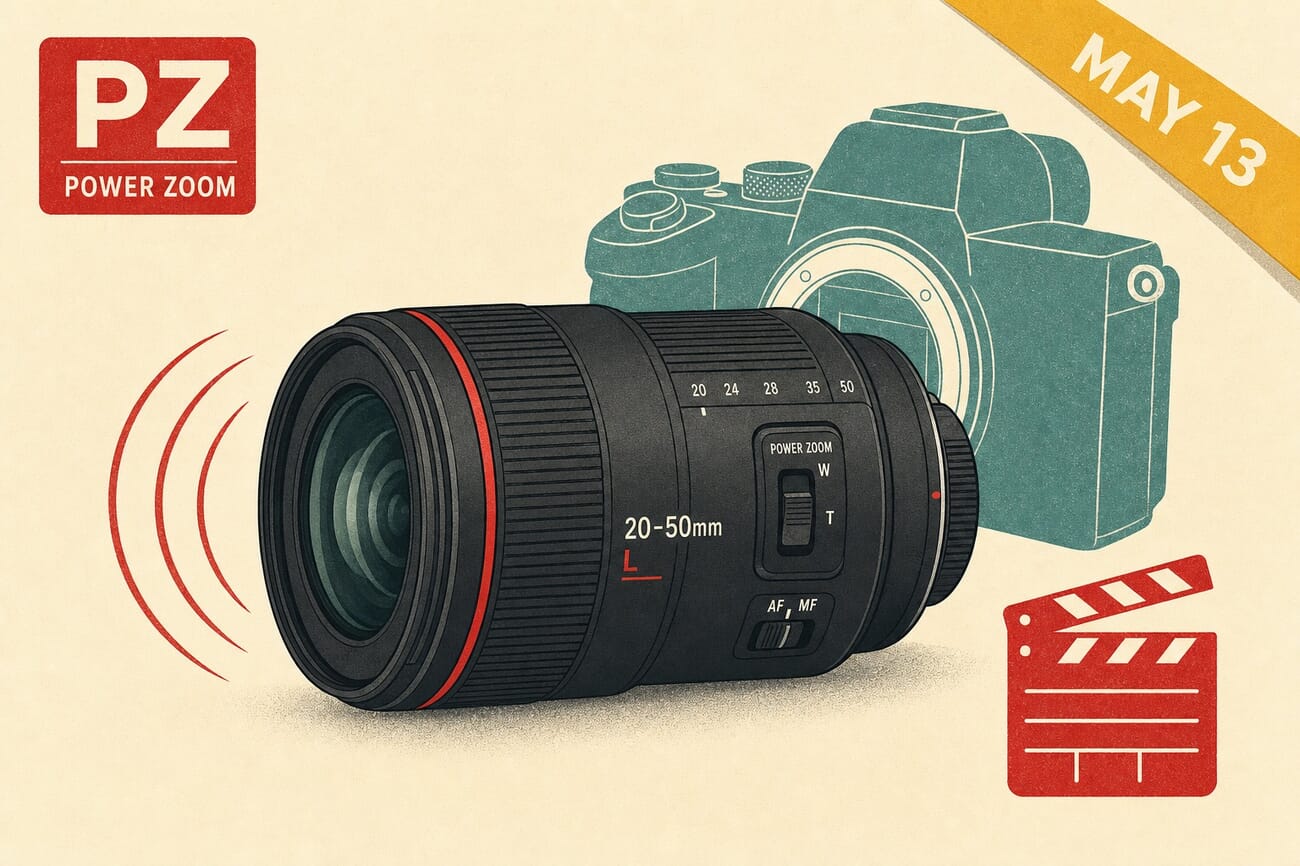
- Canon RF 20-50mm f/4L IS USM PZ — confirmed for May 13 launch alongside the EOS R6 V, with shipping in June 2026.
- First L-series power-zoom for the RF mount. Canon previously shipped a non-L PZ lens (the RF-S 14-30mm f/4-6.3 IS STM PZ); this is the pro-grade jump.
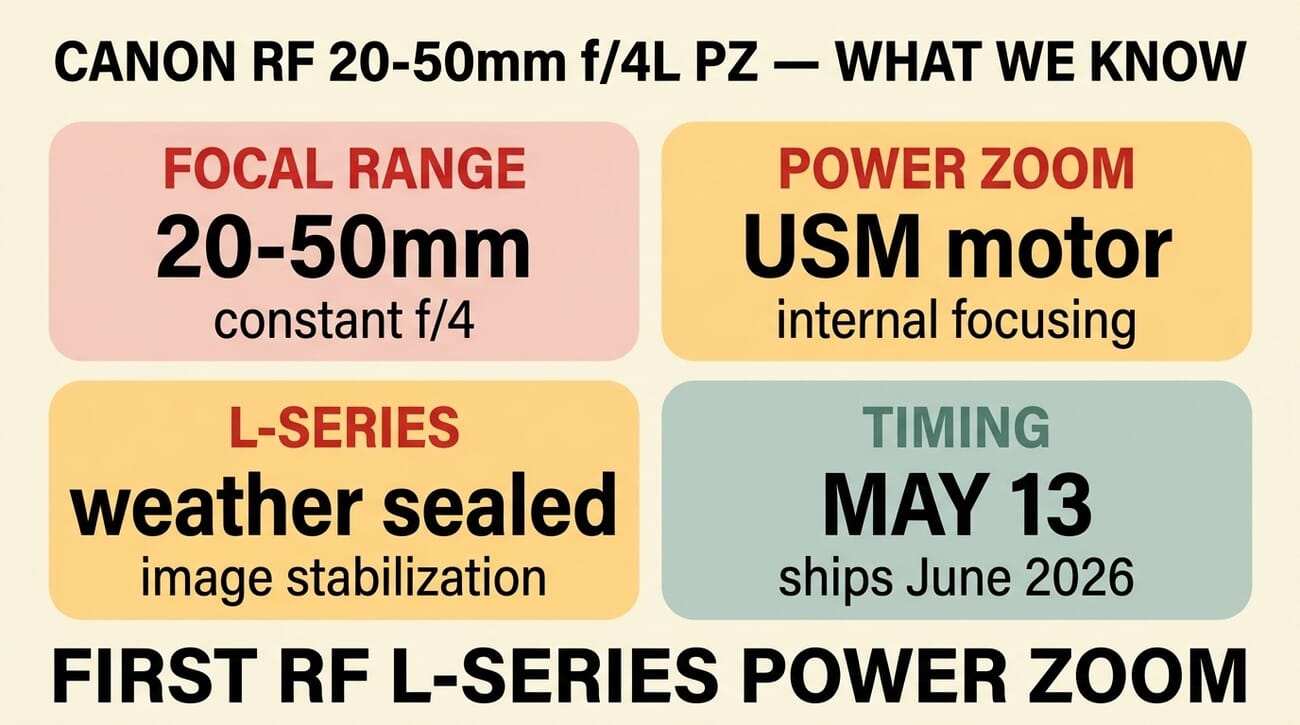
- Constant f/4 across 20-50mm, USM motor, in-lens IS, internal focusing, weather-sealed L-series body. Roughly the same physical size as the RF 24-105mm f/4L IS USM.
- Aimed at hybrid stills/video shooters. The 20-50mm range and motorized smooth zoom are the giveaway — this is closer to Sony’s FE PZ 16-35mm F4 G than to a stills-first travel zoom.
- Pricing not yet confirmed. The R6 V body lands at $2,499; expect the lens to follow Canon’s $1,200-1,500 L-zoom pricing band.
Canon Rumors confirmed on May 1 that the long-rumored Canon RF 20-50mm f/4L IS USM PZ is launching May 13, 2026, alongside the EOS R6 V. Shipping starts in June. The lens has been on Canon survey forms since late 2025 and seen on lens roadmaps for most of 2026, but May 13 is the first hard launch date — and the spec confirmation of “L-series power zoom” rather than a stills-first travel zoom changes who this lens is built for.
The headline detail: this is Canon’s first L-series power-zoom lens on the RF mount. Canon’s only prior PZ on RF was the consumer-grade RF-S 14-30mm f/4-6.3 IS STM PZ — variable aperture, plastic build, no weather sealing. The 20-50mm f/4L PZ flips every one of those spec choices: constant aperture, USM motor, weather-sealed L-series build, in-lens IS. That positioning is unambiguously aimed at hybrid stills/video shooters who need clean motorized zoom for video without losing optical quality for stills.
When you buy through links on our site, we may earn a commission at no cost to you. We evaluate products independently. Commissions do not affect our evaluations.
What Canon Has Effectively Confirmed
The lens still hasn’t been formally announced, but the May 13 launch date and the spec sheet are now well-sourced. From Canon Rumors’ confirmation and the May 13 launch coverage:
- Focal range: 20-50mm. Wider than the typical 24-70mm “standard” zoom, and short enough on the long end to keep the lens compact.
- Aperture: constant f/4 across the zoom range. Not f/2.8 — Canon clearly prioritised size and weight over a stop of light.
- Power zoom (PZ): motorised internal zoom mechanism. Smooth video-grade zoom transitions, no manual zoom-ring snap.
- Drive: USM (UltraSonic Motor) — same family as Canon’s pro stills primes, prioritised for accuracy and silent operation.
- Image stabilization: in-lens IS. Combines with the R6 V’s IBIS for hybrid system stabilisation in video.
- Focus: internal — front element doesn’t rotate or extend, same approach as the RF-S 14-30mm PZ predecessor.
- Build: weather-sealed L-series construction, red ring marking.
- Size: roughly the same physical envelope as the RF 24-105mm f/4L IS USM (105mm length, 700g class).
What’s not confirmed: exact weight, filter thread (almost certainly 77mm to match the rest of Canon’s f/4L lineup), aperture-blade count, IS stops rating, MFD, and crucially — pricing. Canon’s recent f/4L zooms have landed in the $1,099-1,499 USD range; expect this to slot near the top of that band given the PZ mechanism adds engineering cost.
What a Power Zoom Actually Does (and Why Canon Built One)
A “power zoom” replaces the manual zoom ring on a traditional lens with a motorised internal mechanism. A small rocker switch on the lens body (or a rotary controller, depending on the design) drives the zoom in or out at a programmable speed. The user sets the speed; the lens executes a smooth, continuous focal-length change.
For stills shooters, this is mostly a curiosity. You don’t need motorised zoom for stills — you just turn the ring. For video shooters, it’s the difference between a usable focal-length change mid-shot and an unusable one. Manual zoom rings always introduce micro-jitters from the operator’s hand; even small jitters look terrible at 4K and ruin a take. A power zoom on a smooth ramp produces cinema-grade pulls that don’t need cleanup in post.
The other reason: parfocal video framing. Most modern AF systems can hold focus through a manual zoom, but the framing change happens in your hand and stops mid-pull. A motorised zoom gives the AF system a predictable, smooth focal-length curve to track against, which means cleaner AF transitions during the zoom. For run-and-gun video — events, weddings, vlogs, doc work — that difference is meaningful.
Travel Lens or Video Tool? Both, Probably — But Mostly Video
On paper, the 20-50mm range looks like a travel zoom: wide enough for landscapes and interiors, long enough for environmental portraits. Compared to the workhorse RF 24-105mm f/4L IS USM, this lens trades the 50-105mm reach for 4mm of additional width on the short end (24mm → 20mm) and a power-zoom mechanism. For pure travel stills, that’s a downgrade — you lose the ability to compress distant subjects, you give up the 105mm portrait sweet spot, and you’re paying L-series money for a more limited range.
But for travel video — which is where most modern hybrid shooters actually need range — the calculus flips. 20mm is essential for handheld vlog framing (the equivalent on full-frame is roughly an iPhone’s ultra-wide). The 50mm long end is fine for talking-head shots. And the power zoom turns the lens into a single tool that handles establishing-wide → mid → tight-frame transitions in one continuous take, which is the workflow YouTube and TikTok creators have been wanting on RF mount since the system launched.
The honest read: this is a video lens that can shoot stills competently, not a stills lens with video bonus features. The 20-50mm range is too constrained for serious stills travel; the closest direct comparison in the Canon lineup is still the 24-105mm f/4L for that use case. But for the hybrid creator who shoots a 70/30 video/stills split — which describes most R6 V buyers — this lens is exactly the focal range that’s been missing.
How the 20-50mm PZ Compares
The closest comparison in the broader mirrorless market is Sony’s FE PZ 16-35mm F4 G — also a constant-f/4 power-zoom built for hybrid use. Sony’s lens goes wider (16mm vs 20mm), tops out shorter (35mm vs 50mm), and weighs about 350g. Canon’s wider zoom range (20-50 = 2.5x; Sony 16-35 = 2.2x) plus the L-series build will likely push it heavier and more expensive — Sony’s lens currently retails around $1,200.
Within Canon’s own lineup, the relevant comparisons are:
- RF 24-105mm f/4L IS USM ($1,099) — broader stills-first range, no power zoom. The default workhorse for R5/R6-series travel.
- RF 24-70mm f/2.8L IS USM ($2,399) — pro standard zoom, one stop faster. Different use case (event/portrait/wedding); not a hybrid video tool.
- RF-S 14-30mm f/4-6.3 IS STM PZ ($499, APS-C only) — the consumer PZ that proved the form factor works on RF. The 20-50mm L is the pro answer.
Should You Wait for May 13?
- Buying an R6 V for hybrid work → wait. The kit/bundle pricing on May 13 will likely include this lens at a meaningful discount vs separate purchase.
- Shooting mostly stills, need a versatile zoom → don’t wait. The 24-105mm f/4L is the right answer for stills-first work and isn’t going anywhere.
- Already have a 24-70 f/2.8 and want a video-specific second zoom → wait, this slots in cleanly as the dedicated video lens.
- Vlogger / hybrid creator on RF mount → this is the lens you’ve been waiting for. May 13 confirmation is two weeks away.

Frequently Asked Questions
When does the Canon RF 20-50mm f/4L PZ ship?
Canon will officially announce the lens on May 13, 2026 alongside the EOS R6 V. Shipping is expected to begin in June 2026.
How much will it cost?
Canon hasn’t set the price yet. Based on Canon’s recent f/4L zoom pricing ($1,099 for the 24-105 f/4L, $1,399 for the 14-35 f/4L), expect the 20-50mm f/4L PZ to land in the $1,200-1,500 USD range. The PZ mechanism adds engineering cost, so the upper end of that band is more likely.
Will it work on the R5, R6 Mark III, and other RF cameras?
Yes. RF mount lenses work on all RF-mount cameras, including R5, R5 Mark II, R5 Mark III, R6, R6 Mark II, R6 Mark III, R6 V, R3, R8, and R8 V. The power-zoom controls are activated via firmware on each body — older R5/R6 bodies should support PZ via firmware update, but check Canon’s compatibility list at launch.
Is the power-zoom controlled from the lens, the camera, or both?
Both, on Canon’s implementation. The lens has a physical zoom rocker for direct control, and the camera body can drive the zoom via menu controls or assignable buttons. The R6 V is expected to ship with PZ-specific assignable controls in firmware.
How does this compare to the RF 24-105mm f/4L IS USM for travel?
For stills-first travel, the RF 24-105 wins on range (105mm vs 50mm long end, more reach for environmental portraits and compression). For hybrid travel where video matters, the new 20-50 PZ wins on smoother zoom mechanics, wider 20mm framing for vlog use, and motorised zoom for clean video pulls. They’re different tools — own one if you shoot mostly stills, the other if you shoot mostly video.
Will the lens have OIS, IBIS, or both?
Both. The lens has its own optical IS, and the EOS R6 V has IBIS (in-body image stabilization). Canon’s coordinated IS firmware combines them when both are present, giving up to 8 stops of stabilization in good conditions.
Image credits: PhotoWorkout editorial illustrations. Canon has not yet released official press images of the RF 20-50mm f/4L IS USM PZ; the visualisations above are stylised editorial interpretations.
Affiliate disclosure: Product links above are Amazon affiliate links — PhotoWorkout earns a commission if you purchase through them at no extra cost. Editorial recommendations are independent.
Primary Coverage
- Canon Rumors — A Little Bit of Info on the Canon RF 20-50mm f/4L IS USM PZ – May 1 spec confirmation — first L-series PZ for RF, internal focusing, USM motor, similar size to RF 24-105 f/4L.
- Canon Rumors — EOS R6 V and RF 20-50mm f/4L IS USM PZ are coming May 13 – Original May 13 launch-date confirmation for both products.
- ShutterCount — Canon EOS R6 V & RF 20-50mm F4L IS USM PZ Rumor – Independent rumor consolidation with shipping timeline (June 2026).
Comparison References
- Canon — RF 24-105mm f/4L IS USM Specifications – Manufacturer page for the closest stills-first comparison lens.
- Sony — FE PZ 16-35mm F4 G – The closest competitor — Sony's hybrid-aimed L-class power zoom.
Some product links are Amazon affiliate links: PhotoWorkout earns a commission if you purchase through them at no extra cost. Recommendations are independent.