

- NASA’s Artemis II crew has sent back the first photos of Earth from deep space in over 50 years, captured on Nikon D5 DSLRs.
- The Orion spacecraft carries 28+ cameras including two Nikon D5s, a last-minute Nikon Z9, four exterior GoPros, smartphones, and fixed monitoring cameras.
- Commander Reid Wiseman fought to add the Nikon Z9 — a test run for NASA’s future Handheld Universal Lunar Camera (HULC) planned for the Artemis III Moon landing.
- The crew’s lunar flyby on April 6 could recreate the iconic 1968 “Earthrise” photograph — with far better camera technology.
For the first time since Apollo 17 in 1972, humans are photographing Earth from beyond low orbit — and the results are breathtaking. The Artemis II crew, now more than halfway to the Moon aboard NASA’s Orion spacecraft, has downlinked the first images from the mission. They show our planet as a luminous blue marble suspended in the void, complete with visible auroras and the familiar outlines of continents.
But what makes this mission uniquely interesting for photographers isn’t just the images themselves — it’s the unprecedented arsenal of cameras aboard. With 28+ imaging devices ranging from decade-old Nikon DSLRs to GoPros strapped to solar panels, Artemis II may become the most comprehensively photographed space flight in history.
The First Photos: Earth Like You’ve Never Seen It
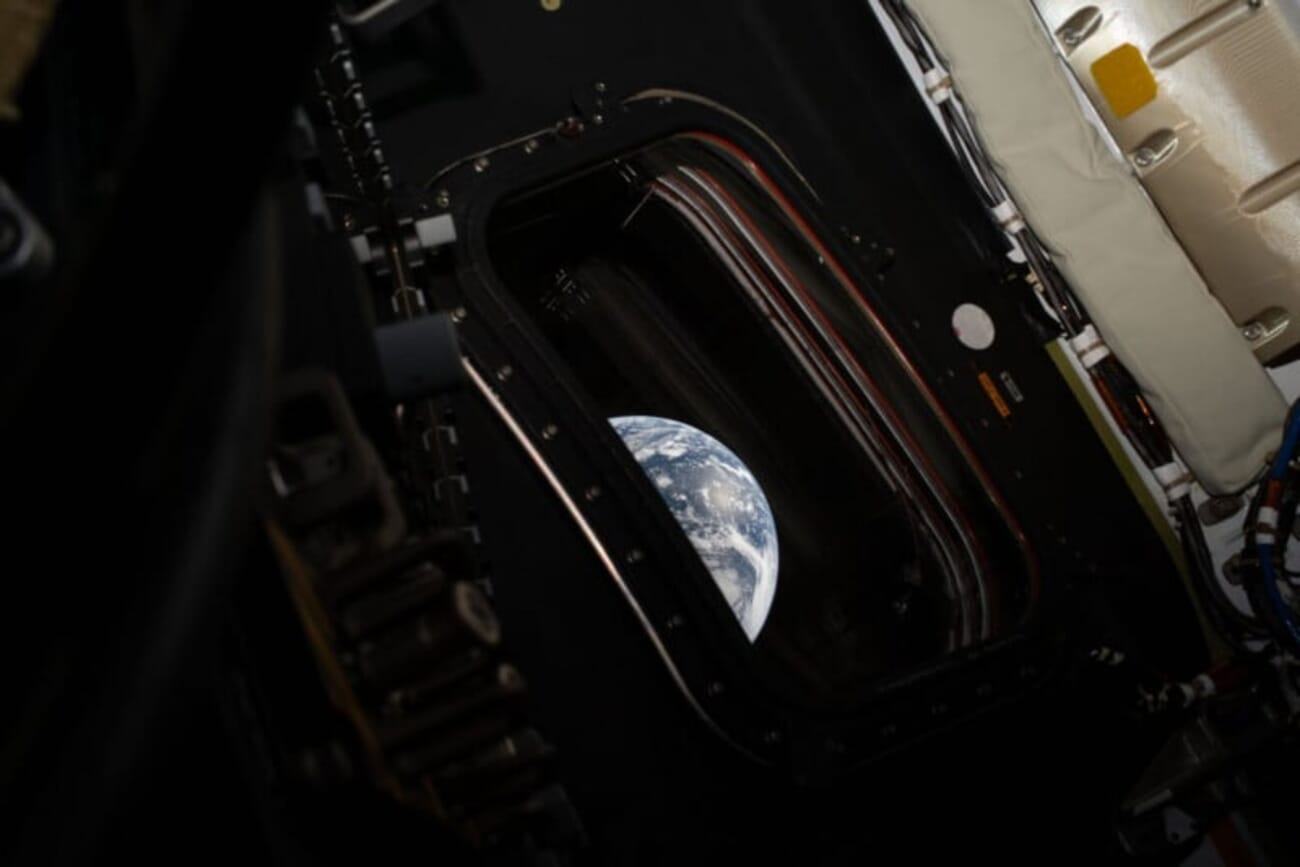
On April 3, NASA released two images captured by Mission Commander Reid Wiseman using one of the onboard Nikon D5 DSLRs. The first shows Earth peeking through the Orion capsule window — a reminder of how small our world looks from tens of thousands of miles away.
The second image is even more striking: a full-disk portrait of Earth showing Africa and the Iberian Peninsula, with a green aurora glowing near the top of the frame. Zodiacal light — sunlight reflected off interplanetary dust — creates a soft band at the edge of the image.
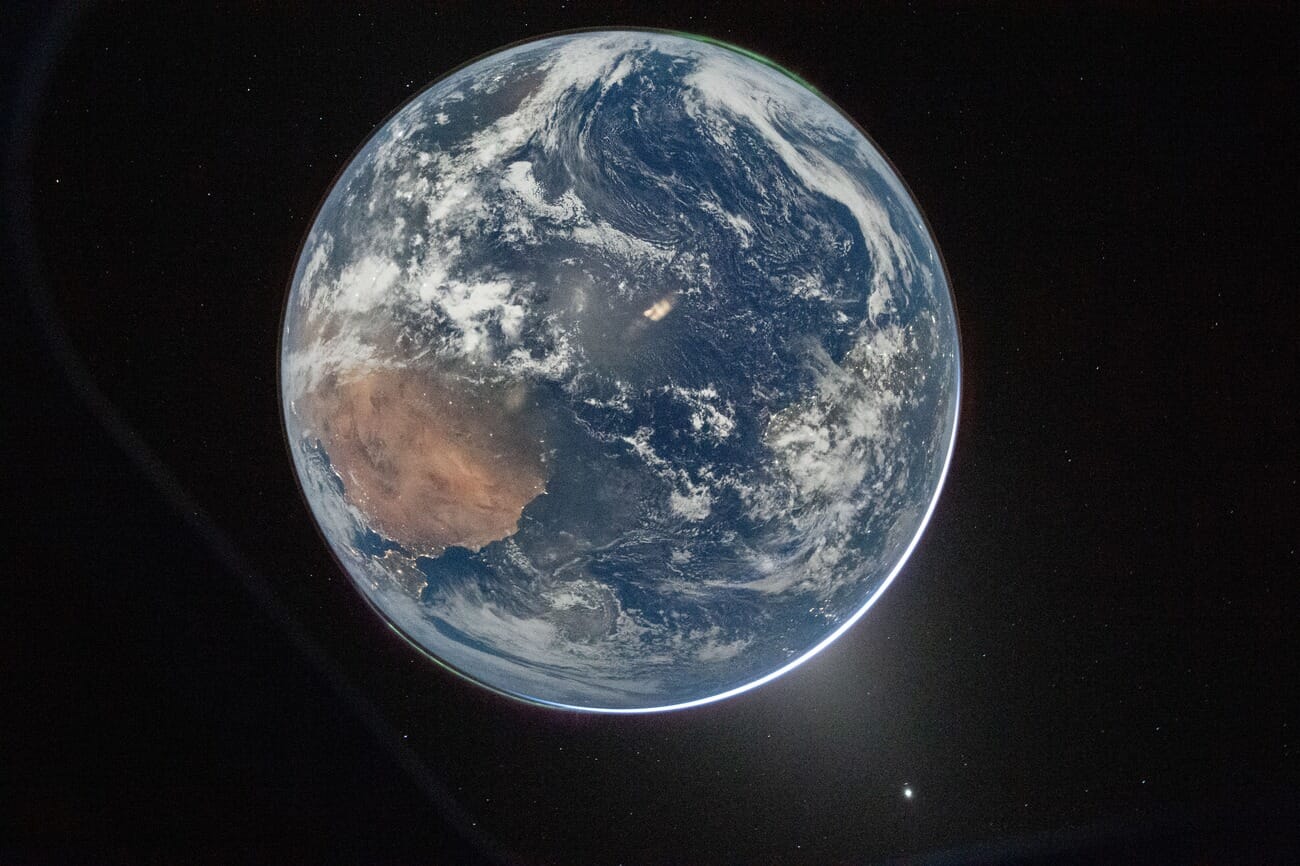
NASA described the moment: “We see our home planet as a whole, lit up in spectacular blues and browns. A green aurora even lights up the atmosphere… That’s us, together, watching as our astronauts make their journey to the Moon.”
Every Camera Aboard Artemis II
The Orion spacecraft is carrying more imaging hardware than any crewed deep-space vehicle in history. Here’s the complete breakdown of 28+ cameras aboard.
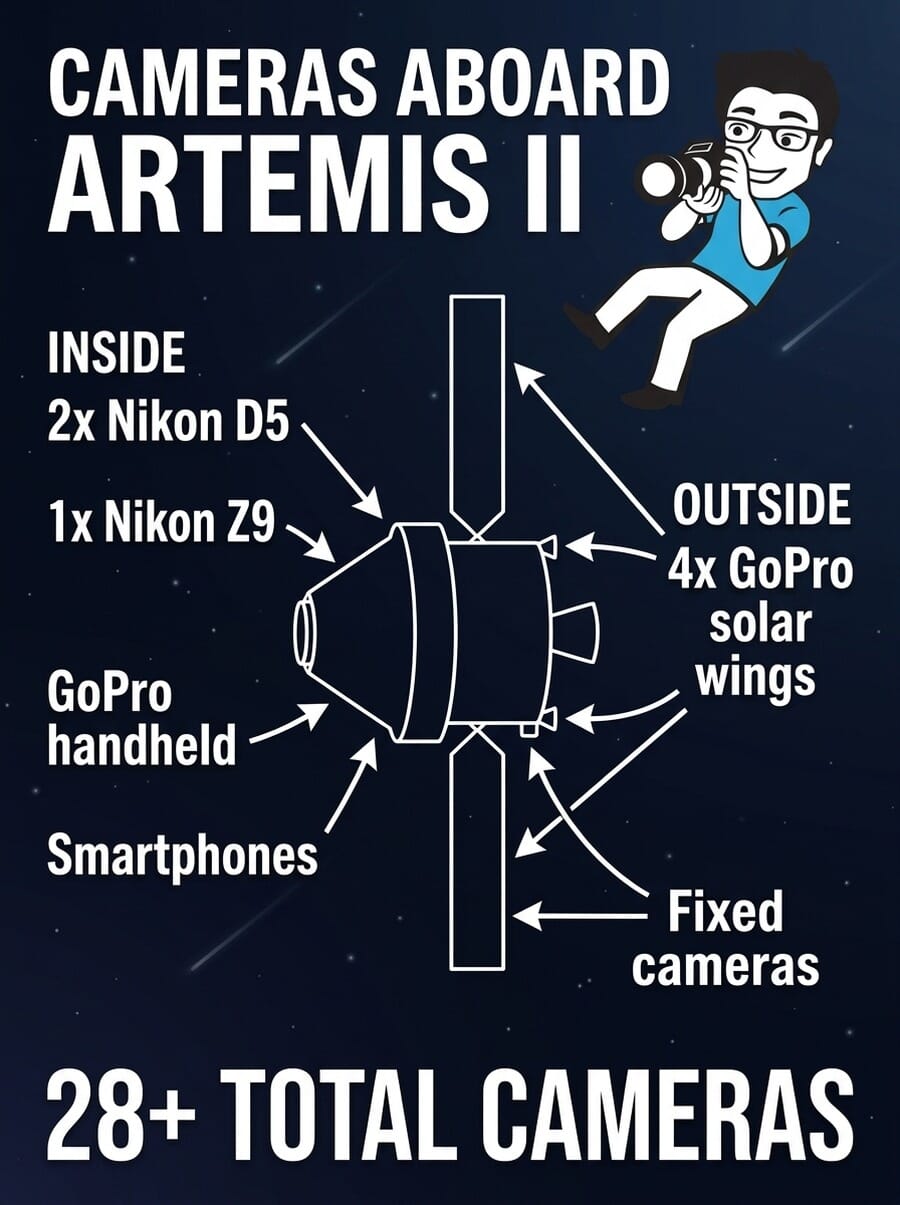
Nikon D5 DSLRs (x2) — The Workhorse
The primary photographic tools are a pair of Nikon D5 DSLRs — cameras first released in 2016. That might seem odd for a flagship space mission, but there’s a reason NASA chose decade-old technology: the D5 has been extensively flight-qualified for deep-space radiation, vibration, and extreme temperatures.
Key advantages for space photography:
- ISO range up to 3,280,000 — critical for capturing everything from harsh sunlight to the dark side of the Moon
- Proven radiation resistance — tested beyond low Earth orbit environments
- Optical viewfinder — no electronic viewfinder to malfunction from cosmic ray hits
- Paired with wide-angle and telephoto lenses for versatile coverage
Nikon Z9 (x1) — The Last-Minute Addition
The most interesting camera story from Artemis II is the Nikon Z9 mirrorless camera that was added to the manifest at the last minute. Commander Wiseman personally fought to include it.
“That’s the camera that they’ll be using, the crew will be using on Artemis III plus, so we were fighting really hard to get that on the vehicle to test out in a high-radiation environment in deep space,” Wiseman explained.
The Z9 is a test platform for NASA’s Handheld Universal Lunar Camera (HULC) — a modified Z9 with custom thermal protection designed for astronauts to use on the lunar surface during Artemis III. Testing it in the high-radiation environment beyond Earth’s magnetosphere is critical before trusting it for a Moon landing.
Wiseman called the Z9 a “great piece of gear” for the future of Artemis photography.
GoPro Cameras — Inside and Out
Four modified GoPro cameras are mounted on Orion’s solar array wings, facing outward to capture high-resolution views of the spacecraft, Earth, and the Moon. These also serve as visual inspection tools during critical mission phases.
Inside the capsule, astronauts carry additional handheld GoPros to record daily life aboard the mission. This footage is being captured for a National Geographic documentary project called Return to the Moon — making this mission both a scientific achievement and a media production.
Smartphones, Fixed Cameras, and More
Rounding out the camera inventory:
- Crew smartphones — starting with ISS Crew-12 and now Artemis II, NASA allows astronauts to bring personal phones with cameras into space
- Wireless cabin cameras — monitoring crew activity and vehicle performance, especially during launch, ascent, entry, and landing
- Human health monitoring cameras — tracking crew wellbeing throughout the mission
- External fixed cameras — mounted at various positions on the spacecraft hull
The Big Moment: Lunar Flyby Photography
The most anticipated photographic opportunity is still ahead. On April 6, the Orion spacecraft will pass approximately 4,300 miles above the lunar surface — giving the crew a chance to recreate the iconic “Earthrise” photograph first captured by Apollo 8 astronauts in 1968.
According to David Melendrez, NASA’s lead for Orion capsule imagery integration, there will be two brief opportunities to capture both Earth and the Moon in the same frame, with approximately 45 minutes between an Earthset and Earthrise view.
The challenge: these moments occur while the capsule is on the far side of the Moon, out of communication range with Houston. The crew will have roughly three hours of dedicated photography time to photograph the lunar surface, capture Earthrise, and make verbal observations.
One difference from Apollo: Artemis II will be much farther from the Moon (4,300 miles vs. Apollo 8’s roughly 69 miles), meaning Earth will appear smaller in frame — but with the Nikon D5’s telephoto lenses and the Z9’s 45.7-megapixel sensor, resolution shouldn’t be a problem.
Meet the Crew Behind the Cameras
Four astronauts are making history on this 10-day mission that launched April 1 from Kennedy Space Center:
- Reid Wiseman (Commander, NASA) — Navy test pilot and photographer behind the first downlinked images
- Victor Glover (Pilot, NASA) — Navy aviator and ISS veteran
- Christina Koch (Mission Specialist, NASA) — holds the record for longest single spaceflight by a woman
- Jeremy Hansen (Mission Specialist, CSA) — Canadian astronaut making his first spaceflight
Splashdown is expected in the Pacific Ocean off San Diego on April 10. Until then, expect a steady stream of increasingly dramatic photographs as the crew approaches and loops around the Moon.
Why NASA Chose a 10-Year-Old DSLR Over Modern Mirrorless
Photographers often ask why NASA would send a 2016 camera to the Moon when newer options exist. The answer comes down to flight qualification — a rigorous process that costs millions and takes years.
Every camera aboard a deep-space mission must survive:
- Cosmic radiation — beyond Earth’s magnetosphere, radiation can corrupt sensor data and damage electronics
- Extreme vibration — launch forces that would destroy consumer electronics
- Temperature swings — from direct sunlight to deep shadow in seconds
- Vacuum exposure — outgassing can fog optics and short circuits
The Nikon D5 has passed all of these tests. The Z9’s inclusion on Artemis II is specifically to begin that same qualification process for next-generation missions. If it performs well in deep space, expect the Z9 (or a modified version) to become NASA’s primary camera for future Artemis missions including the Moon landing.
What to Expect Next
As the mission progresses, keep an eye out for:
- Earthrise photos during the April 6 lunar flyby — potentially the most historic images
- Lunar surface photography during three hours of dedicated observation time
- Crew portraits with Earth and Moon visible through the windows
- GoPro footage from the exterior cameras showing the spacecraft against the lunar backdrop
- National Geographic documentary footage from the onboard handheld GoPros
NASA is sharing photos and video through its Artemis II Multimedia page and live mission broadcast. For photographers, this mission is a masterclass in how professional imaging gear performs at the extreme frontier — and a preview of how the cameras we use on Earth today are evolving for entirely new environments.
Frequently Asked Questions
What cameras are the Artemis II astronauts using?
The crew has two Nikon D5 DSLRs as primary cameras, one Nikon Z9 mirrorless camera added at the last minute, multiple GoPro cameras (four mounted externally, plus handheld units), personal smartphones, and various fixed monitoring cameras — totaling 28+ imaging devices aboard the Orion spacecraft.
Why is NASA using a Nikon D5 from 2016 instead of a newer camera?
Deep-space cameras require extensive flight qualification — testing for radiation resistance, extreme vibration, temperature swings, and vacuum exposure. This process takes years and costs millions. The Nikon D5 has completed this qualification, while the Z9 is aboard Artemis II specifically to begin testing for future missions.
When will the Earthrise photos from Artemis II be released?
The lunar flyby is scheduled for April 7, 2026. However, the Earthrise photo opportunities occur while the spacecraft is behind the Moon and out of communication with Earth, so images may take hours to downlink after the flyby. NASA is releasing photos through its official Artemis II Multimedia page.
What is NASA’s HULC camera?
The Handheld Universal Lunar Camera (HULC) is a modified Nikon Z9 with custom thermal protection, designed for astronauts to use on the Moon’s surface during Artemis III. The Z9 aboard Artemis II is a test run to evaluate how the camera body performs in the high-radiation environment beyond Earth’s magnetosphere.
Sources used for this article:
Featured image: NASA/Artemis II (public domain).


Get the Weekly Photography News Digest
Join photographers who get our top stories delivered every Monday morning. No spam, unsubscribe anytime.