

- Canon is reportedly developing an RF 300-600mm F5.6L IS VCM super-telephoto zoom — a constant-aperture lens with VCM autofocus and possible DO (diffractive optics) elements for reduced weight.
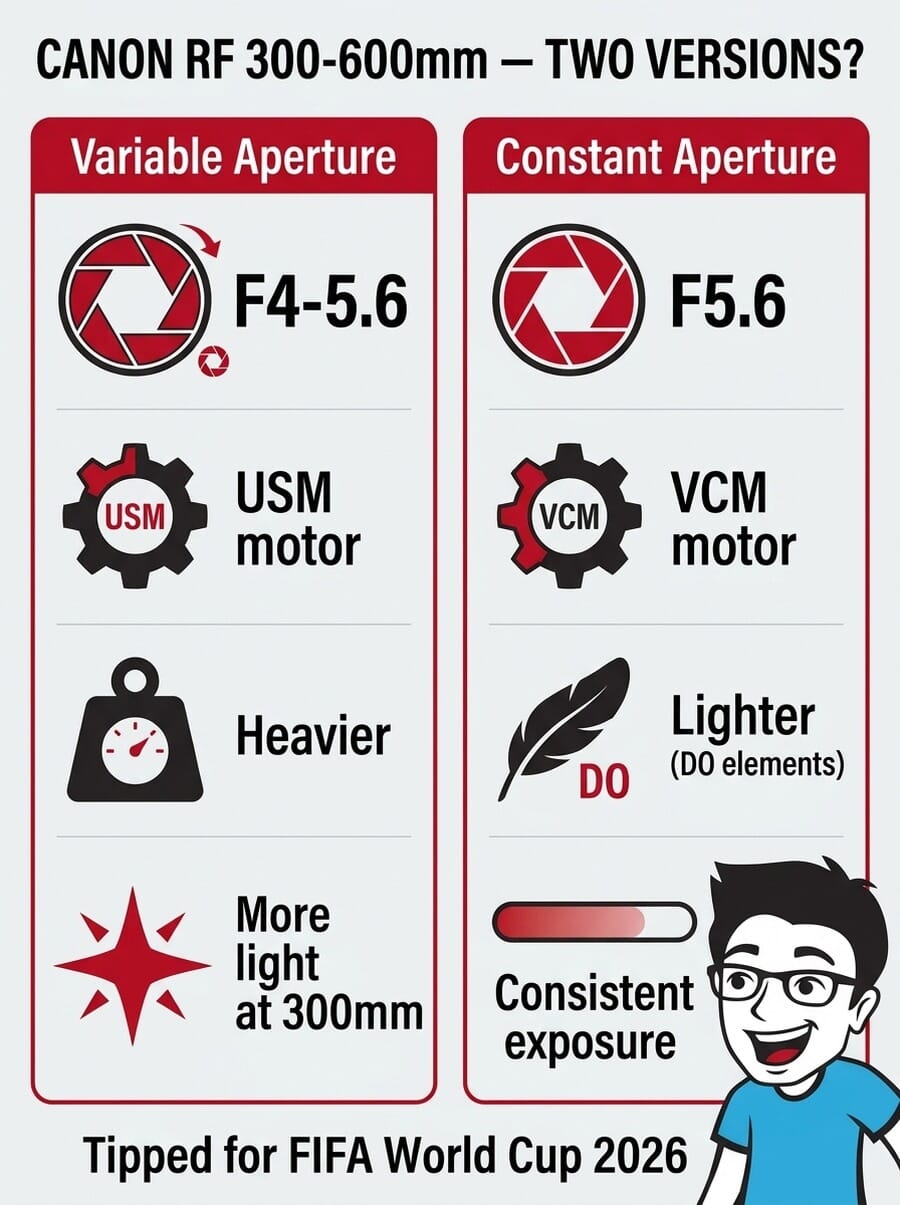
- Two versions have been discussed: a variable-aperture F4-5.6 USM and a constant-aperture F5.6 VCM. Industry sources consider the constant-aperture VCM version more likely.
- The FIFA World Cup 2026 (June, USA/Canada/Mexico) is the suspected launch window — Canon historically times flagship gear releases to major sporting events.
- If confirmed, this lens would fill a critical gap in Canon’s RF lineup between the RF 100-500mm and the big-white primes, giving sports and wildlife shooters a lighter, more versatile option.
Canon’s most-discussed phantom lens may finally be materializing. Multiple sources now point to the Canon RF 300-600mm F5.6L IS VCM arriving before the FIFA World Cup kicks off in June — and this time, the chatter carries more weight than the usual rumor-mill recycling.
K&F Concept published a detailed breakdown on March 26 describing two possible versions of the lens, while Canon Rumors reports that a recent retailer meeting once again featured the 300-600mm in a product roadmap presentation. The convergence of independent sources — plus a massive sporting event on the horizon — suggests Canon is finally ready to ship its super-telephoto “unicorn.”
Two Versions on the Table
The rumor landscape has coalesced around two distinct lens designs:
- Canon RF 300-600mm F4-5.6L IS USM — A variable-aperture design using Canon’s proven Nano USM motor. This would offer a brighter f/4 aperture at 300mm, but would be heavier and larger.
- Canon RF 300-600mm F5.6L IS VCM — A constant-aperture design with Voice Coil Motor (VCM) autofocus. Sources consider this the frontrunner, likely incorporating DO elements to keep weight manageable.
According to K&F Concept’s analysis — which references Canon Rumors reporting — the constant-aperture F5.6 VCM version has the higher probability of release. The reasoning is straightforward: a constant aperture simplifies exposure management during fast action, and VCM autofocus is the direction Canon has been moving with its latest L-series glass.
Why DO Elements Matter
Diffractive optics (DO) technology uses thin diffractive optical elements instead of traditional glass to correct chromatic aberration. The practical result: lenses can be significantly shorter and lighter than conventional designs of the same focal length and aperture.
Canon has a proven track record with DO. The EF 400mm f/4 DO IS II USM — launched in 2014 — was widely praised by sports photographers for delivering sharp, fast performance in a body considerably smaller than its f/2.8 sibling. Two current RF lenses already use diffractive optics: the budget-friendly RF 600mm F11 IS STM and RF 800mm F11 IS STM.
For a 300-600mm zoom, DO technology could be the differentiator that makes the lens genuinely handholdable. Canon Rumors noted that sources describe the 300-600mm as “lighter than most people would expect” — a strong hint at DO construction combined with Canon’s ongoing weight-reduction engineering.
VCM Autofocus: Canon’s New Standard
Voice Coil Motor (VCM) autofocus represents Canon’s latest focusing technology for high-performance lenses. Unlike ring-type USM motors, VCM drives use electromagnetic force to move focusing elements directly — resulting in faster, quieter, and more precise focus acquisition.
Canon has been rolling VCM into its newest L-series lenses, including the RF 35mm f/1.4L VCM and RF 24-105mm f/2.8L IS USM Z. For a super-telephoto zoom designed to track fast-moving athletes on a pitch, VCM would provide a meaningful edge in continuous autofocus performance — especially when paired with Canon’s latest R-series bodies and their deep-learning subject detection.
World Cup Timing: Canon’s Playbook
The 2026 FIFA World Cup — hosted across the United States, Canada, and Mexico from June 11 to July 19 — presents the biggest stage in global sports. Canon has historically used major sporting events as launch platforms for flagship gear. The company deployed thousands of cameras, lenses, and accessories across four service locations at the recent Winter Olympics in Milan-Cortina, and the World Cup would be an even larger showcase.
A 300-600mm f/5.6 lens would be perfectly positioned for football (soccer) photography. Most stadium sideline positions require focal lengths between 300mm and 600mm, and a constant f/5.6 aperture would maintain consistent shutter speeds under mixed stadium lighting — whether shooting in blazing afternoon sun in Dallas or under floodlights in Toronto.
Canon’s press infrastructure at major events — with on-site loan programs, cleaning stations, and repair services — means professional photographers would get hands-on access immediately. It’s the kind of real-world endorsement that no marketing campaign can replicate.
Where It Fits in Canon’s RF Lineup
Currently, Canon RF shooters face a gap in their telephoto options:
- RF 100-500mm f/4.5-7.1L IS USM — Versatile but relatively slow at the long end (f/7.1 at 500mm)
- RF 200-800mm f/6.3-9 IS USM — Massive reach but very slow aperture, limiting low-light use
- RF 600mm f/4L IS USM / RF 800mm f/5.6L IS USM — Exceptional quality, but priced around $13,000 and offering fixed focal lengths
The RF 300-600mm f/5.6L would slot neatly between these tiers — offering professional-grade reach with a constant aperture at a (presumably) more accessible price point than the big-white primes. For sports photographers who need flexibility without carrying multiple prime lenses, it could become the go-to sideline zoom.
The Competition Is Already There
Canon isn’t entering this space unopposed. Nikon already offers the Z 400mm f/4.5 VR S and the Z 600mm f/6.3 VR S — both lightweight, modern super-telephoto primes that have been well-received by sports and wildlife shooters. Sony’s FE 200-600mm f/5.6-6.3 G OSS remains a popular choice for its balance of reach, speed, and value.
More recently, Sigma launched the 300-600mm f/4 DG OS Sports — a constant f/4 beast that’s heavier but faster. The RF 300-600mm f/5.6L with VCM and DO would offer a different proposition: lighter weight and native RF mount integration at the cost of one stop of aperture.
For Canon shooters who’ve been eyeing competitors’ glass with envy, this lens could remove the last major reason to consider switching systems for sports and action work.
What to Expect on Price and Availability
No official pricing has leaked, but context clues help bracket expectations. Canon’s RF 100-300mm f/2.8L IS USM launched at $9,499, and it shares a similar entrance pupil diameter. Accounting for the longer zoom range but slower maximum aperture, industry watchers estimate the 300-600mm f/5.6L could land between $7,000 and $10,000.
As for timing: Canon has a pattern of announcing lenses 2-4 weeks before a major event, then making them available through on-site loan programs at the event itself. A May announcement with immediate availability would align perfectly with World Cup preparation.
That said, this lens has been “coming soon” since late 2024. Canon Rumors has dubbed it “the unicorn” for good reason — it’s the most talked-about, most anticipated, and most delayed lens in the RF roadmap. But with retailer meetings, K&F Concept publishing detailed analysis, and a World Cup deadline looming, the stars may finally be aligning.
Frequently Asked Questions
When will the Canon RF 300-600mm be announced?
No confirmed date exists, but multiple sources point to a pre-World Cup announcement — likely May or early June. Canon has confirmed in retailer meetings that the lens is “coming in 2026.”
Will it have a constant or variable aperture?
Two versions have been discussed. The constant f/5.6 VCM version is currently favored by industry sources over the variable f/4-5.6 USM design.
What are DO (diffractive optics) elements?
DO elements use thin diffractive coatings to correct chromatic aberration, replacing multiple heavy glass elements. This allows Canon to build shorter, lighter telephoto lenses without sacrificing optical quality.
How much will the Canon RF 300-600mm cost?
No price has been leaked. Based on comparable lenses like the RF 100-300mm f/2.8L ($9,499) and the competitive landscape, estimates range from $7,000 to $10,000.
Will it work with Canon teleconverters?
If it follows the L-series design pattern, it should be compatible with Canon’s RF 1.4x and 2x teleconverters — potentially extending reach to 840mm or 1200mm, though at reduced aperture and autofocus performance.
Sources used for this article:
Featured image: Photo by Alex George on Unsplash.


Get the Weekly Photography News Digest
Join photographers who get our top stories delivered every Monday morning. No spam, unsubscribe anytime.