

- Fujifilm’s Yuji Igarashi confirmed at CP+ 2026 that autofocus improvements are coming to existing 5th-gen cameras via firmware updates.
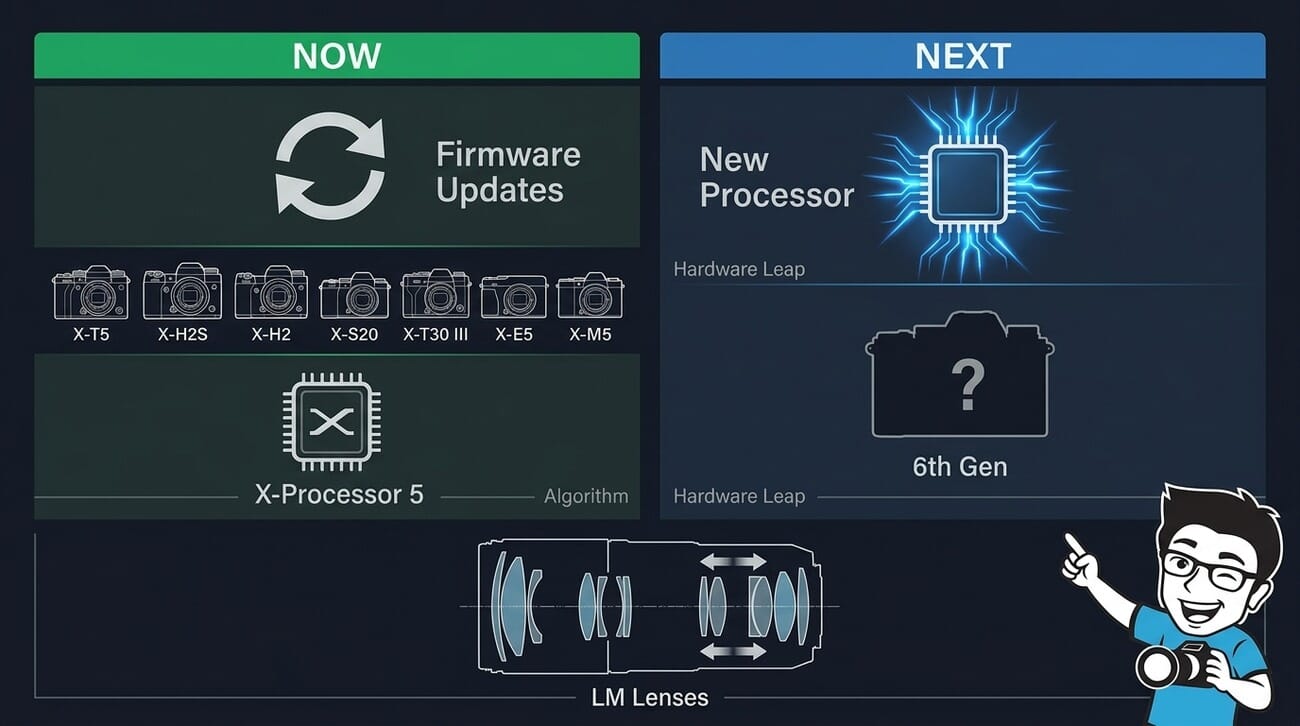
- The company is pursuing a dual approach: algorithm upgrades for current models plus a new, faster processor for future cameras.
- Video AF wobble remains the biggest complaint — and Fujifilm says it’s actively working on fixes that don’t require new hardware.
- Lens autofocus motors also play a role — newer Fujinon lenses with linear motors (LM) deliver smoother, quieter AF performance.
Fujifilm has finally addressed the elephant in the room. At CP+ 2026 in Yokohama, Yuji Igarashi — General Manager of Fujifilm’s Professional Imaging Group — sat down with PetaPixel and laid out exactly how the company plans to fix its autofocus shortcomings, particularly for video.
The short version: help is coming for current camera owners, and the next generation will take things even further.
Algorithm Upgrades for Current Cameras
Igarashi made it clear that Fujifilm’s 5th-generation cameras — which include popular models like the X-T5, X-H2S, X-H2, and X-S20 — can still be improved through firmware updates. The key lever is algorithm optimization.
“There are two improvements we can make, one based on the algorithm and then one based on the device itself,” Igarashi explained. “So we have the fifth-generation device now, and to make an improvement here, we just need to improve the algorithm. That’s the maximum we can do.”
This is significant for anyone who already owns a Fujifilm X-series camera. Rather than requiring a hardware upgrade, Fujifilm is committing to squeezing more AF performance out of existing processors through smarter software. The company’s recent releases — the Fujifilm X-E5 and Fujifilm X-T30 III — already ship with Fujifilm’s latest autofocus algorithms and show noticeable improvements over older firmware.
The Video Autofocus Problem
Let’s be direct about what’s driving this conversation: Fujifilm’s video autofocus has been a weak point compared to Sony and Canon. Focus wobble during video recording — where the camera hunts or briefly loses lock on a subject — has frustrated creators who otherwise love Fujifilm’s color science and film simulations.
“We’re trying,” Igarashi told PetaPixel. “We still believe it’s necessary to just continue to improve by algorithm improvement. And it’s not that we’re not doing it. We are continuing to work on it.”
For stills, PetaPixel noted that their experience with Fujifilm’s latest cameras has been “universally positive.” It’s specifically the continuous video AF where the gap remains most visible.
New Processor for Future Models
Beyond firmware fixes, Igarashi confirmed that Fujifilm’s next-generation processor will bring a significant leap in AF capability. Higher processing speeds will enable more sophisticated tracking and prediction — things that current hardware simply can’t keep up with.
“In theory, future devices will be much more advanced, with the consideration of higher processing speed,” Igarashi said. “That would help us as well, but that wouldn’t help existing users, so we’re trying to do both — algorithm improvement plus device improvement.”
A separate interview at CP+ 2026 with Fujifilm’s Jun Watanabe (reported by Phototrend) confirmed the same priorities for the 6th-generation sensor/processor platform: improved image quality, faster autofocus response, and better video performance.
Lenses Matter Too
One factor that often gets overlooked: the lens autofocus motor plays a critical role. Older Fujinon lenses with slower AF motors can’t be fixed with firmware or processor upgrades. Newer lenses with linear motor (LM) actuators deliver smoother, quieter, and more precise focus — which is especially important for video.
Fujifilm has been actively expanding its lineup of modern AF-optimized lenses. The company recently ran its 2026 Lens Vote survey, letting users pick which future lenses should be prioritized — and confirmed that Mark II updates to older lenses focus specifically on shrinking size while improving autofocus performance.
What This Means for Fujifilm Owners
If you own a 5th-generation Fujifilm camera, the takeaway is straightforward: keep your firmware updated. Fujifilm is actively working on AF algorithm improvements, and future firmware releases should deliver measurable gains — especially for video.
For those considering a Fujifilm purchase, the 6th-generation platform (expected in future X-H and X-T series bodies) should close the gap with Sony and Canon’s class-leading AF systems significantly. Fujifilm is clearly treating autofocus as a top priority going forward.
The dual approach — fixing what they can now, while building something fundamentally better for tomorrow — is exactly what Fujifilm users have been asking for. Whether the firmware improvements arrive fast enough to satisfy impatient creators remains to be seen.
Frequently Asked Questions
Which Fujifilm cameras will get autofocus improvements?
All 5th-generation X-series cameras — including the X-T5, X-H2S, X-H2, X-S20, X-T30 III, X-E5, and X-M5 — can receive AF improvements via firmware updates. Older 4th-gen models are unlikely to benefit.
Is Fujifilm’s autofocus good enough for stills?
For still photography, Fujifilm’s latest cameras perform very well. PetaPixel described their experience as “universally positive.” The main complaints center around continuous autofocus during video recording.
When will Fujifilm’s 6th-generation processor arrive?
Fujifilm hasn’t announced a specific timeline. The 6th-gen platform will likely debut in a flagship body (such as an X-H3 or X-T6), but no release date has been confirmed.
Sources used for this article:
Featured image: Photo by Portuguese Gravity on Unsplash.
Related Posts
Get the Weekly Photography News Digest
Join photographers who get our top stories delivered every Monday morning. No spam, unsubscribe anytime.