


- TTartisan launched a new sub-line called Neo, starting with full-frame AF primes that have no focus ring and no aperture ring — every adjustment runs through the camera body.
- The first member, the Neo AF 50mm f/1.8, weighs 157 g, takes 52 mm filters, focuses to 0.48 m, ships in Sony E and Nikon Z (L-mount later) — and lists for around $90.
- An 85mm f/1.8 companion has been announced with the same minimalist DNA but no detailed specs or final price yet — release follows the 50mm.
- At $90, the Neo 50mm undercuts every name-brand full-frame AF 50mm by 60–80%. The bigger question is whether stripping out the rings is a clever cost-cut or a usability compromise too far for portrait shooters.
TTartisan, the Shenzhen-based optics maker best known for ultra-cheap manual lenses, just announced something more interesting than another spec bump. The brand is launching a new sub-line called Neo, and the design philosophy is simple: take everything off the lens that costs money to put on, hand the controls to the camera body, and pass the savings on. The first lens in the line, the Neo AF 50mm f/1.8, lists at around $90 for full-frame Sony E and Nikon Z mounts.
An 85mm f/1.8 companion was announced alongside it, with the same minimalist DNA — but specs and pricing for the longer focal length haven’t been finalized yet. L-mount versions of both are scheduled to follow.
What makes this notable is not just the price (TTartisan has been pushing budget AF for over a year now, with the $168 AF 40mm f/2 already on shelves), but the design choice underneath it. The Neo lenses ship without a focus ring and without an aperture ring. There is nothing to grip on the barrel. Every adjustment — focus, aperture, manual override — runs through camera-body controls. That is unusual enough on a manual lens. On a portrait prime, it is genuinely new territory.
What ‘Neo’ Actually Means
TTartisan already sells autofocus lenses. The AF 75mm f/2 arrived in 2024, the AF 40mm f/2 followed in August 2025, and the AF 56mm f/1.8 and AF 27mm f/2.8 rounded out the range. Those lenses have conventional barrels: a focus ring, an aperture ring, weather-sealed mounts, USB-C firmware ports.
The Neo line is positioned below all of that. The pitch from TTartisan: clean, minimalistic, and stripped of every control surface that a modern mirrorless body can already handle. There is no focus ring, no aperture ring, no clicked stops, no tactile feedback. The lens body becomes a smooth tube with the mount on one end and the front element on the other. Aperture lives in the camera menu. Focus is autofocus or rear-control manual override.
TTartisan also says the Neo lenses support DIY custom armor — replaceable outer skins so users can swap colours or finishes. That sells less to working photographers and more to creator-economy buyers who want a lens that matches their body. It also helps explain why the barrel is featureless — the design is intentionally a blank canvas.
The 50mm at $90: What’s Confirmed
The Neo AF 50mm f/1.8 is the first lens to ship under the new label. Confirmed specs from TTartisan’s announcement:
- Focal length: 50mm
- Maximum aperture: f/1.8
- Coverage: Full-frame
- Weight: 157 g
- Filter thread: 52 mm
- Minimum focus distance: 0.48 m
- AF motor: STM stepping motor
- Mounts: Sony E, Nikon Z (L-mount coming later)
- Price: approximately $90
- Customization: DIY swappable armor
At 157 grams, this is one of the lightest full-frame autofocus 50mm primes on the market — lighter than Sony’s FE 50mm f/1.8 (186 g, $250) and Nikon’s Z 50mm f/1.8 S (415 g, $600). The smaller filter size (52 mm versus the more common 55 mm or 67 mm) suggests a fairly modest front element — fitting for the price.
The 85mm: Announced, Specs Pending
The Neo AF 85mm f/1.8 was announced at the same time as the 50mm but is not yet shipping. TTartisan has confirmed the focal length, the f/1.8 aperture, autofocus, full-frame coverage, and availability for Sony E, Nikon Z, and L-mount. Beyond that, the optical formula, weight, filter thread, MFD, aperture blade count, and final price all remain unannounced.
Based on the 50mm’s positioning, an 85mm in the same line would likely land in the $120–$180 bracket. If TTartisan can hold the f/1.8 aperture and a sub-300 g body weight at that price, the Neo 85mm becomes the cheapest full-frame autofocus 85mm portrait prime in production — meaningfully below the next budget tier.
How It Compares to Other Budget AF Primes
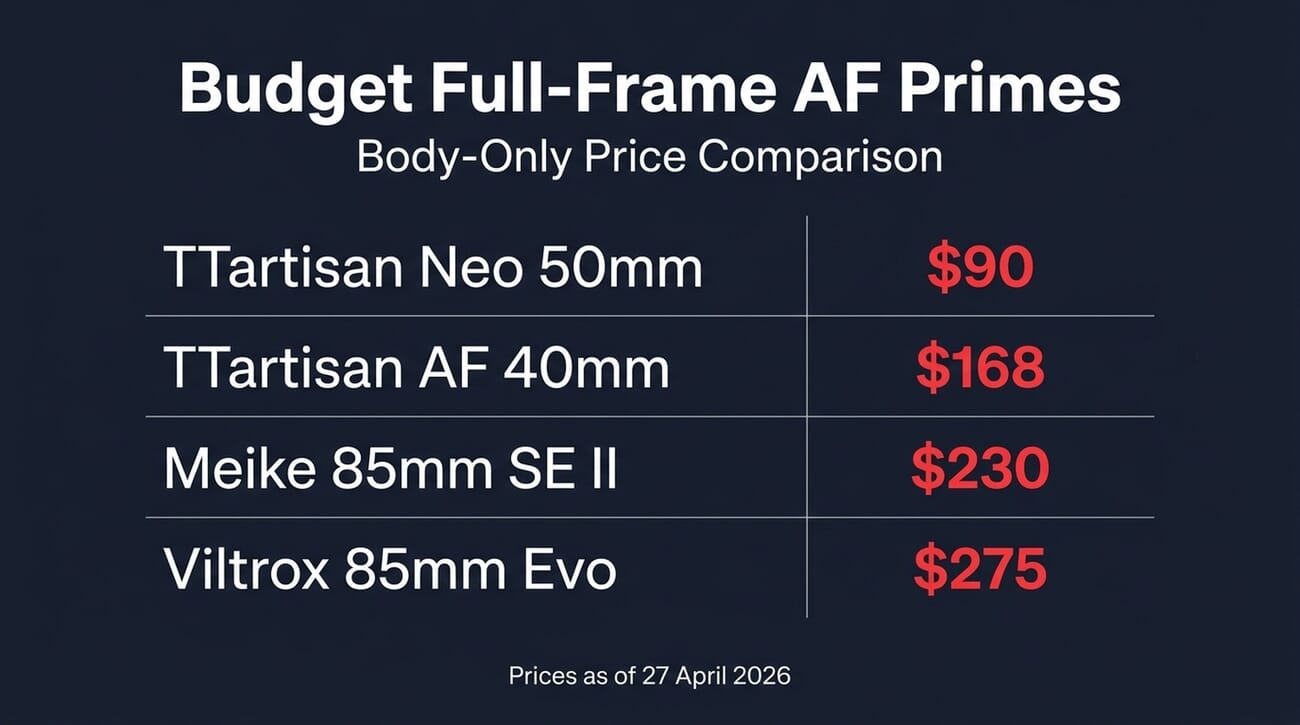
The Neo 50mm’s $90 price is unusual enough that it deserves a frame of reference. Among full-frame autofocus primes that ship today, the closest comparisons are:
- TTartisan AF 40mm f/2 — TTartisan’s previous-generation AF prime, $168, 167–176 g, conventional barrel with aperture ring.
- Sony FE 50mm f/1.8 — Sony’s own kit-tier prime, $250, 186 g, basic AF, plastic mount.
- Yongnuo YN 50mm f/1.8 DA DSM — closest sub-$100 competitor on Sony E, but Sony-only and reviewed as average.
- Meike AF 85mm f/1.8 SE II — for the longer focal length, $230 on Sony E and Nikon Z.
- Viltrox AF 85mm f/2 Evo — $275 on Nikon Z, the current budget AF 85mm benchmark.
On price alone, the Neo 50mm undercuts every comparable name-brand AF prime. On weight, it beats most of them too. What it gives up is the entire control surface — and that is where the design becomes a question, not just a spec.
Are Rings a Feature, or a Cost-Cut?
The Neo’s no-ring design will land differently for different shooters. For someone using the lens as a casual everyday prime — autofocus on, set aperture in the menu once, leave it alone — the missing rings are invisible. The lens does everything a $250 Sony FE 50mm does, at a third of the price, with a third less weight.
For portrait work, the calculation shifts. Manual focus override matters when locking onto an eye through narrow depth of field. Aperture changes between portrait and environmental framing happen often enough that the menu-driven approach creates friction. Most pros will reach for a lens with a focus-by-wire ring even when shooting AF, simply because the muscle memory is faster.
There is also the question of long-term feel. Rings get worn smooth, treaded, recoated. They become part of the lens’s tactile identity. A featureless tube is a different category of object — closer to a smartphone accessory than a piece of camera glass. Whether that registers as modern or as cheap depends entirely on the buyer.
TTartisan’s bet is that the buyer pool for a $90 full-frame AF 50mm doesn’t care about tactile identity. They want sharp images, autofocus that works, and a price that fits between a B&H gift card and an entry-level zoom. On those terms, the Neo 50mm is genuinely interesting. On the terms a working portrait shooter cares about, the upcoming 85mm is the more revealing test.
FAQ
When does the TTartisan Neo AF 50mm f/1.8 ship?
TTartisan announced the lens on April 24, 2026, with pre-orders opening at the official TTartisan store. Sony E and Nikon Z mounts ship first; the L-mount version is scheduled to follow. A specific shipping date for each region has not been published.
Is this TTartisan’s first autofocus lens?
No. TTartisan released the AF 75mm f/2 in 2024 and added the AF 40mm f/2 ($168) in August 2025, followed by the AF 56mm f/1.8 and AF 27mm f/2.8. The Neo line is a new sub-brand within TTartisan’s existing AF range, defined by the no-rings minimalist design rather than by it being their first AF effort.
Can the Neo lenses be focused manually if autofocus misses?
Manual override is handled through the camera body rather than a ring on the lens. On Sony E and Nikon Z bodies, this means using the rear control wheel or a custom button mapping for focus pull. The experience varies by camera. TTartisan has not yet specified whether the Neo lenses report focus distance back to the body or rely entirely on the camera’s AF system.
How does the $90 price compare to Sony’s own FE 50mm f/1.8?
The Sony FE 50mm f/1.8 lists at $250 — roughly 2.8x the Neo. Both cover full-frame, both are f/1.8, both autofocus. The Sony has a focus ring and an AF/MF switch on the barrel; the Neo has neither. Optically the two will need to be tested side by side once review samples are available.
Will there be an L-mount version?
Yes. TTartisan has confirmed the Neo AF 50mm f/1.8 will ship in L-mount after the Sony E and Nikon Z versions. The 85mm is announced for all three mounts — Sony E, Nikon Z, and L — from launch.
The Bottom Line
The TTartisan Neo AF 50mm f/1.8 is interesting for two reasons. First, it lands the cheapest full-frame autofocus 50mm prime on the market by a wide margin — 60–80% less than the next name-brand option. Second, it does so by making a design choice that no major lens-maker has been willing to make: removing the rings entirely.
Whether that choice ages well depends on who is buying. Casual shooters and creator-economy buyers will likely shrug — they were going to control aperture from the camera anyway. Portrait professionals will probably wait for the 85mm and make a careful judgement on whether the savings are worth the missing tactile feedback. Either way, the Neo line is the most distinctive thing TTartisan has shipped in years, and it forces the rest of the budget AF tier — Viltrox, Meike, Yongnuo, Samyang — to answer one question: how cheap can a full-frame AF prime get before something has to give?
Image credit: All editorial graphics by PhotoWorkout. TTartisan logo and product references via TTartisan official store. Spec data via Photo Rumors and Sony Alpha Rumors press coverage.
Primary Coverage
- Photo Rumors — TTartisan announces two full-frame AF lenses from the new Neo series – Original story breaking the Neo announcement
- Sony Alpha Rumors — New TTartisan Neo 50mm 1.8 and 85mm 1.8 lenses – Sony-mount-specific coverage with sample renders
Manufacturer & Reference
- TTartisan official store — AF lens collection – TTartisan's existing AF range (the Neo line is being added here)
- PetaPixel — TTartisan Debuts $168 AF 40mm f/2 Full-Frame Prime Lens (Aug 2025) – Context — TTartisan's previous AF prime, the predecessor to the Neo line
- PetaPixel — Viltrox Brings Its $275 AF 85mm f/2 Evo to Nikon Z (Nov 2025) – Direct competitor in the budget AF 85mm tier