


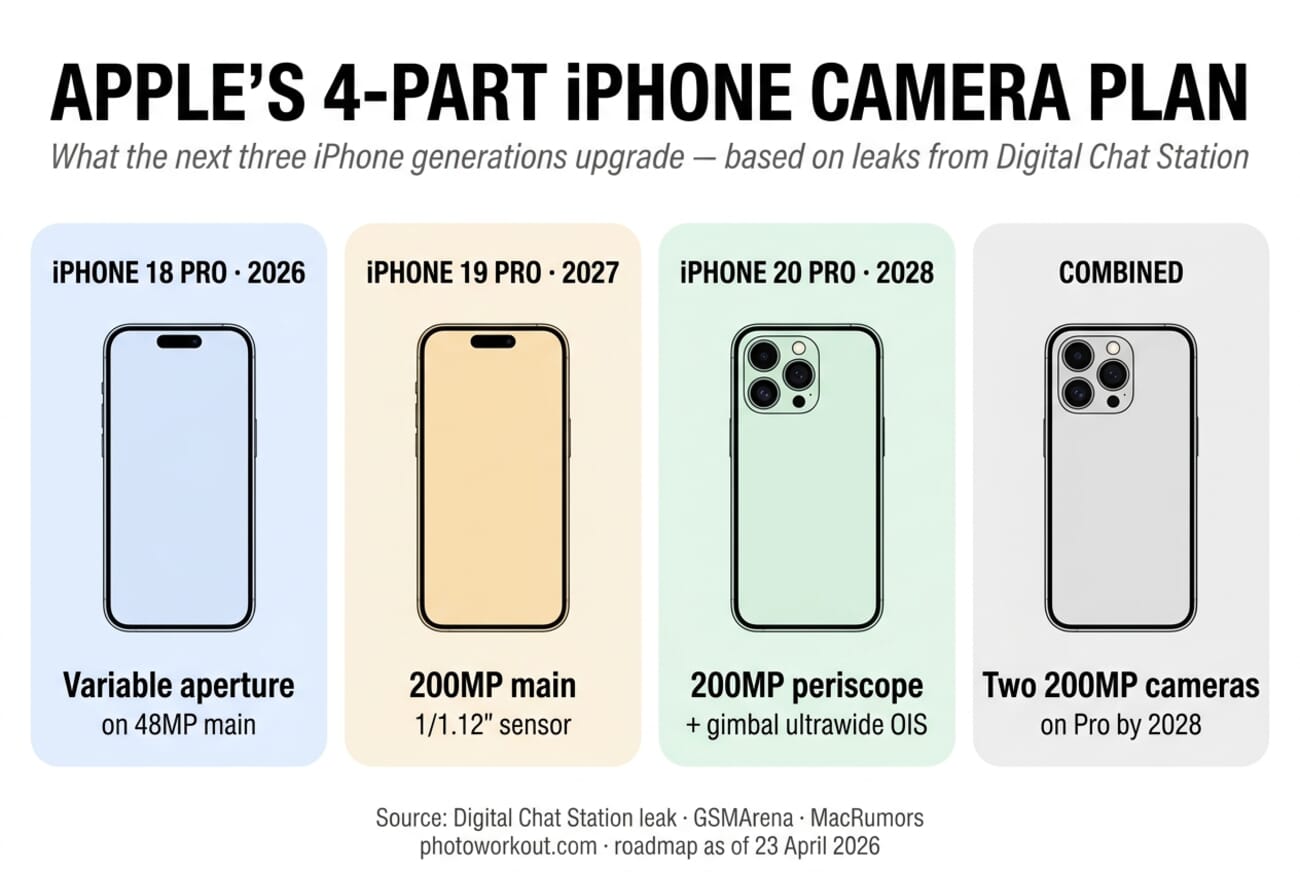
- A Digital Chat Station leak on Weibo (amplified by GSMArena and MacRumors) maps out four distinct camera upgrades across the next three iPhone Pro generations.
- iPhone 18 Pro (September 2026): variable aperture on the 48MP main camera — the first mechanical aperture on a mainstream iPhone.
- iPhone 19 Pro (2027): 200MP main sensor on a 1/1.12″ type — roughly 55% larger than the current iPhone 17 Pro’s 48MP sensor.
- iPhone 20 Pro (2028): 200MP periscope telephoto (claimed 200x digital zoom) plus gimbal-style OIS on the ultrawide. Two 200MP cameras on a single iPhone.
- Samsung already ships what Apple promises in 2028. The Galaxy S26 Ultra has a 200MP main (ISOCELL HP2, 1/1.3″, f/1.4) and a 50MP periscope with 10x optical zoom — today.
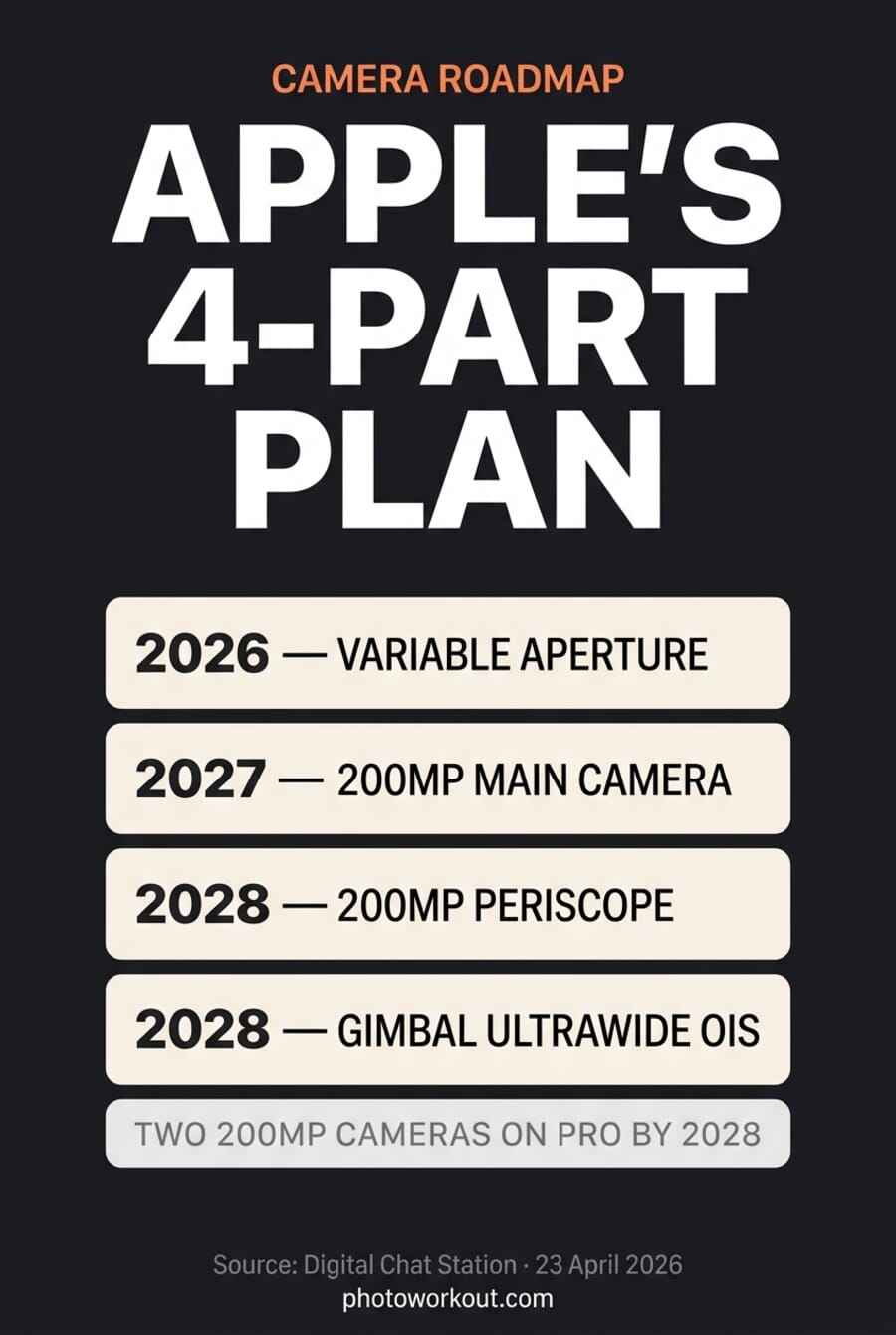
Apple is planning a four-part iPhone camera upgrade that unfolds over three generations, according to a Weibo leak from Digital Chat Station picked up by GSMArena and MacRumors. The headline claim: a 200MP main camera in 2027 and a 200MP periscope telephoto in 2028, meaning the iPhone 20 Pro will carry two 200MP cameras at once.
What the iPhone 18 Pro — shipping this September 2026 — actually gets is narrower: a variable aperture on the 48MP Fusion main camera, plus nine non-camera upgrades (Dark Cherry color, smaller Dynamic Island, A20 Pro 2nm chip, C2 modem with 5G-via-satellite, redesigned ceramic shield). The big sensor story doesn’t kick in until 2027.
iPhone 18 Pro (September 2026): Variable Aperture
The 2026 upgrade is the one you’ll actually buy this year. The iPhone 18 Pro and Pro Max will carry the same 48MP Fusion main camera as the iPhone 17 Pro — but with a mechanically variable aperture instead of a fixed f/1.78.
Variable aperture is the feature Huawei shipped on the Mate 50 Pro in 2022 and Samsung briefly offered on the Galaxy S9 in 2018 before abandoning it. For mobile photographers it matters because it finally gives iPhone real control over depth of field without computational trickery. A wide aperture (likely f/1.4–f/1.8) for low light and subject separation; a narrow aperture (f/4 or f/5.6) for landscape-sharpness scenes and video where rolling-shutter-friendly motion blur matters.
The iPhone 17 Pro already simulates aperture change computationally in Portrait mode. The 18 Pro promises to do it optically — which means better edge rendering, real bokeh falloff, and genuinely different exposure characteristics instead of AI approximations. For the roughly 80% of iPhone owners who buy a Pro specifically for its camera, this is the meaningful upgrade this year.
iPhone 19 Pro (2027): The 200MP Main Sensor
A year later, the iPhone 19 Pro reportedly gets a 200MP main camera on a 1/1.12″ type sensor — a significant physical-size jump. For reference, the iPhone 17 Pro’s main sensor is roughly 1/1.28″. The Galaxy S26 Ultra’s 200MP sits on 1/1.3″. At 1/1.12″, Apple would be pushing into territory typically occupied by 1-inch-type compact cameras like the Sony RX100 VII.
In practice, 200MP phone sensors don’t output 200MP by default. They pixel-bin 4-to-1 or 16-to-1, producing cleaner 50MP or 12MP images with larger effective pixels and better low-light performance. The 200MP full-resolution mode becomes a specialty trick for daylight detail capture — useful for landscape and architecture, overkill for most social content.
The real benefit is computational headroom. A larger sensor plus more pixels gives the image pipeline more data to work with — better crop flexibility, better noise floor, better highlight rolloff. Apple will almost certainly default to 24MP or 48MP output and reserve the 200MP mode for Pro/ProRAW workflows.
iPhone 20 Pro (2028): 200MP Periscope + Gimbal Ultrawide
This is the upgrade that meaningfully changes what an iPhone can do. The 2028 iPhone 20 Pro reportedly adds a 200MP periscope telephoto with the long-rumored 200x digital zoom claim, plus gimbal-style optical image stabilization on the ultrawide camera. Combined with the 200MP main from the year before, it means an iPhone Pro with two 200MP cameras — main and periscope — at the same time.
200x zoom on a phone is marketing, not optics — the periscope’s true optical reach will be closer to 10x-12x (matching Samsung), with the rest being AI upscaling. But a 200MP periscope at native resolution gives Apple room to digitally crop to 20x-40x without losing usable detail, which is what “200x zoom” actually means in current flagship Android marketing.
The gimbal ultrawide is the more interesting feature for video creators. Vivo pioneered the tech in the X-series flagships — a physically-moving sensor that compensates for motion with real mechanical correction, not just software stabilization. On an ultrawide, it dramatically reduces the warping that happens when a handheld phone tilts or pans during video capture. This is the feature that would make iPhone video usable without a gimbal rig.
How Apple’s Plan Compares to the Galaxy S26 Ultra (Today)
Apple’s 2028 destination is essentially the Galaxy S26 Ultra’s 2026 starting point. The specs match the Samsung flagship Samsung announced in February 2026:
| Camera | Galaxy S26 Ultra (now) | iPhone 20 Pro (2028 rumor) |
|---|---|---|
| Main sensor | 200MP Samsung ISOCELL HP2, 1/1.3″, f/1.4 | 200MP, 1/1.12″ sensor (inherited from 19 Pro) |
| Periscope telephoto | 50MP, 10x optical | 200MP, ~10-12x optical, claimed 200x digital |
| Ultrawide OIS | Standard OIS | Gimbal-style OIS |
| Max main aperture | f/1.4 (fixed) | Variable (if carried over from 18 Pro) |
Samsung beat Apple to 200MP by two full generations. DXOMARK’s Galaxy S26 Ultra review scored it class-leading for stills, and the 10x periscope has become the benchmark for mobile zoom. What Apple arguably has in its favor by 2028: a larger 1/1.12″ main sensor (vs Samsung’s 1/1.3″), variable aperture optics, and whatever computational pipeline wins the intervening two years of neural-processor development.
That’s worth weighing against Apple’s track record. The company has historically lagged the megapixel race, shipped later, and won through computational polish instead of raw spec bragging. The 2028 upgrade wouldn’t be the first time Apple caught up to Android on hardware while keeping the edge on video and editing workflow.
Does 200MP Actually Matter for Mobile Photographers?
For most people, no. The benefits of 200MP on a phone sensor show up in three specific scenarios:
- Aggressive cropping — if you shoot a scene and want to crop in 50% or more for social or print, 200MP gives you the headroom that a 48MP capture doesn’t.
- Large-format print — 200MP at 300 DPI prints about 47 × 35 inches. That’s poster-size output from a phone. Nobody actually does this, but it’s possible now.
- Periscope zoom — this is where 200MP earns its keep. At 10x optical the sensor is already cropping into a small native image; starting from 200MP gives the resulting cropped frame enough pixels to matter at 20x-30x extension.
For everyday shooting — Instagram posts, family photos, short-form video — the difference between 48MP and 200MP is imperceptible after both are down-sampled to the final delivery resolution. What will matter more to most users is variable aperture (2026), gimbal ultrawide (2028), and whatever computational-photography updates come with the A20, A21, A22 chips along the way.
The one group that genuinely benefits from 200MP is professional or semi-pro mobile photographers — people shooting content they’ll edit in Lightroom Mobile, crop aggressively, and publish at high resolution. For that audience, the 200MP main in the iPhone 19 Pro (2027) is the upgrade to wait for.
Frequently Asked Questions
Does the iPhone 18 get a 200MP camera?
No. According to Weibo leaker Digital Chat Station and MacRumors’ April 22, 2026 roundup, the iPhone 18 Pro (September 2026) keeps the 48MP Fusion main camera from the 17 Pro — but adds variable aperture. The 200MP main sensor is for the iPhone 19 Pro in 2027. The 200MP periscope arrives on the iPhone 20 Pro in 2028.
What is variable aperture and why does it matter?
A mechanically adjustable lens opening — the iris can physically get bigger or smaller, changing how much light hits the sensor and how much of the frame falls into bokeh. Most phones today have fixed apertures (iPhone 17 Pro is fixed at f/1.78). Variable aperture gives real optical depth-of-field control instead of AI simulation, which matters for portrait subjects and for video where real aperture produces consistent look across the frame.
Will the 200MP iPhone actually output 200MP photos?
Rarely. 200MP phone sensors pixel-bin by default — combining 4 or 16 adjacent pixels into one larger effective pixel, producing cleaner 50MP or 12MP images. The full 200MP mode will likely be opt-in for Pro workflows. Expect Apple’s default iPhone 19 Pro output to be 24MP or 48MP HEIF.
How big is the 1/1.12″ sensor compared to today’s iPhone?
About 55% larger in area than the iPhone 17 Pro’s current 1/1.28″ sensor. For context, 1/1.12″ is larger than the Galaxy S26 Ultra’s 1/1.3″ main sensor and approaches the 1-inch-type sensors in compact cameras like the Sony RX100 VII.
Does Samsung already have a 200MP iPhone equivalent?
Yes — the Galaxy S26 Ultra (February 2026) ships a 200MP Samsung ISOCELL HP2 main on a 1/1.3″ sensor with f/1.4 aperture, plus a 50MP periscope with 10x optical zoom. Samsung has had 200MP since the Galaxy S23 Ultra in 2023. Apple’s rumored 2028 plan is essentially parity with Samsung’s current flagship.
What’s gimbal-style ultrawide OIS?
Traditional OIS shifts internal lens elements or the sensor slightly to compensate for small movements. Gimbal-style OIS (pioneered by Vivo in the X90 Pro and X100 Ultra) uses a much larger physical sensor-shift range, approximating what a mechanical gimbal does externally. It dramatically reduces the wobble and warping in handheld ultrawide video. For hybrid content creators, this is arguably the most practically useful upgrade in Apple’s whole three-year plan.
When will the iPhone 18 Pro launch?
Apple’s standard release window is early-to-mid September 2026, following the usual pattern. Pre-orders typically open a week before shipping. Rumored launch colors: Dark Cherry (new), Light Blue, Dark Gray, and Silver.
Is this leak trustworthy?
Digital Chat Station (DCS) is a Chinese Weibo leaker with a mixed-but-decent track record on iPhone component rumors. The roadmap aligns with independent reports from Morgan Stanley’s investor notes and matches the pattern of Samsung supply-chain leaks. Treat specific years as probable, specific specs as indicative — final details shift between leak and launch.
Featured hero, 4-part timeline, and vertical pin: PhotoWorkout editorial. Camera specs sourced from GSMArena, MacRumors, 9to5Mac, and Digital Chat Station’s original Weibo post. Comparison data verified against DXOMARK’s Galaxy S26 Ultra test.
All sources verified on April 23, 2026.
Primary — iPhone roadmap leaks
- GSMArena — Camera upgrades coming to next iPhone generations – Full rundown of the four-part Digital Chat Station leak.
- MacRumors — iPhone 18 Pro to Kick Off 4-Part Camera Upgrade Plan – Breakdown of the four upgrades with release-year analysis.
- 9to5Mac — 200MP iPhone camera rumors align on 2028 release – Cross-references DCS leak with Morgan Stanley's investor-note timing.
- GSMArena — 200MP telephoto camera may not arrive until 2028 – Earlier coverage of the 2028 periscope timing.
- MacRumors — iPhone 18 Pro 10 New Features – Full non-camera feature list for context.
Comparison
- GSMArena — Samsung Galaxy S26 Ultra specifications – Official Galaxy S26 Ultra camera specs for Apple comparison.