


- Canon officially launched the EOS R6 V on May 13 at $2,499 body-only ($3,699 with the new RF 20-50mm f/4L IS USM PZ kit). Ships late June 2026 — Amazon and B&H pre-orders are live.
- 32.5MP full-frame sensor, 7K RAW internal video, 4K/120p uncropped, 40fps electronic shutter, 7.5-stop IBIS, built-in cooling fan, vertical UI for handheld video — Canon’s most video-focused R-series body to date.
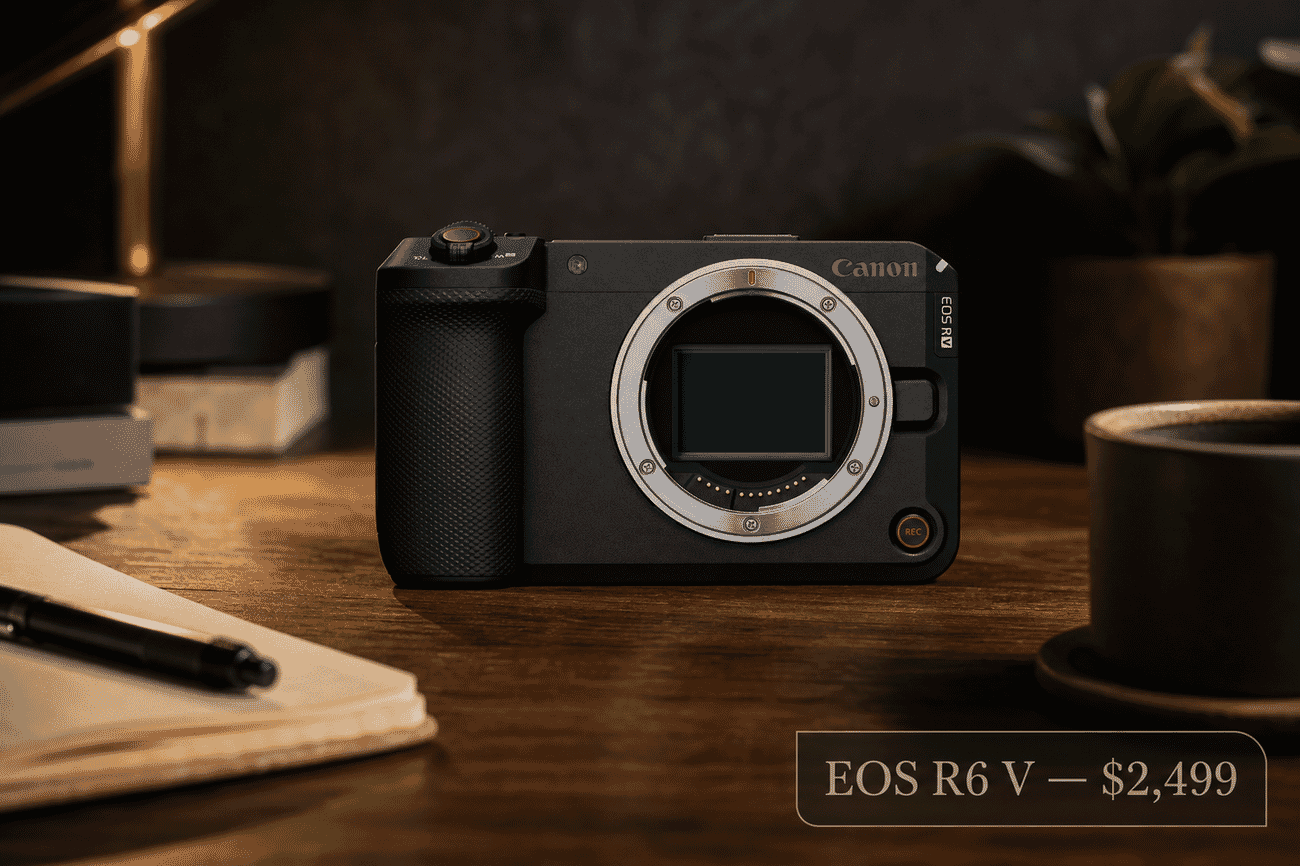
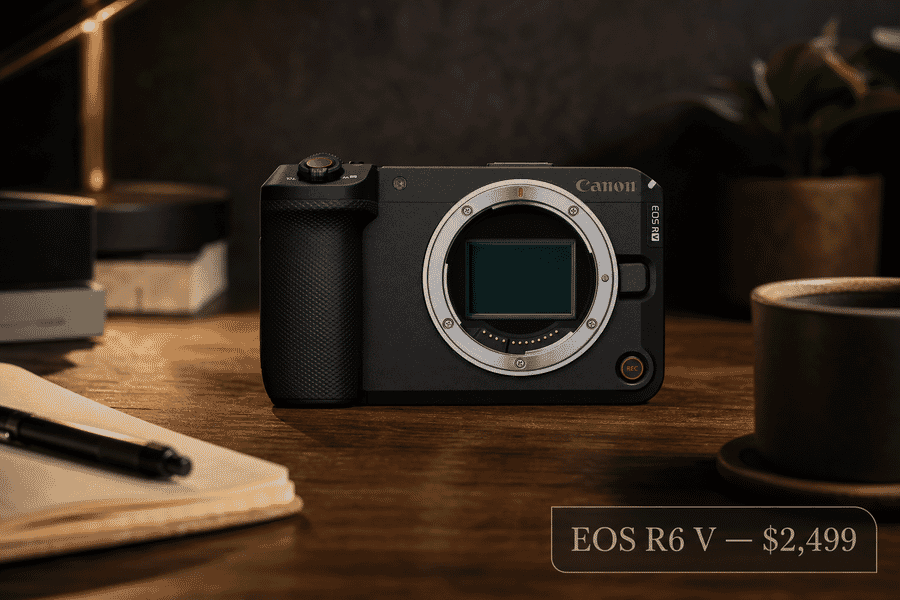
- No EVF, no mechanical shutter, no built-in flash. Canon’s most explicit signal yet that the R6 V is a video-first hybrid, not a stills-first body with video tacked on.
- Slots between the EOS R5 Mark II (stills-first hybrid) and the Cinema EOS C50 (cinema dedicated). For working hybrid shooters at the $2,500 budget, this is the most credible run-and-gun video body Canon has shipped.
Canon officially launched the EOS R6 V on May 13, 2026, with body-only pricing at $2,499 (€2,499 / £2,399 / CA$3,199) and a kit option at $3,699 paired with the freshly-launched RF 20-50mm f/4L IS USM PZ. Pre-orders are live at the Amazon pre-order listing, B&H, Adorama, and Canon USA direct. Ships late June 2026.
PhotoWorkout’s April 29 coverage called the active-cooling-fan build correctly. What the leak couldn’t preview: Canon dropped the EVF entirely. No EVF, no mechanical shutter, no flash support. The R6 V is Canon’s most explicit video-first body in the R lineup — a deliberate run-and-gun positioning that splits the R-series into stills-first (R5 Mark II) and video-first (R6 V) tiers.
The Spec Sheet at a Glance
Confirmed specs from Canon’s May 13 launch sheet:
- Sensor: 32.5MP full-frame CMOS (35.9 × 24.9 mm), 32.3MP recording (6960 × 4640), 5.16 µm pixel size
- Processor: DIGIC X
- Video — internal: 7K/60p RAW Light, 7K/30p Open Gate RAW, 4K/120p uncropped, S&F 1-180fps
- Video — external: 7K ProRes RAW over HDMI, 4-channel audio
- Color profiles: Canon Log 2, Canon Log 3, 20 Custom Picture (CP) files, .cube look-file support
- Stills burst: 40fps electronic shutter with Pre-Continuous Shooting
- Stabilization: 7.5-stop IBIS (5-axis) coordinated with RF lens IS
- Autofocus: Dual Pixel CMOS AF II, Subject Tracking, Register People Priority (10 faces)
- Cooling: Built-in fan (active cooling — confirmed)
- Display: Vari-angle LCD with vertical UI rotation, false-colour, zebra, waveform monitor
- Storage: CFexpress Type B + SD UHS-II dual slots
- Connectivity: Wi-Fi 802.11ac, Bluetooth 5.1, USB 3.2 Gen 2 (10Gbps)
- Body: 598g, weather sealed, RF mount
- What’s missing: No EVF, no mechanical shutter, no built-in flash
No EVF, No Apology
The biggest conversation point isn’t a spec — it’s an absence. The R6 V ships without an electronic viewfinder. No EVF, no mechanical shutter, no flash. For a body in the R6 lineage, that’s an unusual deletion.
Canon’s positioning is direct: this is a video-first hybrid. EVFs are stills-first ergonomics — eye-level shooting, locked composition, single-frame mindset. The R6 V is built for handheld video, gimbal mounting, monitor rigs, and run-and-gun documentary work where the vari-angle LCD with vertical UI rotation is the primary interface. Adding an EVF would have added weight, drained battery, and signaled stills-first when Canon explicitly wants the opposite.
For hybrid shooters who shoot stills 70% of the time and video 30%, the R5 Mark II is still the right body. The R6 V is for the inverse: video-primary shooters who want a 32.5MP stills sensor in the same body so they don’t have to carry a second camera. The lens kit choice — the new RF 20-50mm f/4L IS USM PZ with Power Zoom for video work — reinforces the positioning.
The Video Pipeline — Why 7K Matters Here
7K RAW Light internal recording at 60fps is the headline number. Two practical implications:
1. Crop-flexibility for editorial workflows. 7K source files can be cropped down to 4K for delivery while maintaining full 4K resolution — useful for documentary editing where you don’t always know the final framing in the field. The 7K Open Gate (full sensor area) lets you reframe between 16:9 and 4:5 in post for social-aspect deliverables without re-shooting.
2. Color-grading headroom. 10-bit Canon Log 2 and Log 3 with the .cube look-file support means professional grading workflows in DaVinci Resolve, Premiere, or Final Cut. The Custom Picture files (20 CP files supported) are inheritable from Canon’s Cinema EOS line — the C50 and C70 use the same CP file format.
4K/120p uncropped is the slow-motion baseline. Most R-series bodies that hit 4K/120p cropped the sensor to do it; the R6 V doesn’t. For wedding, sports, and event hybrid shooters who use 4K slow-mo for highlight reels, no-crop 120p is meaningful.
Built-in cooling fan removes the recording-time limitation that affects most mirrorless bodies attempting cinema-tier video. The R6 V can sustain 7K capture indefinitely — a baseline expectation in the cinema category that’s been missing from the R-series until now.
Where the R6 V Fits — vs R5 Mark II and Cinema EOS
Canon’s 2026 R-line and Cinema EOS lineup now slots cleanly across three tiers:
- EOS R5 Mark II ($4,299 body-only) — stills-first hybrid. 45MP sensor, EVF, mechanical shutter. For wedding/portrait/landscape professionals who occasionally shoot video.
- EOS R6 V ($2,499 body-only) — video-first hybrid. 32.5MP sensor, no EVF, built-in fan. For documentary/event/run-and-gun video shooters who occasionally need 32.5MP stills.
- Cinema EOS C50 ($3,899 body-only) — cinema-dedicated. Full Cinema EOS ergonomics, deeper professional video features (timecode in/out, 12G-SDI, ND filter wheel). For cinematographers and dedicated video professionals.
The R6 V’s $2,499 price puts it $1,400 below the C50 and $1,800 below the R5 Mark II. For the working hybrid shooter at the $2,500 budget who’d previously had to choose between R6 Mark II (stills-priority) or jump to C50 territory, the R6 V is a meaningful new option that didn’t exist last week.
Pre-Order, Pricing, and Who Should Wait
Pre-orders open now:
- Body only: $2,499 / €2,499 / £2,399 / CA$3,199
- Body + RF 20-50mm f/4L IS USM PZ kit: $3,699
- RF 20-50 PZ alone: $1,399
Available at: Amazon pre-order listing, B&H Photo, Adorama, Canon USA direct, Midwest Photo, Foto Koch (DE), Foto Erhardt (DE), Wex Photo (UK), Photo Camera Canada (CA). Shipping starts late June 2026 — about 6 weeks from launch, standard for Canon RF launches.
Who Should Skip the R6 V
The R6 V is the wrong body for these shooters:
- Wedding/portrait/landscape pros who want EVF eye-level shooting — the R5 Mark II is the right tool here. The R6 V’s no-EVF design is intentional, not a feature you can work around.
- Stills-only shooters wanting maximum resolution — the R5 Mark II’s 45MP sensor or even the existing R6 Mark II’s 24MP at $1,998 are better fits.
- Cinema-dedicated production shooters — the EOS C50 has the professional video infrastructure (12G-SDI, timecode, ND wheel) that the R6 V lacks. Worth the extra $1,400.
- Anyone who needs a built-in flash — none here, no workaround.
Bottom Line
The Canon EOS R6 V is the most opinionated R-series body Canon has shipped. Dropping the EVF, mechanical shutter, and flash to make room for built-in cooling and vertical UI is a deliberate carve-out: this is a video-first hybrid body, not a hedged compromise that pretends to serve both audiences equally.
At $2,499 with 32.5MP full-frame, 7K RAW internal, 4K/120p uncropped, 7.5-stop IBIS, and an active cooling fan, the spec-sheet value is genuine — particularly for hybrid documentary, event, and run-and-gun video shooters who’d previously had to cross-shop the C50 or accept the stills-first compromises of the R5 Mark II. For shooters in that exact lane, the R6 V is the body that didn’t exist three weeks ago.
Manufacturer
- Canon USA — EOS R6 V Newsroom (May 13 launch) – Canon's official launch press release with confirmed specs, pricing, and pre-order availability.
Primary Coverage
- Canon Rumors — Canon Officially Announces the EOS R6 V – Detailed launch breakdown with full spec sheet, pre-order links, and community framing.
PhotoWorkout's Earlier Coverage
- PhotoWorkout — EOS R6 V Active Cooling Confirmed (April 29) – Our April 29 leak coverage that called the active-cooling fan correctly. This post replaces that one with the launch breakdown.
- PhotoWorkout — Canon RF 20-50mm f/4L IS USM PZ Is Official – Our launch coverage of the RF 20-50mm f/4L PZ — the kit lens that ships with the R6 V kit option.
Image Sources
- Canon Press Kit / Amazon Product Image – Featured + lead image is Canon's official EOS R6 V product photography, distributed via Amazon's product listing. Image credit: Canon.