


- Canon EOS R7 Mark II reportedly features a 39MP BSI stacked sensor — a first for Canon APS-C cameras.
- The stacked design should deliver faster readout speeds, reduced rolling shutter, and improved low-light performance.
- Announcement expected between mid-May and early June 2026, based on FCC certification timelines.
- If confirmed, this would bring flagship-level sensor technology to Canon’s most popular crop-sensor body.
The Canon EOS R7 Mark II is shaping up to be one of the most significant APS-C camera launches of 2026 — and a fresh sensor leak has the photography community buzzing.
According to a new report from Canon Rumors, multiple sources have confirmed that the R7 Mark II will pack a 39-megapixel backside-illuminated (BSI) stacked sensor. If true, this would be a landmark moment for Canon’s crop-sensor lineup, bringing technology previously reserved for flagship full-frame bodies down to the enthusiast APS-C tier.
What Leaked: 39MP BSI Stacked Sensor
Canon Rumors founder Craig Blair reports that multiple independent sources — including anonymous tipsters — have consistently pointed to a 39MP resolution for the R7 Mark II’s sensor. No contradicting resolution figures have surfaced, lending credibility to this number.
More importantly, Blair writes with “a good level of confidence” that the sensor will be backside-illuminated and stacked. This would make it the first BSI stacked sensor in any Canon APS-C camera — a technology currently found only in Canon’s flagship EOS R1.
The current Canon EOS R7 uses a 32.5MP CMOS sensor. A jump to 39MP with BSI stacked architecture would represent a substantial generational leap — not just in resolution, but in fundamental sensor performance.
Why BSI Stacked Matters
For photographers who aren’t deep into sensor engineering, here’s what a BSI stacked sensor actually means in practice:
- Dramatically faster readout speeds — Stacked sensors place the processing circuitry directly beneath the photodiodes, enabling much faster data transfer. This translates to significantly reduced rolling shutter distortion, which is critical for fast-moving subjects like sports and wildlife.
- Better low-light performance — BSI designs flip the sensor’s wiring layer behind the photodiodes, allowing more light to reach each pixel. The result: cleaner high-ISO images with less noise.
- Higher burst frame rates — Faster readout enables higher continuous shooting speeds. Some rumors suggest the R7 II could reach 40fps electronic shutter.
- Potential for 8K video — The increased resolution and readout speed could open the door to 8K video recording, which would be a first for a Canon APS-C body.
Canon’s EOS R1 already uses stacked CMOS sensor technology to deliver its class-leading autofocus and burst shooting performance. Bringing a version of this tech to the R7 line would close a major gap between Canon’s professional and enthusiast tiers.
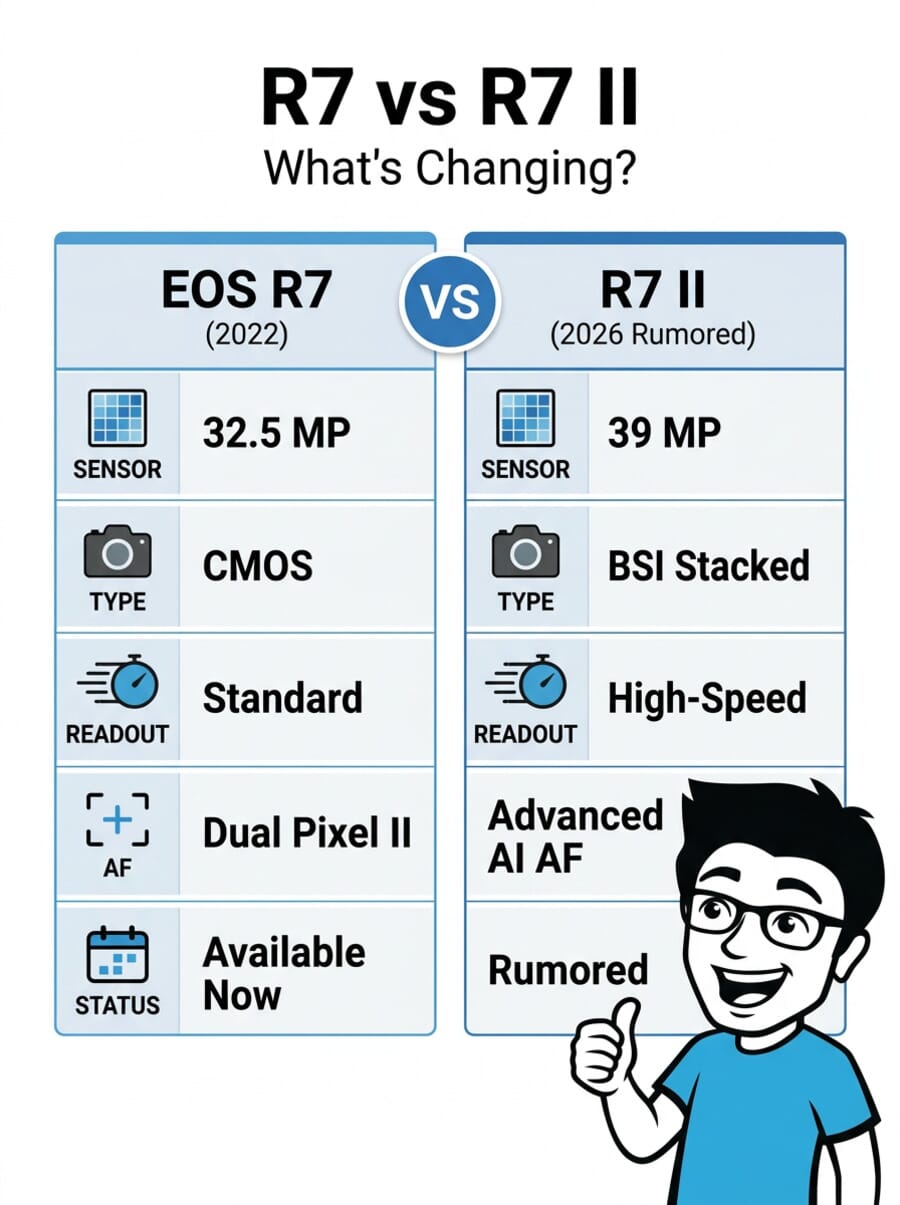
How It Compares to the Current R7
The Canon EOS R7, released in June 2022, quickly became one of Canon’s most popular cameras. It offered a compelling mix of performance and value that the 7-series line has always been known for. Here’s how the rumored Mark II stacks up:
| Feature | EOS R7 (2022) | EOS R7 II (Rumored) |
|---|---|---|
| Resolution | 32.5 MP | 39 MP |
| Sensor Type | CMOS | BSI Stacked CMOS |
| Burst (Electronic) | 30 fps | Up to 40 fps (rumored) |
| Video | 4K 60fps | Potentially 8K (rumored) |
| AF System | Dual Pixel CMOS AF II | Advanced AF (details TBC) |
| IBIS | 5-Axis (up to 8 stops) | Expected improvement |
| Battery | LP-E6NH | LP-E6P (per FCC filing) |
Note: R7 Mark II specs marked as “rumored” are based on leaks and speculation. Nothing is confirmed until Canon officially announces the camera.
When to Expect the Announcement
Multiple sources point to an announcement window between mid-May and early June 2026. This timeline is supported by an FCC certification filing from December 17, 2025, which lists confidential materials (including camera images and the user manual) set to become public on June 16, 2026.
Historically, Canon tends to announce cameras 2-4 weeks before their FCC confidentiality periods expire. That pattern would place the R7 Mark II reveal in the second half of May — roughly three years after the original R7’s May 2022 announcement.
The FCC filing also confirms the camera uses an LP-E6P battery — the same battery found in Canon’s higher-end bodies — rather than the LP-E6NH used in the current R7. This suggests the Mark II may draw more power (potentially due to the stacked sensor’s higher processing demands), or Canon is simply standardizing its battery lineup.
What This Means for Canon’s APS-C Lineup
If the BSI stacked sensor rumors hold true, the R7 Mark II would sit in a very different position than its predecessor. It wouldn’t just be “a good APS-C camera” — it would be a genuine flagship-tier APS-C body with technology borrowed from Canon’s $6,000 EOS R1.
Canon Rumors also notes that this stacked sensor technology would be a “7 series exclusive for a while at least” — meaning cheaper Canon APS-C cameras like the EOS R10 likely won’t see similar sensor upgrades anytime soon. Canon appears to be widening the performance gap between its enthusiast and entry-level crop bodies.
For wildlife photographers and sports shooters who prefer APS-C for its 1.6x crop factor advantage (effectively turning a 400mm lens into a 640mm equivalent), a stacked sensor R7 Mark II could be a game-changer. The combination of faster readout, higher resolution, and improved autofocus would address the current R7’s main limitations.
What We Still Don’t Know
Canon Rumors acknowledges that some reported specs contain contradictions, and the site is holding back certain details until clearer information emerges. Key unknowns include:
- Exact burst frame rates — 40fps has been mentioned, but isn’t confirmed
- Video capabilities — 8K is speculated but not verified
- AF improvements — Some rumors mention a DIGIC Accelerator chip from the R1, but details are conflicting
- Price — The current R7 launched at $1,499; a stacked sensor could push the Mark II higher
- Whether a mechanical shutter will be retained — Some rumors suggest Canon may drop it entirely
We’ll likely see a clearer picture emerge as the rumored May/June announcement window approaches. For now, the sensor details alone are enough to make the R7 Mark II one of the most anticipated cameras of the year.
The Bottom Line
A 39MP BSI stacked sensor in the Canon EOS R7 Mark II would be a genuinely significant upgrade — not just a spec bump. It would bring flagship-level sensor technology to Canon’s most popular APS-C body and could redefine what’s possible in the crop-sensor segment. Combined with a strong lens ecosystem (including Canon’s growing RF-mount sport lens lineup), the R7 Mark II could become the definitive enthusiast camera for action, wildlife, and hybrid shooters.
As with all pre-announcement rumors, take the specifics with a grain of salt. But the consistent reporting from multiple independent sources — combined with the FCC certification timeline — suggests Canon has something substantial in the pipeline.
When will the Canon EOS R7 Mark II be announced?
Based on FCC certification timelines and multiple rumor sources, the Canon EOS R7 Mark II is expected to be announced between mid-May and early June 2026. The FCC confidentiality period expires on June 16, 2026, and Canon typically announces cameras 2-4 weeks before that date.
What sensor will the Canon EOS R7 Mark II have?
According to multiple leaked reports, the R7 Mark II will reportedly feature a 39-megapixel backside-illuminated (BSI) stacked CMOS sensor. This is unconfirmed and based on rumor sources — not official Canon announcements.
What is a BSI stacked sensor and why does it matter?
A BSI (backside-illuminated) stacked sensor places wiring behind the photodiodes for better light gathering, while the stacked design integrates processing circuitry directly beneath the sensor for faster readout speeds. This combination reduces rolling shutter, improves low-light performance, and enables higher burst frame rates.
How much will the Canon EOS R7 Mark II cost?
No pricing information has leaked yet. The current Canon EOS R7 launched at $1,499 (body only). Given the rumored BSI stacked sensor upgrade, the Mark II could be priced higher, but this is purely speculative until Canon makes an official announcement.
Is the Canon EOS R7 Mark II the first Canon APS-C camera with a stacked sensor?
If the rumors are accurate, yes — the R7 Mark II would be the first Canon APS-C camera to feature a BSI stacked sensor. This technology is currently only found in Canon’s flagship EOS R1. Canon Rumors reports it will remain a 7-series exclusive for some time.
Sources used for this article:
Featured image: Photo by <a href="https://unsplash.com/photos/o7paS8JK_Zk" target="_blank" rel="noopener">Dimitri Karastelev</a> on <a href="https://unsplash.com" target="_blank" rel="noopener">Unsplash</a>.
Related Posts
Get the Weekly Photography News Digest
Join photographers who get our top stories delivered every Monday morning. No spam, unsubscribe anytime.