


- A new Canon patent application (2026-043301) reveals optical designs for an RF 18mm f/1.4L VCM — a focal length Canon has never offered as a prime.
- The patent shows a sophisticated 121mm-long optical design with a smaller-than-full-frame image circle, similar to the existing RF 20mm f/1.4L VCM.
- Canon’s f/1.4L VCM series now has six released lenses (14mm–85mm). An 18mm would fill the gap between the 14mm and 20mm.
- As with all patents, this is research — not a product announcement. Canon may never release this lens.
Canon appears to be exploring uncharted territory. A recently published Japanese patent application reveals optical designs for an RF 18mm f/1.4L VCM prime lens — a focal length that Canon has never offered in prime form in its entire history.
The patent (application number 2026-043301) covers a range of wide-angle VCM lens designs, but the 18mm f/1.4 embodiment stands out as the most novel. If Canon ever decides to produce it, the lens would slot neatly between the recently launched RF 14mm f/1.4L VCM ($2,599) and the existing RF 20mm f/1.4L VCM in Canon’s rapidly expanding fast-prime lineup.
What the Patent Reveals
The patent outlines a sophisticated optical design with some notable characteristics. The lens has a total length of approximately 121.17mm — sandwiched between the RF 14mm f/1.4L VCM and the other VCM primes in physical size. The front element is described as large and prominent, consistent with what you’d expect from an ultra-wide f/1.4 design.
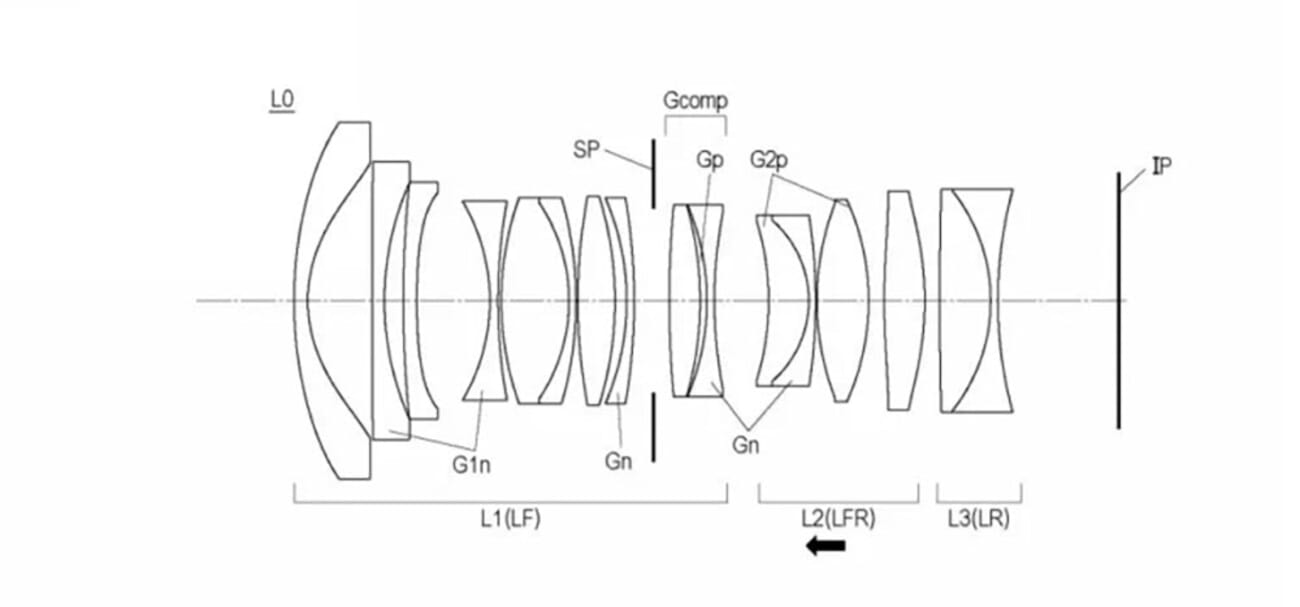
Key specifications from the patent filing:
- Focal length: 18.45mm
- Maximum aperture: f/1.46
- Half angle of view: 45.46°
- Image height: 18.75mm
- Total lens length: ~121.17mm (~103mm protruding from body)
- Back focus distance: 17.78mm
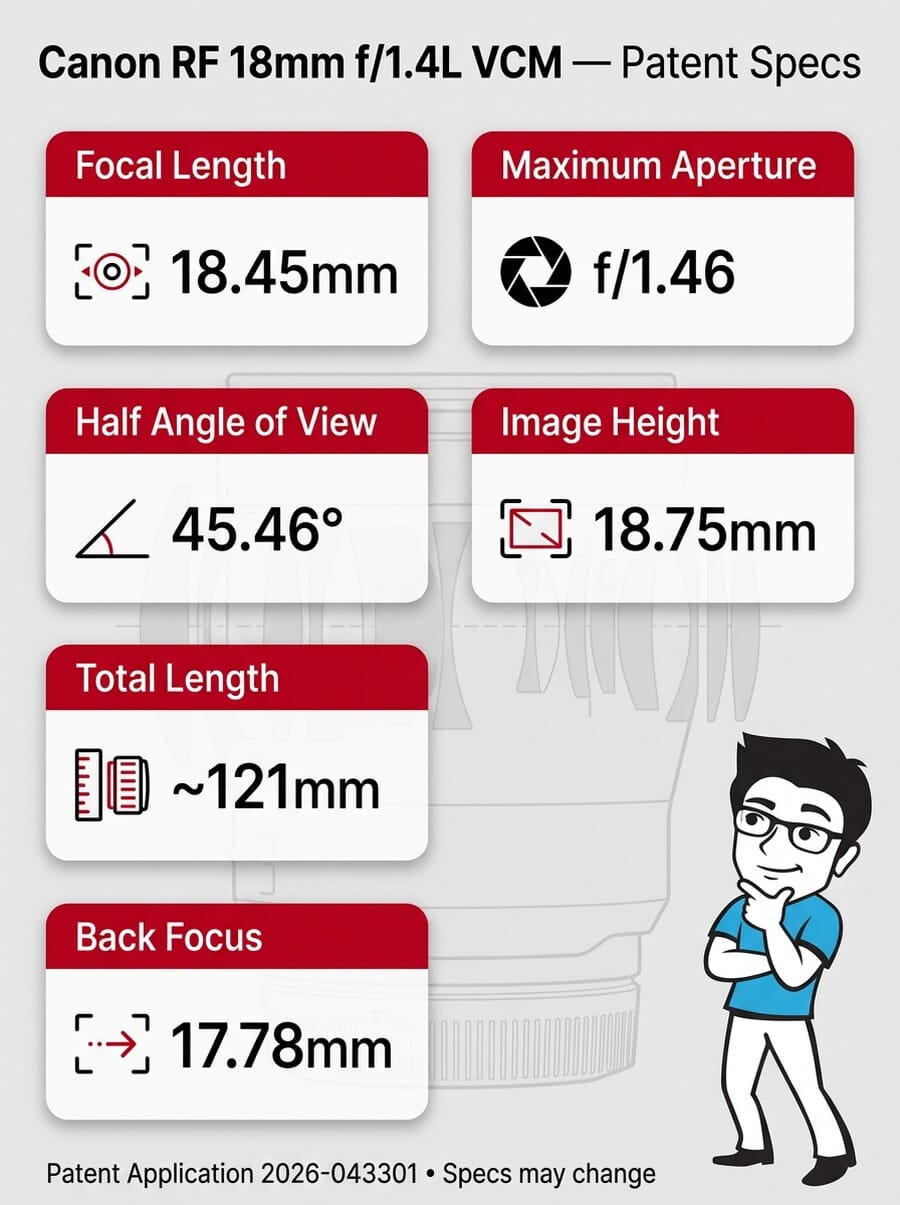
One notable detail: the image height is listed at 18.75mm, which is smaller than the standard full-frame image circle (21.64mm). This means the lens would rely on in-camera software correction to stretch the image to fill the sensor — the same approach Canon already uses in the RF 14mm f/1.4L VCM and RF 20mm f/1.4L VCM. While some photographers find this controversial, it’s become standard practice in Canon’s modern ultra-wide designs and hasn’t drawn meaningful criticism in real-world use.
Why 18mm Matters
An 18mm prime is genuinely rare in the camera industry. Canon has never produced one — not in the EF mount era, and not in the RF mount system. The few 18mm primes that have existed came from other manufacturers: Zeiss offered an 18mm f/3.5 classic for the Yashica mount, and later the 18mm f/2.8 Milvus for Canon EF and other mounts.
At f/1.4, an 18mm prime would be a compelling tool for several genres. Astrophotographers would benefit from the combination of ultra-wide field of view and massive light-gathering ability. Architectural and real estate photographers would get dramatic interior perspectives. And for video creators — the primary audience Canon has targeted with the VCM series — an 18mm f/1.4 offers cinematic ultra-wide framing with beautiful shallow depth of field control.
Canon’s Growing VCM Prime Family
Canon launched its f/1.4L VCM prime series in June 2024 with the RF 35mm f/1.4L VCM, and the lineup has expanded rapidly since then. The “VCM” designation refers to the Voice Coil Motor autofocus system, which delivers fast, near-silent focusing — a critical feature for hybrid photo/video shooters.
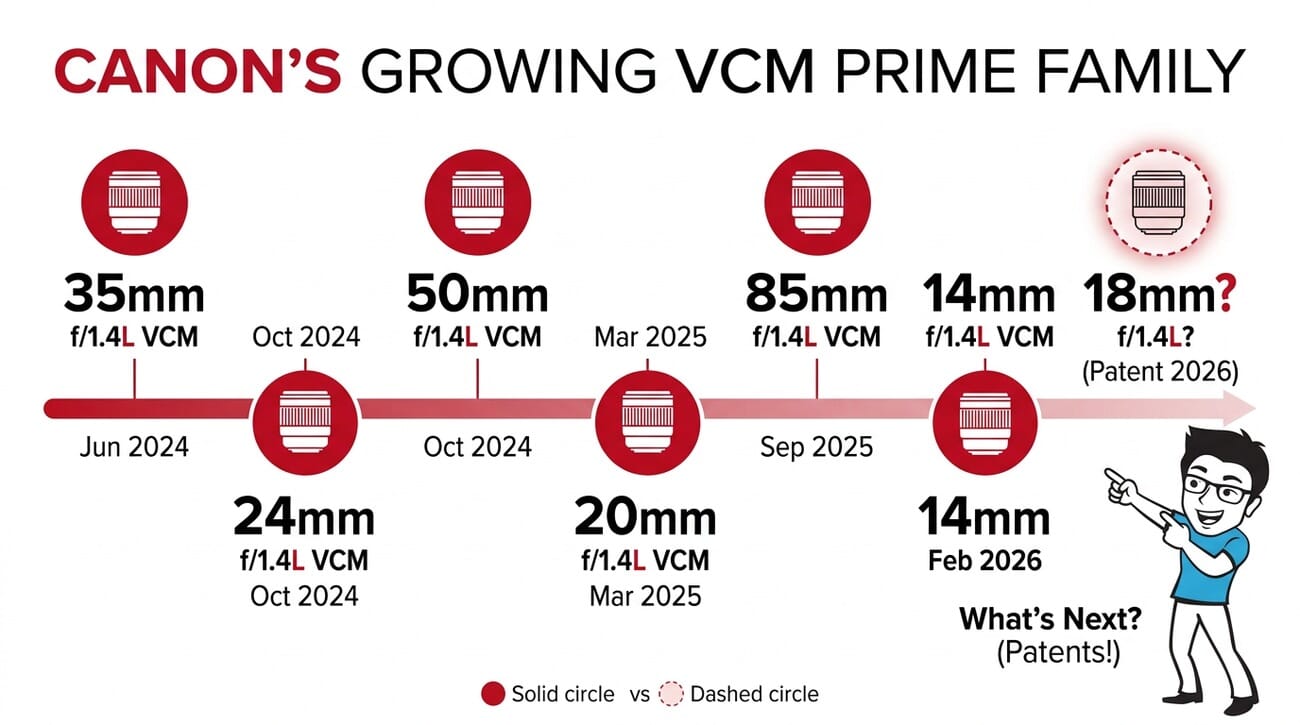
The current lineup includes:
- RF 14mm f/1.4L VCM — February 2026 ($2,599)
- RF 20mm f/1.4L VCM — March 2025
- RF 24mm f/1.4L VCM — October 2024
- RF 35mm f/1.4L VCM — June 2024
- RF 50mm f/1.4L VCM — October 2024
- RF 85mm f/1.4L VCM — September 2025
An 18mm f/1.4L VCM would fill the only remaining gap in the wide-angle end of the series. Canon has also been rumored to be exploring a 100mm f/1.4L VCM, which would extend the lineup on the telephoto end.
Bonus Patent: A Redesigned 35mm f/1.8
The same patent application includes another interesting design: a new 35mm f/1.8 optical layout. Canon currently sells the RF 35mm f/1.8 IS Macro STM, which launched alongside the RF mount system back in 2018. It’s one of Canon’s oldest RF lenses.
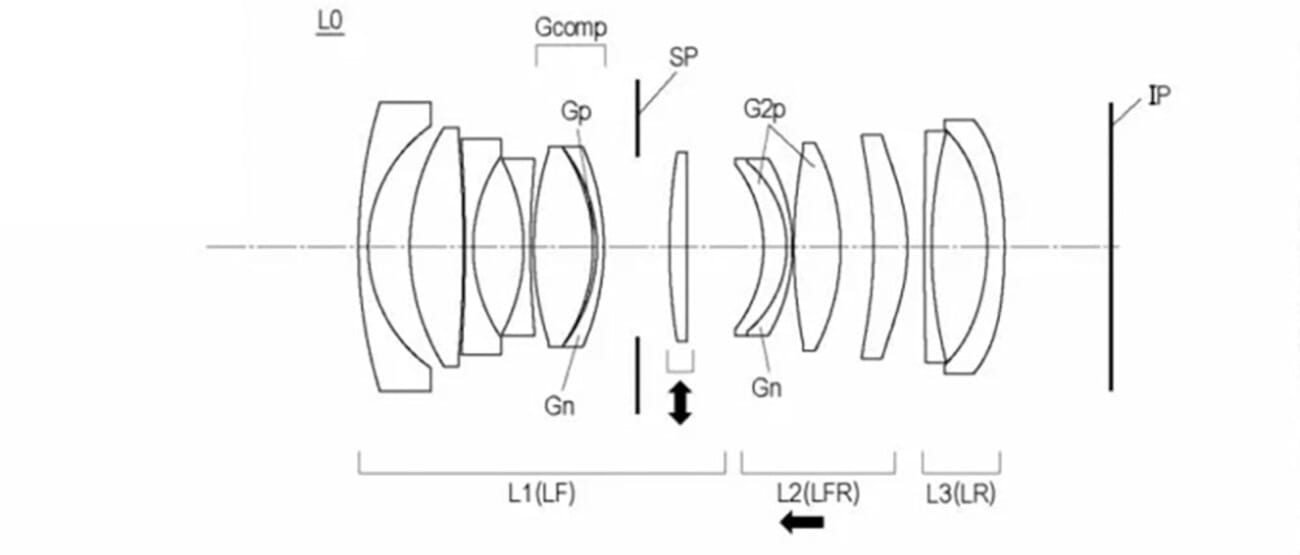
The patented design is noticeably more sophisticated than the current 35mm f/1.8, and slightly larger. Whether Canon would actually update a budget-friendly non-L prime that already performs well at its price point is debatable — but the fact that someone at Canon thought it was worth including suggests it’s at least on someone’s radar.
Patent ≠ Product
It’s worth emphasizing: a patent application is not a product announcement. Canon patents dozens of optical designs every year, and only a fraction ever make it to production. The patent system is used to protect research, and many designs exist purely as intellectual property protection rather than product roadmap indicators.
That said, this particular patent is more interesting than most because it includes the RF 20mm f/1.4L VCM as one of its embodiments — a lens that Canon has already released. This means the patent was filed in connection with an active product line, which gives the 18mm design slightly more credibility than a completely standalone filing.
Whether or not the RF 18mm f/1.4L VCM ever becomes real, one thing is clear: Canon is aggressively building out the most comprehensive set of fast primes in the mirrorless era. Six f/1.4L VCM lenses in under two years is an impressive pace, and the company shows no signs of slowing down.
Has Canon ever made an 18mm prime lens before?
No. Canon has never produced an 18mm prime in any mount — not EF, not RF. If the patented RF 18mm f/1.4L VCM ever reaches production, it would be a first for the company. The few 18mm primes that have existed came from Zeiss and other third-party manufacturers.
What does VCM mean in Canon lenses?
VCM stands for Voice Coil Motor, Canon’s autofocus motor technology designed for fast, near-silent focusing. It’s specifically engineered for hybrid photo/video use, making it ideal for creators who switch between stills and video. All Canon f/1.4L VCM lenses share this motor system.
How many Canon RF f/1.4L VCM lenses are there?
As of early 2026, Canon has released six f/1.4L VCM primes: 14mm, 20mm, 24mm, 35mm, 50mm, and 85mm. The patented 18mm and a rumored 100mm could potentially expand the series further.
Does a patent filing mean Canon will release this lens?
Not necessarily. Camera manufacturers file patents for many optical designs that never reach production. Patents protect research and intellectual property. However, this filing is slightly more noteworthy because it includes the existing RF 20mm f/1.4L VCM as an embodiment, connecting it to an active product line.
Sources used for this article:
Featured image: Photo by Jakob Owens on Unsplash.
Related Posts
Get the Weekly Photography News Digest
Join photographers who get our top stories delivered every Monday morning. No spam, unsubscribe anytime.