


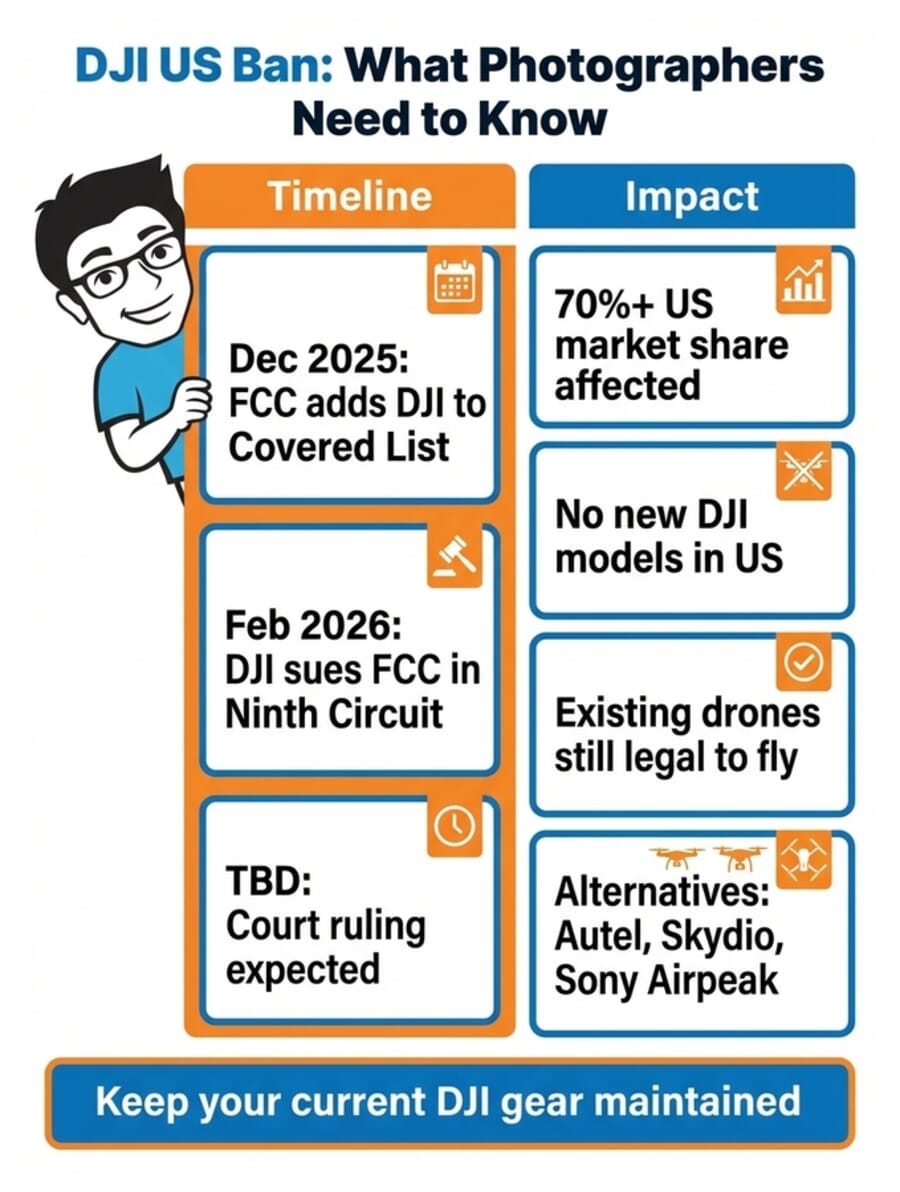
- DJI filed a federal appeal on February 20, 2026, challenging the FCC’s ban on importing new DJI drones into the US.
- The ban has been active since December 23, 2025 — no new DJI models can enter the US market.
- DJI argues the FCC exceeded its authority and violated due process by never giving the company a chance to respond.
- Photographers who rely on DJI for aerial work face limited alternatives at comparable price-to-performance ratios.
DJI Takes the FCC to Court
DJI, the world’s largest drone manufacturer, has formally filed an appeal with the US Court of Appeals for the Ninth Circuit. The petition, filed on February 20, 2026, challenges the Federal Communications Commission’s decision to place the company on its “Covered List” — effectively blocking all new DJI drone models from being imported or sold in the United States since December 23, 2025.
The FCC’s Covered List includes communications equipment deemed to pose “an unacceptable risk to the national security of the United States.” By adding DJI, the agency prevented any new DJI products from receiving FCC authorization — a requirement for selling wireless devices in the US.
In its filing, DJI argues that the FCC “exceeded its statutory authority, failed to observe statutorily required procedures, and violated the Fifth Amendment.” The company says it was never given the opportunity to provide information to address or refute the government’s security concerns.
Why This Matters for Photographers
DJI commands over 70% of the US consumer and commercial drone market. For aerial photographers and videographers, DJI drones like the Mavic, Air, and Mini series have become essential tools. The ban does not affect drones already purchased — you can still fly your existing DJI gear — but it means no new models, no upgraded cameras, and eventually no replacement parts.
This is especially significant for professionals who depend on the latest sensor technology and stabilization improvements for commercial aerial photography, real estate shoots, and cinematic video work. Reports have already emerged of “panic stockpiling” across the US, with cinematographers and content creators buying up existing inventory before supplies run out.
The situation mirrors broader US-China trade tensions that have already impacted camera gear pricing. As we covered in our piece on 2026 tariffs and camera prices, photographers are feeling the squeeze from multiple directions.
The Bigger Picture
This lawsuit is just one front in a multi-year legal battle between DJI and Washington. The company has also been fighting its designation as a “Chinese Military Company” by the Department of Defense since 2024. A federal judge upheld that listing in September 2025, though the court found no evidence that DJI is owned or controlled by the Chinese Communist Party.
Meanwhile, the FCC has granted limited exemptions to some European drone makers and Japanese component manufacturers like Sony and Panasonic — but no exemptions for any Chinese-made drones or parts.
What Are the Alternatives?
If the ban holds, photographers will need to look elsewhere for aerial platforms:
- Autel Robotics — The closest DJI competitor with the EVO series, though also Chinese-made and potentially facing similar restrictions.
- Skydio — American-made with strong autonomous flight. More expensive and primarily enterprise-focused, but consumer models exist.
- Sony Airpeak — Professional drone platform with excellent imaging at a significantly higher price point.
- Parrot (ANAFI) — French-made drones meeting Western security requirements, but with more limited camera specs.
None of these currently match DJI’s combination of image quality, flight performance, and affordability that made aerial photography accessible to working photographers.
What Happens Next
The Ninth Circuit will now consider DJI’s appeal. For photographers, the practical advice is straightforward: maintain your current DJI equipment carefully, stock up on batteries and spare parts while available, and keep an eye on this case. The broader question — whether the US can build a domestic drone industry that serves photographers as well as DJI has — remains unanswered.
This article was researched using official court filings, government databases, and reporting from major technology publications.