

- Google Search referral traffic to publishers has fallen by up to 60% over the past year, with smaller sites hit hardest.
- AI-generated answers in search results send less than 1% of total referral traffic to source websites.
- Photographers who rely on Google for blog and portfolio traffic need to diversify now – email lists, social media, and direct audience building are no longer optional.
A new report paints a stark picture for anyone who depends on Google Search to drive visitors to their website. Data gathered by analytics firm Chartbeat and shared by Axios reveals that Google Search referral traffic to publishers across the web has dropped sharply over the past year – and AI-powered search features are doing almost nothing to make up the difference.
For photographers who maintain blogs, portfolio sites, or educational content, this is a wake-up call.
The Numbers: How Bad Is It?
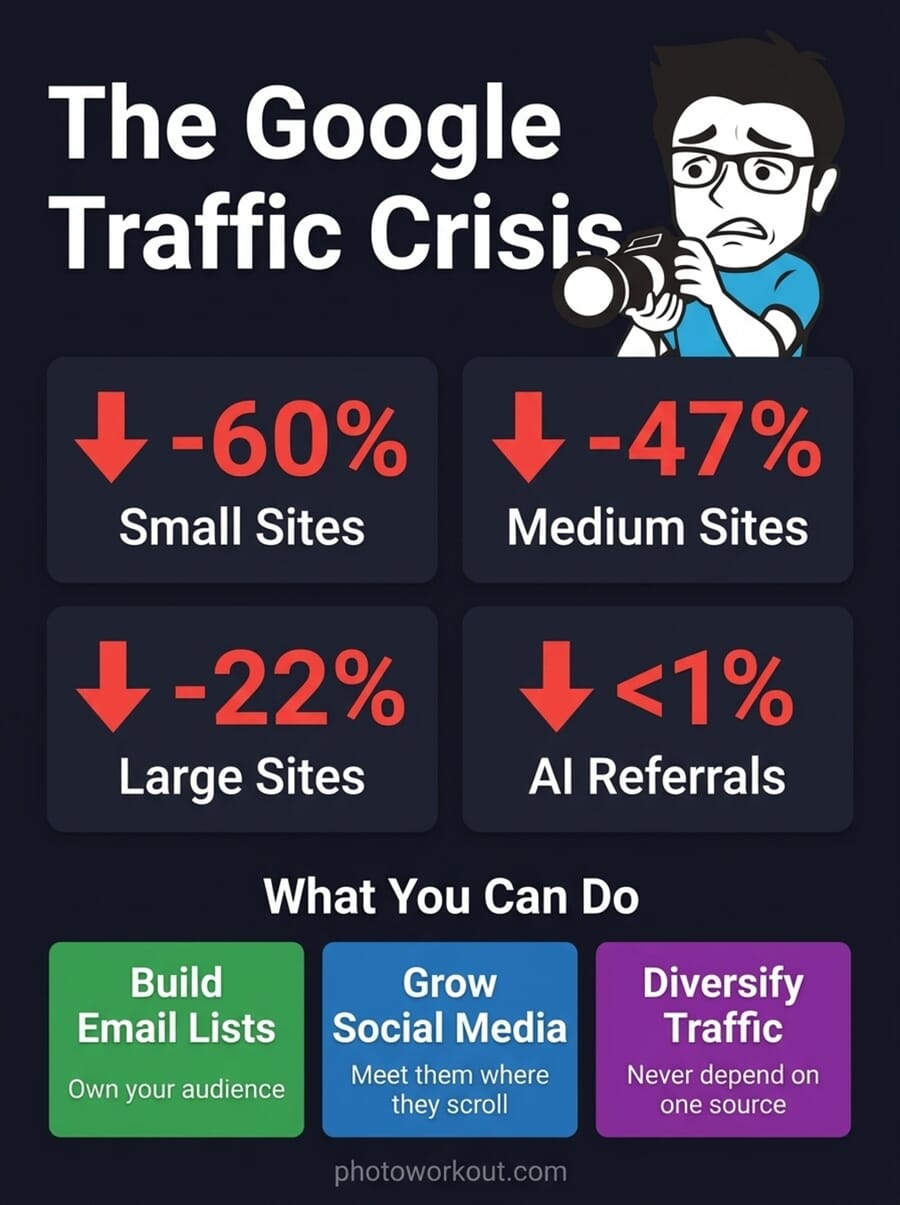
The Chartbeat data breaks down the traffic decline by publisher size, and the pattern is clear – smaller sites are getting crushed:
- Small publishers (under 10,000 daily pageviews): 60% drop in Google Search referrals
- Medium publishers (10,000-100,000 daily pageviews): 47% drop
- Large publishers (over 100,000 daily pageviews): 22% drop
Google Discover traffic also fell by 15%. And across the board, total publisher traffic dropped 6% between 2024 and 2025.
Perhaps the most telling stat: AI chatbots account for less than 1% of all publisher page view referrals. Even though ChatGPT referrals grew by over 200% during 2025, the absolute numbers remain tiny. Google’s AI Overviews, which now appear at the top of many search results, are effectively answering queries without sending users to the original sources.
Tech Media Is Getting Hit Even Harder
A separate report from Growtika found that tech media has been devastated. Sites like The Verge, HowToGeek, and others have seen Google Search traffic drops of 85% or more. Digital Trends reportedly lost 97% of its search traffic and laid off almost its entire full-time staff in early 2025.
Google has pushed back against these findings, claiming that “total organic click volume from Google Search to websites has been relatively stable year-over-year” and that it is sending “slightly more quality clicks.” But the independent data tells a very different story.
What This Means for Photographers
Most photography websites – whether they are personal blogs, tutorial sites, or portfolio platforms – fall squarely into the “small publisher” category. That means they are in the group being hit hardest by this decline.
If you have been writing blog posts about photography techniques, gear reviews, or sharing your work online with the expectation that Google will send readers your way, the math has fundamentally changed. The era of “publish good content and Google will find it” is fading fast.
This is especially painful for photographers who have invested years building up educational content or stock photography income streams that depend on organic search visibility. When AI answers a user’s question directly in search results – drawing from your content but never sending the user to your site – the value proposition of creating that content collapses.
What You Can Do About It
The good news: this is a problem with solutions, but they require a shift in mindset from “SEO-first” to “audience-first.” Here is what photographers should be doing right now:
1. Build an Email List
An email list is the one audience channel you actually own. No algorithm can take it away. If you are not collecting email addresses on your photography website today, start immediately. Offer a free preset pack, a mini-guide, or exclusive behind-the-scenes content as an incentive. Every visitor you convert to a subscriber is a visitor you never need Google’s permission to reach again.
2. Go Heavy on Social
Instagram, YouTube, TikTok, and even Pinterest are becoming more important for photography discovery than Google Search. Short-form video content showing your process, behind-the-scenes footage, and quick tips tends to perform well. The Chartbeat report also noted that “email, apps and instant messages” are a growing source of referral traffic – social platforms feed directly into that ecosystem.
3. Diversify Your Traffic Sources
Do not put all your eggs in Google’s basket. Consider guest posting on other photography sites, contributing to forums and communities, collaborating with other photographers, and building referral partnerships. Direct traffic from people who know your name and bookmark your site is now more valuable than ever.
4. Create Content AI Cannot Easily Replace
AI-generated answers work best for factual, look-up-the-answer queries. They struggle with nuanced opinion pieces, personal experience, original photography (obviously), local guides, and deeply specialized content. Instead of writing “what is aperture” articles that AI can summarize in two sentences, focus on content that has your unique perspective, original images, and real-world experience baked in.
The Bigger Picture
This traffic shift is part of a broader transformation driven by AI that is reshaping every corner of the creative industry. For photographers, it is a double hit: AI is already competing with their images, and now it is also cutting off the discoverability pipeline that brought audiences to their work in the first place.
The photographers who will thrive through this transition are the ones building direct relationships with their audience – not the ones waiting for Google to send them traffic. Start treating your website as a hub, not a destination that Google delivers people to. Build the audience yourself, and Google becomes a bonus rather than a lifeline.
Sources used for this article:
Featured image: Photo by Justin Morgan on Unsplash.
Related Posts
Get the Weekly Photography News Digest
Join photographers who get our top stories delivered every Monday morning. No spam, unsubscribe anytime.