


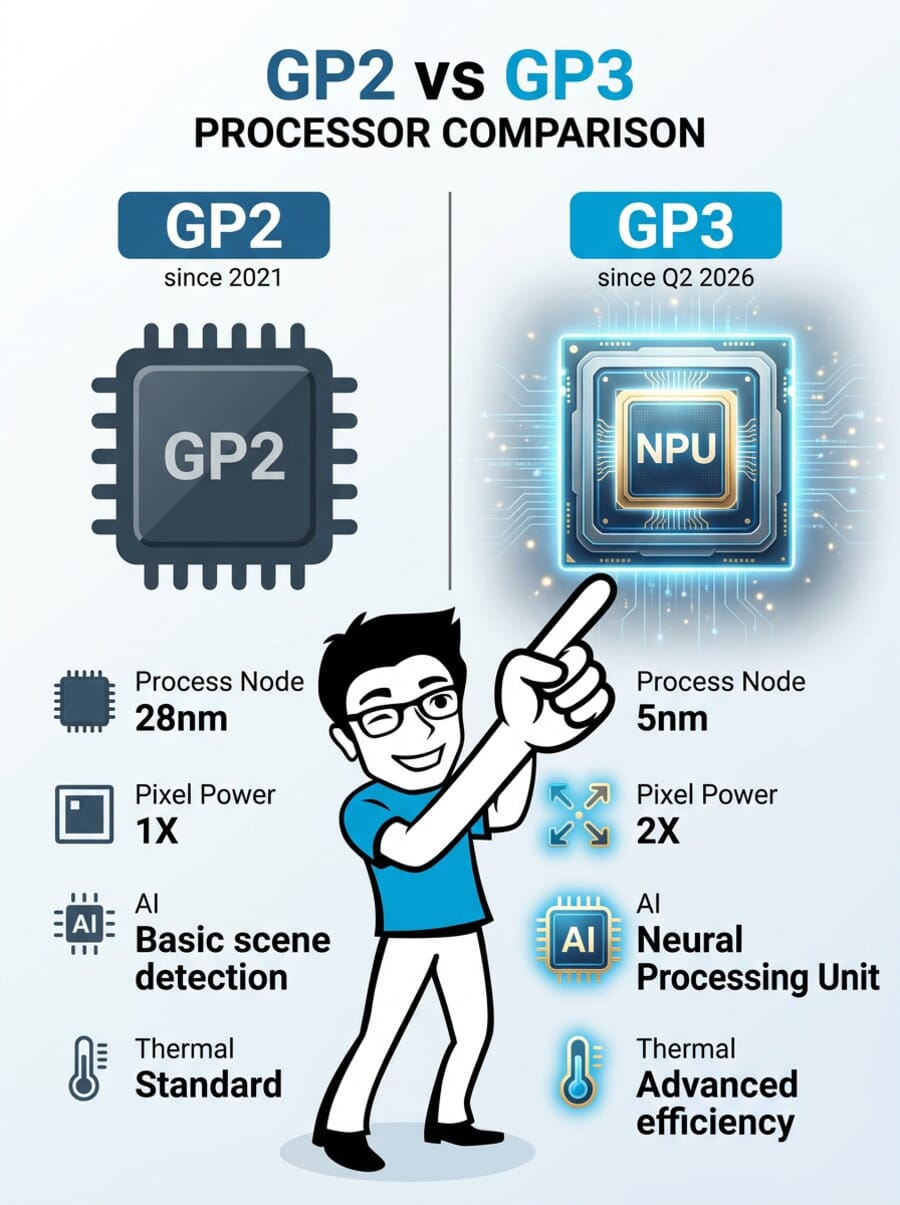
- GoPro’s new GP3 is a 5nm SoC with a dedicated AI Neural Processing Unit, delivering 2x the pixel-processing power of the GP2.
- The chip promises significantly improved low-light performance and thermal management — two of the biggest complaints about current GoPro cameras.
- CEO Nicholas Woodman says GP3 will power “ultra-premium, compact cinema-grade cameras” — signaling a push upmarket beyond action cameras.
- New GP3-powered cameras are expected to launch in Q2 2026, including action cameras, 360 cameras, vlogging cameras, and a new cinema-grade line.
GoPro has announced the GP3, its next-generation custom imaging processor, promising a significant leap in low-light performance, thermal efficiency, and AI-driven image processing. The 5-nanometer chip will debut in new cameras launching in Q2 2026 — and GoPro is making no secret about its ambitions to move upmarket.
The announcement comes at a pivotal moment for the company. In February, GoPro lost its ITC patent complaint against rival Insta360, with the U.S. International Trade Commission ruling that Insta360 did not violate five of GoPro’s utility patents related to stabilization, horizon leveling, and distortion correction. The GP3 reveal reads as GoPro pivoting from legal battles to technological differentiation.
What the GP3 Brings to the Table
The GP3 is a 5-nanometer System-on-a-Chip (SoC) — putting it in the same process node category as the latest chips from competitors like Insta360 and DJI. GoPro says it delivers more than 2x the pixel-processing power of the GP2, which has powered every GoPro camera since the Hero 10 in September 2021.
Key improvements include:
- Dedicated AI Neural Processing Unit (NPU) — enables next-generation video pixel processing and improved scene recognition
- Enhanced low-light performance — GoPro’s biggest acknowledged weakness, with the GP2 consistently trailing competitors in dim conditions
- Improved thermal management — the 5nm architecture should reduce heat buildup, a persistent complaint with small-body cameras during extended recording
- Dedicated cores for subject detection — allowing cameras to identify and track subjects in real-time while auto-adjusting settings
- Higher resolutions and frame rates — likely enabling 8K capability to match Insta360 and DJI offerings
“We expect our new, exclusive GP3 processor to lead in every performance area — image quality, resolution, frame rates, low-light performance, and power and thermal efficiency,” said Pablo Lema, GoPro’s Senior Vice President of Product Management.
The “Cinema-Grade” Ambitions
The most telling detail in GoPro’s announcement isn’t the spec sheet — it’s the language. CEO Nicholas Woodman described the GP3 as enabling “ultra-premium, compact cinema-grade cameras,” adding that the chip will let GoPro “enter the ultra-premium end of the imaging market this year.”
GoPro specifically listed the camera categories GP3 will power: action cameras, 360 cameras, vlogging cameras, and ultra-premium compact cinema-grade cameras. That last category is new territory. It suggests GoPro is preparing to launch a product line that competes not just with Insta360 and DJI’s action cameras, but with compact cinema cameras from the likes of Sony, Blackmagic, and DJI’s own Ronin line.
For a company built on action cameras strapped to helmets and surfboards, this is a significant strategic shift. Whether the GP3’s processing power can truly deliver “cinema-grade” results in GoPro’s tiny form factors remains to be seen — but the ambition is clear.
Why This Matters Now
GoPro’s GP2 processor has been in service since 2021 — an eternity in consumer electronics. During that time, both Insta360 and DJI have released cameras with newer chipsets that outperform GoPro in several areas, particularly low-light shooting.
The competitive landscape has shifted dramatically. DJI’s wireless-enabled products are effectively banned in the U.S. due to the FCC restriction, which removes one major competitor from the American market. But Insta360’s X5 remains a formidable rival, especially after the ITC ruling validated its technology against GoPro’s patent claims.
GoPro also skipped releasing a Hero 14 in September 2025, breaking its annual release cycle for the first time in years. Instead, it launched the GoPro Hero 4K LIT — which received lukewarm reviews, with critics noting that even its LED flashlight couldn’t compensate for poor low-light footage quality. The GP3 announcement signals that GoPro was holding back its biggest upgrade for a more impactful launch.
What Cameras to Expect in Q2 2026
While GoPro hasn’t confirmed specific products, the press release and surrounding reporting suggest several GP3-powered cameras are in the pipeline:
- Hero 14 — the long-awaited flagship action camera update, likely GoPro’s core product refresh
- Max 3 — a next-generation 360 camera building on the Max 2’s generally positive hardware reviews
- A new cinema-grade compact camera — the most intriguing possibility, targeting filmmakers and content creators who want cinema quality in a pocket-sized body
- Vlogging camera — potentially competing with Sony’s ZV series and DJI’s Osmo Pocket line
GoPro released sample images shot with GP3-powered cameras alongside the announcement. The images, showing low-light and outdoor scenes, look impressive — though as with all manufacturer-provided samples, the real-world results will need independent testing.
Can the GP3 Actually Deliver?
On paper, the GP3 addresses GoPro’s two biggest pain points: low-light quality and overheating. The 5nm process node should inherently run cooler and more efficiently than the GP2’s older architecture, and the dedicated NPU for AI-driven image processing could meaningfully improve nighttime and indoor footage.
But processor specs only tell part of the story. Image quality depends on the entire pipeline — sensor, lens, ISP tuning, and computational photography algorithms. GoPro’s competitors haven’t been standing still, and both Insta360 and DJI have made significant strides in their own AI-powered image processing.
The “cinema-grade” claim is the biggest question mark. Professional filmmakers have specific expectations around dynamic range, color science, and codec support that go far beyond raw processing power. If GoPro can deliver on even a fraction of that promise in its compact form factor, the GP3 could represent a genuine turning point for the company.
For photographers and videographers invested in the action camera ecosystem, the Q2 2026 launch window — likely April through June — will be worth watching closely. After years of incremental updates, GoPro appears ready to make its biggest move yet. Whether the GP3 lives up to the “cinema-grade” marketing will determine if this is a comeback story or just another press release.
When will GoPro GP3 cameras be available?
GoPro has confirmed that GP3-powered cameras will launch in Q2 2026, which means between April and June. The company has not announced specific product names or exact release dates yet.
How does the GP3 compare to the GP2?
The GP3 is a 5nm SoC (vs. GP2’s older architecture) with more than 2x the pixel-processing power. It adds a dedicated AI Neural Processing Unit, improved low-light performance, better thermal management, and enhanced scene recognition and subject detection.
What does GoPro mean by ‘cinema-grade’ cameras?
GoPro CEO Nicholas Woodman described GP3 as enabling ‘ultra-premium, compact cinema-grade cameras’ — suggesting a new product line targeting filmmakers and professional content creators, not just the traditional action camera market.
How does this relate to GoPro’s patent dispute with Insta360?
In February 2026, the U.S. ITC ruled that Insta360 did not infringe GoPro’s stabilization and horizon-leveling patents. The GP3 announcement signals GoPro shifting focus from legal challenges to technological competition.
Will the GP3 fix GoPro’s low-light issues?
GoPro has specifically highlighted improved low-light performance as a key GP3 feature, with a dedicated AI NPU for enhanced video pixel processing. Sample images released by GoPro look promising, but independent testing will be needed to verify real-world improvements.
Featured image: Photo by Daniel Vergeles on Unsplash.
Sources used for this article:
Related Posts
Get the Weekly Photography News Digest
Join photographers who get our top stories delivered every Monday morning. No spam, unsubscribe anytime.