


- Schneider-Kreuznach and Samyang (Rokinon in North America) revealed the AF 60-180mm f/2.8 at CP+ 2026 — a constant-aperture telephoto zoom for Sony E-mount and L-Mount.
- The 60mm wide end gives this lens a unique advantage over every 70-200mm f/2.8, covering a focal range no competitor offers at f/2.8.
- It completes an unusual f/2.8 holy trinity alongside the 14-24mm f/2.8 ($960) and 24-60mm f/2.8 ($899) — potentially the most affordable fast zoom trinity on the market.
- Pricing, weight, and exact release date are still unknown, but expect a price well under $2,000 based on the lineup’s track record.
At CP+ 2026 in Yokohama, Schneider-Kreuznach and LK Samyang unveiled the third lens in their collaborative f/2.8 zoom trilogy: the AF 60-180mm f/2.8. It’s a full-frame autofocus telephoto zoom available for Sony E-mount and L-Mount — and it does something no 70-200mm f/2.8 on the market can do.
That wider 60mm starting point may not sound revolutionary on paper, but it fundamentally changes what a telephoto zoom can do. While Canon, Nikon, Sony, and Sigma all start at 70mm, this lens reaches back to 60mm — giving photographers tighter framing than a 50mm prime while maintaining the compression and bokeh of a true telephoto.
What We Know So Far
Details remain scarce — Schneider-Kreuznach and Samyang are treating this as a teaser rather than a full product launch. No official press renders have been released yet, but PetaPixel’s Jaron Schneider and Sarah Teng got hands-on with the lens at the CP+ booth (their article includes close-up photos of the actual lens). Here’s what’s confirmed:
- Focal range: 60-180mm (constant f/2.8 aperture)
- Mount options: Sony E-mount and L-Mount
- Filter thread: 77mm
- Minimum focusing distance: 0.35–0.78m (1.1–2.6 ft) depending on focal length
- Controls: AF/MF switch, zoom lock switch
- Size: Relatively compact — reportedly smaller than most 70-200mm f/2.8 zooms
- Brand: Sold as Rokinon in North America, Samyang elsewhere
The lens shares the same design language as the AF 14-24mm f/2.8 and AF 24-60mm f/2.8, including the distinct grip texture on the zoom ring. Together, the three lenses cover 14mm to 180mm at a constant f/2.8 — one of the widest continuous fast-aperture ranges from any manufacturer.
Why 60-180mm Matters
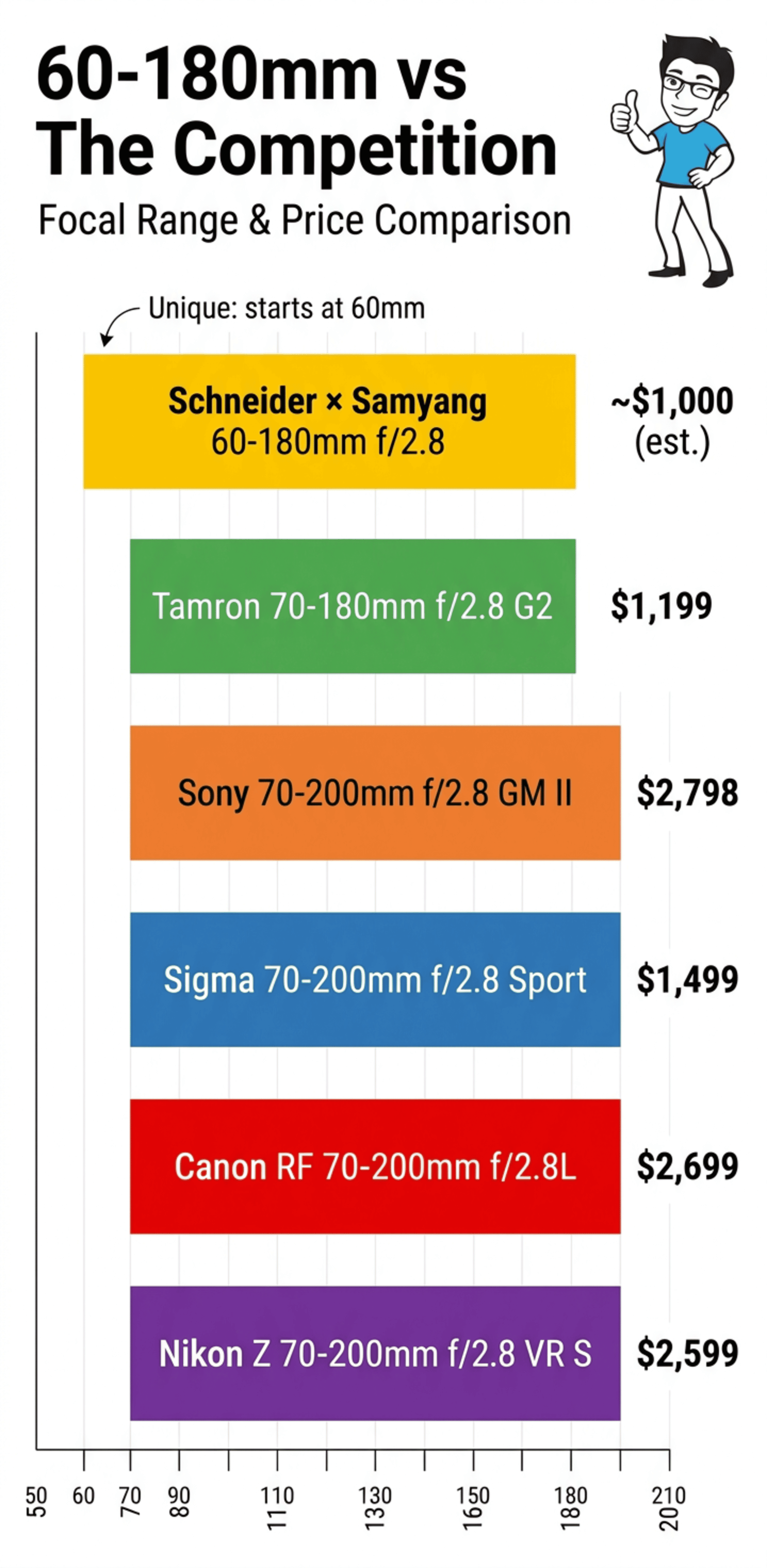
Every major 70-200mm f/2.8 starts at 70mm. The Schneider-Kreuznach × Samyang lens starts at 60mm — and that 10mm difference at the wide end is more significant than it sounds.
At 60mm, you get a field of view that’s noticeably wider than 70mm. This means tighter group shots without switching lenses, more environmental context in portraits, and a more versatile general-purpose range. For event photographers who often find 70mm just slightly too tight for group shots in confined spaces, 60mm could eliminate the need to swap to a 24-70mm.
The 180mm long end is only 20mm shorter than a 200mm, which translates to a barely noticeable difference in reach. For most real-world shooting — portraits, events, sports sidelines, wildlife from moderate distances — 180mm delivers nearly identical framing to 200mm.
The 70-200mm f/2.8 Competitive Landscape
The telephoto f/2.8 zoom is one of the most competitive lens categories in photography. Here’s how the major options stack up:
- Sony FE 70-200mm f/2.8 GM II — $2,798. The benchmark for mirrorless telephoto zooms. Exceptionally sharp, fast AF, 1045g.
- Canon RF 70-200mm f/2.8L IS USM — $2,699. Canon’s flagship telephoto zoom with internal zoom design. 1070g.
- Nikon Z 70-200mm f/2.8 VR S — $2,397. Nikon’s top-tier option with excellent VR performance. 1140g.
- Sigma 70-200mm f/2.8 DG DN OS Sport — $1,499. Strong third-party option for Sony E and L-Mount. 1345g.
- Tamron 70-180mm f/2.8 Di III VC VXD G2 — $1,199. The current value champion with a similar shorter focal range. Compact and light.
The Schneider × Samyang entry is expected to slot in at the budget-friendly end of this spectrum. Given that the 14-24mm f/2.8 sells for $960 and the 24-60mm f/2.8 for $899, a price around $1,000–$1,200 seems likely — which would make it the most affordable constant f/2.8 telephoto zoom with the widest focal range in its class.
Schneider-Kreuznach: Why the Name Matters
Schneider-Kreuznach isn’t a household name for most photographers, but it’s a heavyweight in optics. Founded in 1913 in Bad Kreuznach, Germany, the company has over a century of lens-making expertise spanning cinema, industrial, and photographic optics.
They’re the company behind B+W filters (a staple in every serious photographer’s bag), Xenon cinema lenses used in Hollywood productions, and the legendary optics in Rollei medium-format cameras. Their involvement with Samyang signals a serious commitment to optical quality — not just affordable pricing.
Early reviews of the AF 14-24mm f/2.8 confirmed that the Schneider collaboration delivers real optical performance improvements. If that quality carries over to the 60-180mm, this lens could punch well above its price class.
What We Don’t Know Yet
For all the excitement, there’s still a lot Schneider-Kreuznach and Samyang haven’t revealed:
- Pricing — No official price yet. Based on the lineup, expect $900–$1,200.
- Exact release date — “Coming soon” is all we have.
- Weight — It looked compact at CP+, but no official specs.
- Weather sealing — Unknown. The other two lenses in the trinity offer basic sealing.
- Optical stabilization — No mention of OIS. May rely on in-body stabilization.
- Nikon Z / Canon RF mounts — Only Sony E and L-Mount confirmed so far.
There’s also a fourth lens on the Schneider × Samyang roadmap: an ambitious AF 28-135mm f/2.8 for L-Mount and Sony FE — which would be a superzoom-class lens with a constant f/2.8. No timeline on that one, but it suggests the collaboration is expanding well beyond a simple three-lens trilogy. We’ll update this article as Samyang and Schneider-Kreuznach release more details. For now, check out our full CP+ 2026 lens roundup for everything else announced at the show.
When will the Schneider-Kreuznach × Samyang 60-180mm f/2.8 be available?
No official release date has been announced yet. The lens was shown as a teaser at CP+ 2026 in February. Based on the timeline of previous lenses in the collaboration (14-24mm announced at CP+ 2025, shipped mid-2025), a mid-to-late 2026 release seems likely.
What mounts will the 60-180mm f/2.8 be available in?
Sony E-mount and L-Mount have been confirmed. L-Mount compatibility means it will work with Leica, Panasonic, and Sigma cameras. No Canon RF or Nikon Z mount versions have been announced.
How much will the Schneider × Samyang 60-180mm f/2.8 cost?
Pricing hasn’t been announced. The 14-24mm f/2.8 sells for about $960 and the 24-60mm f/2.8 for $899, so a price in the $1,000–$1,200 range would be consistent with the lineup.
Is 60-180mm really better than 70-200mm?
It depends on your priorities. The 60mm wide end gives you a noticeably wider field of view than 70mm — useful for group shots and environmental portraits. You lose 20mm on the long end (180mm vs 200mm), which is a minor difference in practice. The wider starting point is more impactful for most photographers.
Is the Samyang 60-180mm the same as the Rokinon 60-180mm?
Yes. Samyang lenses are sold under the Rokinon brand in North America. The lenses are functionally identical — same optics, same build, different name on the barrel.
Featured image: Photo by Saif71.com on Unsplash.
Sources used for this article: