


- A Sony camera wearing dazzle camouflage was photographed in the press box at the Milano Cortina 2026 Winter Olympics during a Women’s Ice Hockey match.
- The camera features a Sony battery grip and G Master lens, with a top-plate dial layout matching the A9 series — not the A7R line.
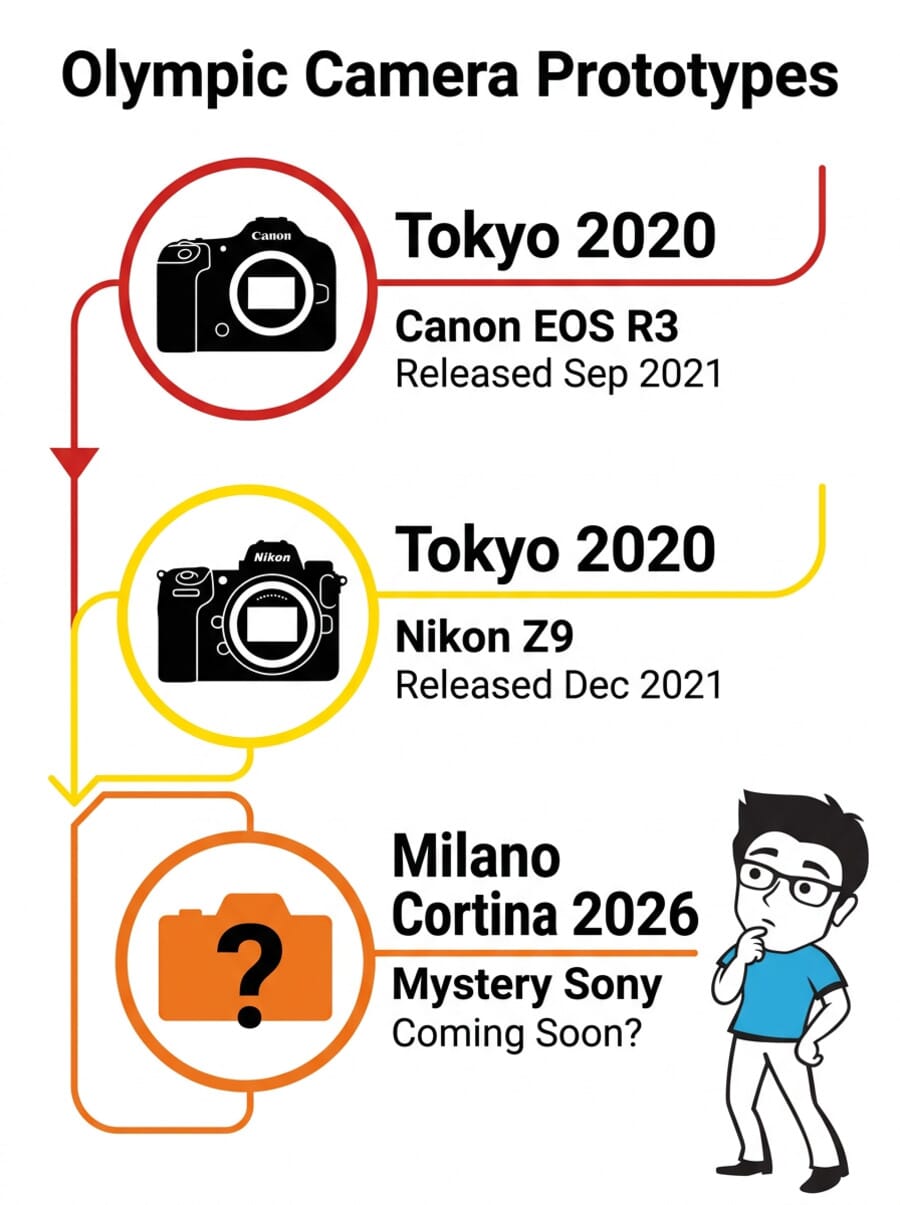
- Camera manufacturers have a long tradition of field-testing prototypes at the Olympics — Canon tested the R3 and Nikon the Z9 at Tokyo 2020, both released months later.
- The Sony A9 III’s global shutter sensor trades roughly 1 stop of dynamic range and high-ISO performance versus conventional sensors — a successor could close that gap.
A Getty Images photographer has captured what appears to be a camouflaged Sony camera at the 2026 Winter Olympics in Milano Cortina — and the photography world is buzzing with speculation about whether this could be an early prototype of Sony’s next flagship sports camera.
The image, credited to photographer Eyes Wide Open, shows two Sony cameras resting on a ledge in the press box during a Women’s Ice Hockey preliminary round match between Germany and Japan on February 7, 2026. One of the cameras is wrapped in a distinctive black-and-white dazzle camouflage pattern — the kind traditionally used to disguise prototype vehicles and, occasionally, unreleased camera bodies from competitors’ prying eyes.
Getty’s own caption on the image reads “A Sony photo camera in prototype design” — which is either a genuinely revealing slip or a Getty editor making an assumption. Either way, it’s fueled days of speculation on Sony Alpha Rumors and camera forums worldwide.
What We Know About the Mystery Camera
Despite the camouflage obscuring many details, the Getty photo reveals several telling features that narrow down what this camera might be.
A Sony logo is clearly visible on the camera’s battery grip, and the orange “G” logo associated with Sony’s G Master optics can be seen on the attached lens. But the most revealing detail is ergonomic: there’s a dial on the left side of the camera’s top plate.
This matters because Sony’s lineup has clear physical differences. The Sony A7R series doesn’t have a dial in this position. The Sony A9 III and A1 II both do — it controls burst mode settings, which makes perfect sense for a sports-oriented camera. Furthermore, the port door layout on the side of the camera is a closer match for the A9 III than the A1 II, based on the visible hinge lines.
A second camera sits behind the first with an inverted version of the same dazzle pattern. This could be a photographer’s strategy for quickly telling two identical bodies apart during fast-paced sports coverage — a common practice among pros who shoot with dual bodies fitted with different lenses.
The A9 III’s Global Shutter: Groundbreaking But Imperfect
To understand why an A9 IV makes sense, you need to understand what the A9 III got right — and where it still falls short.
The Sony A9 III was a genuinely historic camera. Released in early 2024 at a price of 5,999 dollars, it was the first full-frame mirrorless camera with a global electronic shutter. Traditional rolling shutters read the sensor line by line (top to bottom), which takes time — typically 1/125s to 1/200s on most mirrorless cameras. That delay causes skewed verticals on fast-moving subjects and can interact badly with artificial lighting. The A9 III’s global shutter reads every pixel simultaneously, eliminating rolling shutter distortion entirely.
The result: 120fps burst shooting with zero blackout, zero distortion, and flash sync at any shutter speed — including 1/80,000s. For sports photographers, that’s transformative. No more timing flash sync. No more warped tennis rackets or golf clubs.
But global shutter technology came with a cost. According to DPReview’s lab analysis, the A9 III’s sensor loses roughly 1 stop of dynamic range compared to the best conventional sensors, and high-ISO noise is noticeably higher than you’d expect from a 24.6MP full-frame sensor. The base ISO is 250 (not 100), which means less latitude when shooting in bright daylight. And at higher ISOs, the sensor shows visible fixed-pattern noise artifacts related to the global shutter circuitry.
For sports shooters working in well-lit stadiums, these tradeoffs are acceptable. But for hockey arenas with mixed lighting, or evening outdoor events, the A9 III’s high-ISO performance leaves something on the table — which is exactly what a second-generation global shutter sensor could improve.
Why a Sony A9 IV Makes Sense Right Now
The A9 III began shipping in early 2024, making it over two years old by the time of the Milano Cortina games. Two years is a long time in the sports photography arms race. Consider what’s happened since:
- Canon released the EOS R1 (late 2024) — their long-awaited flagship with a stacked CMOS sensor, 40fps, and cross-type dual-pixel AF. It’s now the camera most commonly seen at major sporting events alongside the A9 III.
- Nikon shipped the Z6 III with a partially stacked sensor delivering faster readout speeds, bringing some global-shutter-like benefits at a much lower price point.
- Sony launched the A1 II (late 2024) — a 50MP hybrid camera that’s faster and more capable than the original A1, but still uses a rolling shutter (albeit a very fast one at 1/300s readout).
- The Sony A7V was announced at CP+ 2026 with improved heat dissipation architecture — which could be a hint at platform-level changes that benefit the entire lineup.
Professional sports photographers demand constant improvement: faster autofocus tracking in chaotic team sports, better low-light performance for indoor venues, higher resolution for aggressive editorial crops, and faster connectivity for press deadlines measured in minutes. The A9 III was the first to prove global shutter was viable. An A9 IV could be the camera that makes it mature.
A History of Olympic Prototype Testing
Camera manufacturers using the Olympics as a real-world testing ground isn’t just common — it’s practically a tradition. The logic is straightforward: the Olympics are the most demanding sports photography environment on Earth. Thousands of frames per hour, unpredictable lighting, split-second moments, and the results need to be on editors’ desks within minutes. If a camera works here, it works everywhere.
At the Tokyo 2020 Olympics (held in summer 2021), Canon put the EOS R3 in the hands of select photographers months before its official September 2021 release. Photographer Atiba Jefferson famously demonstrated the R3’s 30fps continuous shooting capability from the sidelines, and the camera’s eye-control autofocus drew widespread attention. It was a carefully staged preview — Canon knew the R3 would be compared against Nikon and Sony’s flagships, and wanted real-world Olympic images in the PR pipeline before launch.
Nikon did the same with the Z9, which was spotted at Tokyo 2020 in disguised form before its December 2021 launch. The Z9 went on to become Nikon’s most successful professional camera, proving the concept of a fully electronic shutter in a pro body (no mechanical shutter at all).
Going further back, Canon field-tested the EOS-1D X Mark III at the 2019 Rugby World Cup before its February 2020 release, and Nikon has a long history of using the Olympics to showcase development-stage cameras dating back to the film era.
The pattern is clear: spot a disguised camera at the Olympics, and there’s a reasonable chance you’re looking at a product that’ll be in stores within 6-12 months.
What Could a Sony A9 IV Bring?
If this mystery camera is indeed an A9 IV prototype, the most likely improvements would target the areas where the A9 III’s global shutter still lags behind conventional sensors:
- Second-generation global shutter sensor — The biggest anticipated upgrade. Sony Semiconductor has been actively developing improved global shutter designs, and a second generation could narrow the dynamic range and high-ISO gap from ~1 stop to near parity with rolling shutter sensors. A lower base ISO (100 instead of 250) would be a significant practical improvement for outdoor daytime shooting.
- Higher resolution — The A9 III’s 24.6MP is sufficient for most editorial use, but aggressive crops for web and social media mean more pixels are always welcome. A 33-36MP sensor would provide a meaningful resolution bump while keeping file sizes manageable for 120fps burst shooting.
- AI-enhanced autofocus — The A9 III already has excellent subject tracking, but the A1 II introduced improved AI subject recognition with new training data. An A9 IV would likely inherit and expand on this, with better performance in cluttered scenes like team sports huddles or cyclist pelotons.
- Improved connectivity — Faster Wi-Fi 6E/7, potentially built-in 5G, and streamlined FTP workflows for press deadlines. The Milan-Cortina 2026 Olympics showcased near-real-time image delivery; an A9 IV could make that standard without external transmitters.
- 8K video — The Canon R1 and Nikon Z8 both offer 8K, and Sony’s A1 II already does 8.6K internally. An A9 IV with global shutter would mean 8K video with zero rolling shutter — a game-changer for high-end broadcast work.
The Broader Context: 810 Cameras at One Olympics
The mystery Sony isn’t the only camera story at Milano Cortina 2026. Olympic Broadcasting Services (OBS) deployed over 810 camera systems across venues for the live broadcast, including 32 dedicated cinematic cameras (Sony VENICE 2, BURANO, and FX6 units), 25 drones including 15 FPV units, and AI-driven volumetric replay systems. For the first time, large-format Super 35mm and full-frame cinema cameras cut directly into the live broadcast switch alongside traditional broadcast cameras — a fundamental shift in how the Olympics look on screen.
Sony was a key technology partner for the broadcast operation, with NBC Sports confirming more than 100 Sony cameras across competition venues. The entire production ran on an IP-based remote workflow connecting venues separated by hundreds of kilometers of mountainous terrain. If Sony was also quietly testing their next-generation stills camera in the same venues, it would fit perfectly with their overall Olympic presence.
Or Is It Just a Dressed-Up A9 III?
It’s worth being honest about the more mundane explanation: custom camera skins with dazzle patterns are commercially available and easy to buy. Companies like AlphaGvrd sell them specifically for the Sony A9 III for about 30 dollars. It’s entirely possible that a photographer simply dressed up their existing camera — perhaps for scratch protection during the demanding event environment, or just because it looks cool.
There’s also the timeline argument. The A9 III is less than two years old, which is shorter than Sony’s typical pro camera refresh cycle. The A9 II arrived in October 2019, roughly 2.5 years after the original A9 in April 2017. The jump from A9 II to A9 III was even longer — about 4.5 years. A March 2026 prototype test for a late 2026 or early 2027 release would fit the cadence, but it’s tight.
The pro-level Sony camera with the most active rumor mill right now is arguably the Sony A7R VI, which has been the subject of persistent “100MP+” speculation. However, the existing A7R V lacks the top-plate dial visible in the mystery camera photo — though a redesign isn’t impossible.
And there’s a third possibility: this could be an entirely new camera category. Sony recently registered new camera codes with international certification bodies, and the FX3 II (a cinema-focused camera) is widely expected in spring 2026 with a new partially stacked 16MP sensor. Could the mystery camera be something unexpected?
Whatever the truth, the sighting has given the photography community exactly the kind of mystery it loves. The Olympics have always been as much about the technology behind the images as the athletes in front of the lens — and this dazzle-wrapped Sony is the most interesting plot twist of Milano Cortina 2026.
What camera was spotted at the 2026 Winter Olympics?
A Sony camera wearing dazzle camouflage (a black-and-white pattern designed to hide product details) was photographed in the press box during the Women’s Ice Hockey preliminary round at Milano Cortina 2026. It features a Sony battery grip, G Master lens, and a top-plate dial layout consistent with the A9 series.
Is the mystery Sony camera definitely a prototype?
Not necessarily. While Getty Images captioned it as “A Sony photo camera in prototype design,” commercially available camera skins with identical dazzle patterns exist for the Sony A9 III and cost around 30 dollars. It could be a prototype or simply a customized existing camera.
Have camera companies tested prototypes at the Olympics before?
Yes, it’s a well-established tradition. Canon tested the EOS R3 at the Tokyo 2020 Olympics before its September 2021 release, Nikon tested the Z9 at the same games before its December 2021 launch, and Canon tested the EOS-1D X Mark III at the 2019 Rugby World Cup. Cameras spotted at the Olympics typically ship within 6–12 months.
When was the Sony A9 III released and what does it cost?
The Sony A9 III began shipping in early 2024 at a launch price of 5,999 dollars. It was the world’s first full-frame mirrorless camera with a global electronic shutter, offering up to 120fps burst shooting with zero rolling shutter distortion and flash sync at any shutter speed.
What are the A9 III’s known limitations that an A9 IV might fix?
The A9 III’s global shutter trades roughly 1 stop of dynamic range and high-ISO performance versus conventional sensors. The base ISO is 250 instead of 100, which limits bright-daylight latitude. An A9 IV with a second-generation global shutter could close these gaps while potentially adding higher resolution (33-36MP vs 24.6MP), improved AI autofocus, and 8K video.
How many cameras were used to broadcast the Milano Cortina 2026 Olympics?
Olympic Broadcasting Services deployed over 810 camera systems including 32 cinematic cameras (Sony VENICE 2, BURANO, FX6), 25 drones (including 15 FPV units), 1,800 microphones, 50 jibs/cranes, and 12 cablecam rigs. Sony was a key technology partner, with NBC Sports using over 100 Sony cameras across venues.
Sources used for this article:
Featured image: Photo by Klim Musalimov on Unsplash.
Related Posts