


- The U.S. Supreme Court declined to hear Dr. Stephen Thaler’s appeal on March 2, 2026, leaving lower court rulings intact: AI-generated images without human authorship cannot be copyrighted.
- This ruling only applies to fully autonomous AI output where no human creative input is claimed — it does not mean AI-assisted photography or editing tools like Photoshop Generative Fill or Midjourney are off-limits for copyright.
- Photographers who use AI as a creative tool — selecting, arranging, and modifying outputs — can still build a strong case for copyright protection by documenting their creative process.
What Happened: The Supreme Court’s Decision
On March 2, 2026, the United States Supreme Court declined to hear Dr. Stephen Thaler’s appeal seeking copyright protection for an image created entirely by his AI system, the “Creativity Machine.” The decision ends an eight-year legal battle and leaves intact lower court rulings that AI-generated works without human authorship cannot receive copyright protection under U.S. law.
The artwork at the center of the case, titled A Recent Entrance to Paradise, depicts train tracks leading into a portal framed by green and purple plant imagery. Thaler listed his AI system as the sole creator — no human author was named on the application.
The Trump administration’s Department of Justice had urged the justices not to take up the case, arguing that “although the Copyright Act does not define the term ‘author,’ multiple provisions of the act make clear that the term refers to a human rather than a machine.”
Eight Years of Legal Battles
The Thaler case has wound through the U.S. legal system since 2018. Here’s how it played out:
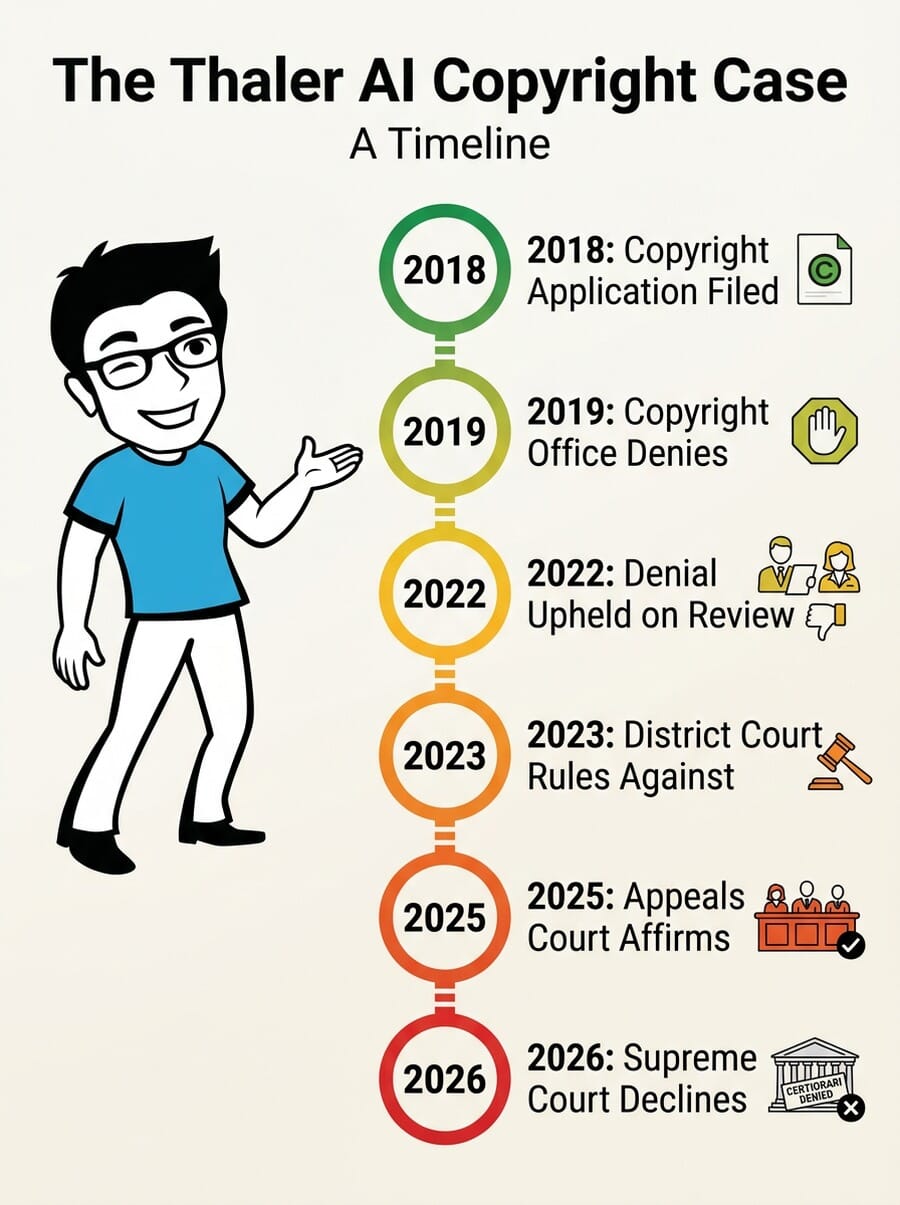
Thaler first applied for copyright registration in 2018, listing his Creativity Machine as the author. The U.S. Copyright Office denied the application in 2019, citing its requirement that copyrighted works must have human authors. After an internal re-review in 2022, the agency upheld the denial, concluding the image “was autonomously created by artificial intelligence without any creative contribution from a human actor.”
Thaler challenged the decision in federal court. In 2023, U.S. District Judge Beryl A. Howell upheld the Copyright Office’s ruling, writing that human authorship is a “bedrock requirement of copyright.” The U.S. Court of Appeals for the District of Columbia Circuit affirmed that decision in 2025.
Thaler’s lawyers argued the case was of “paramount importance” given the rapid rise of generative AI. But with the Supreme Court’s refusal, they warned: “even if it later overturns the Copyright Office’s test in another case, it will be too late.”
What This Doesn’t Mean
Here’s the critical distinction many headlines are missing: this ruling does not mean that all AI-assisted creative work is uncopyrightable.
Thaler’s case was uniquely extreme. He deliberately listed his AI system as the sole author and claimed no human creative involvement whatsoever. The court never addressed the far more common scenario — a photographer or artist who uses AI as one tool among many in a creative workflow.
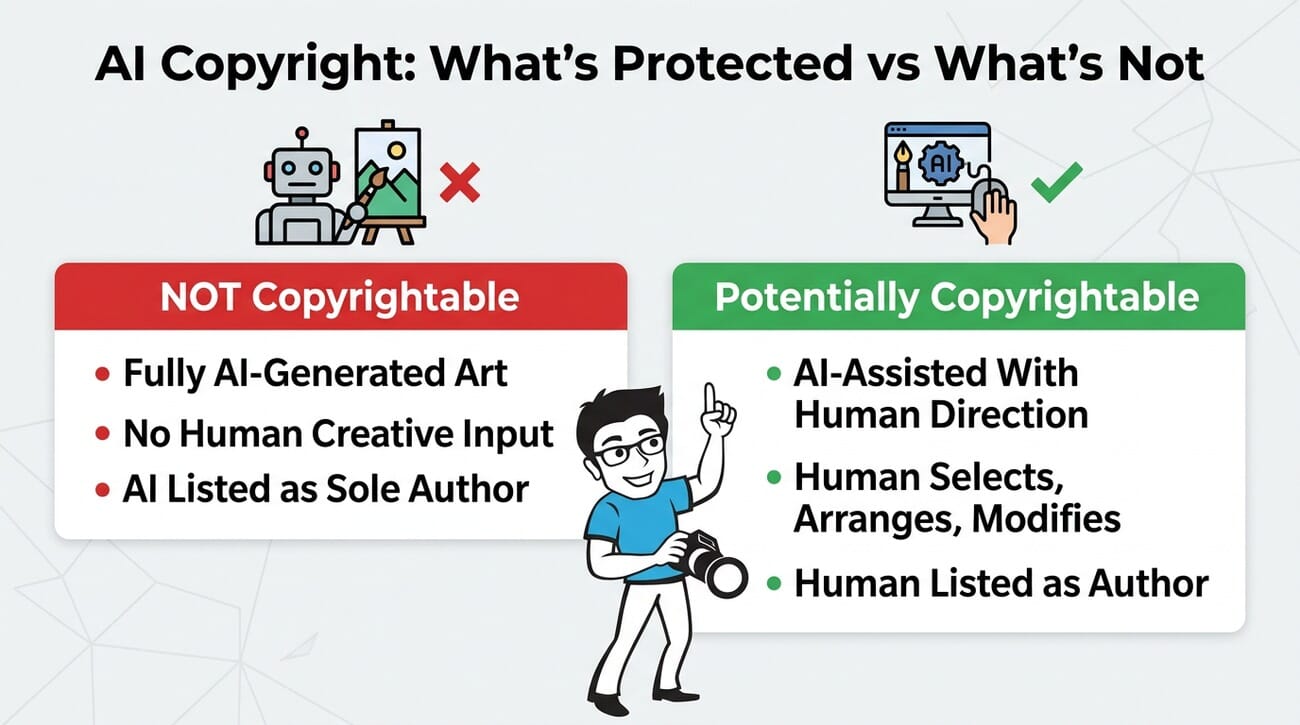
Think of it this way: a photographer who uses Photoshop’s Generative Fill to extend a background, or who uses AI-powered editing tools to adjust lighting, is in a fundamentally different position than someone who types a prompt into an AI system and claims no creative role in the output.
The Copyright Office’s Evolving Stance on AI Tools
The U.S. Copyright Office has been navigating this gray area case by case. It has rejected copyright registrations for images generated using Midjourney, even when the applicants argued they used AI as a tool rather than claiming the system acted independently.
The most notable case involved graphic novelist Kris Kashtanova, who received — and then partially lost — copyright registration for the comic Zarya of the Dawn. The Copyright Office ruled that while Kashtanova held copyright over the text and the selection/arrangement of images, the individual Midjourney-generated images themselves were not copyrightable because the artist could not predict or control the specific output.
This sets up an important framework: the more control a human demonstrates over the creative output, the stronger the copyright claim. Simply typing a text prompt and selecting from generated options may not be enough. But substantially modifying, arranging, and incorporating AI outputs into a larger creative work could qualify.
What Photographers Should Do Now
For photographers who use AI tools in their workflow — whether that’s AI-powered upscaling, generative fill, sky replacement, or noise reduction — the practical takeaways are clear:
- Document human creative decisions. Keep records of the choices made during the creative process — composition, subject selection, editing decisions, and how AI tools were used as instruments rather than autonomous creators.
- List yourself as the author. Never list an AI system as the creator of your work. The human photographer is the author; AI is the tool — no different from a camera’s autofocus or auto-exposure systems.
- Maintain substantial human input. The more a photographer shapes the final image through selection, arrangement, timing, composition, and post-processing, the stronger the copyright claim. Use AI to assist, not to replace creative judgment.
- Stay informed on Content Credentials and C2PA standards. As AI-generated and AI-assisted content becomes more common, provenance metadata that documents the human role in creating an image will become increasingly important for establishing authorship.
- Watch for future legislation. Congress has not yet passed comprehensive AI copyright legislation. The Copyright Office continues to issue guidance on a case-by-case basis, and future rulings — particularly ones involving AI-assisted (not fully autonomous) works — could shift the landscape significantly.
The Bigger Picture
The Thaler case may be over, but the broader question of AI and copyright is far from settled. This ruling addresses only the narrowest scenario: can a machine, with zero human involvement, be an “author” under U.S. law? The answer is no.
The far more consequential battles — over AI training on copyrighted images, over the threshold of human involvement needed for copyright protection, and over how existing copyright law applies to rapidly evolving AI capabilities — remain unresolved. For photographers, the message is straightforward: keep creating, keep using tools that make the work better, and make sure the human behind the camera stays at the center of the creative process.
Can I copyright photos I edited with AI tools like Photoshop Generative Fill?
Likely yes, as long as you — the human — are making the creative decisions. The Thaler ruling only addressed fully autonomous AI output with no human authorship claimed. Using AI as an editing tool within a human-directed workflow is a fundamentally different situation. Document your creative process to strengthen your claim.
Does the Supreme Court ruling mean AI art is illegal?
No. The ruling means AI-generated images without a human author cannot receive copyright protection. Creating AI art is still legal — it simply may not be eligible for the exclusive rights that copyright provides, such as preventing others from copying or distributing it.
What about Midjourney images — are they copyrightable?
The Copyright Office has rejected registrations for individual Midjourney-generated images, ruling that the artist lacked sufficient control over the specific output. However, the selection and arrangement of AI images within a larger work (like a graphic novel) may still qualify for copyright protection.
Should photographers stop using AI tools?
Not at all. AI-powered features like noise reduction, upscaling, sky replacement, and generative fill are standard tools in modern photography workflows. The key is to use AI as an instrument that supports human creative vision, not as an autonomous creator. The photographer remains the author.
Will Congress pass new AI copyright laws?
There is significant interest in AI legislation, but no comprehensive AI copyright law has been passed as of March 2026. The Copyright Office continues to evaluate applications case by case and has issued guidance documents. Photographers should stay informed as the legal landscape continues to develop.
Sources used for this article:
Featured image: Photo by Bernd Dittrich on Unsplash.
Related Posts
Get the Weekly Photography News Digest
Join photographers who get our top stories delivered every Monday morning. No spam, unsubscribe anytime.