


- OM Digital Solutions CEO Shigemi Sugimoto, a 35+ year Olympus veteran, has become the principal shareholder — taking over from Japan Industrial Partners’ OJ Holdings.
- The move shifts control from a restructuring-focused equity firm to a camera industry insider, potentially enabling faster product development and bolder strategic decisions.
- OM System says the change will allow “more agile and flexible decision-making” and strengthen technology development investments.
- The timing is notable — OM System has been unusually active lately with the OM-3 Astro release and hints about a new PEN camera.
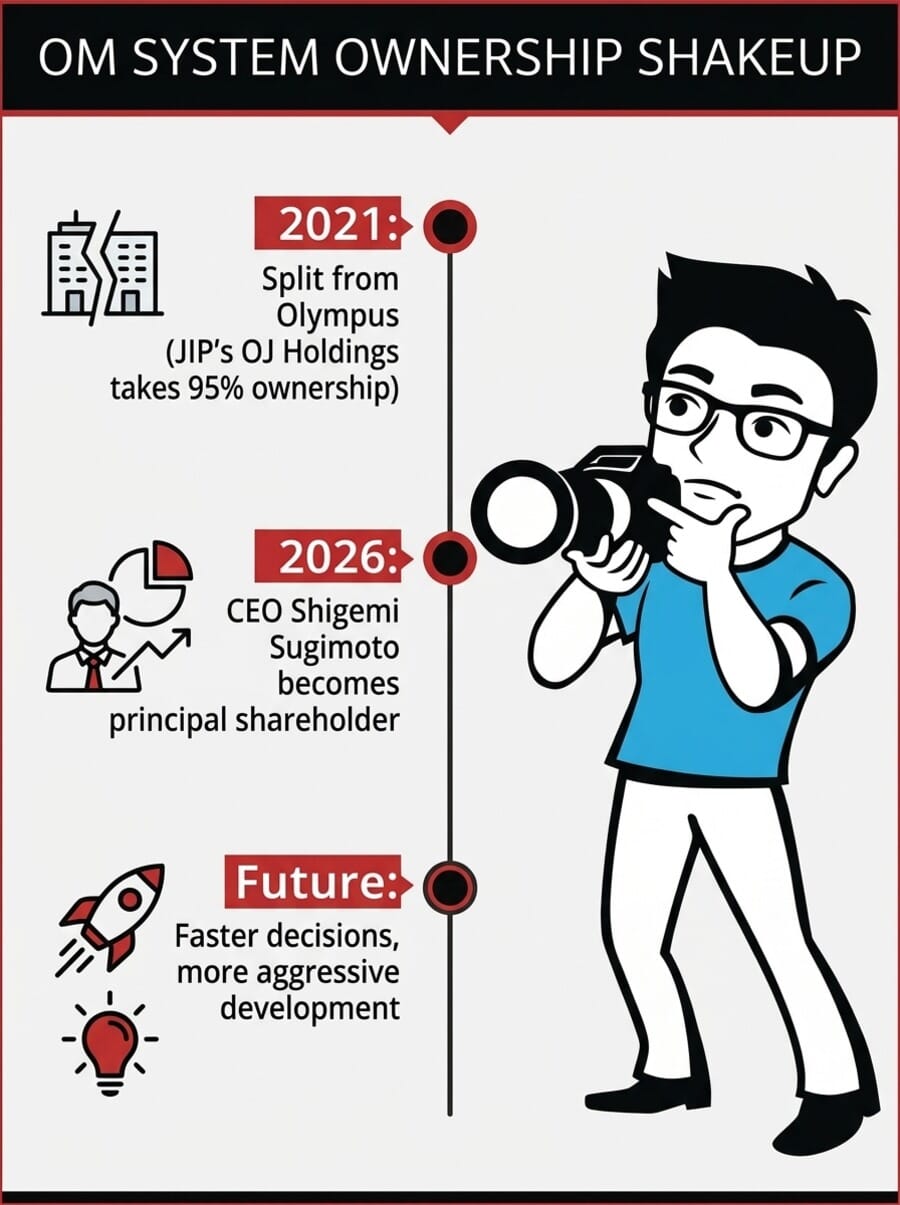
OM Digital Solutions, the company behind the OM System camera brand, has just undergone one of its most significant corporate changes since splitting from Olympus in 2021. CEO Shigemi Sugimoto — a veteran with over 35 years at Olympus and OM System — has personally taken over as the principal shareholder, replacing Japan Industrial Partners’ OJ Holdings as the majority owner.
The announcement, made on April 1 (and no, it’s not a joke), signals a major shift in how the Micro Four Thirds camera maker will be governed going forward. But what does a corporate ownership change actually mean for photographers who shoot OM System gear?
What Happened: From Equity Firm to CEO Ownership
When Olympus exited the camera business in 2021, Japan Industrial Partners (JIP) stepped in through its subsidiary OJ Holdings, acquiring 95% of the newly formed OM Digital Solutions. Olympus retained a 5% stake. JIP is a private equity firm known for restructuring struggling Japanese manufacturing companies — its portfolio has included Toshiba and Vaio.
Now, that ownership structure has fundamentally changed. Sugimoto, who led the original split from Olympus and has served as CEO since the beginning, has become the company’s principal shareholder. The move effectively transfers management control from a holdings corporation to the person who has been running the company day-to-day.
OM Digital Solutions confirmed that there are no changes to the company’s legal entity, name, location, or business activities as a result of the restructuring. It’s a change at the ownership level, not the operational level.
Why This Matters for Photographers
Corporate governance isn’t exactly riveting reading for most photographers. But this particular change could have real implications for the gear OM System develops.
Under JIP ownership, OM System was essentially run by an investment firm focused on restructuring and financial performance. While JIP kept the company alive and operational, private equity firms typically prioritize return on investment over long-term product development — and they often have exit timelines in mind.
With Sugimoto as principal shareholder, the incentive structure flips. His personal wealth is now directly tied to the company’s long-term success, not just quarterly performance metrics. That typically translates to more willingness to invest in R&D and make bolder product decisions.
OM Digital Solutions itself framed the change in exactly those terms, stating it will “enable more agile and flexible decision-making” and “further strengthen promotion of technology development investments and business growth strategies from a medium- to long-term perspective.”
Who Is Shigemi Sugimoto?
Sugimoto is not some outside executive parachuting in. He spent more than 35 years at Olympus before leading the transition to OM Digital Solutions. He previously served as the head of Olympus’ imaging division — the same division that JIP acquired to form OM System.
Under his leadership, OM System has carved out a distinct identity focused on compact, weather-sealed cameras built for outdoor and adventure photography. The Micro Four Thirds system’s size advantage has been positioned as a feature, not a compromise — particularly for wildlife, macro, and travel photographers who value portability.
The fact that a longtime camera executive chose to personally take on majority ownership is itself a strong signal. You don’t put your own money on the line unless you believe in what the company is doing.
The Unanswered Questions
There are still some significant unknowns. The company’s press release doesn’t clarify exactly what happened to JIP’s stake. Did Sugimoto buy them out entirely? Does JIP retain a minority interest? The details of the financial transaction haven’t been disclosed.
OM Digital Solutions is also a privately held company, unlike its former parent Olympus (which is publicly traded). That means there’s limited visibility into the company’s financial health. We don’t know revenue figures, profit margins, or unit sales numbers — only that the company has continued releasing new products at a steady pace.
The private nature of the company also means Sugimoto’s ownership move doesn’t carry the same regulatory scrutiny or public disclosure requirements that it would for a publicly traded firm.
What’s Next for OM System?
The timing of this announcement is intriguing. OM System has been notably active and unusually communicative in recent months.
At CP+ 2026 in February, OM System executives were surprisingly eager to discuss a new PEN camera — a revival of the beloved Olympus PEN line. While no specifics were confirmed, the enthusiasm was palpable and unusual for a company that typically keeps its cards close.
The company’s recent product output has also been encouraging:
- 2025: Released the OM-3 and OM-5 II cameras, plus four new lenses including the entirely new 50-200mm f/2.8 IS Pro
- Early 2026: Launched the OM-3 Astro, a specialized astrophotography variant
- Coming soon: Strong hints about a PEN camera revival
With ownership now consolidated under a camera-industry lifer who has spent three decades building imaging products, the stage appears set for OM System to take some bigger swings. Whether that means more aggressive pricing, faster product cycles, or entirely new product categories remains to be seen — but the structural barriers to bold decision-making just got a lot lower.
Frequently Asked Questions
Is OM System going out of business?
No. This ownership change is actually seen as a positive sign. The CEO taking personal financial ownership suggests confidence in the company’s future, not an exit. OM System continues to release new cameras and lenses.
Does this affect existing OM System cameras and lenses?
Not at all. The change is purely at the corporate ownership level. There are no changes to the company’s products, services, warranties, or business operations.
Who owned OM System before this change?
Japan Industrial Partners (JIP) held 95% of OM Digital Solutions through its subsidiary OJ Holdings, Ltd. Olympus retained a 5% stake after the 2021 split. JIP is known for restructuring Japanese companies including Toshiba and Vaio.
Will OM System still make Micro Four Thirds cameras?
All signs point to yes. Sugimoto has been the driving force behind OM System’s focus on compact, weather-sealed Micro Four Thirds cameras. There’s no indication of a format change — in fact, recent product releases and hints at CP+ 2026 suggest an expanding MFT lineup.
Sources used for this article:
Featured image: Photo by Greg Rosenke on Unsplash.


Don’t miss this week’s photography news
Every Sunday: camera launches, lens announcements, and the photography industry moves that matter — curated before the big sites catch up. Free, one-click unsubscribe.