


- Bloomberg reports that HSG — the Chinese investment firm once known as Sequoia Capital China — is the front-runner to buy Blackstone’s roughly 45% stake in Leica Camera.
- HSG may also pursue the Kaufmann family’s remaining ~55%, which would hand it full control. The deal values Leica at about $1.2 billion (€1 billion).
- Nothing is signed. No party has commented, and an announcement could be weeks away — or never come at all.
- A financial owner isn’t a strategic one: Blackstone held 45% for years without changing how Leica operates, and HSG would likely follow the same playbook.
- Leica’s China ties already run deep through its Xiaomi camera partnership, so “Chinese ownership” is less of a culture shock than the headlines suggest.
The most German of camera brands may be about to get a Chinese owner. Bloomberg reported on May 29 that HSG — the Beijing-based investment firm once known as Sequoia Capital China — has emerged as the front-runner to buy Blackstone’s stake in Leica Camera AG, the Wetzlar company behind the red dot. Leica Rumors followed on June 2 with word that the talks are now “advanced,” and that HSG may not stop at Blackstone’s shares.
On paper it reads like a culture clash: a century-old symbol of German optical craftsmanship passing into the hands of the firm that helped bankroll TikTok’s parent, Meituan and Pinduoduo. The reality is more nuanced — and for anyone who owns a Leica or is saving up for one, mostly reassuring. Here’s what is actually on the table, who HSG is, and what a change of ownership would (and would not) change about Leica.
What’s Actually on the Table
Blackstone holds about 45% of Leica Camera AG, a stake it has backed since 2011. The other ~55% sits with ACM, the investment vehicle of Austrian billionaire Andreas Kaufmann — the man widely credited with steering Leica’s modern luxury revival. Both shareholders have been working with advisers on a sale that values the company at around $1.2 billion (€1 billion).
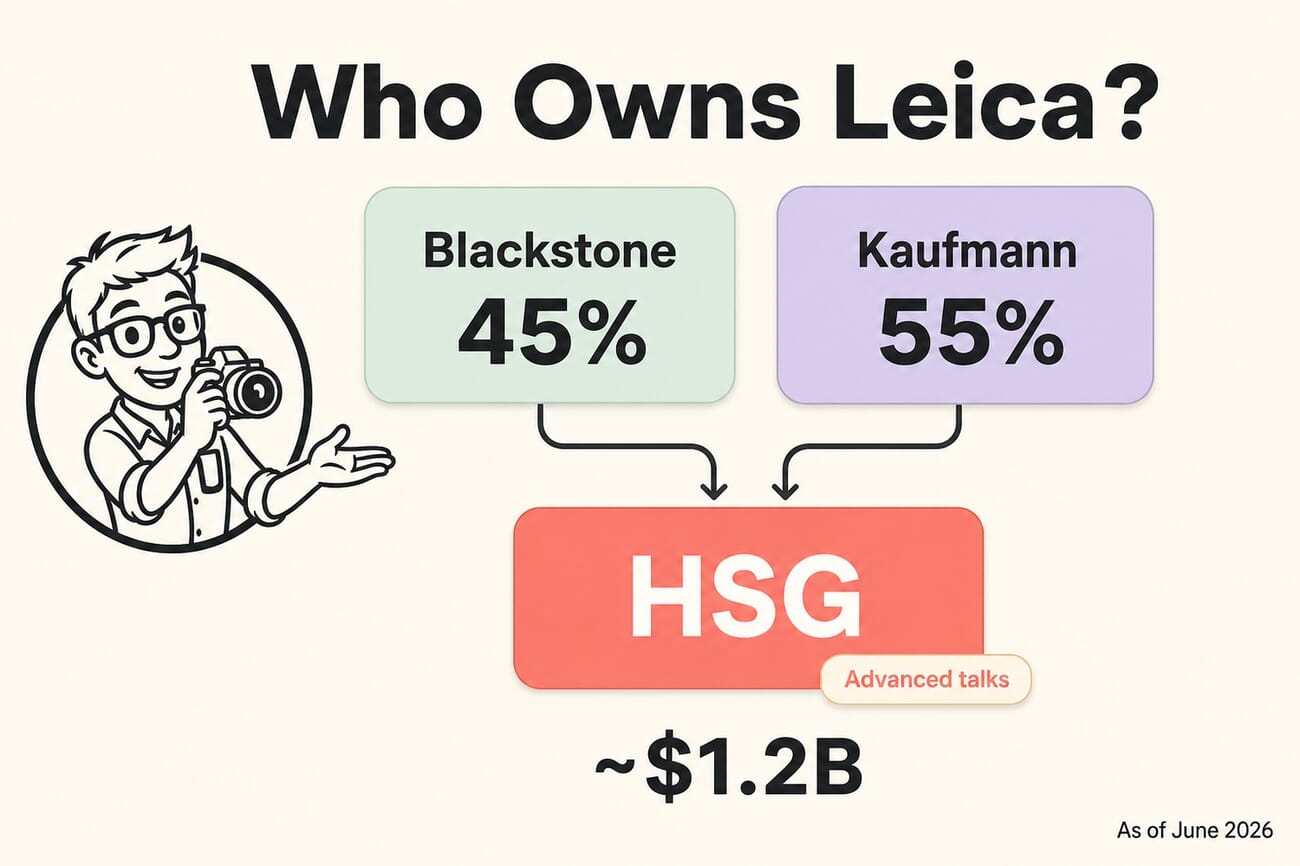
HSG is reported to be ahead of a short field that included Swedish buyout firm Altor Equity Partners. According to Leica Rumors, HSG may also seek to buy out the Kaufmann family’s majority — which would give it outright control. If that happens, sources say HSG could eventually explore taking Leica public through an IPO.
The usual caveats apply, loudly: the talks are still ongoing, none of the parties has commented publicly, and any announcement could be weeks away. Deals at this stage fall apart all the time. The same reporting around Blackstone’s exit has already been linked to Leica’s recent decision to quietly shelve its medium-format mirrorless program.
Who Is HSG?
HSG — short for HongShan Capital Group — spent 18 years as Sequoia Capital’s China arm before splitting off and rebranding in 2023. Led by veteran investor Neil Shen, it manages roughly $55 billion and ranks among the most powerful technology investors in Asia, with past bets on ByteDance, Meituan and Pinduoduo.
That portfolio matters for reading Leica’s future. HSG is a financial investor — not a camera maker, and not a consumer-electronics conglomerate. It buys stakes to grow their value and eventually sell or list them, which is exactly what Blackstone has been doing. A Leica under HSG would have a new name on the cap table, not a new factory floor in Shenzhen.
What Chinese Ownership Could Mean for the “German” in Leica
This is the question driving the headlines, and the honest answer is: probably less than you’d fear. Leica’s worth isn’t in its machinery — it’s in the name, the Wetzlar heritage, and the scarcity that lets it sell cameras for the price of a used car. Any owner that cheapens that destroys the very thing it paid $1.2 billion for.
There’s also precedent. Blackstone has co-owned Leica for over a decade without moving production, watering down the M-system, or turning the brand into a mass-market label. The cameras stayed German-made, expensive, and deliberately niche. A profit-seeking owner — German, American, or Chinese — has the same incentive to leave that formula alone.
What could change is ambition in Asia. A China-based owner with deep local networks could accelerate Leica’s retail expansion in the world’s largest luxury market and lean harder into the collaborations and limited editions that already drive a meaningful slice of its revenue.
The Xiaomi Connection — Leica Is Already Deep in China
If the idea of Chinese involvement in Leica feels new, it isn’t. Leica has spent years co-engineering the camera systems on Xiaomi’s flagship phones, and that partnership now anchors some of the most talked-about cameraphones on the planet — from the 1-inch-sensor Xiaomi 17 Ultra to the LOFIC sensor tech Leica helped tune.
That relationship has been enormously good for Leica. It puts the red dot in the pockets of hundreds of millions of buyers who will never spend $6,000 on a Q3, and it generates licensing income with none of the manufacturing risk. A Chinese financial owner is, if anything, more likely to protect and expand that pipeline than to interfere with it. The “German brand goes Chinese” framing misses that Leica’s biggest growth story is already, in part, a Chinese one.
Should Leica Owners and Buyers Worry?
For now, no — and possibly not later either. Nothing has been signed, the M, Q, and SL lines are unaffected, and warranties, service, and lens roadmaps continue exactly as before. Even if HSG closes a full takeover, the most likely outcome is continuity: the brand is the asset, and continuity is what protects it.
The scenario worth watching isn’t a quality collapse — it’s an eventual IPO. If HSG buys the whole company and later lists it, Leica would answer to public shareholders for the first time, and public markets can pressure heritage brands to chase volume. That’s a multi-year “what if,” though, not a 2026 reality.
What Happens Next
Expect silence, then a sudden headline. None of the parties will confirm anything until a deal is signed or dead, so watch for a formal Bloomberg or Leica statement — until then, “advanced talks” means serious interest, not a done deal. Leica, for its part, has a new CEO in Andreas Voll (appointed March 2026) and a clear luxury strategy. Whoever owns it next inherits a brand in good shape, which is exactly why it’s worth a billion dollars.
FAQ
Who is trying to buy Leica?
HSG (HongShan Capital Group), a Chinese investment firm formerly known as Sequoia Capital China and led by Neil Shen. It’s reportedly the front-runner for Blackstone’s stake and may pursue full control of the company.
How much is Leica worth in this deal?
Around $1.2 billion (€1 billion), according to Bloomberg’s reporting.
Is Leica being sold to China for sure?
No. As of early June 2026 the talks are reported as “advanced” but unsigned. No party has commented publicly, and the deal could still fall through.
Will Leica cameras still be made in Germany?
There’s no indication that would change. Leica’s value is its German heritage and brand, and any owner has a strong financial incentive to keep production and quality intact.
Has HSG owned Leica before?
No — this would be its first stake. Blackstone is the current institutional shareholder with about 45%, and the Kaufmann family holds the rest. Leica’s existing China link is its camera partnership with Xiaomi, which is separate from HSG.
Featured image: Leica Q2 by Aleksandrs Karevs / Unsplash.
Primary Coverage
- Bloomberg — HSG Is Said to Be in Lead to Buy Blackstone-Backed Leica Camera – Original report naming HSG as the front-runner for Blackstone’s stake (May 29, 2026).
- Leica Rumors — Chinese HSG reportedly in advanced talks to acquire Blackstone’s and potentially Kaufmann’s stakes in Leica Camera – Follow-up detailing the advanced talks and a possible full takeover (June 2, 2026).
- The Next Web — Ex-Sequoia China firm HSG said to lead bidding for Leica Camera stake – Context on the deal structure and Leica’s luxury repositioning.
Background
- HongShan — Wikipedia – Firm history: HSG’s split from Sequoia Capital China, Neil Shen, and assets under management.