


- CIPA’s April 2026 figures show camera shipments up across most categories year-on-year: compacts +30%, mirrorless bodies +11%, and APS-C lenses +12%.
- DSLRs keep falling (-31% in units), but even that decline narrowed by about 10% versus the prior month — the slide is slowing, not accelerating.
- Rising shipments signal manufacturer confidence, which typically precedes a busier launch calendar and more competitive pricing.
- For buyers: there’s no urgency to rush. A healthy, growing market favors waiting for the next wave of releases and seasonal deals rather than panic-buying.
For the better part of a decade, the story of the camera industry was decline. So when the Camera & Imaging Products Association (CIPA) — the trade body whose monthly shipment numbers are the closest thing the industry has to a health report — released its April 2026 data, the headline was a pleasant surprise: production is up across most categories.
Mirrorless bodies are shipping in greater numbers than a year ago. Compact cameras are booming. Even lenses are growing. The lone holdout, the DSLR, is still sliding — but its decline is actually slowing down. Taken together, the numbers paint the picture of a market that has stopped contracting and started, cautiously, to grow again.
That matters for more than industry analysts. When manufacturers are shipping more gear, it usually means they are confident enough to launch more of it — and a fuller pipeline of new cameras and lenses changes the math on whether it makes sense to buy now or wait. Here is what the April data shows, and what it means if a camera or lens is on a wishlist.
What the April CIPA Numbers Actually Show
CIPA tracks shipments from its member manufacturers — the Canons, Nikons, Sonys, Fujifilms and others that make up almost the entire global camera business. The April release, broken down by category against the same period last year, looks like this:
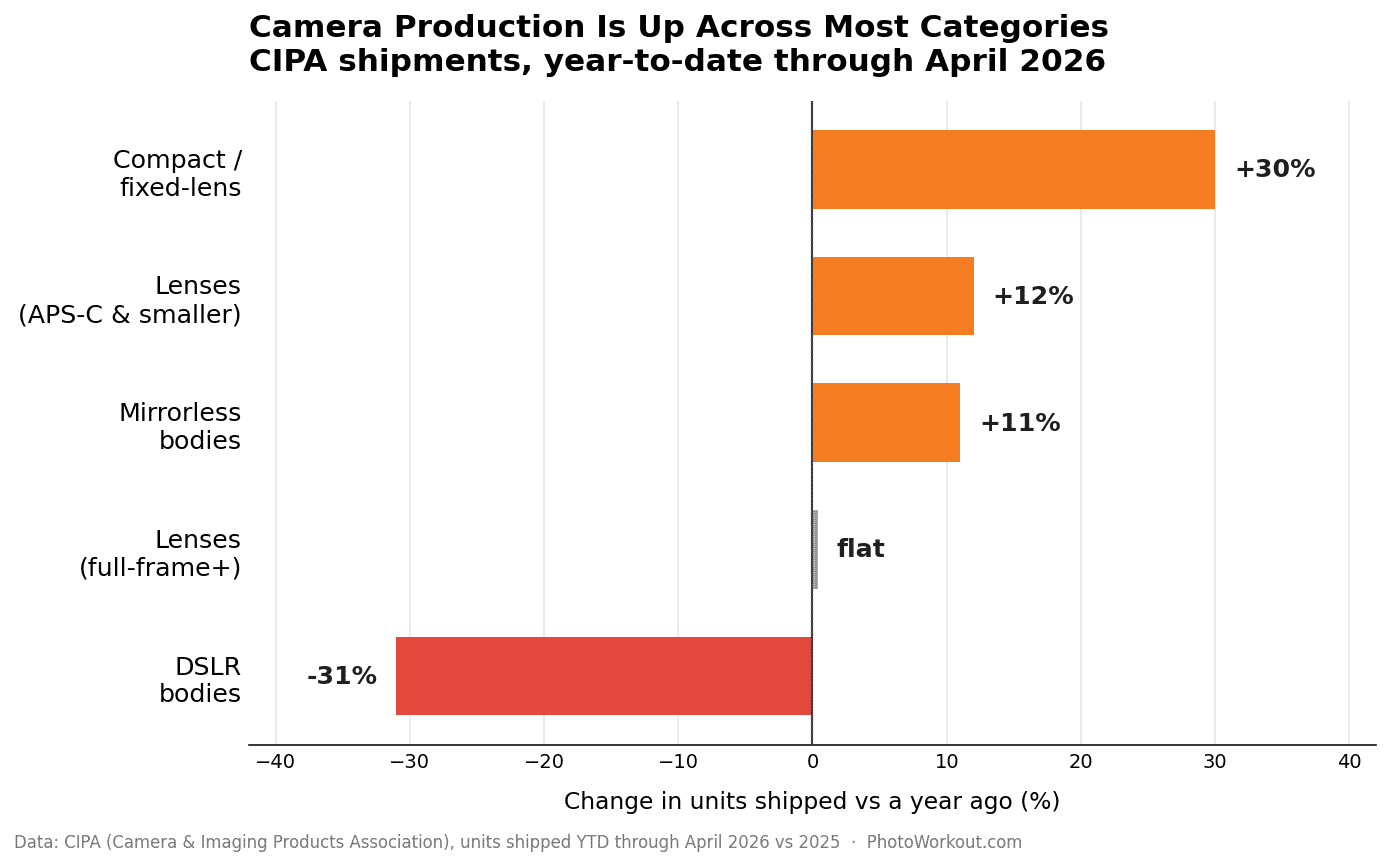
- Compact / fixed-lens cameras: +30% units, +26% value. The point-and-shoot revival that defined 2025 is still going strong, driven by younger buyers who want a dedicated camera that is not their phone.
- Mirrorless bodies: +11% units, +11% value. The format that now is the camera industry keeps climbing, with units and revenue rising in lockstep.
- Lenses for APS-C and smaller sensors: +12% units, +21% value. Faster growth in value than units suggests buyers are reaching for pricier glass, not just kit zooms.
- Lenses for full-frame and larger: flat units, +3% value. A mature segment holding steady.
- DSLR bodies: -31% units, -39% value. Still falling — but the rate of decline narrowed by roughly 10% versus the previous month.
One detail worth flagging for anyone who buys lenses: the lens-to-body ratio sat at 1.55, unchanged from a year ago. In plain terms, photographers are still buying about one and a half lenses for every new body — a sign the broader ecosystem, not just camera sales, is in good shape. Industry analysts now project total interchangeable-lens camera shipments of somewhere between 6.27 and 7.4 million bodies for 2026.
Why Mirrorless and Compacts Are Up While DSLRs Keep Falling
None of this is random. The compact surge is the clearest consumer trend in photography right now — a generation that grew up shooting on phones is rediscovering the appeal of a real camera, and manufacturers are racing to supply it. Canon has gone as far as formally reviving its PowerShot line with three new models slated for late 2026, ramping production specifically to defend the segment.
Mirrorless growth, meanwhile, is being pulled along by a steady drumbeat of high-profile launches. Bodies like the Sony a7R VI and the cinema-leaning Canon EOS R6 V have given enthusiasts concrete reasons to upgrade, and every new body sells lenses alongside it.
The DSLR decline is the flip side of the same story. With Canon and Nikon long since pivoting their development to mirrorless, the DSLR is a legacy format kept alive mainly by existing owners and the used market. A 31% drop sounds dramatic, but it is a managed wind-down of a category the manufacturers themselves have moved on from. The fact that the decline actually slowed in April suggests it is approaching a stable floor of dedicated holdouts rather than falling off a cliff.
It is worth keeping the broader context in mind, too. A growing shipment count does not automatically mean every manufacturer is thriving — Nikon just posted its worst financial year on record, though the damage came from non-camera businesses rather than its imaging division. Healthy industry-wide shipments and individual company turbulence can coexist.
What It Means If You’re Deciding Whether to Buy Now or Wait
Here is the practical read. A camera market that is shipping more units is a market where manufacturers feel confident — and confident manufacturers do two things buyers care about: they launch more products, and they compete harder on price to win attention in a crowded field.
For anyone weighing a purchase, that argues for patience rather than urgency. There is no supply panic, no sign that prices are about to spike industry-wide, and a fuller-than-usual release calendar likely ahead for the rest of 2026. If a specific body has been on a wishlist for a while and it does everything needed today, there is no reason not to buy. But if the itch is more “I should grab something before it’s gone,” the data says relax — this is the opposite of a scarcity market.
The smarter play in a growing market is to time purchases around the predictable discount windows. Major sales events and seasonal rebates tend to land harder when manufacturers are fighting for share, and a healthy market makes generous deals more likely, not less. The one genuine exception worth watching is the storage-and-accessories corner, where memory-card makers have been pushing prices up on their own schedule — there, buying ahead of an announced hike can still pay off.

FAQ
Is the camera market actually recovering in 2026?
By the most reliable measure available — CIPA shipment data — yes. Most categories are shipping more units year-on-year as of April 2026, with compacts and mirrorless leading and only DSLRs still in decline. Analysts project 6.27 to 7.4 million interchangeable-lens cameras shipped for the full year, which would extend the recovery that began in 2025.
Does "production up" mean camera prices will drop?
Not directly, but it helps. Higher shipments reflect manufacturer confidence, and confident makers in a competitive market tend to launch more models and lean harder on rebates and sales events. That dynamic is friendlier to buyers than a contracting market where prices stay sticky.
Should I still buy a DSLR in 2026?
Only if the value works for a specific need — sports shooters on a budget, for instance, can find excellent used DSLRs cheaply. But for a new purchase intended to last, mirrorless is where every manufacturer is investing, and where lens and accessory support will keep growing. The shipment data simply confirms which way the industry is moving.
What is CIPA and why does its data matter?
CIPA, the Camera & Imaging Products Association, is the Japanese trade body whose members make up nearly the entire global camera industry. Its monthly shipment reports are the most authoritative read on how many cameras and lenses are actually moving — which is why the whole industry, and photography press, treats them as the market’s vital signs.
The Bottom Line
The April CIPA numbers are the latest confirmation that the camera industry’s long contraction has given way to a genuine, if measured, recovery. Compacts are surging, mirrorless is steady, lenses are growing and even the DSLR’s slide is decelerating. For buyers, the message is reassuring rather than urgent: this is a market with momentum and supply on its side, where the best move is usually to buy the right gear when it’s the right time — and let the next round of launches and deals come to you.
Featured image: PhotoWorkout editorial illustration. Data chart: PhotoWorkout, based on CIPA shipment figures.
Primary Data & Coverage
- Nikon Rumors — The CIPA numbers for April are out – Category-by-category breakdown of the April 2026 CIPA shipment data, with ZoetMB analysis.
- CIPA — Camera & Imaging Products Association, Statistics – The official shipment statistics the figures are drawn from.
- DPReview — CIPA full-year shipment data – Context on the 2025 recovery and the compact-camera surge that carried into 2026.