


- A high shutter count is rarely a dealbreaker on its own. Mechanical shutters are rated for a minimum number of actuations and routinely outlast that rating by two to three times.
- Ratings scale with tier: entry DSLRs are rated around 100,000 actuations, enthusiast and full-frame bodies 150,000-200,000, and pro flagships 400,000-500,000.
- On modern mirrorless cameras the question is fading. Many makers no longer publish a rating, and bodies like the Nikon Z9/Z8 and Sony a9 III have no mechanical shutter to wear out at all.
- Judge the count against the body’s rating and price, not as an absolute number – then check the count yourself with a free EXIF tool before you buy.
It is the first question almost every used-camera buyer asks: what is the shutter count? A number in the tens of thousands can make a great-looking deal suddenly feel risky – as if the camera is one click away from dying. But how much does shutter count actually matter, and at what point does it genuinely kill a deal?
The short answer: less than most buyers fear. A camera’s shutter is rated for a minimum number of actuations, and in real-world use shutters frequently sail well past that figure. Condition, price, and seller reputation usually matter more than the raw count. Here is the data behind that claim, plus a simple framework for deciding when a high count is fine and when to walk away.
When you buy through links on our site, we may earn a commission at no cost to you. We evaluate products independently. Commissions do not affect our evaluations.
What a Shutter Count Actually Tells You
On a camera with a mechanical shutter, every photo fires a pair of physical curtains. The shutter count (or “shutter actuations”) is the running total of how many times that mechanism has fired – effectively the odometer of the camera. Manufacturers stress-test the shutter and publish a rated durability: a minimum number of cycles the shutter is expected to survive.
Two things are widely misunderstood about that number. First, it is a minimum, not an expiration date – it is the point at which the maker is confident the shutter still works, not the point at which it breaks. Plenty of shutters run to two or three times their rating. Second, a worn shutter is a repairable part, not a totaled camera. A replacement typically runs about $200-$400, which matters when you weigh it against the discount on a high-count body.
Rated Shutter Life by Camera Tier
Manufacturer- and CIPA-rated durability for popular bodies. Treat these as expected minimums, not hard limits – and note that several mirrorless makers no longer publish a figure at all.
| Camera (representative) | Type | Rated shutter actuations |
|---|---|---|
| Nikon D3500 / Canon Rebel T7 (entry) | DSLR | ~100,000 |
| Canon EOS 90D / Nikon D7500 (enthusiast) | DSLR | ~120,000-150,000 |
| Canon 5D Mark IV / Nikon D750 | DSLR (full-frame) | 150,000 |
| Nikon D850 | DSLR (full-frame) | 200,000 |
| Sony a7 III | Mirrorless | 200,000 |
| Canon EOS R6 | Mirrorless | ~150,000 |
| Sony a9 | Mirrorless | 500,000 |
| Canon 1D X / Nikon D6 (pro flagship) | DSLR | 400,000-500,000 |
| Fujifilm X-T5 (and most Fujifilm) | Mirrorless | Not published |
| Nikon Z9 / Z8, Sony a9 III | Mirrorless (electronic / global) | No mechanical shutter |
The pattern is clear: the more a camera is built for heavy use, the higher its rating. An entry-level body that reads 80,000 is near its rating; a pro flagship at 80,000 is barely broken in. That is why a raw number means nothing until you put it next to the body’s rating.
Why Mirrorless Is Quietly Ending the Shutter-Count Debate
The whole conversation is a product of the DSLR era, when every frame meant a mechanical actuation. Mirrorless cameras increasingly shoot with an electronic shutter that has no moving parts to wear out, and the flagship tier has dropped the mechanical shutter entirely. The Nikon Z9 and Z8 are fully electronic, and the Sony a9 III uses a global shutter – none of them has a mechanical shutter to count.
Even on mirrorless bodies that still have a mechanical shutter, many photographers shoot electronic-first, so the actuation count badly understates – or overstates – real use. And makers like Fujifilm and (in recent bodies) Sony often do not publish a rating or store actuations in EXIF at all. On these cameras, the sensor, EVF, battery health, ports, and IBIS tell you far more about wear than a shutter number ever could.
The Buy-or-Skip Framework
Forget absolute numbers. Express the shutter count as a percentage of the body’s rated life, then weigh it against price and condition:
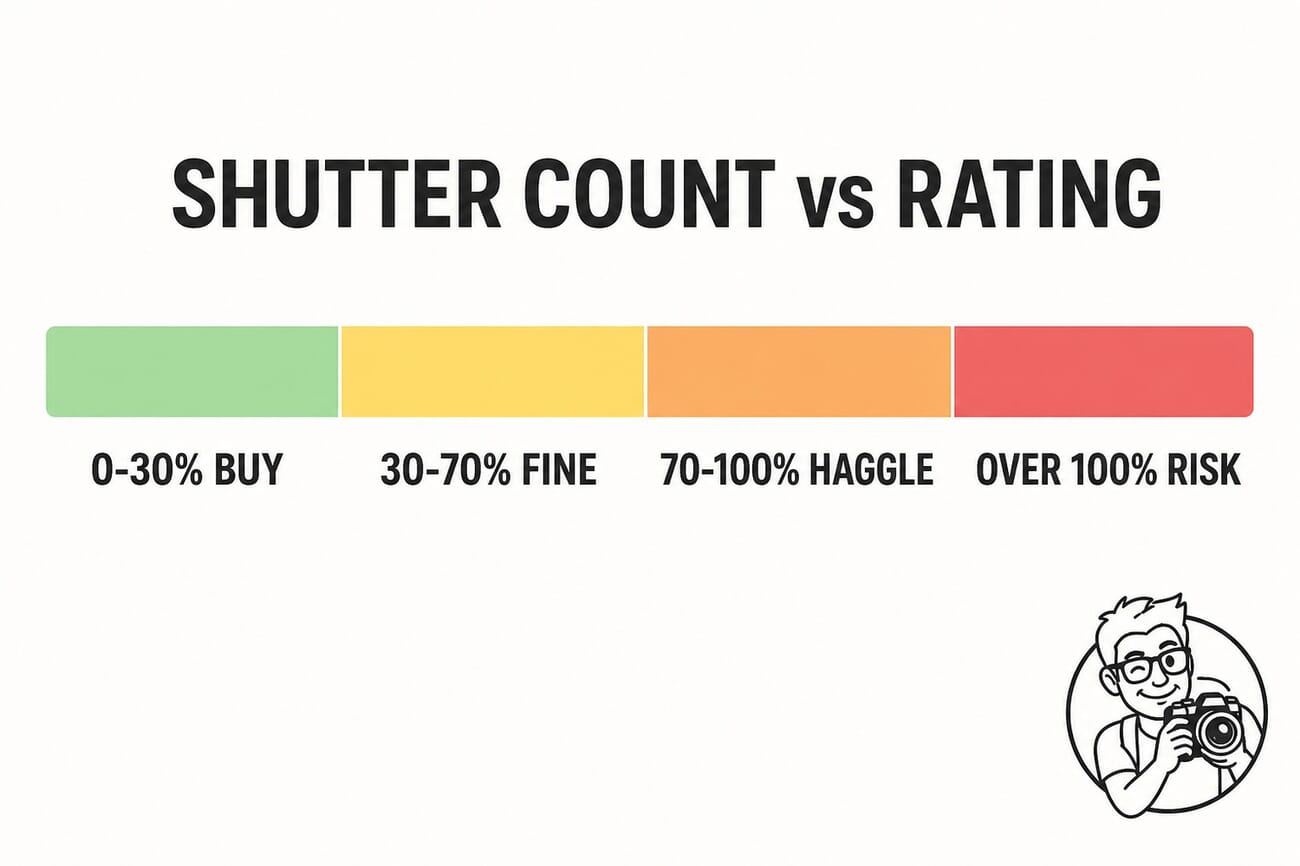
- Under ~30% of rating – barely used. Buy with confidence; this is a non-issue.
- 30-70% – normal, healthy mileage. Fine at a fair price; do not over-think it.
- 70-100% – approaching the rated minimum. Still likely has life left, but negotiate the price down and budget for a possible shutter replacement.
- Over 100% – past the rating. Not an automatic no (shutters often outlast their rating), but treat it as end-of-life: only worth it at a steep discount, and inspect closely.
- Electronic / global-shutter mirrorless – the count is close to meaningless. Shift your attention to sensor condition, EVF, battery, and IBIS instead.
Then sanity-check the math. If a high-count body is $300 cheaper but a shutter replacement costs $250, the “risk” is really a $250 line item – and the shutter may never need it. Buying from a dealer like MPB, KEH, or B&H Used adds a warranty that prices that risk down to near zero, which is often worth more than chasing the lowest possible count on a private sale. A used camera can be a smart way to get more camera for the money, and shutter count should rarely be the thing that stops you.

How to Check a Camera’s Shutter Count
On most DSLRs and many mirrorless bodies, the actuation count is written into the EXIF metadata of every photo. The quickest way to read it is to take a single JPEG with the camera, then run it through a shutter-count reader:
- Use the free PhotoWorkout shutter-count tool – upload a straight-out-of-camera photo and it pulls the actuation count from the EXIF, no software to install.
- Ask the seller for a recent unedited JPEG and check it yourself before you commit – edited or exported files often strip the EXIF, so insist on an original.
- On a body you can hold, take a fresh shot and read it on the spot.
One caveat: a handful of brands – notably Canon’s mirrorless line and some recent Sony bodies – do not store the actuation count in standard EXIF, so a reader may come back blank. That is not a red flag; it just means the shutter count is not a number you can lean on for that camera, which loops right back to the point above: judge those bodies on condition, not clicks.
Frequently Asked Questions
What counts as a “high” shutter count?
There is no universal number – it is relative to the body’s rating. 80,000 is high on an entry-level DSLR rated for 100,000, but trivial on a pro body rated for 400,000. Always compare the count to the camera’s rated life, not to a fixed threshold.
Do mirrorless cameras even have a shutter count?
Bodies with a mechanical shutter do, and it can be read the same way. But many mirrorless cameras shoot electronically, and flagships like the Nikon Z9, Z8, and Sony a9 III have no mechanical shutter at all – so there is nothing to wear out or count.
How much does a shutter replacement cost?
Typically about $200-$400 including labor, depending on the brand and model. Factor that figure into any high-count deal: if the discount is bigger than a replacement, the math can still favor buying.
Can a shutter last longer than its rating?
Routinely. The rating is a tested minimum, and many shutters reach two to three times that number before failing. A camera reading slightly over its rating is not “dead” – it is just past the point the manufacturer guarantees.
How do I check the shutter count before buying?
Get an original, unedited JPEG from the camera and read its EXIF with a shutter-count tool. Avoid edited or social-media copies, which usually have the metadata stripped.
The Bottom Line
A high shutter count kills far fewer deals than its reputation suggests. Rated as a minimum, routinely exceeded, and cheap to repair, the shutter is rarely the weakest link in a used camera – and on modern mirrorless bodies it is fast becoming a non-issue. Read the count as a percentage of the body’s rating, weigh it against price and condition, and let a genuinely good deal stand. Just check the number yourself first.
Featured image and infographics: PhotoWorkout.
Shutter durability ratings are manufacturer/CIPA figures; replacement costs and real-world longevity reflect industry consensus.
Shutter Ratings & Durability
- Nikon USA – D850 specifications (200,000-cycle shutter) – Manufacturer rated durability
- Adorama 42West – How to Check Your Camera’s Shutter Count – Ratings overview + how to read actuations
- PhotographyLife – Nikon Z9 (fully electronic shutter) – Mirrorless without a mechanical shutter
Tools
- PhotoWorkout / ExifReader – Shutter Count Tool – Free EXIF shutter-count reader