


- Oppo Find X9 Ultra launches globally April 21–22, 2026. Digital Camera World called it “the new king of camera phones” before the launch window had even opened.
- Camera headline: dual 200MP Hasselblad cameras — a 200MP main at f/1.5 on a 1-inch sensor AND a 200MP 3x periscope on a 1/1.28″ sensor (larger than the Galaxy S26 Ultra’s main). Also a 50MP 10x periscope (230mm equivalent) and a 50MP ultrawide.
- Supporting hardware: 6.78″ OLED 3168×1440, Snapdragon 8 Elite Gen 5, up to 16GB LPDDR5X + 1TB UFS 4.1, 7,050mAh battery with 100W wired + 50W wireless charging, 8K video, Hasselblad Master Mode 2.0, 16EV dynamic range.
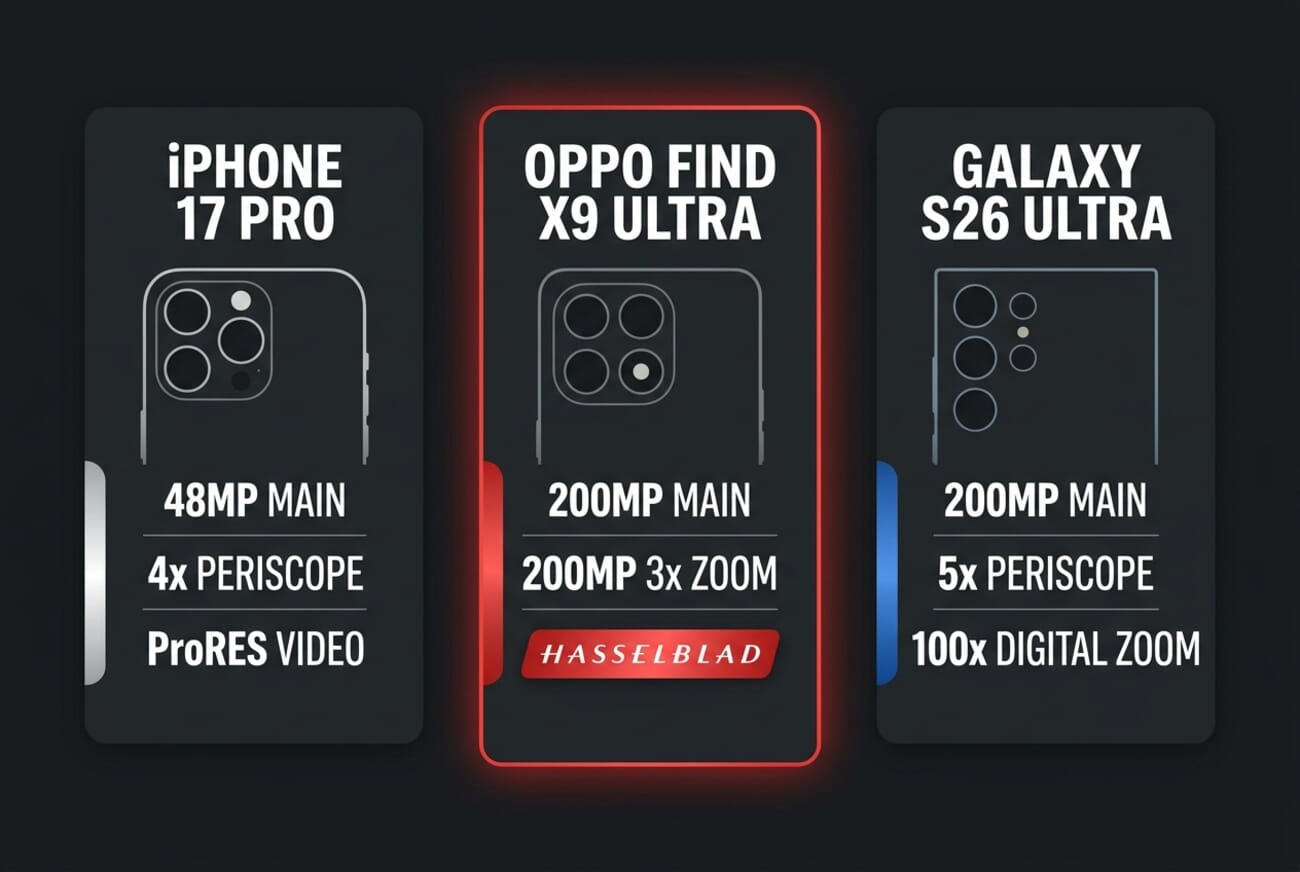
- vs iPhone 17 Pro: Oppo wins on raw sensor size, pixel count, and zoom hardware. Apple wins on video pipeline polish, ProRes workflow, and 3-year app-ecosystem advantage. Most people will prefer one for non-camera reasons.
- vs Galaxy S26 Ultra: Oppo’s 3x telephoto sensor is physically larger than Samsung’s main. Samsung still wins on 5x + 100x digital zoom range and the ProVisual Engine’s video stabilization. Genuine toss-up depending on zoom habits.
Oppo’s Find X9 Ultra goes global this week — April 21 in most markets, April 22 for later time zones — and early reviews are already calling it the best camera phone of 2026. T3 framed Oppo as the potential “undisputed king of the camera phone,” and TechRadar called it a candidate for “the world’s best camera phone” before the global launch window had even opened. The headline specs justify the hype: dual 200MP Hasselblad cameras, a 1-inch main sensor shooting at f/1.5, and a 3x periscope that uses a larger sensor than the Galaxy S26 Ultra’s main camera.
Which raises the question: does the Oppo actually dethrone the iPhone 17 Pro and Galaxy S26 Ultra for photographers? This launch-day breakdown walks through every spec that matters, puts all three flagships side by side, and frames who should actually care.
What Oppo actually launched
The Find X9 Ultra is a quad-camera phone co-engineered with Hasselblad for the fifth consecutive generation. The standout headline is the dual-200MP arrangement — Oppo put its highest-resolution sensors on both the main camera AND the 3x periscope, something no other flagship is doing in 2026.
- Main: 200MP “ultra-sensing” 1-inch sensor, f/1.5 aperture. The wider aperture delivers 10%+ more light than competing 1-inch phones (per Oppo). Optical image stabilization.
- 3x Periscope: 200MP on a 1/1.28″ OmniVision OV52A sensor — physically larger than the Galaxy S26 Ultra’s main sensor. This is the quiet dealbreaker for photographers who shoot at ~70mm-equivalent focal lengths for portraits.
- 10x Periscope: 50MP sensor at 230mm equivalent. Competes directly with the Galaxy’s long telephoto at a slightly shorter native reach.
- Ultrawide: 50MP sensor with 56% more light capture than the previous generation.
- Front: 50MP large sensor — the biggest on any flagship front camera in 2026.
Hasselblad Master Mode 2.0 ships bundled, bringing the color science Oppo and Hasselblad have refined since 2022 plus 16 EV of dynamic range in the RAW pipeline. The LUMO light-condensing imaging system — Oppo’s internal name for its computational pipeline — is positioned as the hardware-accelerated counterpart to Apple’s ProRAW.
Non-camera hardware worth noting: 6.78″ OLED at 3168×1440 (reaches 6,000 nits peak outdoors), Snapdragon 8 Elite Gen 5 chipset, up to 16GB LPDDR5X + 1TB UFS 4.1 storage, and a 7,050mAh battery with 100W wired + 50W wireless charging. 8K video recording is supported across all four rear cameras.
Oppo Find X9 Ultra vs iPhone 17 Pro
Apple’s iPhone 17 Pro is a year old at this point but still the benchmark for computational photography in the US market. The spec-sheet story is clear: Oppo has more sensor, more pixels, more zoom hardware. Apple has more polish and more third-party app support. Here’s the head-to-head:
| Spec | Oppo Find X9 Ultra | iPhone 17 Pro |
|---|---|---|
| Main camera | 200MP, 1″ sensor, f/1.5 | 48MP, 1/1.28″ sensor, f/1.78 |
| Telephoto | 200MP 3x periscope + 50MP 10x | 48MP 4x periscope (fusion zoom to 8x) |
| Ultrawide | 50MP | 48MP |
| Front camera | 50MP | 18MP (Center Stage) |
| Max video | 8K | 4K ProRes |
| RAW pipeline | Hasselblad Master Mode 2.0 | ProRAW (Apple) |
| Ecosystem | Android 15 + ColorOS 16 | iOS 19 + Photos app |
| Launch price (expected) | ~€1,449 (estimate) | $1,199 (current) |
Verdict: If you use the phone as a camera first and an app device second, the Oppo has a genuine hardware advantage. But the iPhone’s software pipeline is famously forgiving, its HDR preview is the best on any phone, and the ProRes video pipeline remains the gold standard for video creators. For most US buyers, the iPhone’s ecosystem lock-in will decide this long before camera specs do.
Oppo Find X9 Ultra vs Galaxy S26 Ultra
This is the closer fight. Samsung updated the S26 Ultra in early 2026 with the ProVisual Engine (the new computational pipeline) and kept its 200MP main + 5x periscope flagship camera stack. Both phones target photographers directly.
| Spec | Oppo Find X9 Ultra | Galaxy S26 Ultra |
|---|---|---|
| Main camera | 200MP, 1″ sensor, f/1.5 | 200MP, 1/1.3″ sensor, f/1.7 |
| 3x telephoto | 200MP, 1/1.28″ sensor | 10MP, 1/3.52″ sensor |
| Long telephoto | 50MP 10x (230mm) | 50MP 5x (111mm) + 100x digital |
| Ultrawide | 50MP | 50MP |
| 8K video | Yes (all 4 rear cams) | 8K @ 30fps / 4K @ 120fps |
| Video stabilization | OIS + EIS | ProVisual Engine OIS |
| RAW pipeline | Hasselblad Master Mode 2.0 | Expert RAW (Samsung) |
| Launch price | ~€1,449 (estimate) | $1,399 (current) |
Verdict: For portrait and mid-range zoom shooters (the 70–200mm equivalent range), the Oppo’s 200MP 3x periscope is a genuine step up. That single sensor is a bigger upgrade than any other camera-phone improvement this year. But Samsung’s ProVisual Engine is on another level for video stabilization, and 100x digital zoom — however artificial — still moves units. Think of the Oppo as the stills camera of the pair and the Samsung as the better-balanced hybrid.
Who should actually care
Three buyer profiles make sense for the Find X9 Ultra:
- Portrait shooters — the 200MP 3x periscope at 70mm-equivalent on a 1/1.28″ sensor is the single most meaningful upgrade in any 2026 flagship. If portraits are the primary use, the Oppo leads.
- Android power users — the 1TB + 16GB config, 7,050mAh battery, and ColorOS customization depth make it a specs-first flagship in the way Samsung used to be before design convergence hit.
- Photographers who want a Hasselblad look OOC — five generations of color-science tuning show. The Master Mode 2.0 presets land closer to classic Hasselblad digital-back output than any competing phone filter.
Three buyers who shouldn’t:
- iPhone ecosystem locked-in users — iMessage, AirDrop, Apple Watch integration, ProRes, FaceTime. No camera spec moves you out of that unless you were already leaving.
- Video creators first — Samsung’s ProVisual stabilization and Apple’s ProRes pipeline both edge out Oppo on moving-subject video. The Oppo is a stills phone with strong video specs, not a video phone.
- Anyone needing US-market support — Oppo’s “global” launch historically has patchy US carrier support and no Apple-caliber warranty network. The Galaxy S26 Ultra and iPhone 17 Pro remain the default US picks.
Frequently Asked Questions
When does the Oppo Find X9 Ultra launch globally?
April 21, 2026 at 7 PM local time in most markets, which means April 22 in some later time zones. Launched alongside the Oppo Find X9s.
Is the Find X9 Ultra better than the iPhone 17 Pro for photography?
On raw camera hardware — yes. Larger sensors, higher resolution, more zoom hardware. On overall photography experience — depends. Apple’s computational pipeline, ProRAW workflow, and third-party app ecosystem still give the iPhone the edge for most users. For stills-first shooters who are already on Android, the Oppo wins.
How does the Oppo Find X9 Ultra compare to the Galaxy S26 Ultra?
Oppo wins on sensor size (its 3x telephoto has a bigger sensor than Samsung’s main), low-light capture at wide apertures, and 8K video across all four rear cameras. Samsung wins on long-reach zoom (5x periscope + 100x digital) and video stabilization via the ProVisual Engine. Neither is universally better — pick based on whether you shoot more portraits (Oppo) or long-range + video (Samsung).
Does the Find X9 Ultra really have Hasselblad cameras?
Hasselblad’s role is color science, Master Mode presets, and design partnership — not the sensors themselves, which come from Sony and OmniVision. That said, the partnership has been running since 2022 and Hasselblad Master Mode 2.0 is a real differentiator in how the Oppo renders portraits and skin tones out of camera.
Will the Find X9 Ultra be available in the US?
Global launch, but Oppo’s US availability has historically been limited — typically import-only with no official carrier support. Confirm with retailers before committing if you need US warranty + carrier compatibility.
What’s the price?
Pricing wasn’t finalized for all regions at the time of writing. Expect roughly €1,449 for the base 16GB/512GB config based on pre-launch signals — above the iPhone 17 Pro’s $1,199 US list but below the typical premium for top-spec Android flagships in Europe.
Featured image, comparison graphic, and pin: editorial illustrations by PhotoWorkout.
Sources for this article:
Primary coverage
- T3 — Oppo could become undisputed king of the camera phone – The "king of camera phones" framing after Oppo confirmed the Find X9 Ultra specs
- TechRadar — Could be the world's best camera phone – Pre-launch analysis of the dual 200MP Hasselblad system
- Digital Camera World — Shaping up to be a monster for photographers – DCW's spec-driven preview of the Find X9 Ultra before the global launch
- TechRadar — Hasselblad-inspired design – On how Hasselblad's design heritage shapes the Oppo's look and color science
Deep-dive specs
- 9to5Google — Specs and 7,050 mAh battery confirmed – Day-before-launch spec confirmation including battery, charging, and display details
- Gizmochina — Earth Explorer Master Set – Detailed pre-launch spec sheet including the dual 200MP arrangement
- Android Central — Hands-on preview – Hands-on impressions positioning the Oppo as a potential camera phone of 2026