


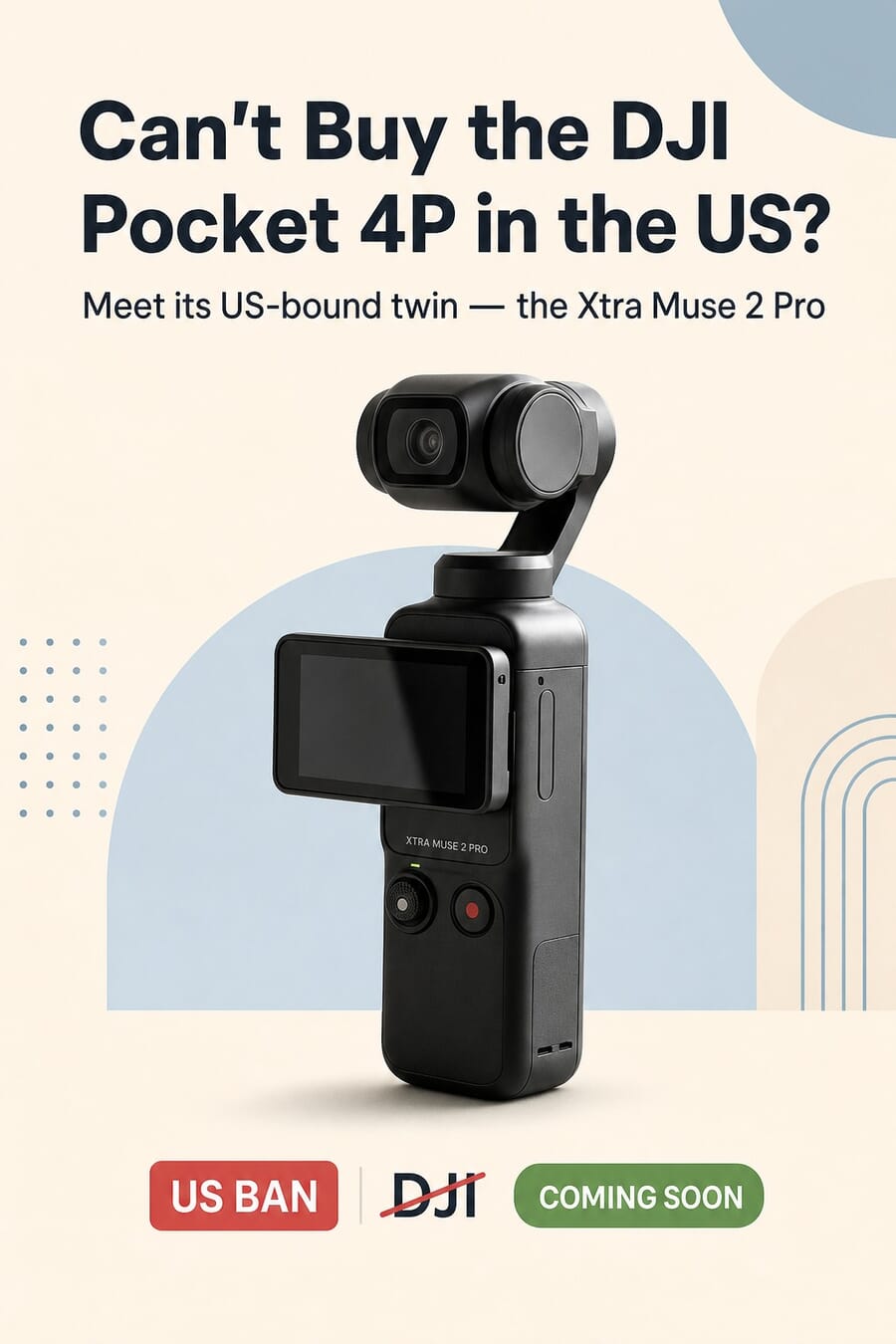
- Xtra Technology has confirmed the Muse 2 Pro, a dual-lens pocket gimbal camera heading to the US this summer — the first credible US-bound stand-in for DJI’s Osmo Pocket 4P.
- DJI’s Pocket 4P can’t be sold in the US: DJI landed on the FCC’s Covered List after a national-security audit required by the 2025 NDAA went uncompleted, blocking FCC certification of new DJI hardware.
- On paper the Muse 2 Pro is the Pocket 4P — same 1-inch sensor, ActiveTrack 7.0, 107GB storage, 10-bit D-Log and 4K/240fps — with a few ergonomic tweaks (dual-side flip screen, side USB-C, built-in 1/4-inch thread).
- The Verge found Xtra’s companion app is built on DJI’s own code with the ‘DJI’ labels swapped out, reinforcing the widely-held view that Xtra is a proxy brand getting DJI hardware into the US under a different name.
- Xtra hasn’t confirmed a price. The original Xtra Muse sells for about $379–$499, so the Muse 2 Pro could meaningfully undercut the tariff-inflated US prices on comparable gimbal cameras — but warranty, support and firmware longevity are real unknowns.
Update (July 2026): The FCC has proposed a $25,000 fine against Xtra Technology as part of a crackdown on suspected DJI front companies. Read the follow-up: what the FCC action means for Muse 2 Pro pre-orders and current owners.
US creators have spent months watching the rest of the world get a pocket camera they can’t legally buy. DJI’s Osmo Pocket 4P — the first dual-lens version of its tiny stabilized vlogging camera — launched globally but skipped the United States entirely, a casualty of the regulatory standoff that has frozen new DJI hardware out of the American market. Now a little-known company called Xtra Technology says it has the answer: the Xtra Muse 2 Pro, a dual-lens pocket gimbal arriving on US shelves this summer.
There is just one wrinkle. By nearly every measurable spec, the Muse 2 Pro is the Osmo Pocket 4P — same sensor, same tracking, same storage, same color science. It simply wears a different name. That makes this less a story about a new camera and more a story about how a banned product finds its way to American buyers anyway.
The Camera DJI Can’t Legally Sell in the US
The Osmo Pocket 4P is real, it’s shipping, and it’s launching globally — just not under the DJI badge in the United States. DJI was added to the FCC’s Covered List in late 2025, a designation that bars the agency from approving the company’s new hardware. The trigger was a provision in the 2025 National Defense Authorization Act requiring a formal national-security audit of DJI by December 23, 2025. No US agency completed that review before the deadline, so DJI’s new drones, cameras and wireless accessories are now blocked from FCC certification — and without certification, new DJI gear can’t legally be imported for sale here.
That’s the gap Xtra is stepping into. (For the fuller backstory on how DJI ended up here, see our explainer on the DJI security audit and what it means for US buyers.) For the full rundown of your legal options, see whether you can buy the DJI Pocket 4 in the US and the real alternatives. If the Pocket 4P can’t come through the front door, a Delaware-registered startup selling a near-identical camera under its own brand is a plausible side entrance.
A Spec-for-Spec Match — With a Few Upgrades
According to spec sheets reported by Newsshooter and a side-by-side comparison published by Notebookcheck, the Muse 2 Pro and the Osmo Pocket 4P share a 1-inch CMOS sensor, ActiveTrack 7.0 subject tracking, 107GB of onboard storage, 10-bit D-Log color, 4K slow-motion up to 240fps, a vertical dual-camera system and an identical 3-axis gimbal layout. Notebookcheck called the Muse 2 Pro “the spitting image of the Osmo Pocket 4P.” It is, spec for spec, the same camera.
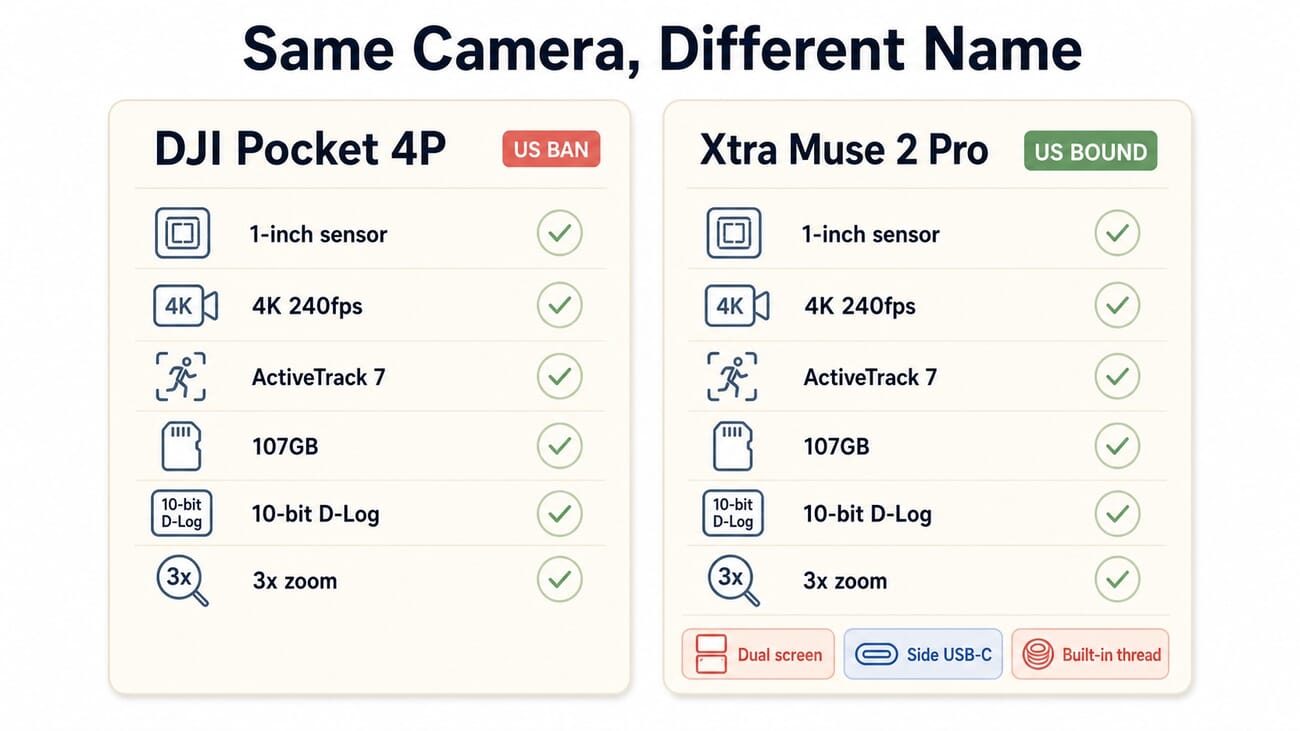
Xtra does make a handful of genuinely useful ergonomic changes over DJI’s design. The Muse 2 Pro reportedly gets a dual-side flip touchscreen that opens from either edge of the body (DJI’s screen is a fixed rotating display), a 1/4-inch mounting thread built directly into the chassis so you don’t need an adapter, and a side-mounted USB-C port instead of a bottom one — a small but real win for run-and-gun shooters who want to monitor audio while the camera is mounted. These are the kinds of refinements that suggest someone who actually shoots with these cameras had a say in the redesign.
Is Xtra Just DJI Wearing a Disguise?
This is where the story gets interesting. The Verge didn’t stop at noting the visual resemblance — it went into the software. Security consultant Jon Sawyer analyzed Xtra’s companion app and found, in his words, “countless places” where DJI’s original code had been replicated with only the “DJI” label swapped out. By his count, the app left behind 7,552 references to DJI. That’s not a coincidence of design language; that’s the same firmware with a new sticker on it.
It also isn’t the first time. Xtra’s debut in October 2025 introduced three cameras at once — the Muse, the Edge and the Edge Pro — which lined up almost exactly with DJI’s Osmo Pocket 3, Osmo Action 4 and Osmo Action 5 Pro. DJI has never publicly commented on Xtra Technology, and Xtra has never claimed a DJI connection. But the pattern is hard to miss, and it fits a broader picture of a company finding creative routes to keep selling into a market that has formally shut it out. (DJI’s legal maneuvering has been busy on other fronts too — it’s currently suing Insta360 over Osmo Pocket patents.)
What Will It Cost?
Xtra hasn’t officially announced pricing for the Muse 2 Pro, so treat any figure you see as an estimate rather than a confirmed number. The useful reference point is the first-generation Xtra Muse, which currently runs about $379 on Amazon and $499 at B&H. For comparison, DJI’s own Osmo Pocket 3 — the hardware equivalent of that first Muse — has climbed to roughly $800 on Amazon as tariffs and scarcity have pushed gray-market prices up. That spread is the entire pitch: if the Muse 2 Pro lands anywhere near the original Muse’s pricing, it would undercut what US buyers are paying for comparable pocket gimbals by a wide margin.
Should You Buy Now or Wait?
For US-based mobile and run-and-gun shooters who specifically want the Pocket 4P’s dual-lens, 1-inch-sensor experience, the Muse 2 Pro is the most direct path to that hardware right now. If you can wait until summer, it’s worth holding out for Xtra’s full spec drop and a confirmed price before committing.
That said, a rebadged-proxy camera carries real unknowns. Warranty coverage, US-based support, and how long the companion app keeps getting updates are all open questions when the brand on the box isn’t the brand that built the firmware. Buyers who want a fully above-board, US-supported alternative should weigh dedicated competitors — Insta360, for one, has been aggressive in this space with its Luna Ultra, and there are plenty of current deals on drones and action cameras worth comparing before you spend. The Muse 2 Pro is the cheapest route to Pocket 4P hardware; it is not necessarily the safest one.
Frequently Asked Questions
Is the Xtra Muse 2 Pro really the same as the DJI Osmo Pocket 4P?
By every reported spec — sensor, tracking, storage, color science and frame rates — yes. The Muse 2 Pro adds a few ergonomic tweaks, but The Verge’s analysis found Xtra’s app is built on DJI’s own code, which is why most observers treat it as the Pocket 4P under a different name.
Why can’t I buy the DJI Osmo Pocket 4P in the US?
DJI is on the FCC’s Covered List, which blocks certification of its new hardware. The 2025 NDAA required a national-security audit of DJI by December 23, 2025; no agency completed it, so new DJI cameras and drones can’t be FCC-certified for US sale.
When does the Muse 2 Pro launch and how much will it cost?
Xtra says it’s coming to US shelves this summer but hasn’t confirmed a price. As a reference, the first-gen Xtra Muse sells for roughly $379–$499, so the Muse 2 Pro could land well under the tariff-inflated cost of comparable gimbal cameras — though that’s an estimate, not an official figure.
Is it safe to buy a rebadged camera like this?
The hardware itself is proven — it’s effectively DJI’s. The risks are around the brand: warranty, US support and how long the companion app keeps getting updates are uncertain when the seller isn’t the original manufacturer. If those matter to you, a fully US-supported alternative may be the safer pick.
The Bottom Line
The Xtra Muse 2 Pro is the clearest sign yet that the DJI ban hasn’t stopped DJI hardware from reaching American creators — it’s just changed the label on the box. For US shooters who want the Osmo Pocket 4P’s dual-lens, 1-inch-sensor performance, this is the most direct route available, and potentially a much cheaper one. Just go in clear-eyed: you’re buying the camera DJI can’t sell you, from a company that won’t say it’s DJI. Wait for the full specs and a confirmed price, decide how much the warranty and support unknowns bother you, and shop accordingly.
Reporting and specifications were drawn from the following sources; pricing and full specs remain unconfirmed by Xtra until launch.
Image Sources
- Xtra Muse 2 Pro product render — courtesy Xtra Technology (staged via Photoroom) – Featured image and pin
- Spec comparison infographic and vertical pin — stylized PhotoWorkout illustrations – Created in-house