


- Sony has made a non-binding proposal to buy all of Tamron and take it fully private, at a price reported around 200 billion yen (roughly $1.2 to $1.3 billion). Tamron confirmed it received the proposal and set up a special committee to review it.
- This is proposal-stage, not a done deal. It is non-binding, subject to due diligence and the committee’s review, and could still fall through. Treat it as Sony’s bid and what it would mean, not a completed acquisition.
- The trigger appears to be activist pressure. Sony was Tamron’s largest shareholder at 15.35%, but Effissimo Capital climbed to about 17.4% and overtook it. Owning Tamron outright would shield it from activist influence.
- The real question for photographers: Tamron makes lenses for Sony E, Nikon Z, Fujifilm X, and L-mount, and designs lenses sold under other brands. A Sony-owned Tamron raises whether non-Sony mounts keep getting Tamron glass.
- The most likely outcome is that Sony keeps Tamron’s profitable multi-mount business running while gaining strategic leverage over timing and priority. Nothing changes at proposal stage, but non-Sony shooters should watch closely.
Tamron makes some of the best-value lenses in photography, and it makes them for almost everyone: Sony, Nikon, Fujifilm, and L-mount shooters all buy Tamron glass, and the company quietly designs lenses that get sold under other brands too. So when Sony proposes buying the whole company, it is not just corporate news. It is a question mark hanging over a lot of camera bags that have nothing to do with Sony.
On July 29, 2026, Sony confirmed it had made a proposal to acquire all of Tamron and take it fully private. We flagged the setup for exactly this when we covered an activist investor overtaking Sony as Tamron’s largest shareholder, and now the other shoe has dropped. Here is precisely what Sony proposed, why now, and the honest answer to the question every non-Sony shooter is asking: will my mount keep getting Tamron lenses?
What Sony Actually Proposed
Sony has submitted a non-binding proposal to acquire all of Tamron’s shares and turn it into a wholly-owned subsidiary. Reports put the price at around 200 billion yen, roughly $1.2 to $1.3 billion. Tamron, Japan’s top-selling lens brand, officially confirmed it received the proposal and has established a special committee to evaluate it.
The emphasis on non-binding matters. This is an opening move, not a signed deal. It is subject to due diligence, the special committee’s assessment, board and shareholder approval, and potentially regulatory review. Deals at this stage do sometimes fall apart, so the responsible way to read this is as a serious bid and what it would mean, not as a completed acquisition. That caveat runs through everything below.
Why Sony Wants Tamron Now
The timing points to a defensive motive as much as a strategic one. Sony was already Tamron’s largest shareholder at 15.35%, a stake it has held for years without disrupting Tamron’s multi-brand business. What changed is that the Singapore-based activist fund Effissimo Capital aggressively built its position from around 11% to roughly 17.4%, overtaking Sony. Activist investors typically push for changes that maximize short-term shareholder returns, and taking Tamron fully private would put it out of their reach entirely.
The strategic logic is just as clear. Tamron is a powerhouse of affordable, high-performing lenses, and a huge share of that business is built around Sony’s own E-mount, where Tamron’s 28-75mm and 35-150mm zooms are staples. Owning the designer of some of the most popular lenses for your own system, and locking down a top independent optics house before a rival could, is a strong position to hold.
The Real Question: What Happens to Non-Sony Mounts?
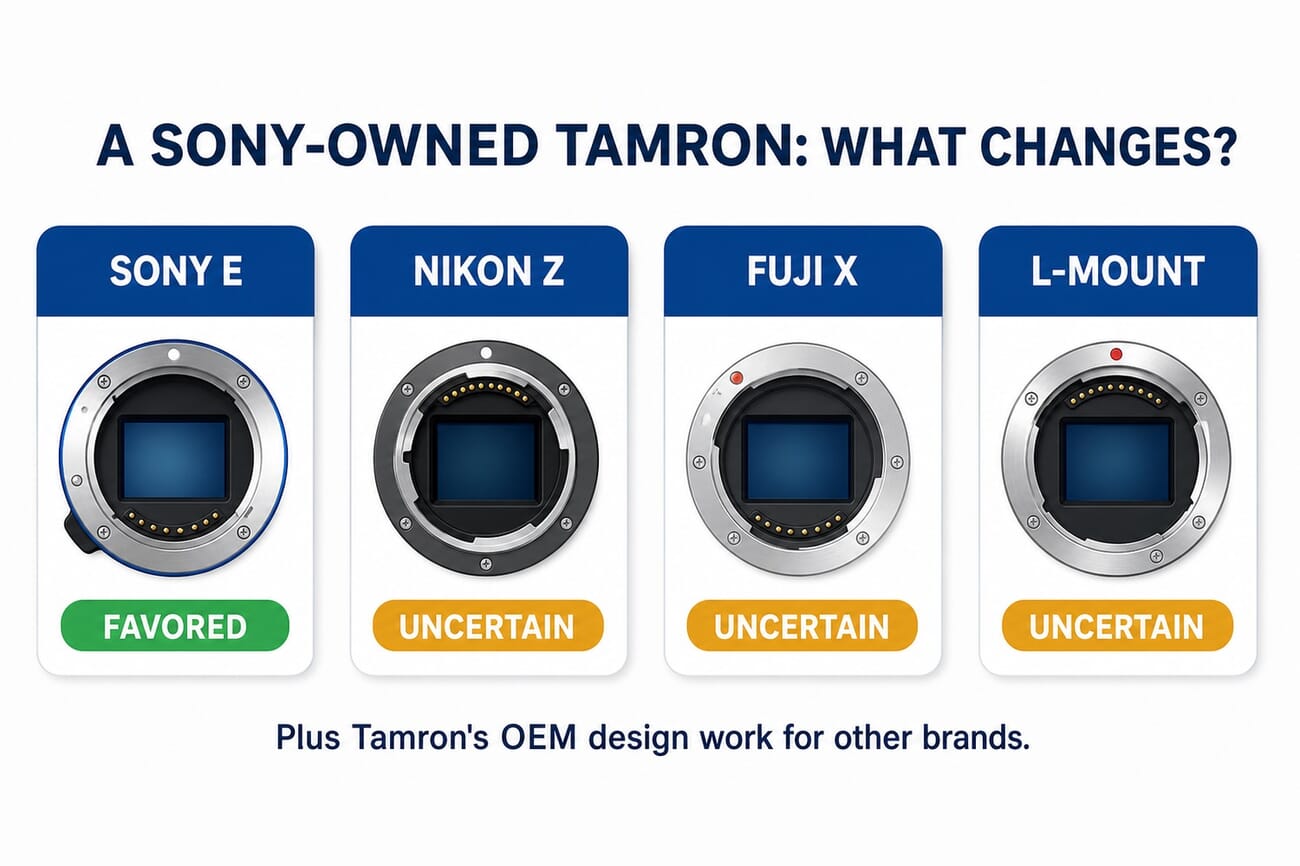
This is where it matters to your camera bag. Tamron does not just build for Sony E. It makes Nikon Z, Fujifilm X, and L-mount versions of its lenses, and it does significant OEM work, designing and building lenses that are rebadged and sold by other companies. A Sony-owned Tamron would therefore have influence over glass that ends up on Nikon, Fujifilm, and Panasonic bodies, and inside other brands’ lineups.
Here is the honest, both-sides read. The reassuring case: Tamron’s multi-mount and OEM business is genuinely profitable, and Sony is a company that comfortably sells camera sensors to its direct competitors when the money is good. Killing Tamron’s Nikon or Fujifilm lines would throw away revenue for little strategic gain, and Sony has not restricted Tamron in the years it has already held a 15% stake. The most likely outcome is business as usual on the surface.
The concerning case: full ownership is different from a minority stake. It hands Sony levers it did not have before. It could give E-mount versions first or exclusive access to new designs, quietly slow the rollout of competitor-mount versions, steer Tamron’s roadmap toward Sony’s priorities, or simply hold the option to pull back from rival mounts later if it ever chose to. None of that has to happen, but the ability to do it is exactly what changes when a company goes from shareholder to owner.
The Bigger Picture: Third-Party Glass Is Consolidating
Zoom out and this fits a pattern. The independent lens market has been the best thing to happen to photographers on a budget in years, with makers like Tamron, Sigma, Viltrox, and others delivering pro-grade optics at a fraction of first-party prices. A camera brand absorbing the biggest of those independents nudges the whole market toward consolidation, and consolidation rarely favors buyers on price or choice.
The flip side is that the vacuum tends to get filled. The same pressure that makes a Sony-owned Tamron worrying is why the aggressive newer players matter more than ever, from Viltrox pushing autofocus glass into neglected mounts to 7Artisans out-innovating the majors into abandoned niches. If Tamron’s independence narrows, expect those brands to move into the gap.
What It Means for You Right Now
If you shoot Sony E: this is likely neutral to positive. Your system already gets Tamron’s best attention, and that is unlikely to change. If anything, a Sony-owned Tamron might integrate more tightly with Sony bodies over time.
If you shoot Nikon Z, Fujifilm X, or L-mount: nothing changes today, and probably not for a while, but this is worth watching. Do not panic-buy, but if there is a specific Tamron lens for your mount you have been meaning to get, there is a mild argument for not waiting indefinitely. Our guide to the best Tamron lenses covers what is currently available across systems.
For everyone: remember this is a proposal, not a purchase. The special committee still has to review it, Effissimo’s near-17.4% stake could complicate the path, and the whole thing could change or collapse. The smart posture is informed patience, not reaction.
Frequently Asked Questions
Is Sony buying Tamron?
Not yet. Sony has made a non-binding proposal to acquire all of Tamron and take it private, reportedly worth around 200 billion yen (about $1.2 to $1.3 billion). Tamron confirmed receiving it and set up a special committee to review. It is a proposal, not a completed deal, and could still change or fall through.
Will Tamron still make lenses for Nikon, Fujifilm, and L-mount?
Most likely yes, at least for now. Tamron’s multi-mount business is profitable, and Sony already sells sensors to its rivals, so cutting those lines would sacrifice revenue. The risk is longer-term: full ownership gives Sony the ability to prioritize E-mount and control the timing of competitor-mount releases if it ever chose to.
Why does Sony want to buy Tamron now?
Two reasons. Defensively, activist fund Effissimo Capital overtook Sony as Tamron’s largest shareholder (rising to about 17.4% versus Sony’s 15.35%), and taking Tamron private removes that pressure. Strategically, Tamron designs many of the most popular lenses for Sony’s own E-mount and is a leading independent optics maker worth locking down.
Should I buy a Tamron lens before the deal closes?
There is no urgency. Nothing changes at proposal stage, and Sony shooters are unlikely to be affected at all. If you shoot Nikon Z, Fujifilm X, or L-mount and there is a specific Tamron lens you want, there is a mild case for not waiting years, but panic-buying on a non-binding proposal is not warranted.
The Bottom Line
Sony wanting all of Tamron is a genuinely significant moment for the lens market, because Tamron is not just a Sony supplier, it is everyone’s supplier. The likeliest near-term reality is that little visibly changes, since Tamron’s multi-mount business makes money for whoever owns it. But ownership is not the same as a stake, and the strategic leverage a wholly-owned Tamron would hand Sony is real, especially over the mounts that compete with it. For now it is a proposal with a committee attached, so watch it closely, know that your current lenses are fine, and make any buying decision on your own timeline rather than a headline’s. We will update this as the review progresses.
Featured image, mount-risk infographic, and pin: stylized illustrations created by PhotoWorkout. No brand logos are used.
Reporting
- Investing.com – Tamron confirms non-binding buyout proposal from Sony – Sony confirmation, the ~200 billion yen figure, and the special committee.
- PetaPixel – Sony Is Reportedly Trying to Buy Tamron, Which Makes Perfect Sense – Analysis and the multi-mount context.
- Digital Camera World – Sony owns a key slice of Tamron shares, and a report hints it wants more – Shareholding background and the Effissimo dynamic.
- Newsshooter – Tamron releases official statement about proposed Sony takeover bid – Tamron's official confirmation of the non-binding proposal.
Image Sources
- Featured image, mount-risk infographic, and vertical pin, created by PhotoWorkout – Editorial illustrations, no brand marks used.