


- Nikon now sells a Z6 III “No Wireless Connectivity” variant (B&H model 2036) with its Wi-Fi and Bluetooth radios physically removed at the factory — not just switched off in software.
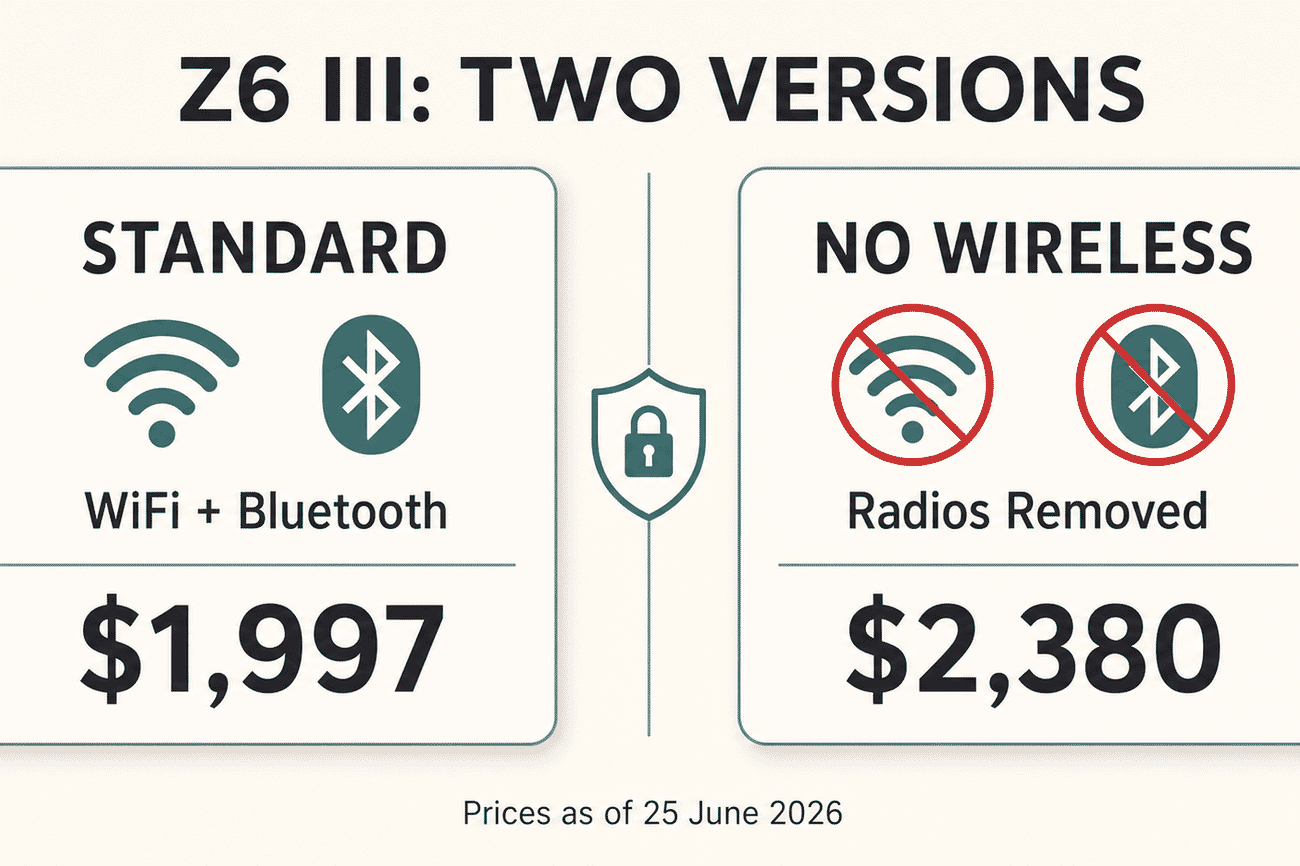
- It costs $2,379.95, a $383 premium over the standard $1,996.95 Z6 III, despite offering identical imaging performance.
- The buyers are government agencies, law enforcement, and secure facilities (SCIFs) where any device that emits radio is a security risk.
- It is not a first for Nikon — the company quietly sold wireless-disabled DSLRs such as certain D750 units for the same reason.
For the first time, a mainstream mirrorless camera is being sold deliberately crippled — and that is the entire point. Nikon has quietly added a Z6 III variant to its lineup with no Wi-Fi and no Bluetooth, the wireless hardware physically stripped out at the factory. There is no menu to re-enable it, no firmware unlock, no SnapBridge pairing. The camera simply cannot transmit or receive a radio signal, by design.
The version, listed at B&H as model 2036 under the plain label “No Wireless Connectivity,” is not aimed at photographers shopping for a deal. It is built for government agencies, law enforcement, and the kind of secure facilities where a camera that can talk to a phone is a liability rather than a convenience. And buyers pay extra for the privilege of owning less.
What Nikon Actually Removed
On paper, the secure Z6 III is the same camera enthusiasts already know: the same 24.5-megapixel partially-stacked full-frame sensor, the same EXPEED 7 processor, the same autofocus and 6K internal video. What is gone is the entire radio stack. The standard model ships with Wi-Fi 5 (802.11ac) and Bluetooth 5.0; the secure variant has both modules physically removed or disabled at assembly so they cannot be reactivated by a user, an IT department, or a firmware hack.
That distinction matters. A software toggle can be reversed, forgotten, or defeated. Hardware that is not present cannot leak. With the radios gone, the camera loses SnapBridge phone pairing, wireless image transfer, remote control over Wi-Fi, and any networked workflow such as FTP upload — the features most working pros rely on daily. Everything else, including wired USB and the card slots, keeps working normally.
Who Pays More for a Camera That Does Less
The price tells the story. The wireless-free Z6 III runs $2,379.95 — about $383 more than the $1,996.95 standard body. Customers are paying a premium not for added capability but for a guaranteed absence of it, and the math makes sense once the buyer is identified.
The target market is government and defense imaging: intelligence agencies, military units, police forensics teams, and contractors who work inside a Sensitive Compartmented Information Facility, or SCIF. A SCIF is a hardened room built to U.S. government standards specifically to prevent the interception of sensitive information, and personal electronics with radios are typically banned at the door. A camera that physically cannot emit a signal can clear that bar where a normal Z6 III never could.
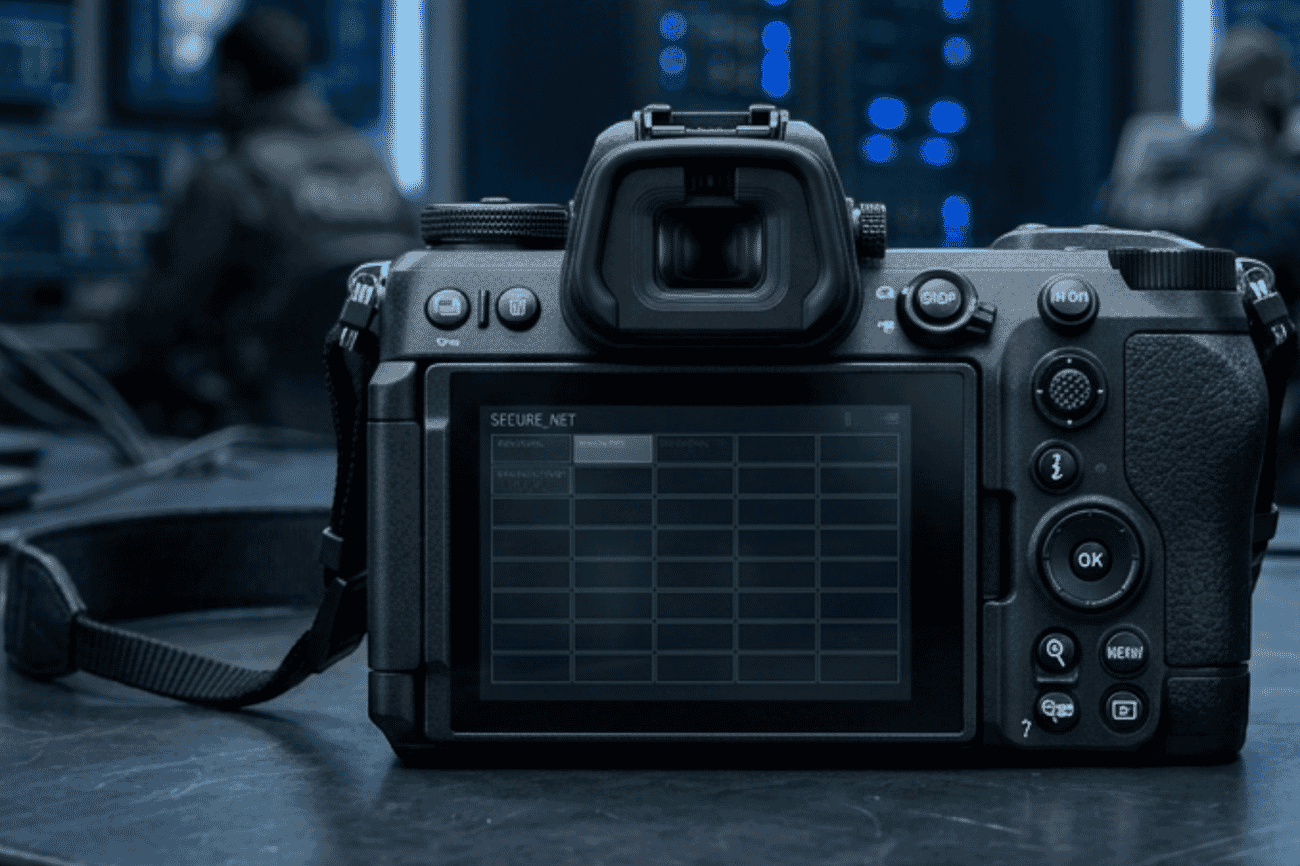
For these users, the wireless modules are not a perk; they are an attack surface. Any transmitter is a potential exfiltration channel and a detectable emission. Removing the radios eliminates the risk that a classified scene could be beamed off-site, intentionally or not, and removes one more thing a security officer has to audit before the body is cleared for use.
Not Nikon’s First De-Wired Camera
This is new for mirrorless, but not new for Nikon. The company has produced wireless-disabled variants of its DSLRs before — certain Nikon D750 units were sold without functional Wi-Fi for exactly the same government and enterprise security reasons. The secure Z6 III simply brings that quiet, low-volume practice into the mirrorless era, where built-in radios are now standard rather than an optional grip or dongle.
It also hints at a small but real market segment that rarely makes headlines: “secure” imaging gear with no radio emissions. As Wi-Fi and Bluetooth became default features across every camera, they created a problem for the one class of buyer that needs the opposite. Nikon offering a catalog model — rather than a one-off special order — suggests the demand is steady enough to productize.
What It Signals for Everyone Else
For the average photographer, the secure Z6 III changes nothing — it is more expensive and strips out the connectivity most people want. But it is a useful window into how security concerns are starting to shape professional camera specs. The same wireless features marketed as conveniences are, in some contexts, the first thing a buyer wants gone.
It is also a reminder of how much a modern camera quietly does. A body that can pair with a phone, geotag over Bluetooth, and push files to a server is a small networked computer. Most photographers never think about that until someone is willing to pay $383 to make sure their camera can do none of it. For more on how today’s bodies differ under the hood, our guide to mirrorless systems and what separates them is a useful primer.
Frequently Asked Questions
Can a regular consumer buy the no-wireless Z6 III?
It is listed at retailers such as B&H (model 2036), so it is technically purchasable, but it is aimed at agencies and secure facilities. For an ordinary photographer it is the wrong choice — it costs more and removes the connectivity most workflows depend on.
Does removing Wi-Fi and Bluetooth affect image quality?
No. The sensor, processor, autofocus, and video specs are identical to the standard Z6 III. Only the wireless radios are gone; image quality and core performance are unchanged.
Why does the wireless-free version cost more if it has fewer features?
It is a low-volume, specialized product built to meet strict security requirements, and the factory modification plus limited production raise the unit cost. Buyers are paying for a guaranteed, auditable absence of radios — a security feature — not for added capability.
Can the wireless hardware be switched back on later?
No. Nikon physically removes or disables the modules at the factory specifically so they cannot be reactivated through software, firmware, or user settings. The absence is permanent by design.
The Bottom Line
A wireless-free Z6 III is a strange product on the surface — a flagship-tier camera that costs more to do less. But it is aimed squarely at a buyer most photographers never think about, one for whom a radio is a risk and silence is the spec that matters. As cameras keep absorbing more connectivity by default, expect the “secure, no-emissions” niche to stay quietly profitable. Nikon clearly thinks it is worth a catalog slot.
Primary Coverage
- Nikon Rumors — Nikon is selling a Z6 III with no wireless connectivity for government and law enforcement agencies – Breaking report with pricing, the B&H model number, and the standard-vs-secure breakdown.
- Nikon — Z6 III official product information – Manufacturer specs for the standard Z6 III used to confirm shared sensor and feature set.
Background
- Sensitive Compartmented Information Facility (SCIF) — overview – Context on why secure facilities restrict radio-emitting devices.
Image Sources
- Featured image — Nikon Z6 III product render (staged via Photoroom) – Real Nikon Z6 III render composited into a studio scene.
- Secure-ops rear image — Nikon Z6 III product render (staged via Photoroom) – Real Nikon Z6 III rear render composited into a secure-room scene.
- Comparison infographic and Pinterest pin — stylized PhotoWorkout illustrations – Original PhotoWorkout editorial graphics.