


- Nikon posted the worst annual result in its history for the year ended March 2026: a group net loss of ¥86.0B (about $570M) and an operating loss of ¥112.4B (about $750M) on ¥677B (~$4.5B) revenue.
- But the cameras weren’t the cause. More than ¥90B ($600M+) of one-time write-downs came from Nikon’s metal-3D-printing (Digital Manufacturing) business, plus a downturn in semiconductor exposure equipment — not the Z system.
- Nikon’s Imaging division stayed profitable: ~$110M operating profit, and it actually shipped more cameras (910,000 vs 850,000), led by the new ZR, Z5II, and Z50II.
- The real watch-item for owners isn’t the headline loss — it’s the camera division’s operating margin sliding from 18.6% (FY2023) to 5.8% (FY2026). Nikon forecasts a group return to profit in FY2027.
Nikon just reported the worst financial year in its history. For the fiscal year ended March 31, 2026, the company posted a group net loss of ¥86.0 billion — roughly $570 million — and an operating loss of ¥112.4 billion (about $750 million) on revenue of ¥677 billion (~$4.5 billion). The headlines write themselves, and for anyone invested in the Z system, the instinct is to worry about the camera roadmap.
But the numbers tell a more specific — and far less alarming — story than “Nikon is in trouble.” Dig into the segment data and one thing is clear: the cameras weren’t the problem. Here’s what actually happened, grounded in Nikon’s own figures, and what it does (and doesn’t) mean for Z owners.
The Headline: A Record Loss
The loss is real and it is large. To put the swing in context: in FY2025 Nikon’s group operating profit was a slim ¥2.4 billion (~$16 million); in FY2026 it cratered to a ¥112.4 billion loss. That’s not a gentle decline — it’s a one-year plunge of nearly $770 million at the operating line.
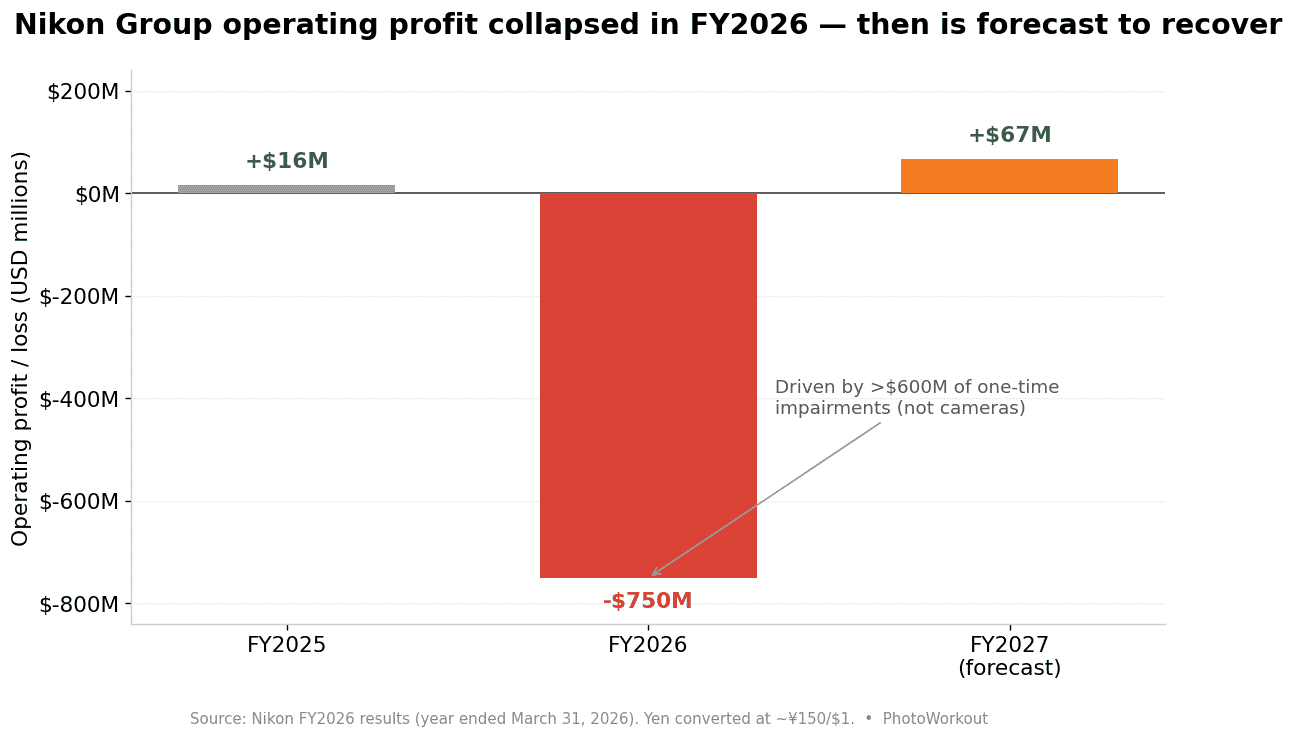
The shape of that chart is the first clue. A loss this size that’s forecast to reverse in a single year usually isn’t an operational collapse — it’s a one-time event hitting the books.
Where the Loss Actually Came From
More than ¥90 billion (over $600 million) of the damage was a one-time write-down on Nikon’s metal-3D-printing / Digital Manufacturing business — the same unit that includes the recently offloaded Mark Roberts Motion Control. On top of that, the Precision Equipment division (semiconductor exposure systems) swung to an operating loss on lower unit sales. Neither has anything to do with cameras and lenses.
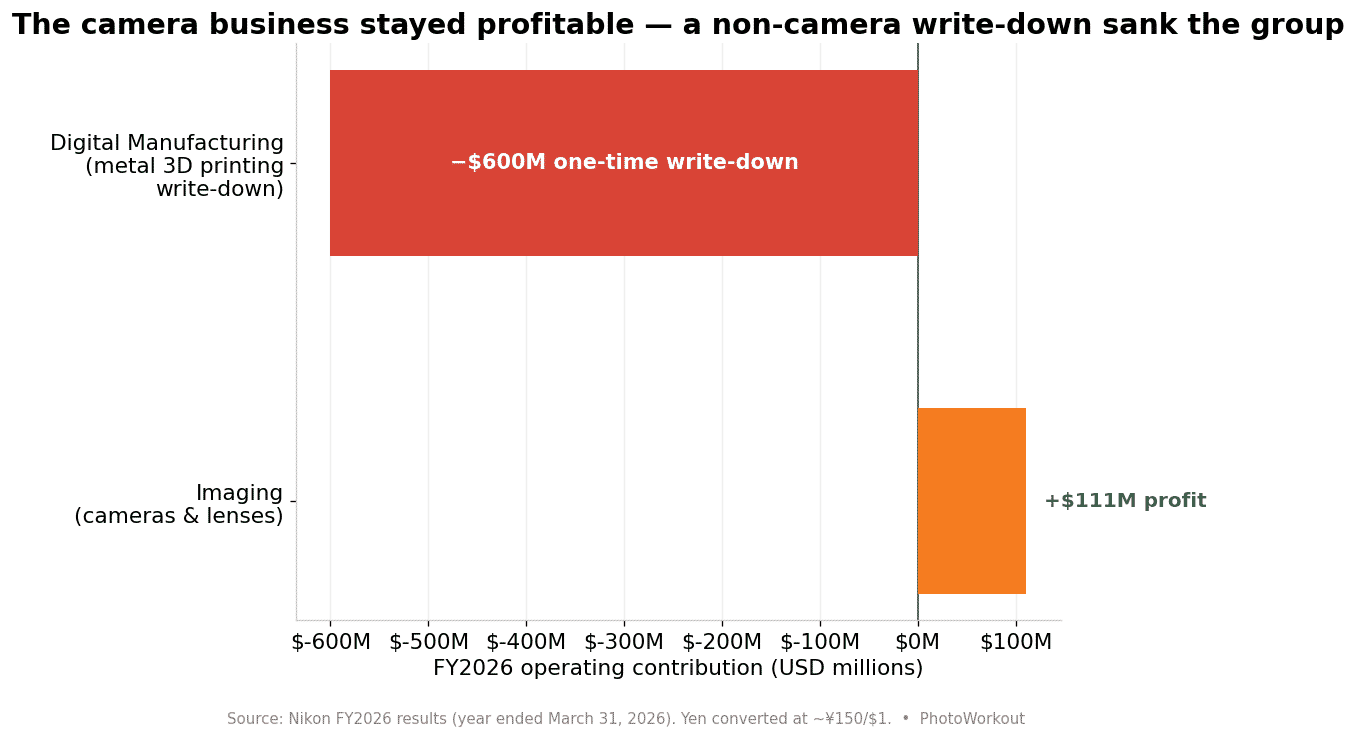
In other words: strip out the impairments and the semiconductor cycle, and the picture is ordinary. That’s exactly why Nikon guides a return to profit in FY2027 — revenue of ¥740 billion (~$4.9 billion) and a ¥10 billion (~$67 million) operating profit — driven mostly by those one-time charges simply not repeating.
How the Camera Business Actually Did
This is the part that matters for Z owners, and it’s genuinely encouraging. Nikon’s Imaging Products division — the cameras-and-lenses business — was profitable, posting ¥16.7 billion (about $110 million) in operating profit on ¥290 billion (~$1.9 billion) revenue. And it didn’t shrink in volume: Nikon shipped 910,000 interchangeable-lens cameras, up from 850,000 the year before, with sales led by the new ZR cinema camera, the Z5II, and the Z50II. Lens shipments held roughly flat at ~1.3 million units.
So the camera division grew units and stayed in the black during the company’s worst year overall. That’s not the profile of a business in retreat.
The Real Watch-Item: Margins, Not the Loss
If there’s a number Z owners should actually keep an eye on, it isn’t the ¥86 billion loss — it’s profitability per camera. Imaging’s operating margin has fallen steadily: 18.6% in FY2023, 16.6% in FY2024, 14% in FY2025, and just 5.8% in FY2026 (with FY2027 guided at 5.3%). Profit was down nearly 60% year-on-year even as units rose.
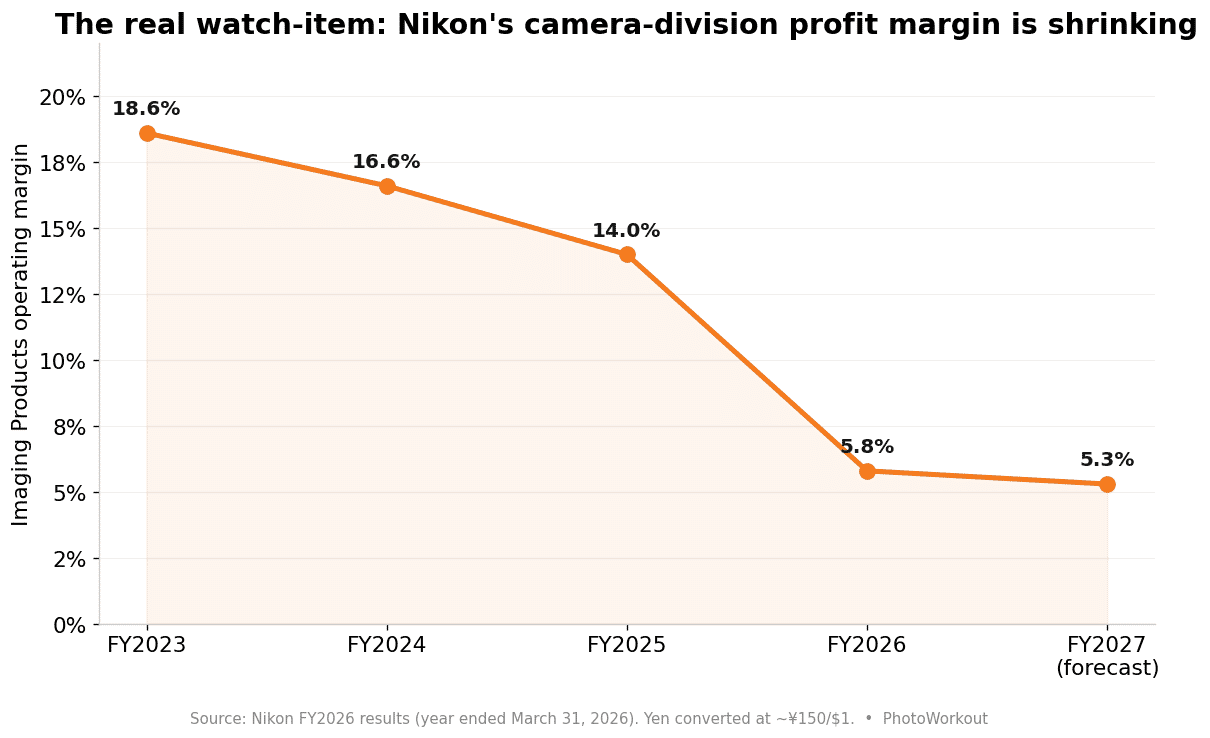
Nikon is candid about why: a product mix tilting toward more affordable bodies (the Z5II and Z50II sell in volume but at lower prices), heavier promotional spending in an intensely competitive market, tariff impacts, and one-time MRMC-related costs. Selling more cameras for less money is good for market share and bad for margin — and it’s the squeeze every camera maker is navigating right now.
What It Means for the Z Roadmap and Lens Pipeline
On the evidence in these results, the Z system is not at risk. A camera division that’s profitable and growing units is one Nikon has every reason to keep investing in — and the recent cadence backs that up: the ZR launched and sold well, the Z 70-200mm f/2.8 VR S II refreshed the pro lens lineup, and Nikon continues to put glass into the field. The record loss is a balance-sheet event from non-camera businesses, not a signal that lens development is being starved.
The honest caveat is medium-term: if Imaging margins stay compressed at ~5–6%, the cash that funds ambitious, low-volume halo lenses and next-gen sensors gets tighter, and Nikon may lean further on higher-margin pro bodies and the RED-derived cinema line to carry profitability. That’s a strategy question, not a survival one — and it’s worth watching across the next few quarters rather than reacting to one headline.
FAQ
Should Nikon camera owners be worried?
Not on the basis of these results. The record loss came from a one-time write-down on a non-camera business and a semiconductor-equipment downturn. The camera division was profitable, shipped more units, and Nikon forecasts a group return to profit next year. Your warranty, parts, and the Z roadmap aren’t threatened by this.
Did Nikon lose money selling cameras?
No. The Imaging Products division made roughly $110 million in operating profit. The group-level loss was driven by impairments in the Digital Manufacturing (metal 3D printing) unit and weakness in Precision Equipment.
What’s the one number to watch going forward?
Imaging operating margin. It’s fallen from 18.6% (FY2023) to 5.8% (FY2026). Stable or rising margins mean healthy reinvestment in bodies and lenses; continued compression would eventually pressure the pace and ambition of new releases.
Is Nikon expected to recover?
Yes — Nikon guides FY2027 (year ending March 2027) back to profit, with ¥740B revenue and ¥10B operating profit, largely because the FY2026 one-time charges won’t repeat and Precision Equipment is expected to recover.
The Bottom Line
“Nikon’s worst year ever” is accurate and “Nikon’s cameras are failing” is not — and the gap between those two statements is the whole story. A ~$570 million net loss is a serious number, but it’s the product of one-time write-downs in businesses most photographers have never heard of, not a collapse in cameras. The Imaging division grew units and stayed profitable; the roadmap looks safe. The thing to actually track is margin: as long as Nikon can defend it, the Z system has the fuel it needs.
Featured image: Gift Habeshaw / Unsplash. Charts: PhotoWorkout, from Nikon IR data.
Primary Coverage
- Nikon — Financial Results for the Fiscal Year Ended March 31, 2026 (official) – Consolidated and segment figures.
- Nikon Rumors — FY2026 results & FY2027 recovery target – Segment breakdown and margin history.
- The Phoblographer / PetaPixel — coverage of Nikon's record loss – Reporting on the headline result and one-time charges.
Notes
- Currency: yen figures converted at ~¥150 to the US dollar – Conversions are approximate and for scale; Nikon reports in yen.
Image Sources
- Charts: PhotoWorkout (data from Nikon IR). Featured photo: Gift Habeshaw / Unsplash.
Disclosure: This article contains affiliate links. When you purchase through these links, we may earn a commission at no additional cost to you. This helps support our research and allows us to continue providing free buying guides. All opinions and recommendations are based on our independent research and analysis.