


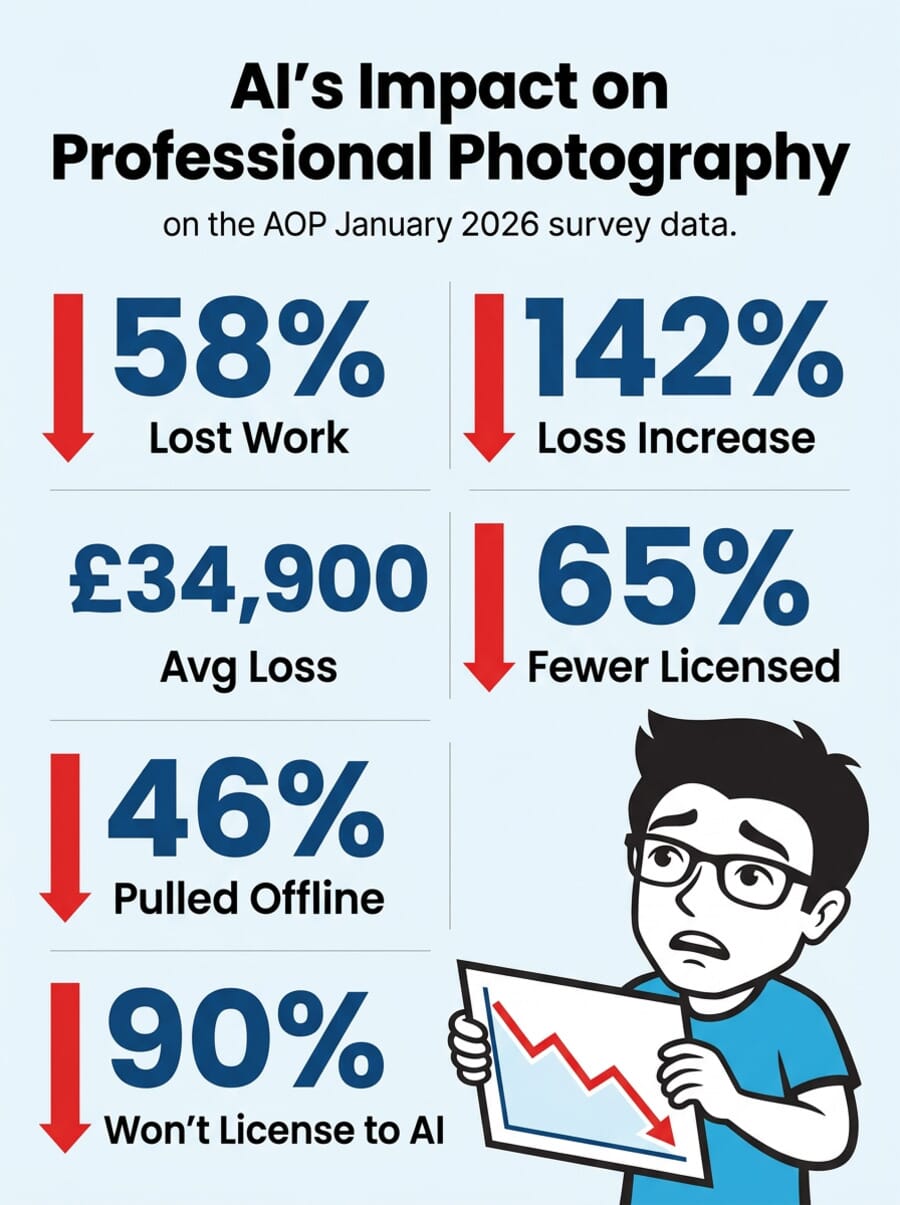
- 58% of professional photographers have lost commissioned work to generative AI, according to the AOP’s January 2026 survey.
- Financial losses surged 142% year-over-year, with the average photographer losing £34,900 (~$48,000) annually.
- Licensed images dropped 65% and images publicly visible online fell 46% as photographers pull work offline to avoid AI scraping.
- 89.9% of photographers refuse to license their work for AI training — up 5.8% from last year.
- Five UK creative organizations are lobbying Parliament, calling generative AI “the greatest act of theft in modern history.”
Professional Photographers Are Losing Work and Money to AI at an Alarming Rate
The numbers are stark, and they’re getting worse. The Association of Photographers (AOP) — a UK-based professional body representing roughly 3,000 members including industry icons like David Bailey, Rankin, Tim Flach, and Nadav Kander — has released the results of its January 2026 Copyright & AI Member Survey.
The headline figure is unchanged from 2025: 58% of members say they have lost commissioned work to generative AI. But while the percentage hasn’t budged, the financial toll has exploded. The average photographer’s reported losses more than doubled, and the profession’s response has hardened from concern into outright defiance.
This survey arrives as the AOP and four other UK creative organizations — the Society of Musicians, the Society of Authors, Equity, and the Association of Illustrators — published a joint report called Brave New World? Justice for Creators in the Age of Generative AI, lobbying the British Parliament into action.
The Financial Damage: 142% Increase in Losses
Of the AOP’s ~3,000 professional members, 20% (around 600) responded to the survey. The financial picture is devastating.
The average reported loss per photographer rose to £34,900 (~$48,000) — up from £14,400 (~$19,800) in the 2025 survey. That’s a 142% increase in just one year. Across the AOP membership, the estimated total loss reaches £104.7 million.
One AOP member put it bluntly: “My business turnover is down over 60% from last year — so £50K–£100K.”
While respondents reported a 10% year-on-year rise in overall income, this was overshadowed by a dramatic collapse in commissions and licensing — the core revenue streams for professional photographers. The income gains likely reflect surviving photographers taking on more commercial work to compensate, not a healthy market.
The Pullback: Photographers Are Disappearing From the Internet
Perhaps the most telling trend isn’t about money — it’s about visibility. Photographers are actively removing their work from the internet.
The number of images publicly visible online via members’ websites dropped 46%, averaging 9,000 per person in 2026 versus 14,000 in 2025. The AOP attributes this decline to photographers’ concerns about illegal scraping of their work for AI training data.
Meanwhile, the number of commissioned images being licensed by AOP members fell 65% — from an average of 10,500 per person in 2025 to just 4,800 in 2026. Across the entire AOP membership, that represents a drop from roughly 1.8 million licensed images to just 628,000 per year.
This is a vicious cycle. Photographers pull their work offline to protect it from AI scraping. Fewer images available means fewer licensing deals. Fewer licensing deals mean less income. Less income means the profession becomes unsustainable — which is exactly what AI companies benefit from.
What Photographers Want: Consent, Transparency, and No AI Copyright
The survey data on what photographers want from regulators is remarkably unified:
- 100% want transparency from AI companies about using their work for training
- 98.4% want compensation for past copyright infringements by AI companies (up 1% YoY)
- 96.1% want mandatory labelling of AI-generated works
- 94.6% are aware their photographic style can be replicated by AI users uploading their images
- 89.9% would NOT license their work for AI training — up 5.8% from 2025
- 86.8% say opt-out is not feasible — they can’t opt out from all platforms for all their works
- 85.3% want opt-IN as the default — creators should choose to allow AI training, not have to fight to prevent it
- 70.5% say AI outputs should NOT receive copyright protection equivalent to human-created works
The 94% calling for a “Personality Right” is particularly notable. This would protect a photographer’s name, likeness, and distinctive creative identity from being replicated by AI. In one case study from the Brave New World report, AOP President Tim Flach found that using the prompt “Tim Flach Tiger Image” generated imagery mimicking his signature style.
Industry Context: Part of a Much Bigger Fight
The AOP survey doesn’t exist in isolation. It’s one data point in a rapidly escalating conflict between creative industries and AI companies.
Getty Images has an ongoing lawsuit against Stability AI for using millions of copyrighted images without permission. The New York Times is suing OpenAI and Microsoft over training data. Courts are still grappling with whether AI-generated works deserve copyright protection — a question that 70.5% of AOP members answer with a firm “no.”
The five UK creative organizations behind the Brave New World report represent over 80,000 creatives and are pushing a framework they call CLEAR:
- Consent first — creators choose which works are used for AI training
- Licensing, not scraping — developed with trade unions, not one-size-fits-all
- Ethical use — creative works aren’t “free raw materials”
- Accountability and transparency — AI companies must disclose training data sources
- Remuneration and rights — fair payment for works used in AI training
The AOP warns that without regulation, generative AI could “hollow out the UK’s £2.4 billion photography industry within five years.” Their report notes that the UK’s creative sector is worth £124.6 billion annually and employs 2.4 million people — nearly 30 times larger than the UK’s AI sector, which accounts for 86,000 jobs and £11.8 billion.
“The destruction we’re witnessing is digital — silent, invisible and global,” the AOP stated. “Shrinking incomes, a marketplace shifting under pressure, widespread theft of intellectual property, the transfer of that IP value to overseas monopolies, and digital replication that puts style and identity itself at stake.”
What This Means for Photographers
Whether you’re a full-time professional or a serious hobbyist building a portfolio, the AOP data carries practical implications. Here’s what photographers can do right now:
Check if your work has been scraped. Tools like Have I Been Trained? let you search AI training datasets for your images. Knowing is the first step.
Use opt-out tools where available. Spawning.ai and DeviantArt both offer opt-out mechanisms. Adobe Firefly claims to only train on licensed content. Check each platform’s policy — and remember, 86.8% of AOP members say opting out of every platform isn’t feasible, so prioritize the biggest ones.
Consider watermarking. Visible watermarks remain the simplest deterrent. For those concerned about aesthetics, invisible watermarking tools embed metadata that survives most transformations. Tools like AI photo editors can remove visible watermarks easily, but invisible ones are harder to strip.
Add metadata and copyright notices. Embed IPTC metadata (copyright holder, usage terms) into every image you publish. It won’t stop scraping, but it establishes a clear legal record.
Be strategic about what you share online. The 46% drop in publicly visible images isn’t paranoia — it’s a rational response. Consider whether every image needs to be on your website, or whether lower-resolution previews with links to licensing platforms serve you better.
Stay informed on copyright developments. The legal landscape is shifting rapidly. Legislation in the EU (AI Act), UK, and US will shape what protections photographers have going forward. Industry organizations like the AOP, ASMP, and PPA are worth following for updates.
Featured image: Photo by Aditya Wardhana on Unsplash.
Sources used for this article:
Related Posts
Get the Weekly Photography News Digest
Join photographers who get our top stories delivered every Monday morning. No spam, unsubscribe anytime.