


- Canon has officially discontinued the EOS 5D Mark IV, ending the iconic 5D DSLR line after 21 years.
- The 5D Mark IV was released in August 2016 and remained in production for nearly a decade — a remarkable lifespan in digital camera years.
- The 5D series changed photography forever, with the Mark II launching the DSLR video revolution in 2008.
- Canon’s mirrorless EOS R5 II and R6 Mark III now carry the 5D’s legacy forward with the RF mount system.
Canon has officially added the EOS 5D Mark IV to its discontinued products list on the Canon Japan store, formally ending production of one of the most iconic camera lines in photography history. The listing was confirmed in March 2026, marking the final chapter for a DSLR series that began in 2005 and helped define modern digital photography.
While the 5D Mark IV had been widely expected to be discontinued for years — Canon confirmed back in 2020 that there would be no 5D Mark V — the official removal from Canon’s product lineup is a symbolic moment. It’s the definitive end of an era.
A Legacy That Changed Everything: The 5D Line (2005–2026)
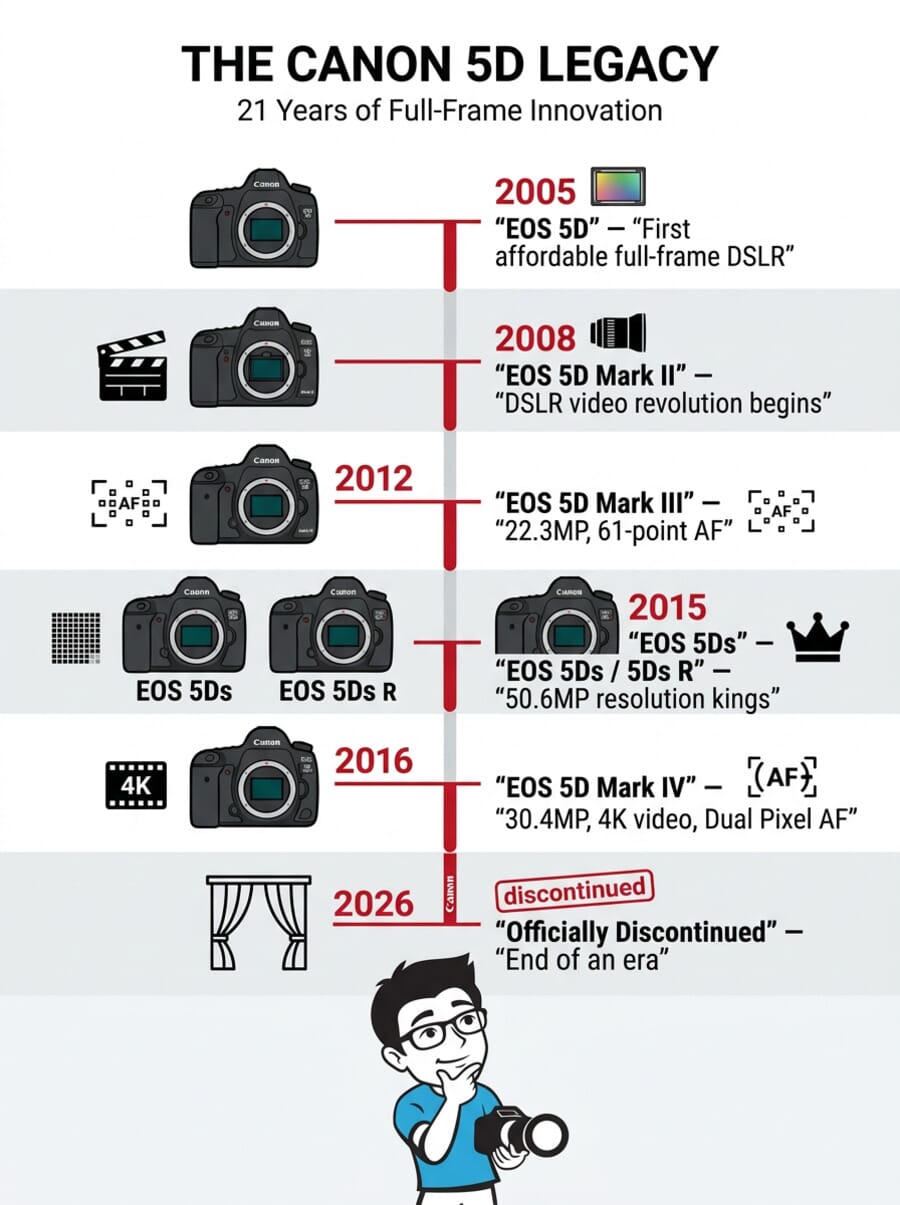
The Canon EOS 5D series wasn’t just a product line — it was a paradigm shift. When the original EOS 5D launched on August 22, 2005, it was the first full-frame DSLR in a standard-sized body at a price point that working professionals and serious enthusiasts could actually afford. Before the 5D, full-frame meant the flagship 1D-series and its flagship price tag.
That single camera opened the floodgates. Suddenly, wedding photographers, photojournalists, and portrait shooters had access to the shallow depth of field, superior low-light performance, and dynamic range that only full-frame sensors could deliver.
The 5D Mark II: The Camera That Changed Filmmaking
If the original 5D democratized full-frame photography, the EOS 5D Mark II (November 2008) democratized cinema. It was the first DSLR to record Full HD 1080p video on a full-frame sensor, and it didn’t just add video as a checkbox feature — it accidentally launched an entire revolution.
Indie filmmakers suddenly had a camera that could produce a cinematic shallow depth-of-field look that previously required lenses and camera bodies costing tens of thousands of dollars. The 5D Mark II was used to shoot the season finale of House M.D., becoming the first DSLR used for a prime-time network television episode. Hollywood films like Iron Man 2 and Captain America used it as a crash cam in stunt sequences.
The ripple effects were enormous. Every mirrorless camera that shoots 4K, 6K, or 8K video today exists in part because the 5D Mark II proved there was a massive market for video-capable stills cameras.
The Mark III and Mark IV: Refinement and Maturity
The EOS 5D Mark III (March 2012) brought a professional-grade 61-point autofocus system, 22.3-megapixel resolution, and improved video capabilities. It became the go-to camera for wedding photographers worldwide.
Canon also released the EOS 5Ds and 5Ds R in 2015 — specialized high-resolution variants with 50.6-megapixel sensors aimed at landscape and studio photographers who needed maximum detail.
Then came the EOS 5D Mark IV, announced on August 25, 2016. With its 30.4-megapixel sensor, Dual Pixel CMOS AF, DCI 4K video at 30fps, 7fps continuous shooting, and dual CF/SD card slots, it was the most well-rounded 5D ever built. Canon Rumors called it “the most refined 5D yet” — and that assessment still holds.
The fact that the Mark IV remained in production for nearly 10 years speaks volumes about how capable it was. Few digital cameras have had that kind of staying power.
Canon’s Full Shift to Mirrorless
The 5D Mark IV’s discontinuation is the latest — and perhaps most symbolic — step in Canon’s complete transition from DSLR to mirrorless. The EOS R5 (July 2020) was effectively the 5D’s mirrorless successor, offering 8K video, in-body image stabilization, and animal eye AF that the 5D Mark IV never had.
The EOS R5 Mark II followed in August 2024 with AI-powered subject tracking, improved 8K workflows, and pre-shot burst capability. And in November 2025, Canon announced the EOS R6 Mark III — a 32.5-megapixel hybrid powerhouse at $2,799 that arguably fills the “affordable full-frame workhorse” role that the original 5D pioneered two decades ago.
Canon’s DSLR discontinuation trend has been accelerating. The EOS-1D X Mark III — Canon’s flagship sports DSLR — was discontinued in September 2025. With the 5D Mark IV now gone, Canon’s DSLR production is effectively over. The company’s future is firmly RF-mount mirrorless.
What This Means for the Used Market
The 5D Mark IV won’t vanish overnight. Existing retail inventory will continue to sell — B&H Photo Video still has units at $500 off the original MSRP. But once that stock is gone, it’s gone.
For used market buyers, the discontinuation could push prices in either direction. Collectors and nostalgic shooters may drive prices up for mint-condition units. On the other hand, the steady migration to mirrorless means used DSLR prices have been trending downward for years, and the official end of production could accelerate that.
If you’ve been considering a 5D Mark IV as a backup body or a dedicated studio camera, now might be a good time to pick one up. The image quality, color science, and build quality remain excellent — the camera didn’t suddenly get worse because Canon stopped making it.
End of an Era, Start of the Next
The 5D line wasn’t just successful — it was foundational. It made full-frame accessible. It turned DSLRs into filmmaking tools. It was the workhorse that covered wars, weddings, and everything in between for two decades.
The cameras Canon is building now are objectively better in almost every measurable way. Eye-tracking autofocus, in-body stabilization, 8K video, computational photography — the EOS R system does things the 5D could never dream of.
But there’s something about the satisfying chunk of a mirror slapping up and down, the optical viewfinder that never needed a battery, and the mechanical simplicity of a well-built DSLR. The 5D was the last great expression of that philosophy, and photographers who grew up with it will remember it fondly.
The Canon EOS 5D Mark IV was announced on August 25, 2016. It would have turned 10 in August 2026 — Canon didn’t quite let it make it to that milestone. But what a run it had.
Is the Canon EOS 5D Mark IV officially discontinued?
Yes. Canon added the EOS 5D Mark IV to its discontinued products list on the Canon Japan store in March 2026. Canon USA also lists it as no longer available. Existing retail inventory may still be purchased while supplies last.
What is the mirrorless successor to the Canon 5D Mark IV?
The Canon EOS R5 (2020) and EOS R5 Mark II (2024) are the direct mirrorless successors in the professional full-frame segment. The EOS R6 Mark III (2025) fills the more accessible full-frame role at $2,799.
Will there be a Canon 5D Mark V?
No. Canon confirmed in 2020 that the 5D series would end with the Mark IV. There are no plans for a 5D Mark V or any new EOS EF-mount DSLR. Canon’s development is focused entirely on the RF-mount mirrorless system.
Is the Canon 5D Mark IV still worth buying in 2026?
For specific use cases, yes. The 5D Mark IV still delivers excellent image quality, reliable autofocus, and outstanding build quality. It’s a solid choice as a backup body, studio camera, or for photographers who prefer the optical viewfinder experience. Used prices are also increasingly attractive.
How many Canon 5D models were there?
Canon produced six models in the 5D family: the original 5D (2005), 5D Mark II (2008), 5D Mark III (2012), 5Ds and 5Ds R (2015), and 5D Mark IV (2016). The 5D Mark II was particularly significant as the first DSLR to record Full HD video.
Sources and further reading:
PhotoWorkout is an independent publication. We were not compensated for this coverage.
Featured image: Photo by Sixteen Miles Out on Unsplash.
Related Posts
Get the Weekly Photography News Digest
Join photographers who get our top stories delivered every Monday morning. No spam, unsubscribe anytime.