

- Adobe’s DNG format is now officially ISO 12234-4:2026, making it the first internationally recognized standard for camera raw files.
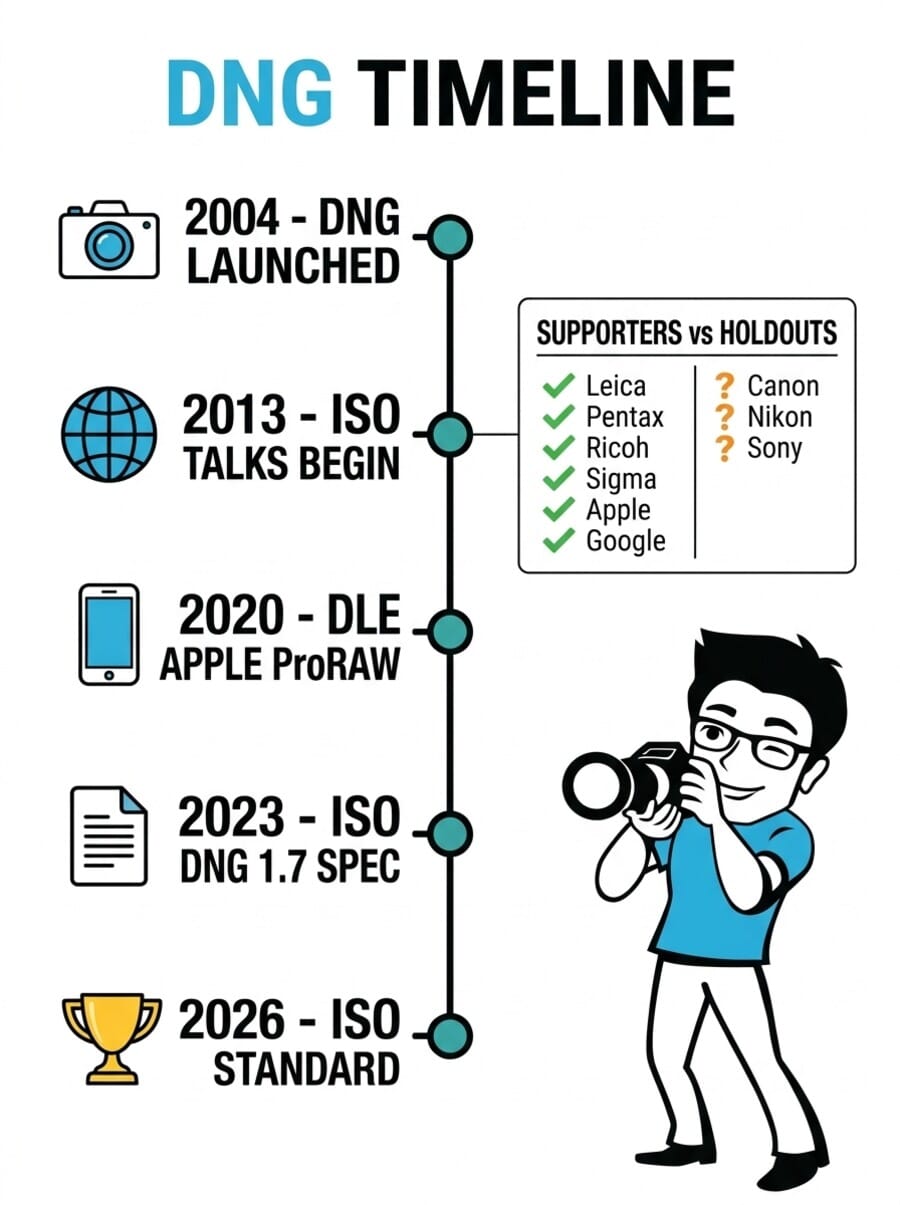
- The milestone caps a 22-year campaign started by Australian photographer Robert Edwards in 2004 — the same year Adobe launched DNG.
- Camera manufacturers like Canon, Nikon, and Sony no longer have a credible excuse to avoid supporting the format alongside their proprietary raw files.
- For archival and preservation workflows, ISO recognition gives DNG the same institutional weight as TIFF and PDF — critical for museums, libraries, and long-term photo storage.
After more than two decades of advocacy, discussion, and painstaking technical work, Adobe’s Digital Negative format has reached a milestone that seemed almost impossible when it was first proposed: DNG is now an official ISO standard.
Published on March 24, 2026, ISO 12234-4:2026 — officially titled “Digital Imaging — Image storage — Part 4: Digital negative format” — formally defines DNG as an internationally recognized file format for storing camera raw data. It sits alongside other ISO-standardized formats like TIFF and PDF, formats that form the backbone of digital imaging worldwide.
The 100-page standardization document is dense, technical, and not exactly beach reading. But its implications are enormous — for camera manufacturers, software developers, archivists, and every photographer who has ever worried about whether their raw files will still be readable in 20 years.
The Long Road to ISO
The story begins in March 2004, when Australian photographer Robert Edwards posted a simple question on Rob Galbraith’s now-defunct photography forums: “Could Adobe make a RAW format?”
Adobe’s answer, later that year, was DNG — the Digital Negative. The concept was straightforward: create a single, openly documented raw format that could outlast individual cameras, companies, and proprietary ecosystems. No license fees. No restrictions. Just an open specification anyone could implement.
Adoption came slowly. Leica, Pentax, Ricoh, Sigma, and Casio were among the first camera manufacturers to offer native DNG output. Then came a bigger shift — Apple and Google brought DNG into smartphones through Apple ProRAW (2020) and Android’s Camera2 API, putting raw photography into the hands of millions.
But Edwards never stopped pushing for something bigger: formal ISO recognition. In February 2013, the Australian Institute of Professional Photography invited him to an ISO meeting on photographic standards. Manufacturers, scientists, government representatives, and engineers were all at the table. From that point, Edwards became part of the standardization process itself.
“This week marks a significant milestone: ISO 12234-4 has been published,” Edwards wrote in his announcement. “DNG is now an international standard, alongside formats such as TIFF and PDF. After more than two decades of discussion, persistence, and advocacy, the goal has been achieved.”
Why ISO Recognition Matters
You might wonder: DNG was already open and widely supported — what does an ISO stamp actually change?
Quite a lot, actually. ISO standardization provides several concrete benefits:
- Institutional permanence. Standards bodies maintain and version documents indefinitely. Even if Adobe were to disappear tomorrow, ISO 12234-4 would continue to exist as a maintained reference.
- Government and institutional adoption. Many archives, museums, and government agencies require ISO-standardized formats for digital preservation. DNG can now meet those requirements directly.
- Manufacturer credibility pressure. When a format is just “Adobe’s thing,” camera makers can dismiss it as a competitor’s product. When it is an ISO standard, that argument evaporates.
- Legal and contractual clarity. Procurement documents, licensing agreements, and institutional policies can now reference ISO 12234-4 instead of a version-specific Adobe specification.
As the ISO document itself states: “This file format can be used in a wide range of hardware and software applications for generating, processing, managing, transcoding, or archiving raw photographs.”
What This Means for Archival Workflows
For anyone serious about long-term photo backup and organization, this is the most significant development in years.
The fundamental problem with proprietary raw formats — Canon’s .CR3, Nikon’s .NEF, Sony’s .ARW, Fujifilm’s .RAF — is that their specifications are not publicly documented. Software developers reverse-engineer support for each format, and there is no guarantee that a .CR3 file from 2024 will be readable by software in 2054.
DNG eliminates that risk by design. The format stores unprocessed sensor data alongside complete metadata about how to interpret it. Because the specification is now an ISO document, it carries the same archival assurance as TIFF — a format that has remained readable for over 30 years.
For museums, photo agencies, and professional archives, ISO recognition means DNG can now be specified as a preservation format in the same category as PDF/A. That is a practical, institutional shift — not just a theoretical one.
Photographers who convert their raw files to DNG using Adobe’s free DNG Converter already benefit from this openness. The ISO standard simply adds a formal guarantee that the format will persist.
Will Canon, Nikon, and Sony Finally Adopt DNG?
This is the question everyone is asking — and the answer is complicated.
The three biggest camera manufacturers have consistently resisted native DNG support. Each uses its own proprietary raw format: Canon shoots .CR3, Nikon shoots .NEF/.NRW, and Sony shoots .ARW. Their most common objection, according to Edwards: “It is owned by Adobe, and they are our competitor.”
That argument was always weak — DNG is openly licensed, freely implementable, and Adobe has never restricted its use. But with ISO standardization, it is now definitively dead. DNG is no longer “Adobe’s format.” It is an international standard, governed by the same body that standardizes everything from film speed ratings to image sensor measurements.
Edwards puts it bluntly: “Camera manufacturers no longer have a valid reason to avoid supporting DNG. Many already do. Others can follow the example of companies like Pentax, offering both a proprietary format and DNG.”
The Pentax model is instructive. Pentax cameras offer shooters a choice: save as the proprietary .PEF format, or as DNG, or both simultaneously. It costs the manufacturer nothing, adds no complexity for users who do not want it, and provides a safety net for those who do.
Will Canon, Nikon, and Sony follow? Realistically, do not expect overnight change. These companies have decades of investment in their proprietary ecosystems, and raw format lock-in provides a subtle competitive moat. But the pressure just increased significantly. If institutional clients — news agencies, museums, government archives — start requiring ISO 12234-4 compliance in procurement specs, the holdouts will have to respond.
Who Already Supports DNG
The list of DNG supporters is longer than most photographers realize:
- Camera manufacturers: Leica, Pentax (RICOH), Ricoh (GR series), Sigma, DJI, Hasselblad, and several others offer native DNG output.
- Smartphones: Apple (ProRAW), Google (Pixel), Samsung, and most Android devices with Camera2 API support can capture DNG.
- Software: Adobe Lightroom, Photoshop, Camera Raw, Capture One, DxO PhotoLab, ON1 Photo RAW, darktable, RawTherapee, and hundreds more read and write DNG.
- Drones: DJI drones have shot DNG for years, and Skydio also supports the format.
The Adobe Lightroom ecosystem has been the primary DNG champion, with the free Adobe DNG Converter (updated to SDK 1.7.1 Build 2502 as recently as March 10, 2026) providing batch conversion from virtually any proprietary raw format.
What Photographers Should Do Now
The ISO standardization does not change your daily workflow tomorrow. Your camera still shoots the same raw format it always did. But it does change the long-term calculus:
- Consider converting to DNG for archival. If long-term readability matters to you, converting proprietary raw files to DNG using Adobe’s free converter adds a layer of future-proofing that now carries ISO-standard weight.
- Ask your camera manufacturer. If you shoot Canon, Nikon, or Sony, let them know you want DNG as an output option. Consumer demand is the most effective pressure.
- Check your backup strategy. If you are storing photos in cloud services, DNG files are more likely to remain readable decades from now than proprietary formats with undocumented specifications.
- For professional archivists: Update your digital preservation policies to reference ISO 12234-4:2026. DNG now meets the same institutional threshold as TIFF/EP and PDF/A.
Frequently Asked Questions
Does this mean my camera will start shooting DNG?
Not automatically. ISO standardization creates pressure on manufacturers but does not force them to change their hardware. Cameras that already support DNG (Leica, Pentax, Ricoh GR, Sigma) will continue to do so. Others may add DNG support in future firmware updates or new models, but that is up to each manufacturer.
Is DNG better than my camera’s native raw format?
DNG is not inherently “better” in image quality — it stores the same sensor data. The advantages are openness (anyone can read the spec), archival safety (guaranteed long-term readability), and universality (one format across all cameras). Some proprietary formats may include camera-specific features that DNG does not replicate identically.
Should I convert all my existing raw files to DNG?
For archival purposes, it is worth considering — especially for older files from discontinued cameras. Adobe’s free DNG Converter handles the conversion losslessly. However, keep backups of your original proprietary raw files as well, since some camera-specific metadata may not transfer perfectly.
What is ISO 12234-4 exactly?
ISO 12234-4:2026 is a 100-page technical document published by the International Organization for Standardization that formally defines the DNG file format. It is part of the ISO 12234 series covering digital image storage, which also includes TIFF/EP (Part 2). The standard costs approximately $200 to purchase from ISO but the DNG specification itself remains freely available from Adobe.
Sources and further reading:
Featured image: Photo by Micah & Sammie Chaffin on Unsplash.


Get the Weekly Photography News Digest
Join photographers who get our top stories delivered every Monday morning. No spam, unsubscribe anytime.