
GoPro just announced it’s cutting 145 jobs — roughly 23% of its entire workforce. The layoffs, disclosed in an SEC filing on April 7, will begin this quarter and should be mostly done by year’s end.
The timing is hard to ignore. These cuts come just weeks before GoPro is expected to debut its next generation of cameras at NAB Show later this month — all powered by the brand-new GP3 processor the company unveiled in March.
So is this a company in freefall, or one making a calculated bet on a comeback?
The Numbers Behind the Cuts
GoPro had 631 employees at the end of Q1 2026. After these layoffs, that drops to roughly 486. The restructuring will cost between $11.5 and $15 million in severance and benefits — spread across Q2 through Q4.
The financial picture that forced this move is bleak. GoPro’s 2025 revenue came in at $652 million — a 19% drop from 2024’s $801 million. The company posted a $9 million loss in Q4 2025 alone and failed to hit its goal of returning to profitability by end of year.
This isn’t the first time GoPro has gone through this. The company cut over 20% of its workforce in January 2018 after killing its drone business. It did the same in 2020 during COVID. More cuts came in 2024. The pattern is becoming disturbingly familiar.
The Market Has Moved On
Here’s the number that really stings: GoPro’s action camera market share peaked at 75.5% in May 2023. By November 2025, it had cratered to under 10%.
DJI and Insta360 now control nearly 80% of the action camera market between them. DJI holds roughly 40%, Insta360 around 38%. Both Chinese manufacturers have been relentless — shipping new models with better stabilization, larger sensors, and more aggressive pricing while GoPro’s innovation pace slowed to a crawl.
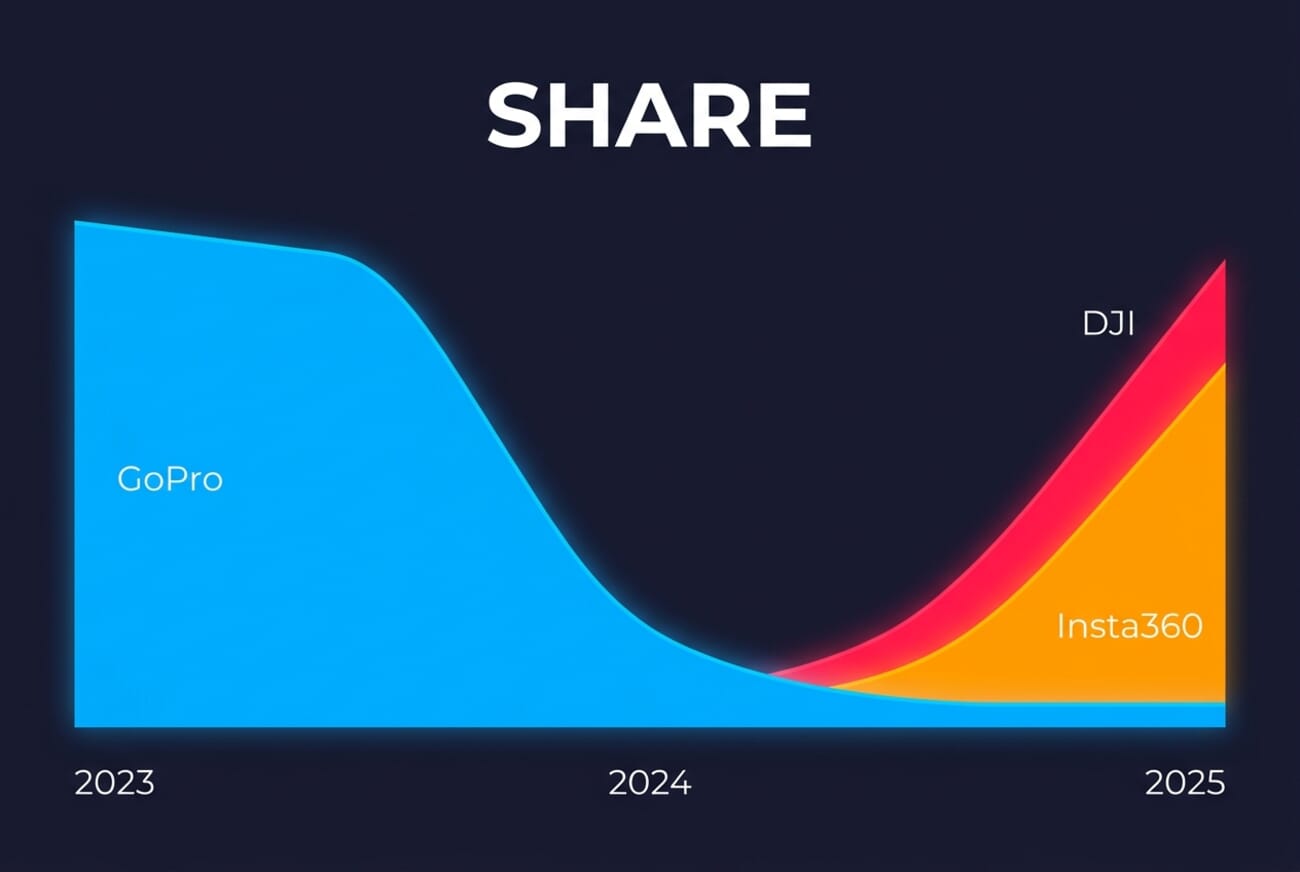
The action camera market itself is actually growing — projected to hit $23 billion by 2035. GoPro just isn’t the one benefiting. The pie is getting bigger, but GoPro’s slice has nearly disappeared.
The GP3 Bet
Everything now rides on the GP3 processor. Announced in early March, the GP3 is a 5-nanometer system-on-chip that GoPro designed in-house. Key specs include:
- 2x the pixel processing power of the previous GP2 chip
- A dedicated AI Neural Processing Unit for real-time scene recognition, subject detection, and automatic camera adjustments
- Significantly improved low-light performance — historically one of GoPro’s biggest weaknesses
- Better thermal management and battery life, which should mean longer recording times without overheating
CEO Nicholas Woodman isn’t being subtle about the ambition: “GP3’s bleeding-edge, cinema-grade performance will enable GoPro to enter the ultra-premium end of the imaging market this year.”
That’s the key pivot. GoPro isn’t just planning another action camera refresh. The GP3 is designed to power four distinct product categories: action cameras, 360 cameras, vlogging tools, and what Woodman calls “ultra-premium, compact cinema-grade cameras.”
SVP of Product Pablo Lema doubled down: “We expect our new GP3 processor to lead in every performance area — image quality, resolution, frame rates, low-light performance and power and thermal efficiency.”
Can It Actually Work?
GoPro is projecting $750–800 million in 2026 revenue — a target built almost entirely on GP3 camera sales. That’s a massive jump from 2025’s $652 million, and it assumes a product line that doesn’t exist yet will reverse years of decline in a matter of months.
The stock market isn’t optimistic. GPRO trades around $0.77, with a 52-week range of $0.46 to $3.05. That’s penny-stock territory for a company that once had a $13 billion market cap.
There are reasons for cautious optimism. The GP3’s 5nm architecture is genuinely impressive for a camera company this size — most competitors rely on off-the-shelf processors. A custom chip with a dedicated AI NPU could deliver real advantages in image processing that DJI and Insta360 can’t easily match.
But GoPro has been here before. The company has a pattern of promising transformative products while cutting staff, only to deliver incremental updates that fail to recapture lost ground. The drone business was supposed to be the next big thing. So was the GoPro subscription service.
What to Watch at NAB
NAB Show runs April 19–23 in Las Vegas. If GoPro shows up with genuinely new form factors — especially that “cinema-grade” compact camera — it could shift the conversation. If it’s just another Hero refresh with a faster chip inside, the market will likely shrug.
The next few months will determine whether the GP3 is a genuine reinvention or just the latest chapter in a long decline. Either way, 145 people are losing their jobs to fund the bet.
Image credit: Photo by Tigran Hambardzumyan on Unsplash


Sources and references for this article.
Image Sources:
- Tigran Hambardzumyan on Unsplash – Featured image
Get the Weekly Photography News Digest
Join photographers who get our top stories delivered every Monday morning. No spam, unsubscribe anytime.