


- Honor’s Robot Phone features a 200MP camera on a mechanical 3-axis gimbal that emerges from the rear housing — a first for any smartphone.
- The gimbal delivers dramatically better stabilization than OIS or EIS, with full 360° pan rotation and AI subject tracking.
- Functional prototypes were demoed at MWC 2026 in Barcelona — Honor confirms it will ship as a real product later in 2026, starting in China.
- A partnership with cinema company Arri will bring professional color science and image processing to the final product.
What happens when a smartphone maker puts a miniature robot inside a phone and lets it control the camera? Honor just answered that question at MWC 2026 in Barcelona with the Robot Phone — an Android device with a full mechanical gimbal built into its body. And this isn’t a concept that will never see daylight: Honor has confirmed it will ship as a finished product in the second half of 2026.
The Robot Phone builds on a non-working prototype first shown at CES in January. The MWC version is fully functional, and the hands-on demos from multiple outlets suggest this could genuinely change how creators think about smartphone photography and handheld video.
How It Works: A Camera That Pops Out and Moves
The Robot Phone’s headline feature is a 200-megapixel camera mounted on a mechanical 4-DoF (degrees of freedom), 3-axis gimbal that physically emerges from the rear camera housing. A sliding cover protects the mechanism when not in use — tap a gesture (hold your palm up to the front camera and flip your hand), and the camera rises out and starts tracking.
Honor engineered a custom micro motor for this, using the same super steel and titanium alloy from its foldable phone hinges. The result is a motor 70% smaller than anything currently on the market, yet strong enough to support smooth, stable rotation across all three axes.
The gimbal offers full 360° pan rotation, meaning it works facing both forward and backward. Video calls become hands-free as the camera tracks the user’s movement automatically. An AI SpinShot feature enables cinematic 90° and 180° stabilized transitions — even when shooting one-handed.
OIS vs. EIS vs. Mechanical Gimbal: Why This Matters
Every modern smartphone uses some form of stabilization, but the approaches differ dramatically in what they can actually achieve:
- OIS (Optical Image Stabilization) shifts a lens element by tiny fractions of a millimeter. It helps with minor hand tremors but can’t compensate for walking or running.
- EIS (Electronic Image Stabilization) crops the sensor and uses software to smooth footage. It works better for video but sacrifices resolution and field of view.
- Mechanical gimbal physically rotates the entire camera module. This is what professional filmmakers use on full-size rigs — Honor has miniaturized it to fit inside a phone.
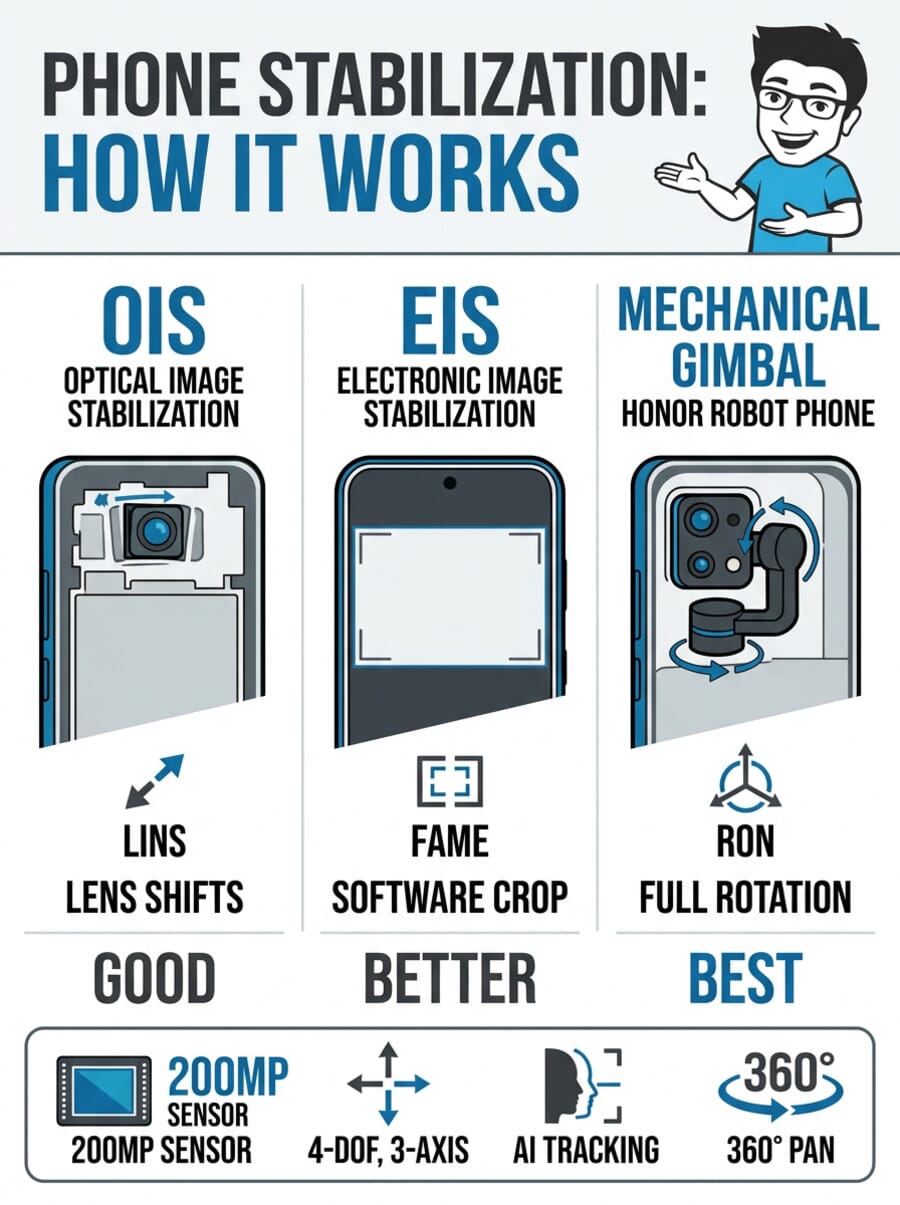
At the MWC demo, Honor mounted the Robot Phone next to an iPhone on a rig that moved and rotated constantly. The difference was stark: the Robot Phone’s viewfinder barely moved while the iPhone’s footage was visibly shaky. A separate demo showed an Honor staffer walking on a treadmill — footage from the Robot Phone looked as if the camera was completely stationary.
For anyone who has struggled with shaky footage while filming on a smartphone, this kind of hardware-level stabilization could eliminate the need to carry a separate DJI Osmo Pocket or phone gimbal accessory.
AI Tracking, Voice Commands, and a Dancing Camera
The gimbal isn’t just a stabilizer — it’s a tracking system. AI Object Tracking locks onto subjects and follows them as they move, working in both selfie and rear-facing modes. This makes it useful for solo creators who need to stay in frame without a cameraman.
Voice commands add another layer. Saying “focus on that” redirects the camera’s attention. Honor also demonstrated multimodal awareness — the camera commented on an attendee’s outfit and noted when a crowd was forming nearby, using visual and contextual AI processing in real time.
Then there’s the personality side. The camera can nod, shake its head, and dance to music, giving it a character that drew comparisons to WALL-E and R2-D2 at the show. It’s a playful touch, but it also demonstrates the precision and responsiveness of the gimbal mechanics.
Arri Partnership: Cinema-Grade Color Science
Honor isn’t going it alone on image quality. A partnership with Arri — the German cinema company whose cameras are used on Hollywood productions — will bring professional color science and image processing to the Robot Phone. Details are slim, but Arri’s involvement signals serious ambitions beyond a novelty gimmick.
This collaboration is part of Honor’s “Alpha Plan,” a $10 billion, five-year investment to evolve from a smartphone maker into an AI ecosystem company.
What We Still Don’t Know
For all the excitement, several questions remain unanswered:
- Still photography performance — all demos focused on video. How will burst mode, portraits, or interval shooting work with a gimbal camera?
- Sensor details — the 200MP resolution is confirmed, but sensor size and manufacturer are unknown.
- Other cameras — the gimbal housing takes up significant space. It’s unclear if there’s room for ultrawide or periscope telephoto lenses.
- Durability — a motorized, exposed camera mechanism raises obvious concerns about drops and pocket lint. Honor claims it’s resilient, but real-world testing will tell.
- Pricing and availability — launching in China first in H2 2026. Global availability and pricing remain unannounced, though Honor’s track record with devices like the Magic series suggests other markets will follow.
What This Means for Smartphone Photographers and Creators
The Robot Phone targets a clear audience: content creators who currently carry both a phone and a gimbal or action camera. Consolidating both into a single device — with AI tracking and cinematic stabilization built in — is a compelling pitch.
If the image quality matches Honor’s confidence (and Arri’s involvement suggests it might), the Robot Phone could set a new standard for what camera phones are expected to do. The next generation of smartphone cameras may need to think beyond software tricks and start engineering hardware solutions that match.
Whether this specific device succeeds commercially or not, the concept is sound: mechanical stabilization produces objectively better results than software-based alternatives. Honor has proven it can fit inside a phone. Now the industry will be watching to see if consumers actually want it.
What is the Honor Robot Phone?
The Honor Robot Phone is an Android smartphone with a built-in mechanical 3-axis gimbal that holds a 200MP camera. The camera physically emerges from the rear housing and can rotate 360° for stabilized video and AI-powered subject tracking.
When will the Honor Robot Phone be available?
Honor has confirmed it will launch in the second half of 2026, starting in China. Global availability has not been announced yet.
How is a mechanical gimbal different from OIS?
OIS (Optical Image Stabilization) shifts a small lens element to counter minor hand tremors. A mechanical gimbal physically rotates the entire camera module across multiple axes, providing dramatically better stabilization — especially for video while walking or moving.
Does the Honor Robot Phone work with Arri?
Yes. Honor has partnered with Arri, the renowned German cinema camera company, to bring professional color science and image processing to the Robot Phone’s camera system.
Can the Robot Phone’s camera track subjects automatically?
Yes. The gimbal camera features AI Object Tracking that locks onto subjects and follows them as they move. It works in both rear-facing and selfie modes, and also responds to voice commands.
Featured image: Screenshot from Honor.
Sources used for this article:
Related Posts
Get the Weekly Photography News Digest
Join photographers who get our top stories delivered every Monday morning. No spam, unsubscribe anytime.