

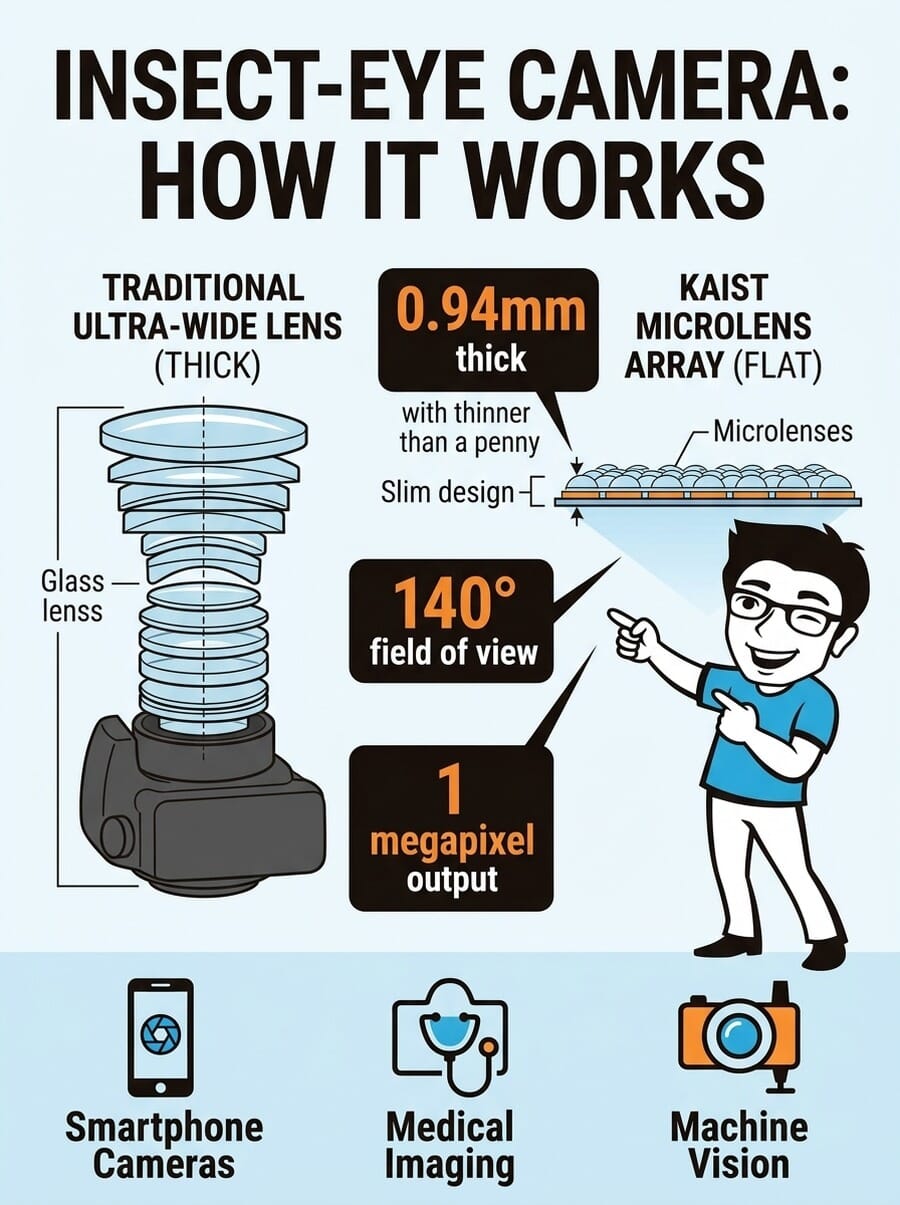
- KAIST researchers built a 0.94mm-thick camera with a 140° field of view — thinner than a penny.
- The design is inspired by the eyes of Xenos peckii, a tiny parasite that feeds on paper wasps.
- It uses a spatially offset ellipsoidal microlens array — dozens of tiny lenses stitched together digitally.
- The tech could eventually reshape smartphone cameras, medical imaging, and machine vision.
Ultra-wide lenses are engineering marvels — but they’re also huge. Fitting a 140° field of view into a traditional optical system means stacking multiple heavy glass elements, which is why wide-angle lenses on mirrorless cameras tend to be among the bulkiest in any manufacturer’s lineup.
A team at the Korea Advanced Institute of Science and Technology (KAIST) just demonstrated that nature solved this problem millions of years ago — in the eyes of a parasite.
A Parasite With Better Optics Than Your Phone
The research, published in Nature Communications on March 23, 2026, draws inspiration from Xenos peckii — a tiny endoparasite that spends most of its life inside paper wasps. Despite being barely visible to the naked eye, the male Xenos peckii has a remarkably sophisticated visual system.
Unlike the compound eyes of most insects (which use thousands of identical facets), Xenos peckii has just a handful of larger “eyelets,” each capturing a separate slice of the visual field. The brain then stitches these slices into a single, wide-angle image. It’s essentially doing computational photography — with a nervous system smaller than a grain of rice.
How the Ultra-Thin Camera Works
The KAIST team, led by researchers from the Department of Bio and Brain Engineering and the School of Computing, built what they call a spatially offset ellipsoidal microlens array camera. Here’s the core idea:
- Array of microlenses — Instead of one large lens, the camera uses an array of tiny ellipsoidal lenses, each aimed at a slightly different angle.
- Spatially offset apertures — Each microlens is paired with a precisely offset aperture, allowing the system to capture different directions without curving the sensor.
- Digital stitching — Software calibrates and stitches the separate views into a single wide-angle image, correcting for aberrations along the way.
- Total track length: 0.94mm — That’s the distance from the top of the lens stack to the image sensor. An American penny is 1.52mm thick.
The resulting camera captures a 140° field of view and produces stitched images at one-megapixel resolution with just 1.1-pixel stitching error. The researchers demonstrated it imaging microfluidic channels, dental phantoms, and even human faces.
Why This Matters for Photography
Let’s be clear: a 1 MP camera isn’t replacing your mirrorless anytime soon. But the implications are significant for where photography is heading.
Smartphone cameras are the most obvious beneficiary. Current phone camera modules are already the thickest component in modern handsets — it’s why the “camera bump” keeps growing. A microlens array approach could deliver ultra-wide coverage in a module thin enough to sit flush with the phone body.
Medical imaging is another area the researchers highlighted. Endoscopes and surgical cameras need wide fields of view in impossibly tight spaces. A sub-millimeter-thick wide-angle camera could transform minimally invasive procedures.
Machine vision and robotics also stand to benefit. Autonomous vehicles, drones, and industrial inspection systems all need wide-angle awareness in compact form factors.
Building on a Decade of Insect-Eye Research
This isn’t KAIST’s first insect-eye camera. The same lab, led by Professor Ki-Hun Jeong, published an earlier Xenos peckii–inspired design in 2018 that achieved a 68° field of view with a 1.4mm track length. The new design nearly doubles the FOV while reducing thickness by a third — a significant leap.
A separate 2025 paper from the same group, published in Science Advances, explored a related microlens array camera optimized for high-speed imaging at 9,120 frames per second. The team is clearly iterating rapidly on the core concept.
Current Limitations
The paper is an early-access publication and has not yet completed peer review. Nature notes it may undergo further editing. Beyond that, there are practical hurdles:
- Resolution — At 1 MP, the current prototype is a proof of concept, not a consumer-ready camera.
- Computational overhead — Stitching dozens of microlens views in real time requires significant processing power.
- Manufacturing complexity — Precisely aligning microlens arrays with offset apertures at sub-millimeter scale is nontrivial to mass-produce.
Still, the trajectory is promising. If resolution can scale with advances in sensor pixel density — and Moore’s Law continues to deliver cheaper compute — this approach could be viable for consumer devices within a decade.
Frequently Asked Questions
What is Xenos peckii?
Xenos peckii is a tiny endoparasite (order Strepsiptera) that lives inside paper wasps. The male has an unusual visual system with a small number of large “eyelets” rather than the thousands of tiny facets found in typical compound eyes. Each eyelet captures a different angle, which the brain assembles into a wide-angle view.
Could this technology replace traditional wide-angle lenses?
Not in the near term. The current prototype produces 1 MP images, far below what photographers need. However, the flat-optics approach could eventually be adopted for smartphone cameras, medical devices, and machine vision systems where compactness matters more than maximum resolution.
How thin is 0.94mm exactly?
Thinner than a U.S. penny (1.52mm) or a UK 1p coin (1.52–1.65mm). For comparison, the camera module in a modern iPhone protrudes about 3.6mm from the phone body — nearly four times thicker than this entire camera system.
Sources and references:
Featured image: Macro photo of a dragonfly compound eye by David Clode on Unsplash.


Get the Weekly Photography News Digest
Join photographers who get our top stories delivered every Monday morning. No spam, unsubscribe anytime.