

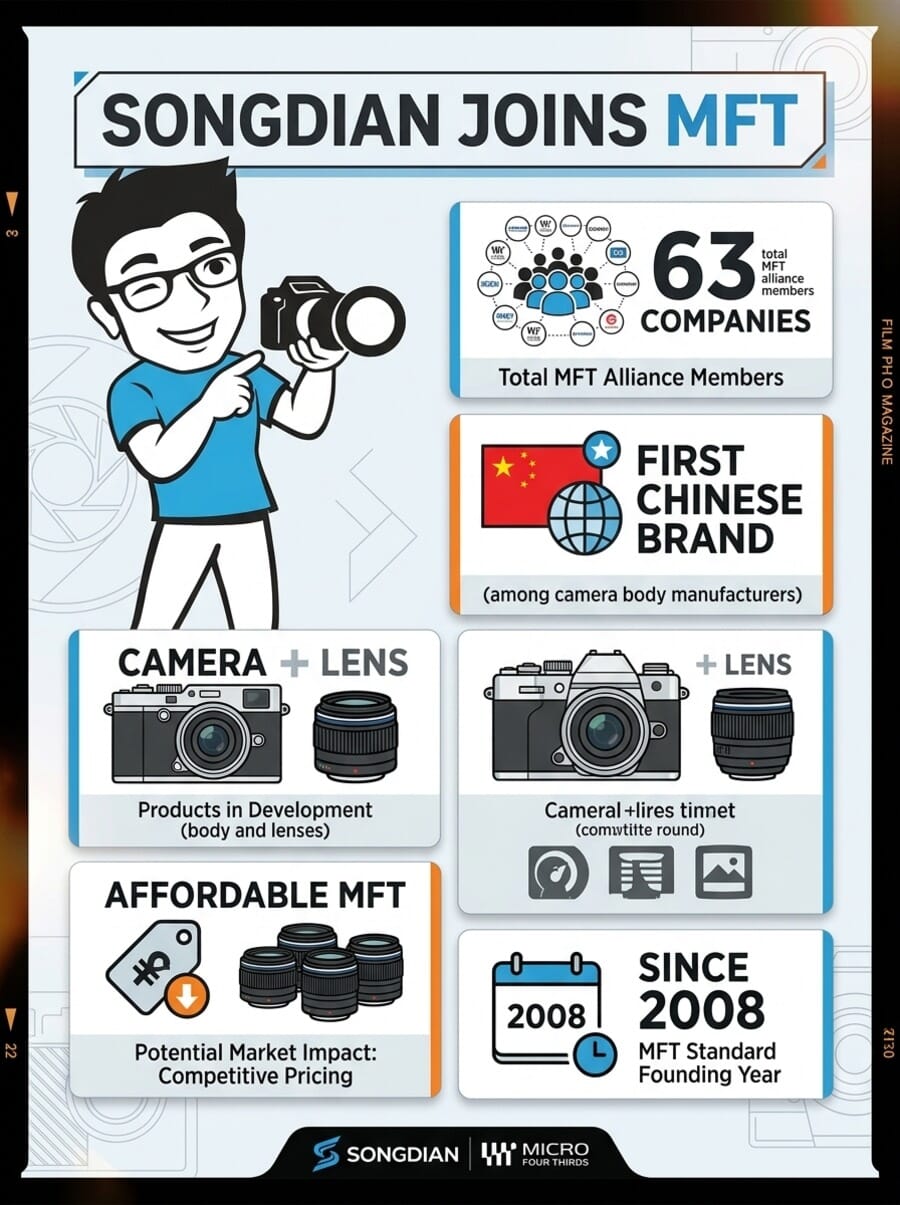
- Chinese camera maker Songdian (Shenzhen Sonida Digital Technology) has officially joined the Micro Four Thirds System standard, becoming the 63rd company in the alliance.
- The company confirmed that a new MFT camera and lens are currently in development — no specs or timeline yet.
- OM Digital Solutions and Panasonic jointly welcomed Songdian, saying new products will “further expand the enjoyment of imaging and video creation.”
- Songdian is known for budget cameras and has a mixed reputation, but MFT fans hope for an affordable interchangeable-lens body that could expand the ecosystem.
The Micro Four Thirds system just got a new — and unexpected — member. Shenzhen Sonida Digital Technology, the company behind the Songdian camera brand, has officially joined the Micro Four Thirds System standard group. The announcement, made jointly by OM Digital Solutions and Panasonic, makes Songdian the 63rd company to support the open mount standard.
More importantly, Songdian confirmed at a recent Digital Imaging Industry Forum in China that a brand-new Micro Four Thirds camera and lens are actively under development. While details remain scarce, this marks a significant moment for the MFT ecosystem — a Chinese consumer camera brand building native MFT products from the ground up.
Who Is Songdian?
Songdian is the consumer brand of Shenzhen Sonida Digital Technology Co., Ltd., a company that has been manufacturing imaging products for over 16 years. The brand primarily targets the budget camera segment in China, producing compact cameras, action cameras, instant film cameras, and webcams.
The company’s portfolio leans heavily into affordable, spec-forward designs — cameras that emphasize features like “4K” and “48MP” at sub-$100 price points. Some models, like the Songdian DC202, have drawn comparisons (and criticism) for closely resembling popular models like the Fujifilm X100 series. Amateur Photographer notably called the DC202 “the worst camera I’ve ever used.”
That reputation has earned Songdian’s products the “scamera” label in some photography circles — cheap cameras with flashy specs that don’t hold up in practice. But that doesn’t mean the company can’t surprise the industry with its MFT entry.
What We Know So Far
The official press release from OM Digital Solutions, dated February 12, 2026, confirmed Sonida’s membership in the Micro Four Thirds Alliance. The company “declared its support for the Micro Four Thirds System standard and will be introducing compliant products to the market.”
Then, on March 18, 2026, Songdian went further — announcing at a product launch event (where it also unveiled the compact DC226 Pro and VE228 cameras) that a dedicated Micro Four Thirds camera and lens are in development. As 43 Rumors reported, no specifications, pricing, or launch timeline were shared.
On its Weibo account, Songdian teased: “Songdian Camera is about to do something big — body, optics, filters, design, software…”
Why This Matters for Micro Four Thirds
The Micro Four Thirds system has been remarkably quiet lately. Panasonic has increasingly focused on its full-frame L-Mount lineup — the company recently hit a record 10% European full-frame market share — and has even begun discontinuing some beloved MFT lenses like the Lumix G 20mm f/1.7.
OM System (formerly Olympus) remains committed to MFT but releases have slowed considerably. The most recent launch was the OM-3, essentially an astrophotography variant of an existing body. Meanwhile, Panasonic’s budget-friendly Lumix G97 offered some hope for affordable MFT hardware.
A new manufacturer — even one with a rocky track record — brings several potential benefits to the ecosystem:
- Price competition: Songdian’s strength is affordable hardware. An MFT body significantly cheaper than OM System or Panasonic could attract first-time mirrorless buyers.
- Market signal: A new company investing in MFT development signals that the format still has commercial viability — important for ecosystem confidence.
- Lens compatibility: Any MFT-compliant body would work with the vast existing library of Micro Four Thirds lenses from OM System, Panasonic, Laowa, Sigma, and others.
- Entry-level gap: Both OM System and Panasonic have largely abandoned the true beginner segment. A sub-$300 MFT body could fill a real gap.
The Elephant in the Room: Quality Concerns
There’s no sugarcoating Songdian’s reputation. The company’s existing cameras have been widely criticized for poor image quality, slow autofocus, and misleading spec sheets. The “scamera” label exists for a reason.
But building an MFT camera is a fundamentally different proposition than slapping a cheap sensor into a trendy shell. The Micro Four Thirds standard enforces specific sensor dimensions, flange distances, and communication protocols. Songdian would need to source a proper MFT sensor, implement reliable autofocus, and ensure lens compatibility across the ecosystem.
As PetaPixel noted, “While many of Songdian’s products may fail to excite dedicated, enthusiastic photographers, that does not mean Songdian’s Micro Four Thirds products can’t be good.” The interchangeable-lens format forces a higher engineering baseline than a self-contained compact.
What Could the Camera Look Like?
With no specs available, speculation is all we have — but it’s informed speculation. Several possibilities emerge:
A PEN-style compact body: 43 Rumors hopes for “something PEN alike,” referring to Olympus’s beloved PEN series. Songdian already has experience copying popular camera designs, and an affordable PEN-style body would tap into strong market nostalgia.
A fixed-lens MFT compact: Songdian could take the fixed-lens route — a compact camera with a built-in MFT lens. This is an area neither OM System nor Panasonic has explored recently, and it could differentiate Songdian’s offering.
A budget interchangeable-lens body: The most exciting possibility. A sub-$300 MFT body with interchangeable lenses would give budget-conscious photographers access to the entire Micro Four Thirds lens ecosystem — dozens of high-quality lenses from multiple manufacturers.
The Bigger Picture: Chinese Brands in the Camera Market
Songdian isn’t the only Chinese company making moves. Xiaomi is reportedly developing a magnetic Micro Four Thirds lens system. YoloLiv already produces an MFT camera aimed at content creators. And lens manufacturers like Laowa (Venus Optics), Viltrox, and TTArtisan have earned genuine respect for their optical quality.
The trend is clear: Chinese imaging companies are moving from accessories and knockoffs toward building serious camera systems. Whether Songdian represents the next step in that evolution — or just another budget disappointment — depends entirely on execution.
For MFT loyalists, the best-case scenario is a capable, affordable body that brings new users into the ecosystem and validates the format’s continued relevance. The worst case? Another forgettable camera that reinforces the “scamera” reputation. Either way, more investment in Micro Four Thirds is better than the alternative — a system slowly fading from neglect.
Frequently Asked Questions
Is Songdian the first Chinese brand to join Micro Four Thirds?
Songdian (Shenzhen Sonida Digital Technology) is the first Chinese consumer camera brand to officially join the MFT standard. However, other Chinese companies like Laowa, YoloLiv, and TTArtisan already produce MFT-compatible lenses and accessories. Songdian is the 63rd company overall to join the alliance.
When will the Songdian MFT camera be released?
No release date has been announced. Songdian confirmed development at a March 2026 event but stated the timeline “remains uncertain.” The company is developing both a camera body and at least one lens.
Will Songdian MFT cameras work with existing MFT lenses?
Yes — that’s the whole point of the open standard. Any Micro Four Thirds compliant camera body works with any MFT lens, regardless of manufacturer. This means a Songdian body would be compatible with lenses from OM System, Panasonic, Sigma, Laowa, and other MFT lens makers.
How much will the Songdian MFT camera cost?
No pricing has been announced. Given Songdian’s focus on affordable hardware (most of their cameras sell for under $100), industry watchers expect a very competitive price point — potentially well under $300 for the body.
Sources used for this article:
Featured image: Photo by Greg Rosenke on Unsplash.


Get the Weekly Photography News Digest
Join photographers who get our top stories delivered every Monday morning. No spam, unsubscribe anytime.