

- Tamron is shifting from its traditional Sony E-mount first launch strategy to simultaneous multi-mount releases, starting with lenses like the 35-100mm f/2.8.
- The company plans to release 10 new lenses in 2026 across Sony E, Nikon Z, Fujifilm X, and Canon RF mounts.
- Canon’s full-frame RF mount remains closed to Tamron — only APS-C RF lenses are possible for now.
- Tamron will continue focusing on unique focal length ranges that first-party lens makers don’t offer.
Tamron has confirmed a significant change in how it brings lenses to market. In an interview at CP+ 2026 in Yokohama, company representatives told DPReview that Tamron is actively moving toward simultaneous multi-mount lens launches — a departure from the company’s long-standing practice of releasing for Sony E-mount first, then porting to other systems later.
It’s a shift that Nikon Z and Fujifilm X shooters have been waiting for, and one that reflects the changing dynamics of the third-party lens market.
Tamron’s CP+ 2026 presence was hard to miss. The company set up an elaborate Back to the Future-themed booth – complete with a life-size DeLorean time machine replica – under the slogan “Focus on the Future.” The theatrical presentation reflected Tamron’s 75th anniversary celebration, but the forward-looking message was clearly about the company’s multi-mount ambitions. Alongside the booth spectacle, Tamron showcased its Lens History Board tracing 75 years of optical innovation, the new 35-100mm f/2.8, and Tamron-Link, a Bluetooth accessory enabling wireless lens control from iOS devices.
Sony First No More
For years, Tamron’s product launches followed a predictable pattern: new lenses debuted for Sony E-mount, and Nikon Z and Fujifilm X versions arrived months — sometimes a year or more — later. This made sense historically. Sony’s mirrorless system had a massive head start, and the E-mount’s open protocol made it the easiest platform for third-party manufacturers to develop for.
But the gap between mount launches has been narrowing. Recent releases like the Tamron 16-30mm f/2.8 Di III VXD G2 shipped for both Sony E and Nikon Z simultaneously. The newly announced Tamron 35-100mm f/2.8 Di III VXD — one of CP+ 2026’s standout lenses — launched for both mounts on the same day, March 26, 2026.
According to the DPReview interview, Tamron management confirmed this isn’t coincidence — it’s strategy. The company is making simultaneous multi-mount availability a priority going forward.
The Evolution of Tamron’s Mount Strategy
To understand how significant this shift is, it helps to look at the full arc of Tamron’s mount strategy over the past several years. What started as a Sony-exclusive approach has gradually evolved into true multi-mount parity.
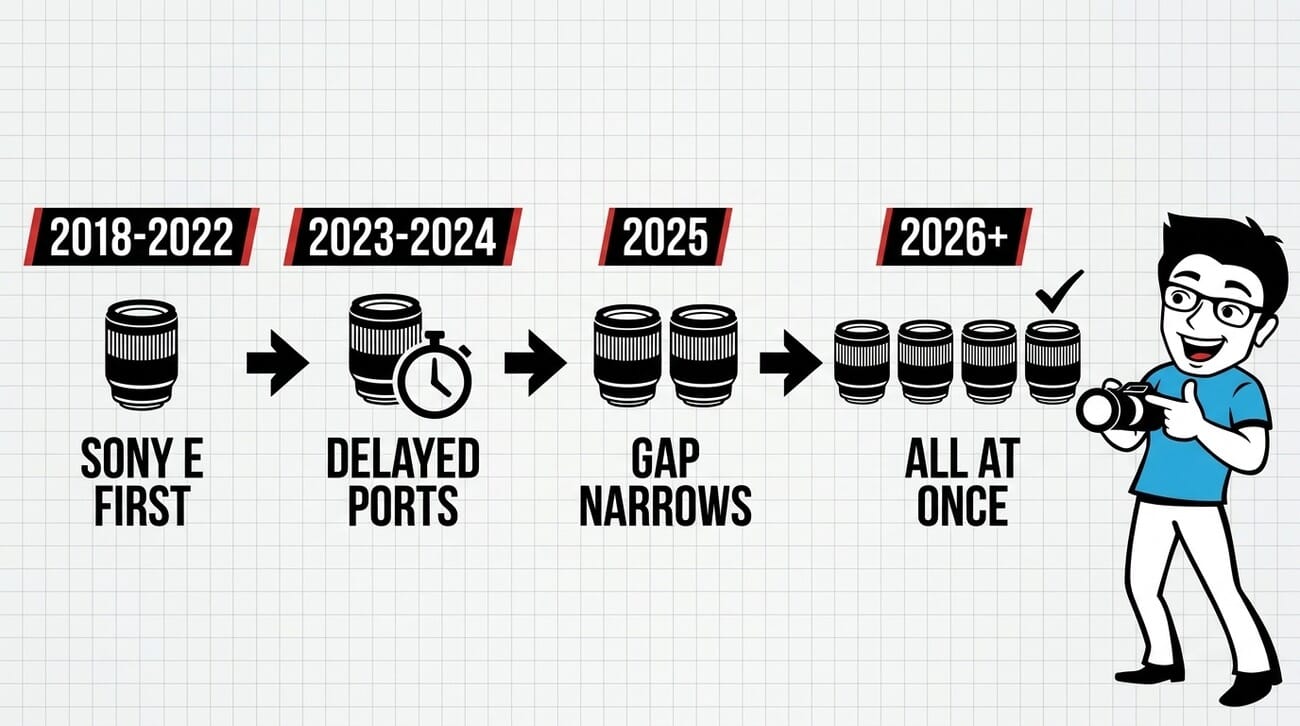
When Tamron launched its first mirrorless-native lenses in 2018, the 28-75mm f/2.8 Di III RXD was available exclusively for Sony E-mount. That lens essentially created the “affordable fast zoom” category and became one of the best-selling third-party lenses of the mirrorless era – but Nikon Z and Canon RF shooters had no access to it. The same pattern repeated with the 17-28mm f/2.8, the 70-180mm f/2.8, and the groundbreaking 35-150mm f/2-2.8 – all Sony-first, with other mounts arriving months or even years later.
The turning point came in late 2024 and 2025, when Tamron began narrowing the gap between Sony and Nikon Z launches. The 16-30mm f/2.8 Di III VXD G2 shipped for both mounts simultaneously – a first for Tamron. Now, with the 35-100mm f/2.8 and the company’s stated commitment to simultaneous releases going forward, the “Sony first” era appears to be officially over.
Ten Lenses Across Four Mounts
The timing aligns with Tamron’s ambitious 2026 roadmap. In its FY2025 financial results, the company announced a target of 10 new lens launches in 2026 — nearly double its six releases in 2025. These launches span four mount systems: Sony E, Nikon Z, Fujifilm X, and Canon RF.
That count includes bringing existing designs to new mounts (Tamron counts each mount version as a separate launch). But even accounting for that, the pace represents Tamron’s most prolific year in recent memory.
The current mount lineup tells the story of why simultaneous launches matter:
- Sony E-mount: 21 lenses — the deepest catalog
- Nikon Z mount: 9 lenses — growing fast
- Fujifilm X mount: 4 lenses — limited, last new lens was May 2023
- Canon RF mount: 2 lenses — APS-C only, no full-frame access
By launching simultaneously, Tamron can close this gap faster and avoid the frustration that Nikon and Fujifilm users have felt watching Sony shooters get first access to popular designs.
Canon Full-Frame RF: Still Locked Out
There’s one notable exception to the multi-mount push. Tamron cannot comment on future full-frame Canon RF lenses, according to the interview. Canon’s restrictive RF mount licensing continues to block third-party manufacturers from making full-frame RF optics — a situation that also affects competitors like Sigma and Viltrox.
For now, Tamron’s Canon RF presence is limited to APS-C lenses like the 18-300mm f/3.5-6.3 VC VXD. Whether Canon eventually opens the full-frame RF mount to third parties remains one of the industry’s biggest unanswered questions — and one that would dramatically reshape the lens landscape if it happened.
Unique Focal Ranges Remain the Strategy
Beyond the multi-mount shift, Tamron reaffirmed its commitment to unique focal length ranges that first-party manufacturers don’t offer. This has been a defining characteristic of Tamron’s mirrorless lineup — think the 35-150mm f/2-2.8, the 20-40mm f/2.8, and the 28-75mm f/2.8 that essentially created the “affordable fast zoom” category.
The new 35-100mm f/2.8 Di III VXD is a perfect example. It covers the four most popular portrait focal lengths (35mm, 50mm, 85mm, and 100mm) in a package that weighs just 565g and costs $899 on Sony E-mount ($929 on Nikon Z). That’s lighter and cheaper than most first-party 24-70mm f/2.8 zooms — and arguably more useful for portrait and event photographers.
How Tamron’s Approach Compares to Sigma
Tamron isn’t the only third-party manufacturer navigating multi-mount complexity. Sigma, its closest competitor, has taken a fundamentally different approach – one rooted in the L-Mount Alliance with Leica and Panasonic.
Sigma’s full-frame mirrorless lenses are designed primarily for L-mount and Sony E-mount, launching simultaneously for both systems. However, Sigma has historically not offered Nikon Z mount versions of its full-frame Art and Contemporary lenses – a significant gap that has frustrated Nikon shooters. Sigma does offer APS-C lenses for Nikon Z, Canon RF, and Fujifilm X mounts, but the full-frame catalog remains largely L-mount and Sony E only.
This creates an interesting dynamic. While Tamron is moving toward launching across four mount systems simultaneously (Sony E, Nikon Z, Fujifilm X, and Canon RF APS-C), Sigma’s full-frame lenses remain limited to two mounts. For Nikon Z full-frame shooters in particular, Tamron’s multi-mount push is arguably more impactful than anything Sigma currently offers.
There’s also the matter of Viltrox, which has been rapidly expanding its multi-mount presence. As an official L-Mount Alliance partner since 2025, Viltrox now produces lenses for Sony E, Nikon Z, Canon RF, Fujifilm X, and L-mount – often launching across all systems within weeks of each other. The Chinese manufacturer’s aggressive pricing (often 50-70% less than Tamron or Sigma) is adding competitive pressure from below.
The bottom line: multi-mount availability is becoming table stakes in the third-party lens market. Tamron’s shift isn’t just about catching up – it’s about staying relevant in an increasingly competitive landscape.
What’s Coming Next: Tamron’s 2026 Pipeline
With 10 launches planned for 2026, the question is: what’s actually coming? The 35-100mm f/2.8 accounts for two of those launches (Sony E and Nikon Z versions), and bringing existing lenses to new mounts will fill several more slots. But industry watchers expect at least a few genuinely new optical designs.
The most anticipated is a potential 35-150mm f/2-2.8 Di III VXD G2. The original 35-150mm, launched in 2021, remains one of Tamron’s best-selling lenses and a favorite among wedding and event photographers. Tamron has already released G2 updates for its 28-75mm f/2.8, 70-180mm f/2.8, and 16-30mm f/2.8 – making a 35-150mm G2 the logical next step. If it arrives, expect it to launch for both Sony E and Nikon Z simultaneously.
There’s also the matter of a 28-70mm f/2 lens, for which Tamron filed a patent in Japan in 2024 (granted October 2025). If Tamron can deliver a 28-70mm f/2 at a significantly lower price than Sony’s $2,798 FE 28-70mm f/2 GM, it would be a game-changer – especially for video shooters who need that extra stop of light. However, a lens this complex may still be a year or more away from production.
For Fujifilm X mount users, the 2026 roadmap offers particular hope. With only four Tamron lenses currently available for Fujifilm’s APS-C system (the last new one arriving in May 2023), any expansion would be welcome. The simultaneous launch strategy means new Fuji X lenses won’t be an afterthought – they’ll arrive alongside the Sony and Nikon versions.
And for Canon RF mount, the picture remains complicated. Tamron can only produce APS-C RF lenses due to Canon’s closed full-frame licensing. But with Canon’s APS-C mirrorless camera lineup growing (the EOS R7 and R10 have been popular), there’s room for Tamron to expand its APS-C RF offerings beyond the current 18-300mm f/3.5-6.3.
What This Means for Photographers
Tamron’s shift to simultaneous launches is part of a broader trend. The third-party lens landscape is evolving rapidly, with Sigma, Viltrox, and others also expanding multi-mount availability. For photographers, the practical impact is clear:
- Nikon Z users no longer have to wait 6-12 months after Sony E-mount launches
- Fujifilm X users may finally see Tamron’s catalog expand beyond four lenses
- Lens choice across all mirrorless systems is converging — mount selection matters less for third-party lens availability
- Price competition benefits everyone as third-party makers fight for share across all platforms simultaneously
The era of Sony-first exclusivity from Tamron appears to be ending. For the broader mirrorless ecosystem, that’s unambiguously good news.
There’s also a broader industry implication worth noting. As third-party manufacturers like Tamron commit to simultaneous multi-mount launches, the mount you choose matters less when it comes to lens availability. This could subtly shift how photographers evaluate camera systems – with less emphasis on “which system has the best third-party support” and more emphasis on body features, ergonomics, and native lens quality.
For working professionals, the practical impact is even more immediate. Wedding photographers, event shooters, and content creators who rely on Tamron’s fast, affordable zooms can now switch between camera systems without losing access to their preferred glass. A portrait photographer using the 35-150mm f/2-2.8 on Sony could move to Nikon Z and expect the same lens to be available for both mounts from day one – no more waiting for a port that may or may not arrive.
Frequently Asked Questions
Why did Tamron always launch Sony E-mount lenses first?
Sony’s mirrorless system launched in 2010 and had a significant head start over competitors. The E-mount’s open licensing protocol also made it the easiest platform for third-party lens development, so Tamron naturally built its largest catalog there first.
Will Tamron make full-frame Canon RF lenses?
Not yet. Canon’s RF mount remains closed to third-party full-frame lenses. Tamron currently offers only APS-C RF lenses and could not comment on future full-frame RF plans during the CP+ 2026 interview.
What is the Tamron 35-100mm f/2.8 and when is it available?
The 35-100mm f/2.8 Di III VXD is Tamron’s newest zoom lens, announced at CP+ 2026. It’s available from March 26, 2026 for both Sony E-mount ($899) and Nikon Z mount ($929) — a simultaneous launch that exemplifies their new multi-mount strategy.
How does Tamron’s multi-mount approach differ from Sigma’s?
Sigma primarily launches full-frame lenses for L-mount and Sony E-mount simultaneously, but does not offer full-frame Nikon Z mount versions. Tamron is targeting four mount systems (Sony E, Nikon Z, Fujifilm X, and Canon RF APS-C) with simultaneous launches, giving it broader mount coverage than Sigma for full-frame shooters – especially Nikon Z users.
What Tamron lenses are expected to launch in 2026?
Beyond the 35-100mm f/2.8, Tamron is expected to bring existing lens designs to new mounts and potentially launch a 35-150mm f/2-2.8 G2 update and additional Fujifilm X mount lenses. A patented 28-70mm f/2 design is also in development but may not arrive until 2027. The company has confirmed a target of 10 total lens launches across all mounts in 2026.
Sources used for this article:
Featured image: Photo by Evgeniy Bezkorovayniy on Unsplash.


Get the Weekly Photography News Digest
Join photographers who get our top stories delivered every Monday morning. No spam, unsubscribe anytime.