


- The story has flipped: it’s not just that AI fakes fool people — it’s that the detectors meant to catch fakes routinely flag genuine photographs as AI, and the photographer pays the price.
- A NewsGuard audit (May 2026) found three of five leading detectors wrongly flagged real news photos as AI — collectively 13.3% of the time, and one tool (ScamAI) got it wrong on 40% of authentic images.
- It’s already costing people: an Australian photographer was disqualified from a contest after judges deemed her genuine iPhone shot ‘a little AI-ish,’ and a film-photographer’s Tri-X scan was removed from a forum as suspected AI.
- The deepest problem is procedural: a detector spits out a confident verdict, contests and platforms act on it, and there is no real appeals process. The burden of proof lands on the accused.
- Protect yourself: keep your RAWs and originals, capture Content Credentials (C2PA) where you can, and treat any detector ‘score’ as an opinion to be challenged — not evidence.
For the last two years the fear was that AI images would fool us. The newer, stranger problem is the opposite: the tools built to catch fakes are increasingly accusing real photographs of being fake — and when they do, there is almost nothing the photographer can do about it. One automated verdict can pull a genuine image from a contest, get it removed from a platform, or brand a working pro a cheat, all on the say-so of software that, as the data now shows, is wrong a lot of the time.
We’ve already covered the experience of being falsely accused. This is the other half of the story: how unreliable the accusers actually are, why they fail, and why “guilty until proven innocent” has quietly become the default for anyone whose photo gets flagged.
One False Flag, and No Way to Appeal
Start with what a single false positive does to a working photographer. An Australian photographer recently had a genuine iPhone capture rejected from a photo contest after judges decided it looked “a little AI-ish.” The image was real. The phone took it. None of that mattered, because once a photo is labeled suspect, the cascade is immediate: the entry is disqualified, the photographer’s credibility takes a public hit, and the time, travel and entry fee are simply gone. There’s no panel to appeal to, no second opinion guaranteed, no mechanism that presumes the work is real until proven otherwise.
It isn’t an isolated case. On the film side, a photographer posted a black-and-white frame shot on Tri-X with an EOS 3 — about as analog as photography gets — only to watch it removed after enough people were “convinced” it was AI. When even a scanned film negative gets pulled as a suspected fake, the signal is clear: suspicion now travels faster than proof, and the person holding the real negative is the one who has to defend themselves.
The Tools Are Wrong a Lot — Here’s the Data
This would be tolerable if the detectors were reliable. They aren’t. In a May 2026 audit, NewsGuard ran 15 authentic news photographs — real images of the U.S.–Iran conflict, published by credible outlets — through five leading AI-detection tools: Hive, AI or Not, ZeroGPT, Sightengine and ScamAI. Three of the five repeatedly mistook the real photos for AI. Collectively, the tools declared authentic images to be AI-generated 13.3% of the time.
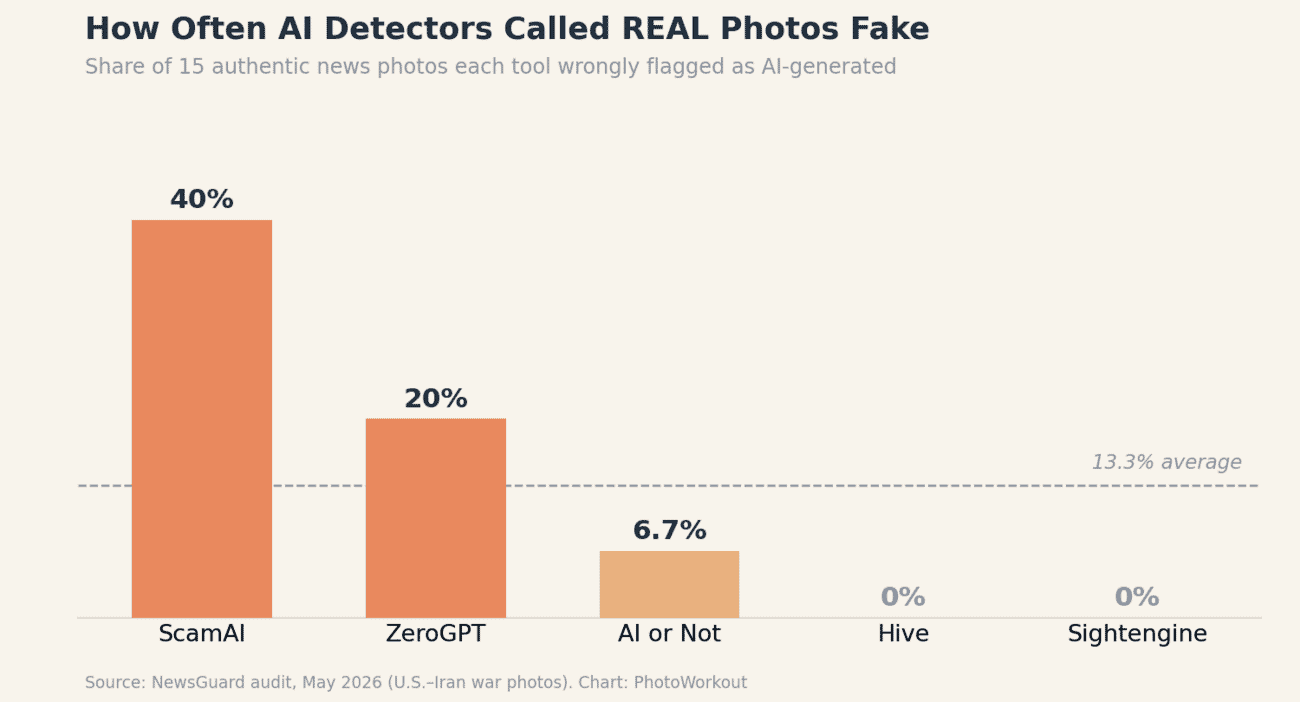
The worst offender, ScamAI — which advertises “industry-leading accuracy” — labeled six of the 15 genuine photos (40%) as AI-generated. ZeroGPT flagged three (20%). Even the tools that did well aren’t a safety net for an individual photographer: you rarely get to choose which detector a contest judge or a forum moderator decides to trust. If the one pointed at your photo happens to be the 40% tool, your real image is “AI,” full stop.
Why Detectors Get It Wrong
The failure modes are mundane, which is exactly why they’re so common. ZeroGPT’s own CEO told NewsGuard that routine image processing — resizing and compression — can cause a real photo to be misread as AI. That’s not an edge case; that’s what happens to every image uploaded to Instagram, exported for a contest, or saved out of an editor. Heavy but legitimate post-processing, film grain, aggressive noise reduction, upscaling, and even certain in-camera computational steps can all nudge a detector toward a false “AI” verdict.
Underneath it all is a structural problem: detection is an unwinnable cat-and-mouse game. Generators improve to defeat detectors, detectors retrain to catch them, and authentic images get caught in the crossfire as the models grow more trigger-happy. A detector doesn’t “see” a photo the way a human does; it reads statistical fingerprints, and the fingerprints of a heavily processed real photo and a polished AI image increasingly overlap. The result is a tool that sounds authoritative and is frequently wrong.
“Guilty Until Proven Innocent” Is Now the Default
The reliability problem becomes a justice problem the moment institutions act on these scores. A detector outputs a number, a judge or moderator treats it as a finding, and the photo is gone — with the burden of proof flipped onto the photographer to demonstrate a negative. Proving an image isn’t AI is genuinely hard: the most robust path is what serious contests like World Press Photo require — the original RAW file plus a sequence of frames around it — and most photographers simply don’t have that ready for every shot, especially older work or phone captures.
That’s the real scandal here. Not that detectors make mistakes — all tools do — but that there’s no due process around them. No standard appeal, no requirement to use more than one tool, no presumption of authenticity, and no consequence for a detector that’s wrong 40% of the time. The accused photographer absorbs all of the cost and all of the doubt.
What Photographers Can Actually Do
Until the institutions catch up, the defense is documentation. Keep your RAW files and untouched originals — they’re your strongest evidence, and increasingly the only thing that ends the argument. Where your camera or software supports it, enable Content Credentials (the C2PA standard) so a tamper-evident record of capture and edits travels with the file. Keep your layered edit files and exported variants. And when a detector “score” is waved at you, treat it as an opinion to contest, not a verdict to accept — cite the false-positive data, ask which tool was used, and ask whether a second was tried. For the flip side of this — what to do when you’re the one accused — see our companion guide, “Is This Real?” and how to prove your shot isn’t AI.
Frequently Asked Questions
How often do AI detectors get real photos wrong?
In NewsGuard’s May 2026 audit of five leading tools, authentic photos were wrongly flagged as AI 13.3% of the time on average, and the worst tool (ScamAI) got it wrong on 40% of real images. Three of the five had a meaningful false-positive rate.
Why would a detector flag a genuine photo as AI?
Ordinary processing is enough. Resizing, compression, heavy editing, noise reduction, upscaling and film grain can all create the statistical patterns detectors associate with AI. ZeroGPT’s CEO specifically cited resizing and compression as causes of false positives.
Can I appeal if my photo is wrongly flagged?
Usually not in any formal sense. Most contests and platforms have no standard appeals process, so the practical “appeal” is producing your RAW file and surrounding frames. That’s why keeping originals and Content Credentials matters so much.
What is C2PA / Content Credentials?
It’s an open standard that attaches a tamper-evident record of how an image was captured and edited. When supported end to end, it gives you verifiable provenance — a far stronger defense than arguing with a detector’s score after the fact.
The Bottom Line
AI detectors are being treated as arbiters of truth while quietly failing a meaningful share of the time — and the people paying for those failures are photographers who did nothing wrong. Until contests and platforms adopt real due process — multiple tools, transparent thresholds, a genuine right of appeal, and a presumption of authenticity — the only sane posture is to assume you may have to prove yourself, and to keep the evidence that lets you do it. The cameras aren’t the problem. The unaccountable software pointed at them is.
Reporting and figures in this article are drawn from the following sources.
Image Sources
- Conceptual 'AI?'-stamped portrait and 'Rejected' pin — stylized PhotoWorkout illustrations – Featured image and pin, created in-house
- False-positive chart — PhotoWorkout, from NewsGuard data – Created in-house