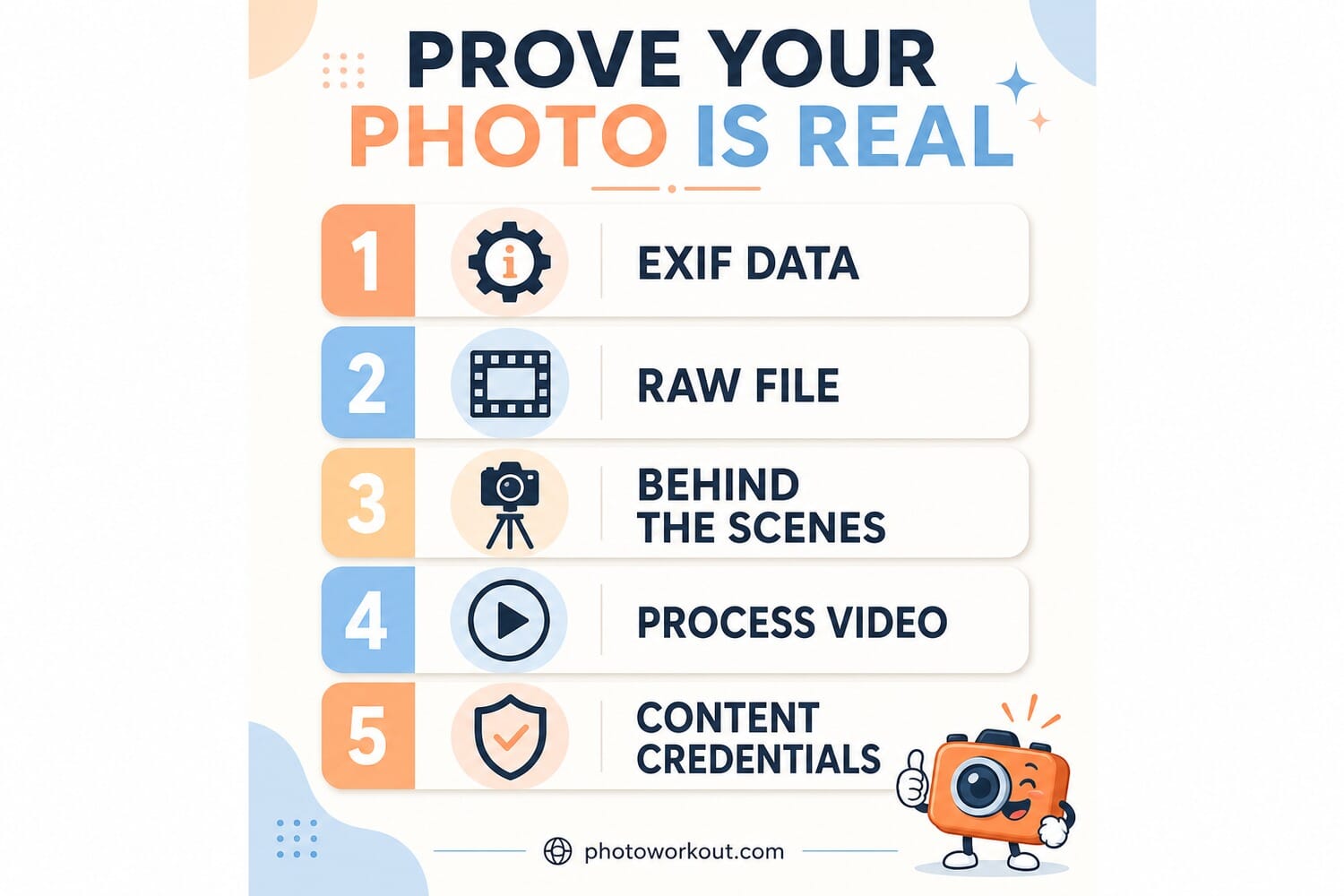


- “That’s AI” has become the reflex reply to any striking photo, and the burden of proof has quietly shifted onto the photographer to show that real work is real.
- Editing has always been part of photography, from dodging and burning to HDR. The line that actually matters is captured light versus generated pixels, not whether a file was processed.
- If you get accused, you have receipts. EXIF, the RAW file, a behind-the-scenes snap, and a burst sequence beat a defensive argument every time.
- Content Credentials (C2PA) sign a photo’s origin at capture and are the real long-term fix, but only some cameras support it, and Nikon’s service was suspended in 2025 after a signing flaw.
- Real photos have already been disqualified for looking “too AI.” Contests and juries are bad at detection, so provenance you control matters more than winning a pixel-peeping argument.
Post a genuinely good photo in 2026 and there is a decent chance the first reply isn’t “nice shot.” It’s “is this real?” Sometimes it comes gently (“looks kind of AI”), sometimes as a flat accusation. The sentiment underneath is always the same: the better your image looks, the more likely a stranger is to assume a machine made it.
This used to be a problem only for working pros and contest entrants. Now it has reached everyone. Spend any week in the photography corners of Reddit and the same threads keep coming back around. A hobbyist asks why their sharp, well-lit shot got called fake. A film shooter defends a high-contrast scan. Someone quietly wonders whether they have been doing photography wrong for years, because their results look too clean to be believed.
The accusation reflex does more damage than it seems. It punishes skill, it discourages people from sharing their best work, and it flips the burden of proof onto the person who did nothing wrong. So this piece does two things at once. It looks at how “that’s AI” became photography’s default insult, and it lays out a calm, practical playbook for what to actually do when the photo under suspicion is yours.
How “That’s AI” Became Photography’s Default Insult
Two years ago the worry ran in one direction. Would AI images sneak into photo contests and beat real photographers? That fear was well founded. It also trained a whole generation of viewers to treat every clean, dramatic, or unusually lucky frame as suspect. The instinct that once helped people catch fakes now fires constantly, including at photos that are completely real.
The tell is who gets accused. It is no longer just the viral, too-perfect composite. It is the wedding photographer whose backlit portrait looks rendered. It is the birder whose once-in-a-season shot is dismissed as a prompt. It is the beginner who finally nailed focus and exposure and gets told the photo can’t possibly be theirs. When a skill milestone is met with suspicion instead of praise, people stop posting, and the accusation has done real damage with no evidence behind it.
The structural problem is the inverted burden of proof. In a healthy conversation, the person making a claim (“this is fake”) carries the burden. Online, it has flipped. A one-word accusation costs nothing, while the photographer is expected to mount a defense. That asymmetry is exactly why having your evidence ready, before you ever need it, is now part of the craft.
The Irony: Photographers Have “Faked” Images Since 1840
Underneath most “is it real?” arguments is a confusion between two very different things: editing and fabricating. Photography has never been a pure, untouched record. Darkroom printers dodged and burned prints to push light around. Ansel Adams treated the negative as a score and the print as the performance, spending hours coaxing tones out of a single frame. Multiple exposures, filters, push-processing, and heavy contrast were all standard long before Photoshop existed.
Modern digital habits continue that history. HDR merges, focus stacking, exposure blending, color grading, and sky-and-shadow recovery all shape light that genuinely hit the sensor. That is editing. It is not the same as typing a sentence and having software invent a scene that never existed in front of any lens. That is generation. The honest line was never “processed versus unprocessed,” because almost everything is processed. The real line is whether the image originates in captured light or in a model’s guess at what light might look like.
This distinction matters the moment you are accused, because it reframes the whole exchange. You are not defending the fact that you edited, since everyone edits. You are showing that a real camera, in a real place, at a real time, captured real light. And that is something you can actually demonstrate.
When You’re the One Accused: a Calm 5-Step Playbook
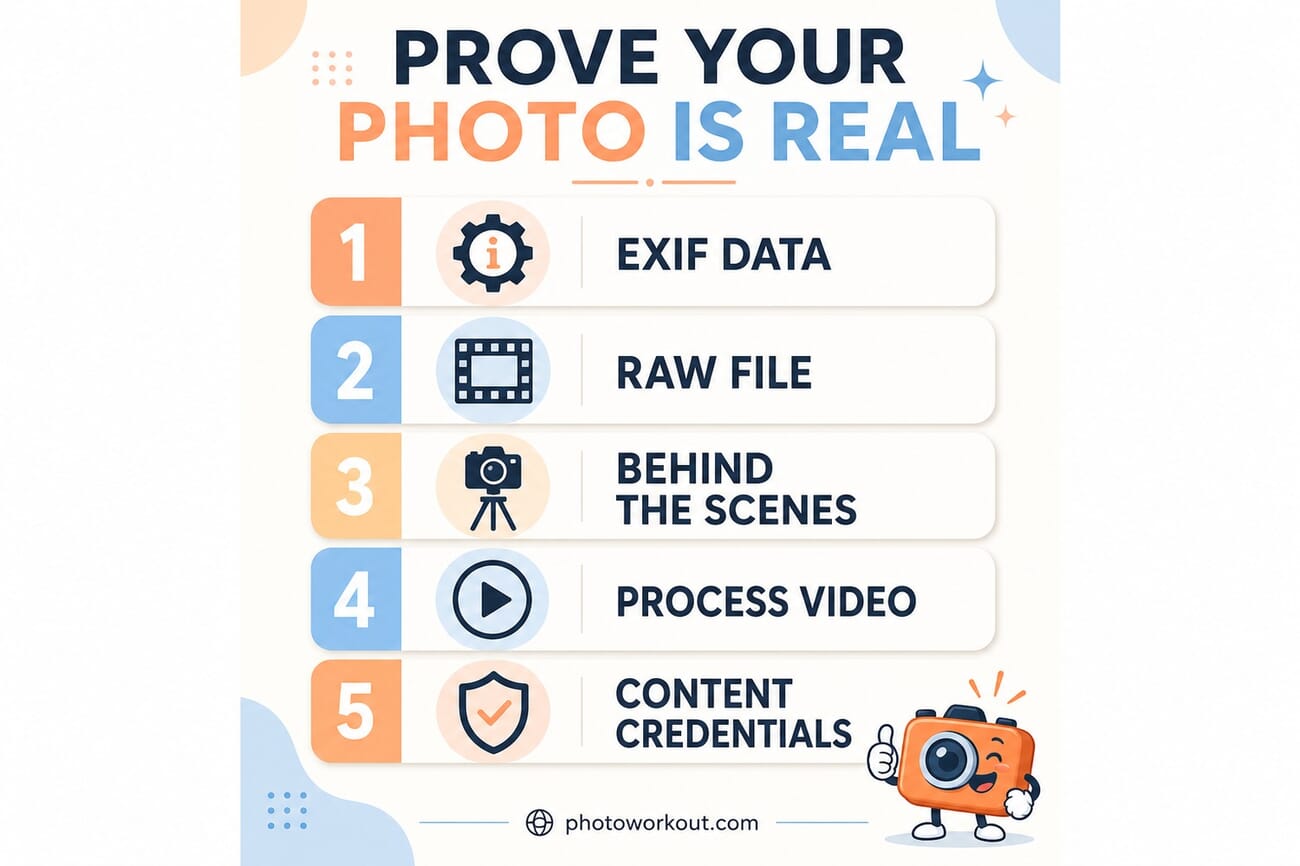
First, a note on tone. Don’t get defensive, and pick your battles. A random comment on a viral post is rarely worth a forensic reply. The people who matter are clients, editors, contest juries, and licensing buyers. For those, lead with process, not protest. Here is the evidence ladder, from weakest to strongest.
1. EXIF Data: the Easy First Answer
Every camera embeds metadata: make and model, lens, focal length, aperture, shutter, ISO, and a timestamp, often with GPS. AI generators don’t produce a coherent camera EXIF block, so pointing to it is the fastest opening move. The honest caveat is that EXIF can be edited, so a determined skeptic can wave it away. Treat it as supporting evidence, not a trump card.
2. The RAW File: Your Digital Negative
This is where the argument usually ends. A RAW file carries sensor-level detail, the specific noise signature, demosaic pattern, and bit depth of a real photosite array, that text-to-image models don’t generate. Better still, your editing software keeps a history. A Lightroom catalog or sidecar .xmp shows the slider-by-slider path from RAW to final. Keep your RAWs. They are the single most persuasive thing you own.
3. Behind-the-Scenes: Proof You Were There
A ten-second phone clip of your setup, a frame of the scene from a different angle, or a shot of you on location is disarmingly effective. It is low-effort to capture and very hard to fake convincingly. Getting into the habit of grabbing one behind-the-scenes frame per shoot is cheap insurance.
4. Process and Burst Evidence: Continuity Is Hard to Fake
The frames around your keeper tell a story a single generated image can’t. The burst sequence, the bracketed exposures, and the slightly-off frames before and after all show a continuous moment unfolding. A screen recording of your edit does the same for post-processing. Sequence and continuity are the things generative tools still struggle to fabricate.
5. Content Credentials: Cryptographic Proof at Capture
The strongest option, where it is available, is a tamper-evident signature written into the file the moment you press the shutter. That is the C2PA standard, branded as Content Credentials, and it is the one rung of this ladder that is still maturing, which is worth its own section.
Content Credentials: the Real Fix, but It’s Not Ready Yet
Content Credentials, built on the open C2PA standard, attach a cryptographically signed “nutrition label” to an image: who captured it, on what device, when, and what edits were applied afterward. Tamper with the file and the signature breaks. It is the most credible answer to “is this real?” because it doesn’t rely on a human eyeballing pixels. On the generation side, OpenAI now labels its outputs while Canon signs real photos at capture, so the two ends of the pipeline are finally speaking the same language.
Where it stands across the major makers in 2026:
- Leica shipped first. The M11-P (late 2023) was the first production camera with Content Credentials, now joined by the M11 and SL3 line, with signing on by default on some bodies.
- Sony added capture authenticity to the Alpha 1 II and Alpha 9 III, with firmware extending it to older pro bodies through its verification workflow.
- Canon brought C2PA firmware to the EOS R1 and R5 Mark II in 2025 and launched a broader Authenticity Imaging System for newsrooms in 2026.
- Nikon added it to the Z6 III by firmware, then suspended the service after a signing-key vulnerability was found and certificates were revoked, a sharp reminder that the plumbing is still young.
So Content Credentials is the right destination, not yet a universal solution. Most cameras in the wild don’t support it, smartphone support is partial, and Nikon’s pause shows the security model is still being hardened. If your camera offers it, turn it on, because it is the closest thing to a tamper-proof receipt. If it doesn’t, the first four rungs of the ladder still carry you. For a deeper look at how the capture-and-label stack is coming together, see our breakdown of how to pick AI photo tools that will actually last.
When a Real Photo Actually Lost: the Flamingo That Beat the Machines
The most quoted example of how badly this can go runs in the opposite direction you would expect. In 2024, photographer Miles Astray entered a genuine photograph, a flamingo tucking its head so completely that it appears to have no head, titled F L A M I N G O N E, into the AI category of the 1839 Color Photography Awards. It won third place and the People’s Vote. A jury that included people from The New York Times, Getty Images, and Christie’s couldn’t tell it was real. When Astray revealed the truth, organizers disqualified him “in fairness to other artists.” His point stuck: nature can still beat the machine, and the experts judging the difference often can’t tell.
The mirror image plays out constantly now, with AI images slipping into real competitions and getting caught not by the jury but by the crowd. Earlier this year an AI entry made a prestigious Hasselblad Masters shortlist, and it was Reddit, not the judges, that flagged it. The lesson across both cases is the same, and a little uncomfortable. Institutions are unreliable at detection. You cannot count on a contest, a platform, or a casual viewer to correctly tell real from synthetic. The only thing you fully control is the provenance trail attached to your own work.
That is also why pixel-peeping arguments are a trap. People love to point at too-perfect skin, weird hands, or impossible reflections as giveaways, and those heuristics fail in both directions, flagging real photos as fake and missing good fakes entirely. If you want to understand why visual detection is so weak, our look at how AI-generated Artemis II images fooled millions walks through exactly where the human eye breaks down.
Build the Habit Before You Need It
The photographers who never sweat an accusation aren’t the ones with the best comebacks. They are the ones whose workflow already produces proof as a byproduct. Four habits do almost all the work: shoot RAW and keep the originals, grab one behind-the-scenes frame per shoot, preserve your edit history instead of flattening and deleting, and switch on Content Credentials if your body supports it. None of that is extra creative effort. It is just not throwing away the evidence you generate anyway.
Do that, and “is this real?” stops being a threat and becomes a thirty-second answer, or one you can choose to ignore entirely, because the people who actually matter can be shown, not argued with.

Frequently Asked Questions
Can EXIF data alone prove my photo isn’t AI?
Not on its own. EXIF is strong supporting evidence, because AI generators don’t produce a coherent camera metadata block, but since EXIF can be edited, a determined skeptic can dismiss it. Pair it with the RAW file, which is far harder to argue with.
Does heavy editing make my photo “not real”?
No. Editing, whether contrast, color, HDR, or dodging and burning, shapes light that actually hit the sensor, and it has been part of photography since the darkroom era. The meaningful distinction is captured light versus generated pixels, not processed versus unprocessed.
Which cameras support Content Credentials right now?
As of 2026: Leica (M11-P, M11, SL3 line), Sony (Alpha 1 II, Alpha 9 III, plus firmware for some older pro bodies), and Canon (EOS R1, R5 Mark II, with a broader newsroom system). Nikon added it to the Z6 III but suspended the service in 2025 after a signing-key vulnerability. Most consumer cameras still don’t support it.
Should I reply to every “that’s AI” comment?
No. Pick your battles. A random comment on a viral post rarely warrants a forensic defense. Save your evidence for the contexts that matter: clients, editors, contest juries, and licensing buyers. For those, lead with process, a behind-the-scenes clip or the RAW, rather than arguing.
The Bottom Line
“Is this real?” isn’t going away. If anything it will get louder as generated images get better. But the answer was never a clever rebuttal. It is a habit: keep your RAWs, grab a behind-the-scenes frame, preserve your edit history, and turn on Content Credentials when your gear allows. The accusation reflex thrives on the assumption that you can’t prove anything. The quiet satisfaction of this moment in photography is that, more and more, you can, and the burden of proof is starting to swing back where it belongs.
Reporting and reference for this story:
Image Sources
- Featured image, stylized PhotoWorkout illustration – Created in-house (gpt-image-2)
- "Prove your photo is real" infographic, stylized PhotoWorkout illustration – Created in-house (gpt-image-2)
- Vertical pin graphic, stylized PhotoWorkout illustration – Created in-house (gpt-image-2)