


- GoPro has filed a going-concern warning — “substantial doubt” it can survive another year — yet just launched its most ambitious camera in years, the Mission 1 series.
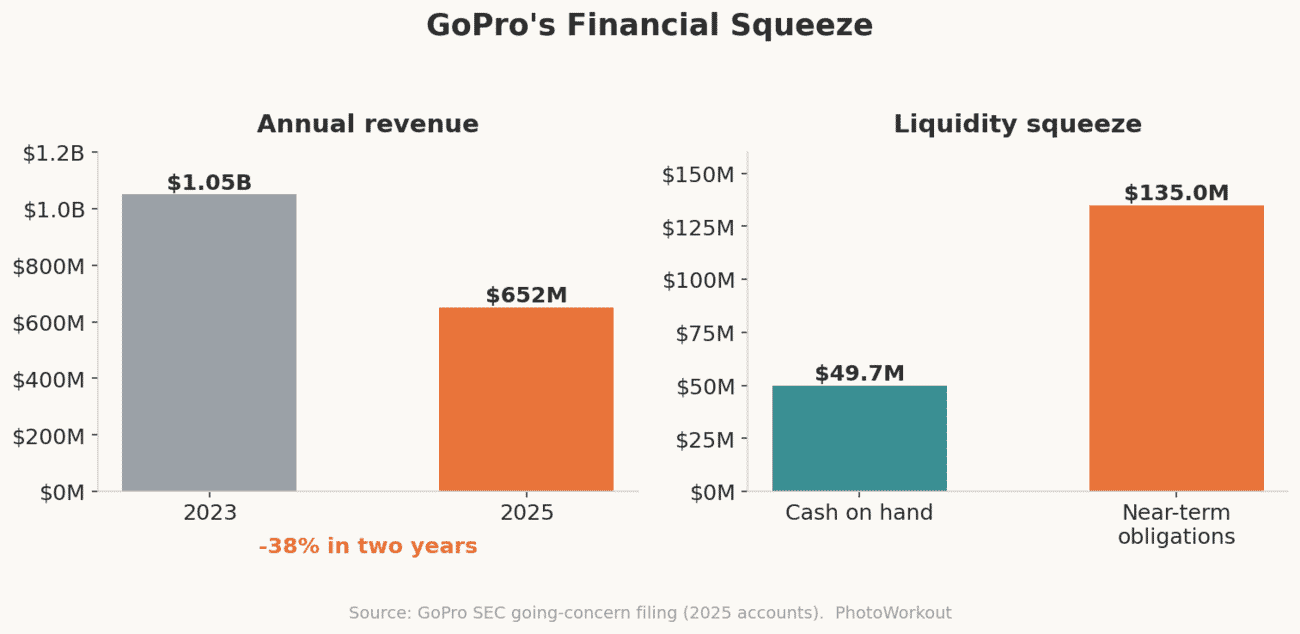
- The numbers are stark: revenue fell from $1.05B (2023) to $651.5M (2025), and the company reported roughly $49.7M cash against about $135M in near-term obligations after a memory-chip price spike of 80–115% broke its loan covenants.
- GoPro has hired Houlihan Lokey to explore a sale or merger and is exploring a defense and aerospace pivot, so a change of ownership is a real possibility.
- The Mission 1 ($599.99 / $499.99 for subscribers) and Mission 1 Pro ($699.99 / $599.99) are genuinely impressive: a 50MP 1-inch sensor, a new 5nm GP3 processor, up to 8K60 video and 14 stops of dynamic range.
- For buyers, the camera and your footage keep working no matter what — but warranty, the app and cloud, and subscriber pricing all depend on GoPro still being around. Buy the hardware, not the promises.
GoPro is doing two contradictory things at once. In an SEC filing it has told investors there is “substantial doubt” the company can continue as a going concern — corporate language for “we might not survive the year.” And almost in the same breath, it has shipped the Mission 1, the most ambitious action camera it has made in a decade. For anyone eyeing one, that creates an awkward question: is the Mission 1 a smart buy, or an orphan-in-waiting?
It is a fair question, and the honest answer is “it depends what you are buying it for.” Here is the financial reality, what is actually at risk for a buyer, and who should pull the trigger now versus wait out the action-cam shakeout.
The Financial Reality
GoPro’s going-concern warning is not a vague mood — it is anchored in hard numbers. Annual revenue has collapsed from about $1.05 billion in 2023 to $651.5 million in 2025, a 38% drop in two years. The company reported roughly $49.7 million in cash against around $135 million in near-term obligations. The trigger was a brutal spike in memory-chip prices — reportedly 80 to 115% in late March 2026 — which pushed costs up enough to breach its loan covenants and leave it months, not years, to find a fix.
A Fire Sale, or a Pivot to Defense?
GoPro is not standing still. It has retained the investment bank Houlihan Lokey to explore “strategic alternatives” — Wall Street shorthand for a sale or merger — and has separately been examining a pivot toward defense and aerospace. The logic there is not crazy: rugged, stabilized cameras and optics built for brutal environments are exactly the kind of dual-use hardware that has military and industrial value. But both paths point to the same buyer-relevant fact: the GoPro that sells you a Mission 1 today may not be the GoPro that supports it a year from now.
Meanwhile, the Mission 1 Is Genuinely Ambitious
This is what makes the timing so strange: the Mission 1 is good. It is built around a 50-megapixel 1-inch sensor with up to 14 stops of dynamic range, paired with a new GP3 processor on a 5nm process and AI-based image processing. It shoots up to 8K60 video, and the larger sensor is a real leap for a category that has long been stuck on small chips. The Mission 1 starts at $599.99 ($499.99 for subscribers), while the Mission 1 Pro is $699.99 ($599.99 for subscribers), with an interchangeable-lens version above that.
Owners seem to agree. Early Mission 1 Pro buyers are already posting sample photos to communities like r/gopro to a genuinely warm reception — hundreds of upvotes, real enthusiasm — despite the financial cloud overhead. The product is not the problem. The company behind it is.
So Should You Actually Buy One?
Start by separating what survives a bankruptcy or sale from what does not. The camera itself is a self-contained device: it records to a card, the footage you shoot is yours forever, and standard GoPro mounts and accessories keep working regardless of who owns the brand. None of that is at risk.
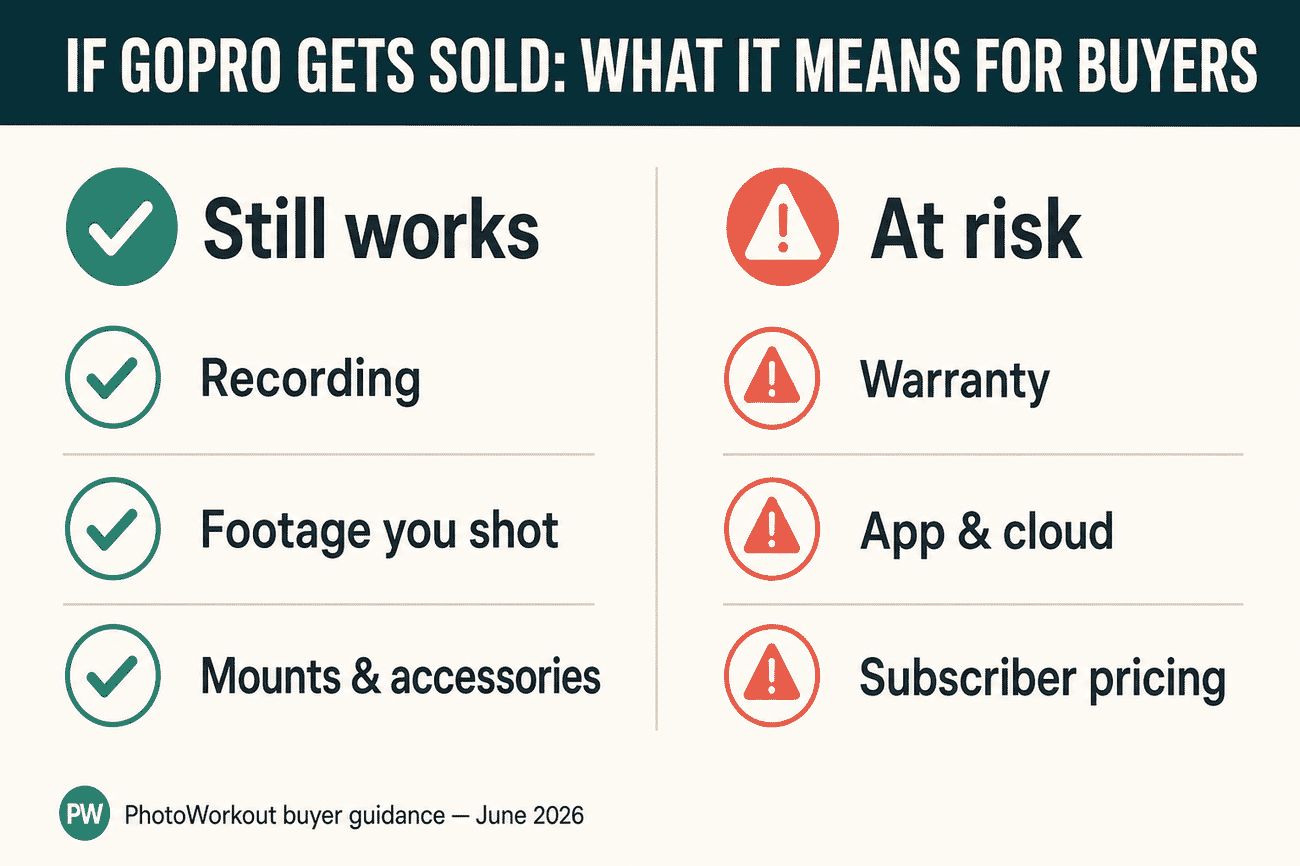
What is genuinely at risk: the warranty (worth little if the company is wound down), the Quik app and cloud services that GoPro’s ecosystem leans on, and — critically — the subscriber pricing. Those $100 discounts require an active GoPro subscription, which ties part of the deal’s value to the company still operating. If you want a Mission 1 purely as a capable camera and you can stomach the risk that support and software may lapse, it is a reasonable buy. If you need warranty peace of mind or you are buying mainly for the subscriber discount, this is a moment to wait — or to look at a more stable rival.
The Bigger Picture: the 2026 Action-Cam Shakeout
GoPro’s crisis is not happening in a vacuum — the whole action-cam market is reshuffling in 2026. DJI’s Osmo Pocket line has been effectively blocked from US sale (see our breakdown of the DJI Pocket US ban and your real alternatives), GoPro is fighting for survival, and Insta360 has been steadily taking share with strong releases. If you are shopping the category right now, it is worth seeing the full field — our action-cam and drone deal roundup covers the GoPro, DJI and Insta360 options side by side. The safest bet in a shakeout is usually the company gaining ground, not the one issuing going-concern warnings.

Frequently Asked Questions
Is GoPro going out of business?
Not yet, but it has formally warned of “substantial doubt” about its ability to continue as a going concern. It is exploring a sale or merger and a possible defense pivot. The outcome is uncertain, which is exactly why buyers should weigh the support risk.
If GoPro is sold or folds, does my Mission 1 stop working?
No. The camera records to a card and your footage is yours permanently; mounts and accessories also keep working. What is at risk is the warranty, the app and cloud services, and subscriber pricing — the parts that depend on the company operating.
How much does the GoPro Mission 1 cost?
The Mission 1 is $599.99 ($499.99 for subscribers) and the Mission 1 Pro is $699.99 ($599.99 for subscribers), with a pricier interchangeable-lens version above that. The subscriber discounts require an active GoPro subscription.
Is the Mission 1 actually a good camera?
On specs, yes — a 50MP 1-inch sensor, a 5nm GP3 processor, up to 8K60 video and 14 stops of dynamic range put it ahead of most action cameras. Early owners are enthusiastic. The reservations are about the company, not the hardware.
The Bottom Line
The Mission 1 is a strong camera launched by a company in real trouble, and both things are true at once. If you buy one, buy the hardware on its merits and treat the warranty, cloud and subscription perks as bonuses that may not last. If those safety nets matter to you, or you just want to avoid the drama, the smarter play in 2026’s action-cam shakeout may be a rival that is gaining ground rather than fighting to survive.
Financials & Strategic Review
- GoPro SEC 8-K — going-concern warning – Revenue, liquidity and covenant disclosures.
- GoPro — Retains Houlihan Lokey to pursue strategic alternatives – Sale/merger exploration and defense pivot.
- CineD / RedShark — going-concern and memory-cost analysis – Context on the chip-price spike and covenant breach.
Mission 1 Launch
- PhotographyTalk — GoPro Mission 1 series specs and pricing – 50MP 1-inch sensor, GP3, 8K, pricing.
- r/gopro — Mission 1 Pro owner sample photos – Early community reception.
Image Sources
- Featured image — GoPro Mission 1 series press render (GoPro) – Official GoPro product imagery.
- Financials chart & buyer-guidance infographic & pin — PhotoWorkout originals – Original PhotoWorkout data visualization and graphics.