


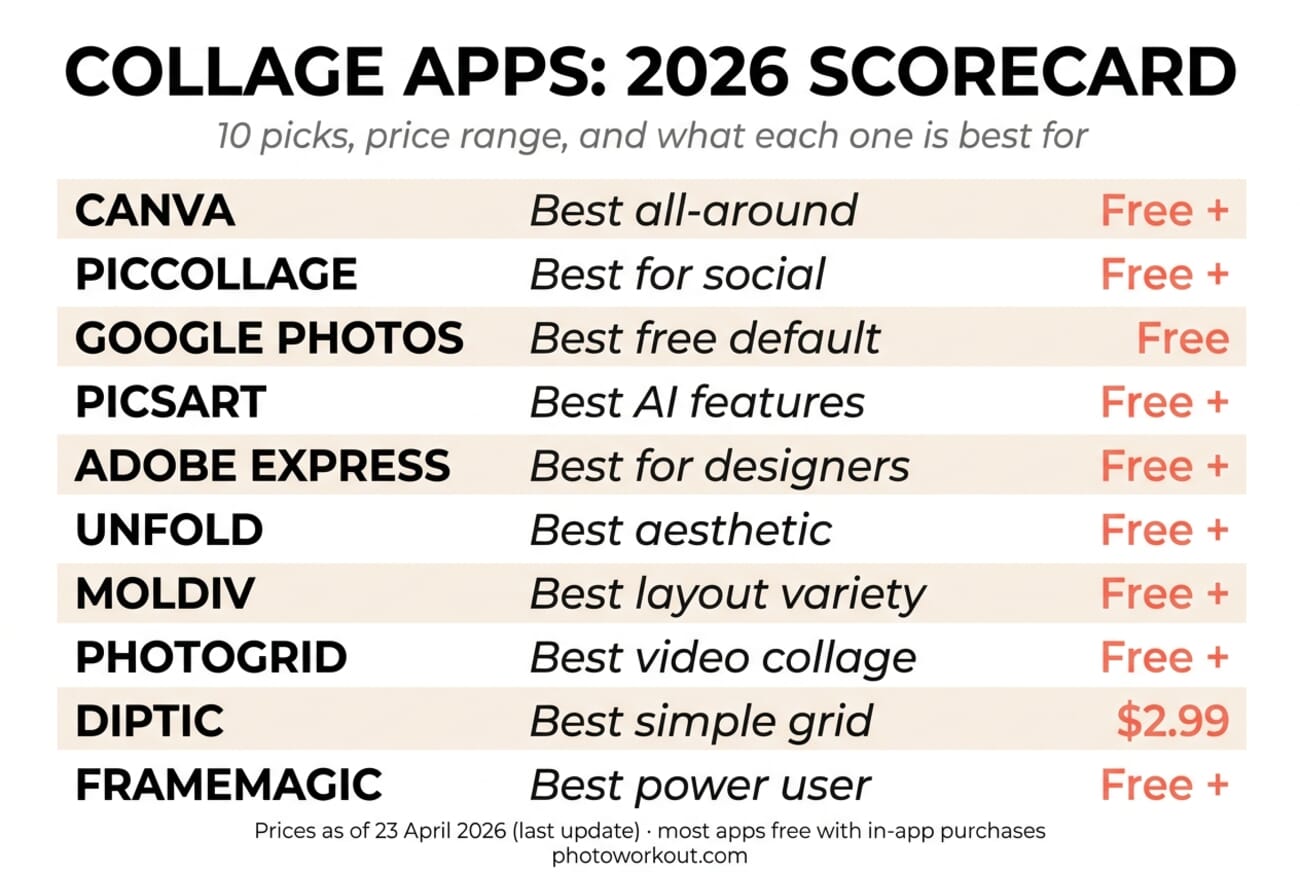
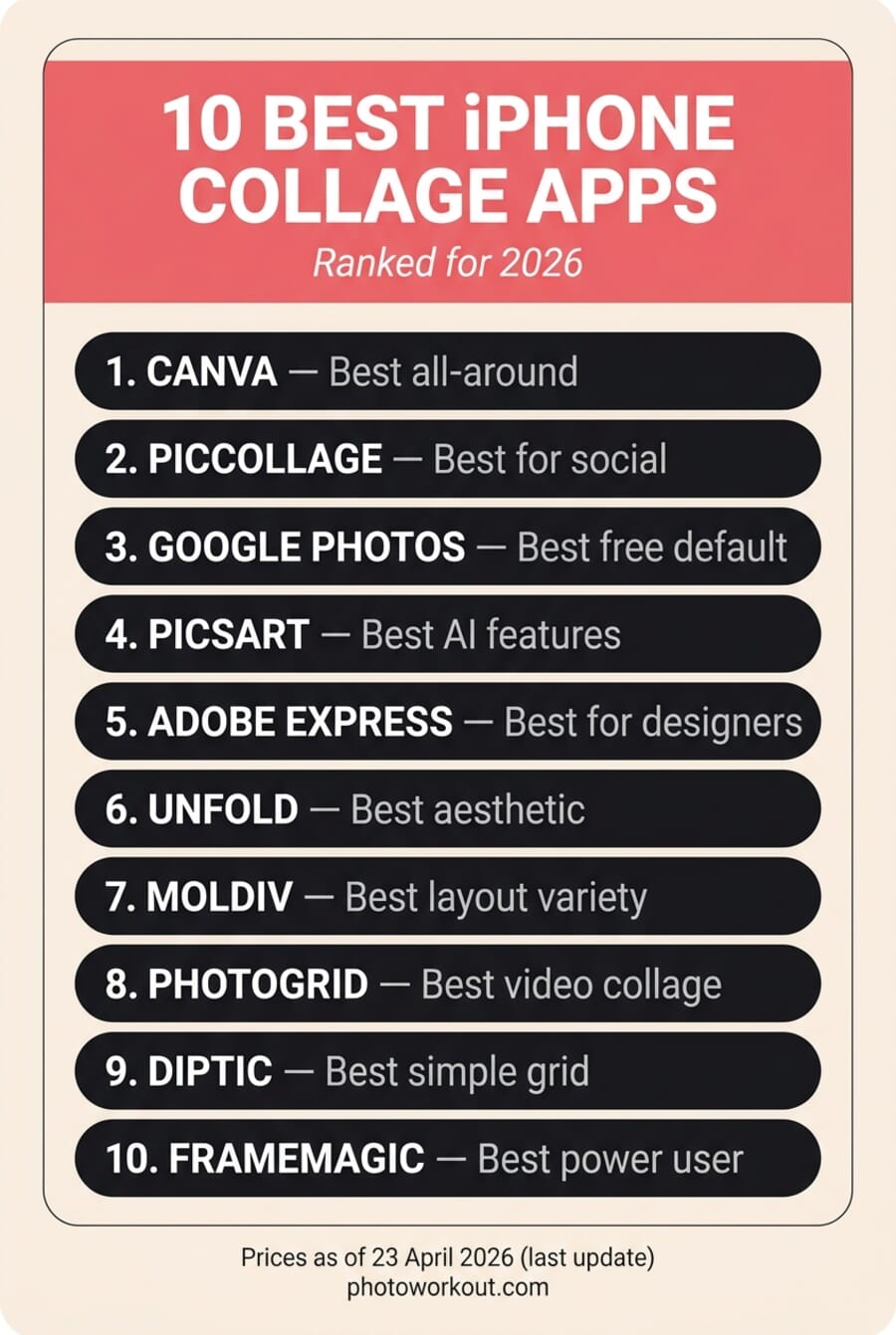
- Canva is the best all-around iPhone collage app in 2026 — 100,000+ templates, real typography, brand colors, and AI design help. Free tier is generous; Pro at $14.99/mo unlocks the pro toolkit.
- PicCollage wins for social-media creators — fastest “drop photos, get Instagram-ready grid” workflow on iOS. 1.8M+ ratings, 4.8★.
- Google Photos is the best free default for people who already use it to back up photos. Its Collage tool lives inside the Photos app and requires zero new installs.
- Picsart is the AI-first pick — AI backgrounds, AI cutouts, AI-assisted layouts. Free tier is capable; Gold tier unlocks watermark-free export and more AI generations.
- Diptic ($2.99, paid) is the one to buy if you want a simple, reliable grid-maker with no subscription pressure. Classic iOS design, trusted since 2010.
iPhone collage apps used to be a commodity — grid, drop, export. In 2026 they’ve split into four real categories: all-around design apps (Canva, Adobe Express), social-first (PicCollage, Unfold), AI-assisted (Picsart, PhotoGrid), and simple grid tools (Diptic, Google Photos, FrameMagic, MOLDIV). This guide compares the 10 best iPhone collage apps in each category, refreshed for April 2026 with current pricing, ratings, and 2026-specific AI features.
Quick rule of thumb: if you’re making anything you’ll print, Canva or Adobe Express. If you’re making Instagram or TikTok content, PicCollage or Unfold. If you just want a 2×2 grid for a text message in 30 seconds, Google Photos is already on your phone. Everything else lives between those extremes.
When you buy through links on our site, we may earn a commission at no cost to you. We evaluate products independently. Commissions do not affect our evaluations.
Quick Picks by Use Case
- Want one app that does everything? Canva.
- Making Instagram posts or Stories? PicCollage or Unfold.
- Already use Google Photos for backup? Skip new installs — use its built-in collage tool.
- Want AI doing the heavy lifting? Picsart.
- Already pay for Creative Cloud? Adobe Express is free with your subscription and uses your Adobe fonts.
- Hate subscriptions? Buy once? Diptic ($2.99) — the only paid pick on this list, worth it.
- Video collages (TikTok, Reels, Shorts)? PhotoGrid.
- Maximum layout variety? MOLDIV.
- Power user with custom needs? FrameMagic.
Canva is the most-downloaded design app on iOS with 3.3M+ ratings at 4.9★. For collages specifically, its strength is template depth — grids, Instagram layouts, Pinterest pins, birthday cards, all pre-sized. 2026 additions include Magic Design (AI-generated templates from a one-sentence prompt) and background removal that actually handles hair.


Free, in-app purchases $14.99/mo Canva Pro. iOS + Android + web. Prices as of 23 April 2026.
Canva is the right starting point for anyone unsure which collage app to install. If you later find the template browser overwhelming, dropping down to PicCollage or Unfold is easier than going the other direction.

PicCollage is the fastest “photos in, collage out” experience on iOS — 1.8M ratings at 4.8★. The app recognizes the aspect ratio you’re heading to (post, Story, Reel) and auto-generates grid suggestions. New in 2026: Magic Photo Editor applies AI cleanup to individual photos before they enter the collage.
Free with ads, PicCollage Pro ~$9.99/mo. iOS + Android.
The app to install if most of your collages end up on Instagram. Where Canva gives you a template menu, PicCollage gives you a drag-and-drop canvas that feels more like TikTok’s creator tools than a design app — and the tap-to-grid is genuinely the fastest on iOS. The tradeoff: less typographic control and more upsells in the free tier. Pair it with Canva for the jobs that need real type.

Google Photos is the app 1.2M+ iOS users rate at 4.8★. Its built-in collage feature lives under Library → Utilities → Collage and produces clean 2-9 photo grids in under 60 seconds. It’s not the most powerful option, but it requires zero additional download for anyone already backing up photos to Google.
Free. iOS + Android + web. No subscription for the collage feature.
The hidden advantage of Google Photos’ collage tool is that it already has access to every photo you’ve taken. No import step, no cross-app shuttling. For anyone using Google Photos as their iPhone backup, the collage tool is the lowest-friction option on this list — even if it has the fewest features. Not a good pick if you want typography or brand colors, but excellent for sending “here’s our weekend” grids to family.
Picsart has become the AI-first creative app on mobile — 1.2M+ iOS ratings at 4.7★. For collages specifically, the AI tools that matter: automatic background removal, AI-generated backgrounds from prompt, and Magic AI Fill that extends a photo to fit a grid cell. The 2026 Gold tier at $13/mo lifts daily AI limits to effectively unlimited.
Free tier; Picsart Gold at $13/mo or $56/yr. iOS + Android.
Picsart’s AI tools are the real reason to install it over something simpler. AI cutouts on people-and-pets photos are the single biggest workflow win for collage-making in 2026 — background removal that used to take Photoshop now takes one tap, and the cut-out subjects drop cleanly into any collage grid. Subscription fatigue is real here, though: the free tier caps daily AI generations, and heavy users will hit the paywall within a week.
Adobe Express is what Adobe Spark Post became — a template-first design app with native access to Adobe Fonts (20,000+), Adobe Stock integration, and Firefly generative AI. 360K+ ratings at 4.8★. For anyone already in Creative Cloud, it’s included in most plans at no extra cost and uses the same font and asset library as Photoshop and Illustrator.
Free tier; Premium $9.99/mo (free with Creative Cloud). iOS + Android + web.
Adobe Express only makes sense as a primary collage app if you’re already inside Creative Cloud. At its $9.99/mo standalone price, Canva is better value for most users. But for Photoshop or Illustrator subscribers, Adobe Express is essentially free, uses the same fonts as desktop Adobe, and roundtrips cleanly back into Photoshop if a collage needs finishing touches. For everyone else, Canva wins.

Unfold is the one pro-creators load for Instagram Stories — 158K+ ratings at 4.9★. Its template library is narrower than Canva’s but every single template looks editorial, not amateur. Two-to-five-photo layouts, minimalist typography, subtle film-grain textures. Acquired by Squarespace in 2020 but has kept its aesthetic discipline.
Free with in-app purchases; Unfold+ $19.99/mo or $99/yr. iOS + Android.
Unfold is the rare app where the narrowness of the template library is a feature, not a limitation. Every template lands in the editorial-magazine aesthetic, which means collages made in Unfold tend to look like they came from a brand’s content team — intentional, restrained, typography-first. For business use on Instagram this is worth the $19.99/mo on its own. For casual use, Canva’s cheaper tier does 80% of the same look.
MOLDIV packs 312 frame templates into one app — more layout variety than any competitor. 37K+ ratings at 4.7★. Where Canva is template-depth (many styles of the same idea), MOLDIV is template-width (many different grid geometries). Especially useful for non-standard collages: 7-photo asymmetric grids, magazine-style fold layouts, circular arrangements.
Free with ads; Premium tier from $4.99/mo. iOS + Android.
MOLDIV is the app worth installing when you need a collage grid nothing else offers — 7-photo asymmetric frames, magazine-fold layouts, circular arrangements. For 80% of collage needs, Canva or PicCollage are more polished. But for the specific cases where you’ve said “no, I need a layout that isn’t a grid or a stack,” MOLDIV has probably already built it.
PhotoGrid is the specialist app for video collages — 114K+ ratings at 4.9★. Where most collage apps grudgingly support video, PhotoGrid is built for it: multi-video grids with independent trim and sync, music synchronization across cells, and direct export to TikTok, Reels, and YouTube Shorts aspect ratios.
Free with ads; Premium ~$5.99/mo. iOS + Android.
Video collage is a niche that barely exists outside PhotoGrid. Canva technically supports video in collages, but the interface treats it as a still-photo extension. PhotoGrid is the only app that treats video as the primary material — independent trim per cell, synchronized audio, direct export to TikTok and Reels aspect ratios. For creators doing more than one split-screen video a month, this is the only serious option.
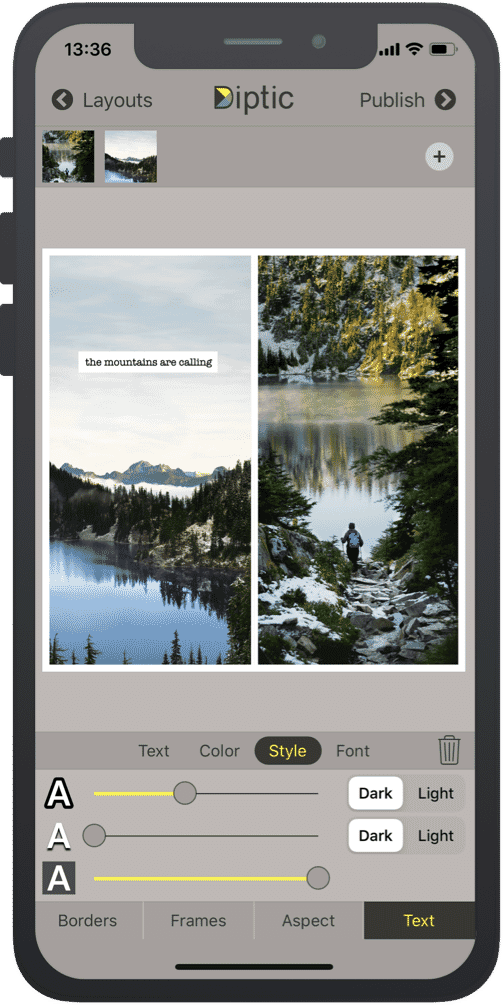
Diptic is the “one-time-purchase, lifetime-use” pick — $2.99 flat, no subscription, 4.5★ across 3K ratings, and trusted since 2010 — though its last major update was back in 2021. The strongest case for Diptic is subscription fatigue: if you want a genuinely good grid-maker without monthly billing, this is the only app on this list that sells outright.
$2.99 one-time purchase on the App Store. iOS only. No ads, no watermarks, no subscription.
The argument for Diptic is philosophical as much as functional. $2.99 buys you a clean, dependable grid maker that will work the same way in 2030 as it does today. Compare that with PicCollage Pro ($120/year) or Canva Pro ($180/year) and the math gets compelling fast. Skip it only if you need templates, AI, or video — Diptic is deliberately minimal, and that’s the whole point.

FrameMagic is the power-user pick — 887 ratings at 4.4★, with deep customization most casual apps don’t expose. Each cell can be independently resized, rotated, zoomed, and re-cropped. Frame borders are adjustable per edge. Export supports PSD-like layers for continued editing elsewhere.
Free; Premium unlocks via in-app purchase. iOS only.
FrameMagic is what collage apps used to be before the template explosion — give me the tools, let me build the layout. For most people that’s a downside (why learn the tools when Canva has 100,000 templates?). For photographers and designers who want every cell independently sized, rotated, and cropped with pixel-level control, FrameMagic is the only app on this list that gets out of your way completely.
How to Choose a Collage App
Five questions, in order:
- Are you creating for social media or for personal use? Social → PicCollage or Unfold. Personal → Canva or Google Photos.
- Do you need video collage? If yes → PhotoGrid. If no → any of the others.
- Do you want AI doing the work? Yes → Picsart, Canva Pro, or Adobe Express (Firefly). No → Diptic, FrameMagic, or Google Photos.
- Are you already paying for Creative Cloud? Yes → Adobe Express is included. No → proceed to #5.
- Do you hate subscriptions? Yes → Diptic ($2.99 one-time) or free Google Photos. No → any of the subscription apps are viable.
Most iPhone users end up with two apps installed: a template-heavy design tool (Canva) for one-off projects and a quick-grid tool (Google Photos or Diptic) for everyday use. That combination covers 95% of collage needs for under $15/month total — or $3 once if you skip the subscription entirely.
Frequently Asked Questions
What’s the best free iPhone collage app?
Google Photos for true zero-cost, zero-ads, no-watermark simplicity. Canva and PicCollage have generous free tiers but include some premium upsells. If you already use Google Photos for backup, its built-in Collage tool under Library → Utilities makes every other app optional.
Are these apps free to use?
Most are. Canva, PicCollage, Google Photos, Picsart, Adobe Express, Unfold, MOLDIV, PhotoGrid, and FrameMagic all have free tiers. Diptic is the only paid pick at $2.99 one-time. Several apps offer optional premium subscriptions that unlock more templates, AI features, or remove ads.
What’s the best collage app for Instagram?
PicCollage is the fastest for standard square posts and carousels; Unfold is the pick for Stories and Reels where aesthetic cohesion matters. Both support the full range of Instagram aspect ratios (1:1, 4:5, 9:16).
Can these apps make video collages?
PhotoGrid is the specialist — multi-video grids with synchronized audio and direct export to TikTok, Reels, and Shorts formats. Canva, PicCollage, and Picsart support basic video collages too, but PhotoGrid handles more complex multi-cell video work better.
Which collage app has the best AI features in 2026?
Picsart leads on raw AI variety (cutouts, backgrounds, generative fill, style transfer). Canva’s Magic Design is strong on template generation. Adobe Express via Firefly is best for brand-consistent AI when you’re already in Creative Cloud. Avoid apps claiming “AI” without specifying what the AI does — some is marketing, some is genuine workflow.
Do any of these apps work offline?
Diptic and FrameMagic work fully offline — they don’t depend on cloud templates or server-side processing. Canva, Adobe Express, and Picsart require internet for template browsing and AI features. PicCollage, MOLDIV, and PhotoGrid work offline for basic grids but need internet for template downloads and cloud features.
Is Diptic worth $2.99 when other apps are free?
For anyone who hates subscriptions, yes. Over a year, PicCollage Pro costs $120, Canva Pro costs $180, and Picsart Gold costs $56. Diptic is a one-time $2.99 for a clean grid maker you own outright. If you only need simple grids (no AI, no templates, no social integrations), it pays for itself the first week.
Can I use these apps on Android too?
Most yes. Canva, PicCollage, Google Photos, Picsart, Adobe Express, Unfold, MOLDIV, and PhotoGrid all have Android versions. Diptic and FrameMagic are iOS-exclusive. The app behavior is broadly consistent across platforms — the same templates and features available on both.
App icons: official App Store press assets. 2026 scorecard, Pinterest pin, and featured graphic by PhotoWorkout editorial. App ratings and pricing verified via iTunes API on April 23, 2026.
All app ratings, prices, and links verified via iTunes API on April 23, 2026.
App Store listings
- Apple App Store — Canva – Current iOS listing with 3.3M+ ratings and feature details.
- Apple App Store — PicCollage – Official iOS listing with 1.8M+ ratings.
- Apple App Store — Picsart – Picsart AI Photo Editor current iOS listing.
- Apple App Store — Adobe Express – Adobe Express current iOS listing with Firefly integration details.
- Apple App Store — Diptic – Paid iOS app, $2.99 one-time purchase.




Comments are closed.