


- Sony and TSMC are reportedly forming a roughly 1 trillion yen ($6.3 billion) joint venture to mass-produce next-generation image sensors in Kumamoto, Japan, with Sony holding about 60% and TSMC 40%.
- It is a direct answer to the quake question: weeks after a 7.1 earthquake halted the Kumamoto fab that makes the sensors in most flagship cameras and phones, Sony is doubling down on that exact hub rather than moving away from it.
- The venture is expected to supply high-performance camera sensors for Apple’s iPhone, notable because reports last year suggested Apple was shifting some sensor orders to Samsung.
- Beyond cameras, the deal targets Sony’s longer-term “physical AI” push: sensors for autonomous vehicles, robotics, and object recognition.
- Keep the horizon in mind. This is a reported plan built on a May basic agreement, with the JV expected to form by early 2027 and commercial output as soon as 2029. It is a strategic and resilience bet, not new sensors arriving soon.
Three weeks ago, a magnitude 7.1 earthquake halted the one Japanese plant that makes the image sensor sitting inside a huge share of the world’s flagship cameras and smartphones. It was the clearest illustration yet of a quiet risk in the imaging world: a single point of failure at the heart of the supply chain. Sony’s answer, reported this week, is not to spread that risk out. It is to plant an even bigger flag on the same spot.
According to Nikkei Asia, Sony and chip giant TSMC are planning a roughly 1 trillion yen ($6.3 billion) joint venture to mass-produce next-generation image sensors in Kumamoto, the very hub the quake just shook. It is a decade-long strategic bet on the sensor layer, and it says a lot about where Sony thinks imaging, and the money, is heading.
The Deal: $6.3 Billion, 60/40, and 2029
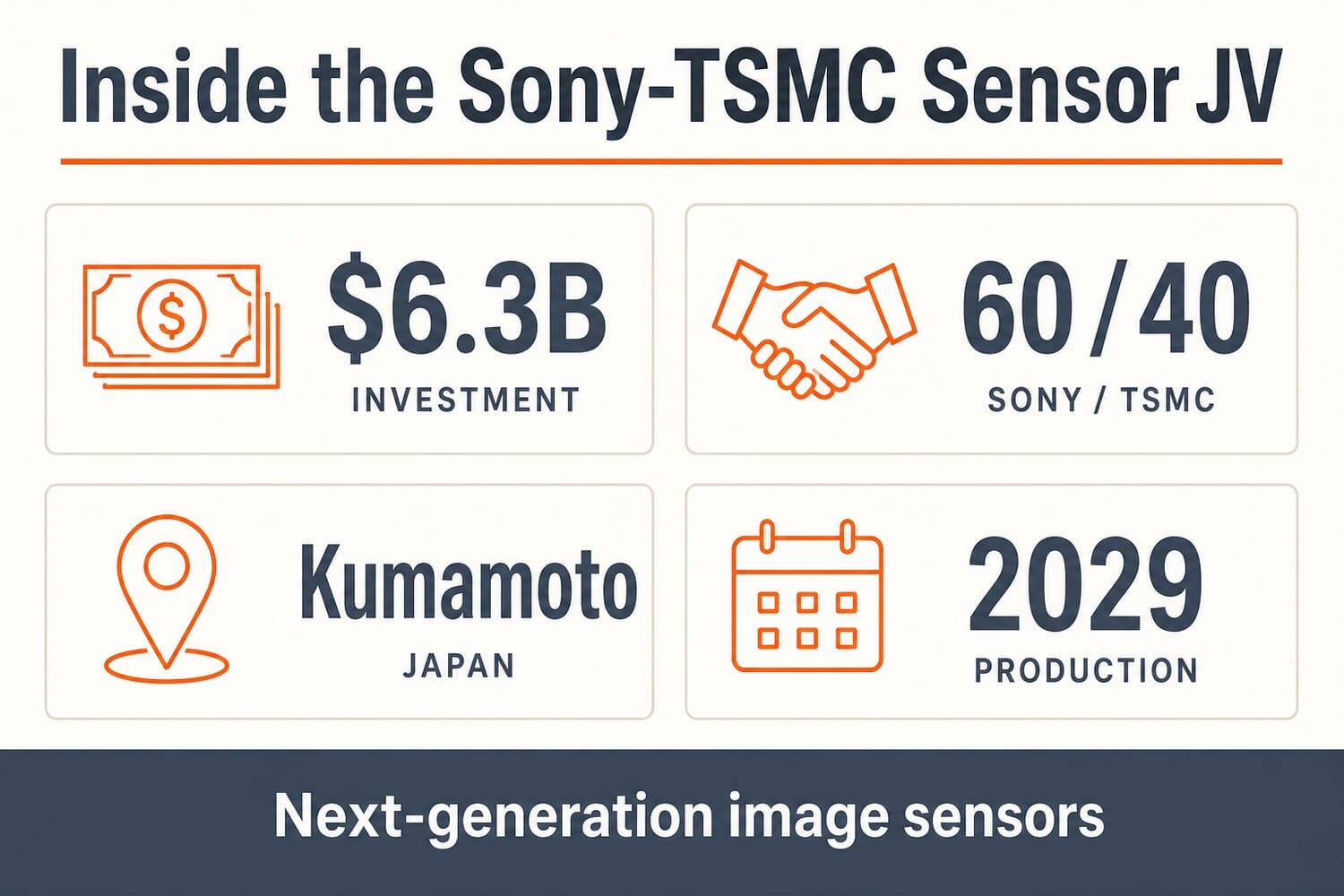
The structure, as reported, is a joint venture roughly 60% owned by Sony and 40% by TSMC, pouring about $6.3 billion into new research and production lines at Sony Semiconductor’s site in Kumamoto. To put that number in perspective, PetaPixel notes it is roughly three times the total profit Sony’s image sensor business made last fiscal year. The two reached a basic agreement back in May; the JV is expected to be established by the end of Sony’s 2026 fiscal year (around March 2027), with commercial output targeted as early as 2029. Japanese government (METI) subsidies are reportedly under discussion.
Why Kumamoto, and Why Now
The timing is the whole story. Sony already dominates the image-sensor market, and Kumamoto is its manufacturing heart, which is exactly why the July quake was such a scare. When one facility underpins the cameras and phones of nearly the entire industry, any disruption ripples everywhere. We laid out that fragility in our coverage of the quake, and the reassuring bookend has since arrived: the plant began a phased restart in early August and was expected back to pre-quake output by mid-month.
Rather than diversify away from a shaken site, Sony is consolidating around it with the world’s number-one contract chipmaker. Pairing Sony’s sensor design with TSMC’s advanced foundry process, on Japanese soil with likely government backing, is a bet on resilience and capability at once. It deepens the concentration, but it also hardens it.
The Apple Angle
One of the most interesting new details is who the sensors are for. Nikkei reports the JV is expected to supply high-performance camera sensors for Apple’s iPhone. Sony has quietly supplied Apple’s main camera sensors for years, so that alone is not shocking. What makes it notable is that it runs counter to reports last year that Apple was shifting some sensor sourcing toward Samsung. A multi-billion-dollar, decade-long commitment reads like Sony re-cementing itself as Apple’s sensor partner, not losing the account.
Beyond Cameras: the ‘Physical AI’ Bet
The JV is not only about sharper photos. Sony frames it around what it calls physical AI, the idea that the next wave of AI needs to see and understand the real world. That means image sensors for autonomous vehicles, robotics, and object recognition, markets that could dwarf cameras and phones over the next decade. Cameras like the ones that use Sony’s 1-inch sensors are the visible tip; the bigger prize is being the eyes of every machine that needs to perceive its surroundings.
What It Means for Photographers
For anyone who shoots, there are three takeaways. First, resilience: after the quake scare, a deliberate, well-funded expansion at Kumamoto is reassuring for the long-term stability of camera and phone sensor supply. Second, Sony’s deepening grip: the company that already makes most of the sensors in your gear is entrenching that position, which is good for continuity and less good for competition, a theme running through Sony’s recent moves like its pursuit of Tamron. Third, quality direction: TSMC-class fabrication points toward genuinely next-generation sensors, higher resolution, better low light, more on-chip intelligence, down the road.
The honest qualifier is time. This is a reported plan, not a shipped product, built on a preliminary agreement with output years away. Nothing here changes the camera you buy this year. It changes the trajectory of the ones you will buy toward the end of the decade.
Frequently Asked Questions
What is the Sony-TSMC joint venture?
It is a reported plan for Sony and TSMC to jointly invest about 1 trillion yen ($6.3 billion) in a new venture to develop and mass-produce next-generation image sensors in Kumamoto, Japan. Sony would own about 60% and TSMC 40%.
When will it start producing sensors?
The companies reached a basic agreement in May 2026, expect to formally establish the JV by around March 2027, and target commercial production as early as 2029. It is a long-term project, not an immediate capacity boost.
Is this connected to the Kumamoto earthquake?
Directly. The July 2026 magnitude 7.1 quake halted the Kumamoto sensor plant and exposed how much of the camera and phone industry depends on it. Rather than move away, Sony is investing further in the same hub.
Will these sensors be in iPhones?
According to Nikkei, the JV is expected to supply high-performance camera sensors for Apple’s iPhone. Sony has supplied Apple’s main sensors for years, and this deal appears to reinforce that relationship.
Does this change the cameras I can buy now?
No. This is a strategic, long-horizon investment with output targeted for 2029. It signals where sensor quality and supply are heading, but it does not affect current or near-term camera and phone models.
The Bottom Line
The quake asked a hard question about a single point of failure, and Sony has answered it with conviction: a $6.3 billion, decade-long bet that doubles down on Kumamoto with the world’s top chipmaker. It reinforces Sony’s already-dominant role in the sensors inside your camera and your phone, extends its Apple relationship, and points toward a future where those sensors power far more than photography. It is still a reported plan on a 2029 horizon, so temper the excitement, but as a statement of where imaging is going, it is hard to miss.
Reference
- Nikkei Asia: Sony, TSMC to invest $6.3bn in advanced image sensor plant in Kumamoto – The report that broke the JV details, ownership, timeline, and Apple supply.
- PetaPixel: Sony and TSMC Are Spending Billions to Make Next-Gen Image Sensors – Photography-industry analysis and the Apple/Samsung context.
- AnySilicon: Sony and TSMC Reportedly Plan $6.3 Billion Joint Venture – Semiconductor-industry perspective on the venture.
- Dataconomy: Sony and TSMC plan $6.3 billion image sensor venture in Japan – Corroborating coverage of the investment.
Image Sources
- Sony full-frame camera with exposed image sensor – Featured image courtesy Sony.
- JV facts infographic and pin – Stylized PhotoWorkout illustrations.