


- President Trump signed a Section 232 proclamation on August 13 imposing tariffs of up to 100% on imported drones and their parts, aimed squarely at China’s dominance of the market.
- The tariffs are tiered: 100% on enterprise, heavy (over 55 lb), thermal, or docking-station drones; 25% on consumer DJI models like the Mini 5 Pro and Air 3S; 15% on allied nations (EU, Japan, Korea, Taiwan); and 10% on UK-made drones.
- Most of it takes effect September 3, 2026, with one tranche delayed to February 9, 2027. Importers pay the tariff and pass it to buyers, so expect DJI prices to climb.
- The 25% consumer tier applies to both new and existing FCC-approved DJI drones. Even if the tariff is later struck down in court, buyers will not get refunds.
- This is the third prong of a coordinated squeeze: it lands the day after the FCC’s retroactive-ban comment deadline, and just after China tightened its own drone-export controls.
The pressure on China-made drones just moved from a proposed rule to a signed price hike. On August 13, President Trump signed a Section 232 proclamation imposing tariffs of up to 100% on imported drones and their components, and unlike the FCC’s still-proposed retroactive ban, this one is done. It takes effect in weeks.
For photographers and creators, the headline is simple: DJI drones are about to get more expensive in the US. But the details matter, because the tariff is calibrated by tier, not a flat 100% across the board. Here is exactly how it breaks down, what you will actually pay, and how it fits with everything else happening to the drone market this month.
The Tariff Tiers, Decoded
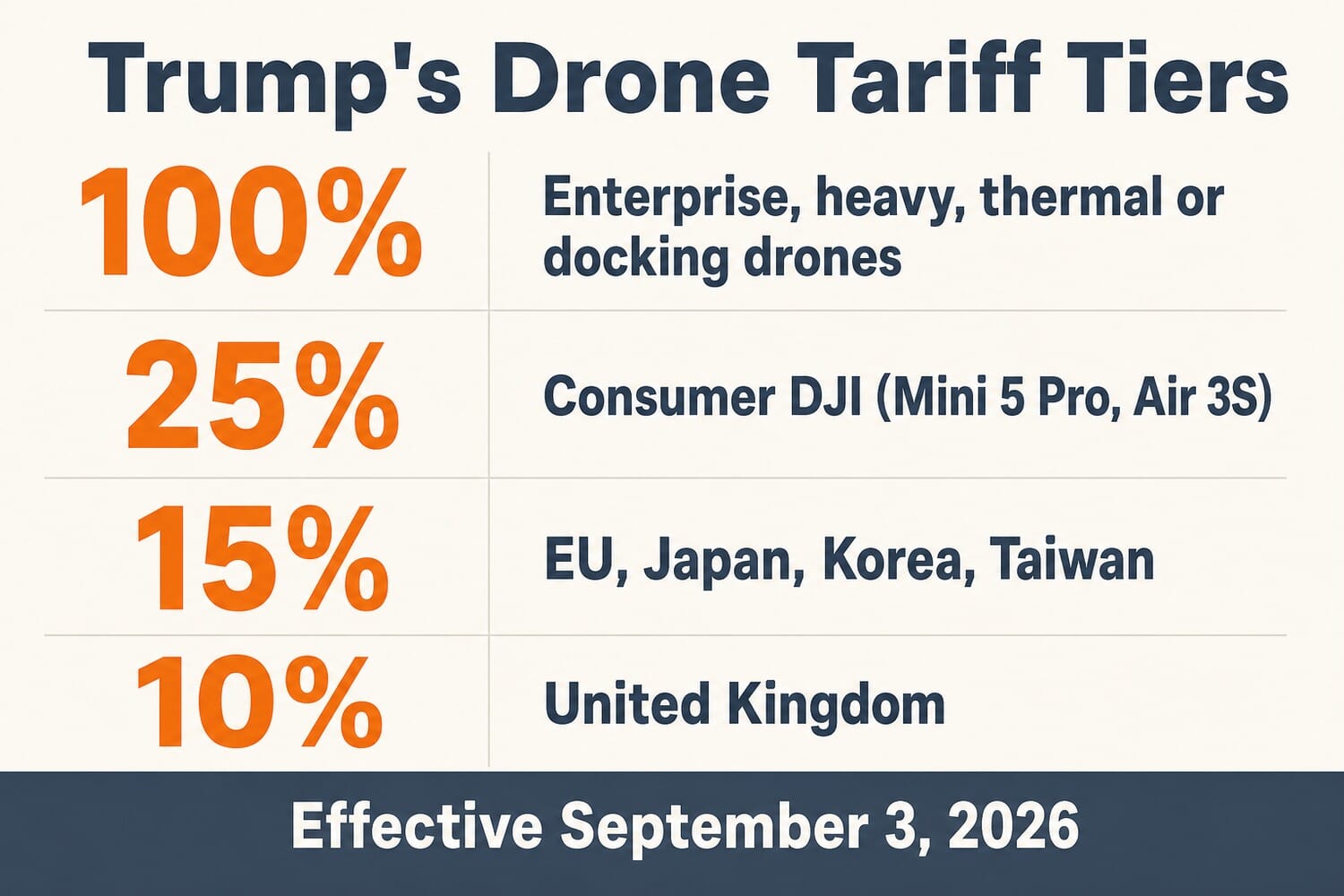
The White House structured the tariffs by capability and country of origin. The full 100% rate hits drones over 25 kg (55 lb) at maximum takeoff weight, or any drone with docking stations or thermal imaging, plus the parts used to build them. Those are the enterprise workhorses used for power-line inspection, crop spraying, and search-and-rescue. Consumer drones under 25 kg, the category that includes the DJI Mini 5 Pro and Air 3S, face a 25% tariff. Allied-made models from the EU, Japan, Korea, Switzerland, and Taiwan get a 15% rate if their components are primarily made there, and UK drones face 10%.
What It Means for Photographers
If you fly a consumer DJI, the practical takeaway is a roughly 25% price bump, and it applies to both new and existing FCC-approved models. Tariffs are paid by the vendors importing the drones and, as with every previous round, passed straight through to the customer at checkout. There is no consumer carve-out, and the White House was explicit that even a later court defeat would not come with refund checks. If you have been eyeing an Avata or an Air 3S, buying before September 3 is the cheaper move.
It also sharpens the case for alternatives. We have already covered the non-DJI options US creators turn to when Chinese drones get harder or pricier to buy, and this tariff makes those look more attractive, at least until domestic supply catches up.
The 100% Tier: Enterprise Takes the Hardest Hit
The heaviest blow lands on commercial operators. A 100% tariff effectively doubles the import cost of enterprise drones over 55 lb or those carrying thermal cameras or docking stations, the exact tools used in agriculture, utilities, public safety, and inspection work. DJI and fellow Chinese maker Autel dominate that segment, and there is no cheap domestic replacement waiting in the wings. For those operators, this is not a price nudge, it is a business-model problem.
The On-Shoring Goal Behind It
The stated aim is national security and, in the White House’s words, “on-shoring” drone manufacturing. Alongside the tariffs, the administration is creating incentive programs for US companies that invest in making drones and drone components domestically. The proclamation also closes a workaround that let companies import Chinese parts and assemble the finished drone in the US to dodge earlier restrictions. Whether American manufacturing can scale fast enough to fill the gap is the open question, and in the near term, the cost lands on buyers.
The Third Prong: How This Fits the FCC Ban and China’s Curbs
This tariff does not stand alone. It is the third move in a tightly timed sequence. The FCC’s proposal to retroactively pull already-approved DJI drones is open for public comment until September 2, and this tariff takes effect September 3, the very next day. The categories line up too: the tariff’s 100% triggers (over 55 lb, docking, thermal) are almost identical to the capabilities the FCC wants to reclassify as military-grade. That is not a coincidence, it is a coordinated policy.
And it is happening while China pushes from the other side. On August 5, Beijing tightened its own export controls on drones and components and sanctioned several US firms, the same cross-border tension we have tracked through the DJI and Insta360 patent fight. Put the three together, a proposed import ban, a signed tariff, and Chinese export curbs, and the US drone market is being squeezed from every direction at once.
Frequently Asked Questions
When do the drone tariffs take effect?
Most of the tariffs take effect September 3, 2026, following the August 13 proclamation, with one tranche delayed to February 9, 2027.
How much more will a DJI Mini 5 Pro or Air 3S cost?
Consumer DJI drones under 25 kg fall in the 25% tariff tier. Because importers pass tariffs through to buyers, expect roughly a 25% price increase on those models in the US.
Does the 100% tariff apply to my camera drone?
No. The 100% rate targets enterprise and heavy drones, over 55 lb, or those with thermal imaging or docking stations. Consumer camera drones like the Mini 5 Pro and Air 3S are in the lower 25% tier.
Do the tariffs apply to non-Chinese drones?
Yes, but at lower rates: 15% for models from the EU, Japan, Korea, Switzerland, and Taiwan (if primarily made there), and 10% for UK-made drones.
Is this the same as the FCC drone ban?
No, they are separate. The FCC action is a proposed rule to block import and sale of certain drones, still open for comment until September 2. This tariff is a signed order that raises the price of imported drones starting September 3. They are coordinated but distinct.
The Bottom Line
Unlike the FCC proposal, this one is signed and imminent. Consumer DJI drones are heading for a roughly 25% price bump on September 3, enterprise models could double, and there is no refund even if the courts intervene later. Paired with the retroactive FCC ban and China’s export curbs, it adds up to the tightest squeeze the US drone market has faced. If a DJI purchase is on your list, the window to buy at today’s price is measured in weeks, not months.
Reference
- White House: Fact Sheet on tariffs on drones and their parts and components – The official proclamation and tariff structure.
- AOL / Engadget: Trump slaps a 100 percent tariff on heavy and sensitive drones – The tiered breakdown (100/25/15/10) and pass-through to buyers.
- Eastern Herald: Trump signs proclamation imposing 100% tariffs on Chinese drones and UAS parts – Section 232 basis, effective dates, and allied-nation rates.
- Bloomberg: Trump imposes 100% tariffs on certain drones, countering China – Original report of the proclamation.
Image Sources
- DJI Air 3S product image – Featured image courtesy DJI.
- Tariff-tier infographic and pin – Stylized PhotoWorkout illustrations.