


- Memory card prices have tripled since late 2025 — a 128GB SanDisk Extreme Pro SD card jumped from ~$30 to over $50.
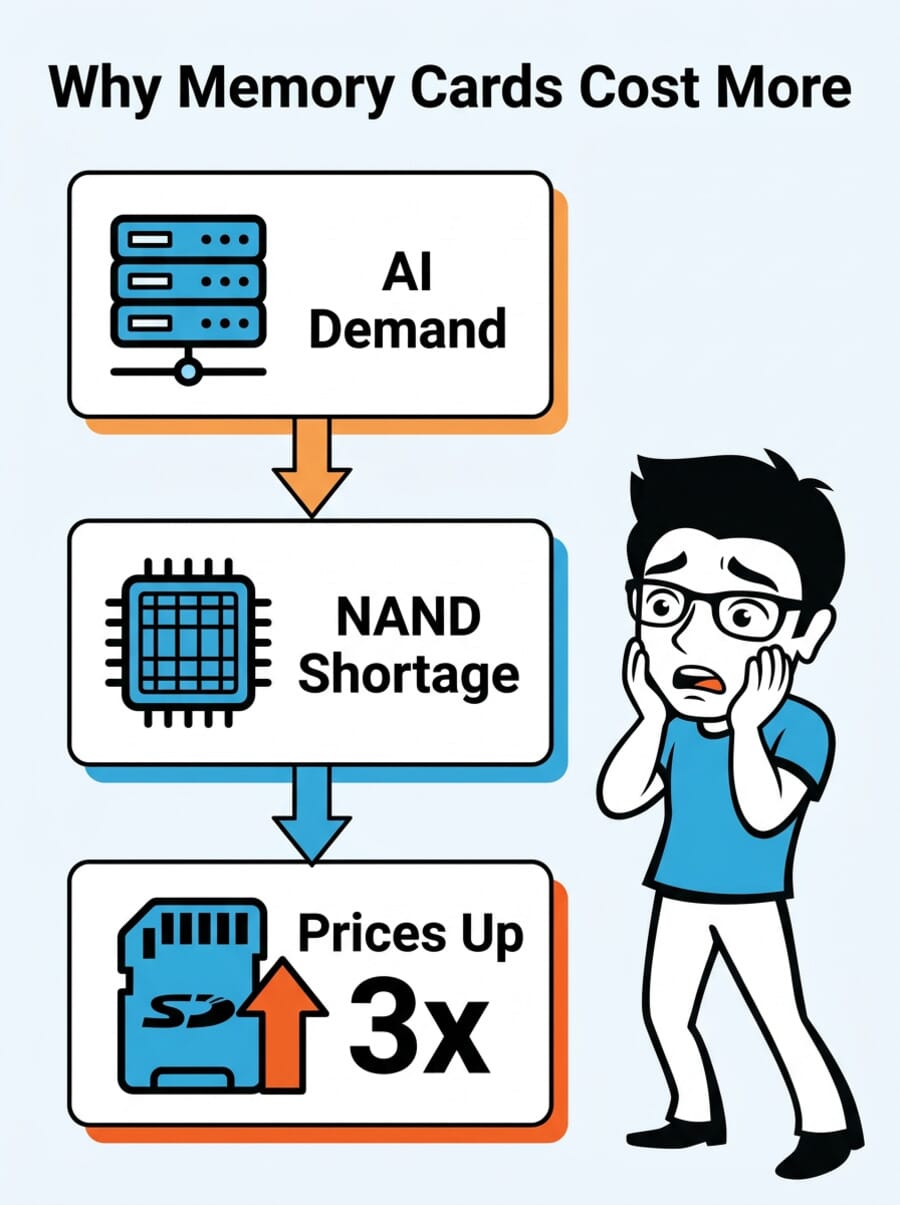
- AI data centers are consuming massive amounts of NAND flash, creating a global shortage that’s hitting SD cards and CFexpress cards hard.
- NAND wafer costs surged 25% in February 2026 alone, with contract prices up 55–60% quarter-over-quarter.
- Relief likely won’t come until mid-to-late 2027 when new fab capacity comes online.
- If you need memory cards, buy now — prices are expected to keep climbing through 2026.
If you’ve shopped for SD cards or CFexpress cards recently, you’ve probably done a double take at the prices. That 128GB card that cost $17 a few months ago? Now it’s pushing $40. The 512GB CFexpress Type B card you’ve been eyeing? Add another $100 to what you remember paying.
This isn’t a temporary blip. A global NAND flash shortage — driven almost entirely by artificial intelligence infrastructure — is pushing memory card prices to levels not seen in years. And it’s going to get worse before it gets better.
Why Memory Card Prices Are Skyrocketing
The culprit is AI. Companies like Google, Meta, Nvidia, and OpenAI are building massive data centers that devour NAND flash memory and DRAM at an unprecedented scale. According to Wikipedia’s documentation of the shortage, OpenAI alone consumes roughly 40% of the global DRAM supply. A 2024 McKinsey analysis projected that AI data center demand would grow at 33% annually through 2030.
Memory manufacturers — Samsung, SK Hynix, and Micron — have responded by diverting factory capacity toward high-margin High Bandwidth Memory (HBM) chips used in AI accelerators. HBM manufacturing requires significantly more wafer capacity per bit than standard memory, so every HBM chip produced means fewer NAND wafers available for consumer products like SD cards and SSDs.
The result: manufacturers of memory cards have to fight for whatever NAND flash is left after AI companies have paid top dollar. When demand outstrips supply this dramatically, prices surge.
How Bad Is It?
Bad. According to Digital Camera World’s analysis, memory card prices have tripled across the board in recent months. Here are some real examples:
- SanDisk Extreme 128GB microSDXC — was ~$17 in October 2025, now nearly $40
- Samsung EVO Select 512GB microSD — was ~$35, now approaching $70
- SanDisk Extreme Pro 128GB SD — was ~$30 at the start of 2026, now around $52 on Amazon (as of March 2026)
CFexpress Type B cards — essential for high-end Canon and Nikon mirrorless cameras — have been hit even harder. As Canon Rumors reports, some cards have doubled in price in just a couple of months. Large-capacity cards (1TB and above) have become “extremely expensive.” A SanDisk 128GB Extreme PRO CFexpress Type B now runs $150 on Amazon.
It’s not just online retailers. Jon Gilchrist, co-owner of Gene’s Camera store in Indiana, told a local news outlet: “A card that was $2.99 is now $4.99… $300 to $500 is ouch.”
At the industry level, the numbers are staggering. NAND wafer spot prices surged 25% in February 2026 alone, according to Tom’s Hardware. TrendForce data shows NAND flash contract prices climbed 55–60% quarter-over-quarter in Q1 2026. The DRAM market is so volatile that prices now shift hourly, with smaller firms fighting over scraps.
When Will Prices Come Down?
The honest answer: not until 2027, and possibly not even then.
New NAND fabrication capacity takes 18–24 months to bring online. Samsung, SK Hynix, and Micron all have expansion plans in progress, but those new fabs won’t produce enough volume to meaningfully ease the supply crunch until mid-to-late 2027 at the earliest.
Meanwhile, AI demand isn’t slowing down. Data centers are projected to consume 70% of all memory chips produced in 2026, according to industry analysts. Dell’s COO described the situation as costs “escalating at a pace we’ve never witnessed.” Lenovo disclosed that its memory inventories are 50% above normal as it stockpiles against further increases.
Some analysts warn the situation could trigger an “industry cycle collapse” — where spiraling costs push smaller memory card brands out of the market entirely, further reducing competition and keeping prices high.
What Photographers Should Do Now
Waiting for prices to drop isn’t a strategy — not when every month brings another price hike. Here’s what makes sense right now:
- Buy what you need now. Prices in six months will almost certainly be higher than today. If you know you need cards for an upcoming season or project, don’t wait.
- Stick to reputable brands. Canon Rumors specifically warns against unknown or paid-branding cards (like Kodak-branded cards that aren’t actually made by Kodak). Brands like SanDisk, Lexar, ProGrade, Delkin, Samsung, and Transcend are safe bets. Check our best SD cards for photography guide for tested recommendations.
- Consider lower-capacity cards. Rather than one 512GB card, two 128GB or 256GB cards give you redundancy and may be more affordable per shoot.
- Check the used market. Sites like MPB, KEH, and even eBay have used memory cards at pre-shortage prices. Just verify the seller’s reputation and test the cards thoroughly.
- Offload to external storage faster. A reliable SD card reader and a fast external SSD let you reuse fewer cards by transferring files quickly between shoots.
- Protect what you have. Proper storage and backup practices become more important when replacing a damaged card costs 2–3x what it used to.
When you buy through links on our site, we may earn a commission at no cost to you. We evaluate products independently. Commissions do not affect our evaluations. As an Amazon Associate, we earn from qualifying purchases.
Why are SD card prices so high right now?
AI companies are consuming massive amounts of NAND flash memory for data center storage and infrastructure. This has created a global shortage of NAND flash — the same type of memory used in SD cards, microSD cards, CFexpress cards, and SSDs. With manufacturers prioritizing high-margin AI chips, less supply is available for consumer memory products, driving prices up 200–300%.
When will memory card prices go back to normal?
Most industry analysts don’t expect meaningful price relief until mid-to-late 2027, when new NAND fabrication facilities come online and begin producing enough volume to ease the supply shortage. Until then, prices are expected to remain elevated or continue climbing.
Are CFexpress cards more affected than SD cards?
Yes, CFexpress cards have generally seen steeper price increases because they use more NAND flash per card (especially at higher capacities like 512GB and 1TB) and have a smaller, more specialized market. Some CFexpress Type B cards have more than doubled in price since late 2025.
Should I buy memory cards now or wait for prices to drop?
If you need memory cards for upcoming shoots or projects, buying now is the safer bet. Prices have been rising consistently month-over-month, and industry forecasts suggest they’ll continue climbing through 2026. Waiting risks paying even more later.
Sources used for this article:
Featured image: Photo by Samsung Memory on Unsplash.
Related Posts
Get the Weekly Photography News Digest
Join photographers who get our top stories delivered every Monday morning. No spam, unsubscribe anytime.