


- Nick Ut has filed a criminal defamation lawsuit in France against Netflix and the VII Foundation over claims in The Stringer documentary.
- The documentary alleges a freelance photographer named Nguyen Thanh Nghe, not Ut, took the iconic 1972 “Napalm Girl” photograph.
- Ut is seeking $139,000 in damages and legal costs, with plans to donate any proceeds to charity.
- The case raises critical questions about photographer attribution and what happens when decades of photographic credit get challenged.

Nick Ut, the photojournalist credited with one of the most recognized photographs in history, is taking Netflix to court. The 75-year-old has filed a criminal defamation lawsuit in France against the streaming giant and the VII Foundation over their documentary The Stringer, which claims he did not take the Pulitzer Prize-winning image known worldwide as “Napalm Girl.”
The lawsuit, filed in early March 2026, marks a dramatic escalation in a dispute that has divided the photojournalism community since the documentary premiered at the Sundance Film Festival in January 2025. At its core is a question that matters to every photographer: who gets credit for the image?
What the Lawsuit Claims
Ut’s legal team filed for public defamation under France’s Press Law of 1881, naming Gary Knight, CEO of the VII Foundation, and Netflix France as defendants. The suit seeks 100,000 euros (approximately $118,000) in damages and 20,000 euros ($27,000) in legal costs.
According to court documents reviewed by PetaPixel, the lawsuit alleges that The Stringer defames Ut on two fronts: by asserting he is not the author of “Napalm Girl,” and by claiming he misrepresented his role in transporting the injured child, Phan Thi Kim Phuc, to medical care after the napalm attack.
Ut’s lawyers describe the film’s portrayal as painting him as a “shameless liar who, over the years, has skillfully cultivated a narrative that he knew to be false and a stolen attribution.” The filing includes specific timestamps from the documentary where Ut alleges defamation occurs, starting from the opening sequence.
Why France? The documentary was produced by Paris-based nonprofit Index, and the VII Foundation has an office registered in southern France. French criminal law allows a person who believes they are a victim of defamation to summon the alleged perpetrator directly before a criminal court.
Ut’s attorney, James Hornstein, emphasized that his client “has brought the action forward to defend his reputation, and not for financial gain.” Any awarded damages will reportedly be donated to charity.
The Documentary’s Controversial Argument
The Stringer, released on Netflix on November 28, 2025, follows Gary Knight as he investigates claims that the famous photograph was actually taken by an unknown freelance photographer named Nguyen Thanh Nghe. The documentary presents testimony from Carl Robinson, a former AP photo editor in Vietnam at the time the image was captured.
Robinson claims he examined rolls of film from both Ut and Nghe on June 8, 1972, and that the iconic frontal shot of Kim Phuc running came from the stringer’s roll, not Ut’s. He alleges that his supervisor, legendary photo editor Horst Faas, instructed him to credit the image to Ut instead of Nghe.
“It’s been with me the rest of my life, those words,” Robinson says in the film, explaining that he was afraid of losing his job and didn’t challenge Faas’s decision. Faas died in 2012 and could not be interviewed, though the AP notes he publicly discussed the image many times without ever questioning Ut’s authorship.
The documentary also includes a reconstruction of events and uses newsreel footage to argue that Nghe was better positioned to take the shot. Following its own investigation in May 2025, the World Press Photo Foundation suspended Ut’s credit on the image, though the Associated Press continues to stand firmly behind Ut.
Hornstein has pushed back against the documentary’s evidence, arguing that “no new documentary evidence – no negative, no contact sheet, no print, no contemporaneous note, and no photographic archive – has surfaced to support an alternative authorship.”

The Photo’s Legacy
The photograph officially titled The Terror of War was taken on June 8, 1972, in Trang Bang, Vietnam. It shows nine-year-old Phan Thi Kim Phuc running naked down a road, her clothes burned away by a South Vietnamese napalm strike. The image won the Pulitzer Prize for Spot News Photography in 1973 and became one of the most powerful anti-war images ever captured.
Ut was 21 years old and working as a staff photographer for the Associated Press when the image was taken. He went on to have a decades-long career with the AP, primarily based in Los Angeles. The photograph helped turn public opinion against the Vietnam War and has been featured in countless history books, museums, and visual storytelling discussions.
Kim Phuc survived her injuries and eventually became a UNESCO Goodwill Ambassador. She and Ut have maintained a relationship over the decades, with Ut frequently referred to as having helped save her life by rushing her to a hospital after taking the photograph – a claim the documentary also disputes.
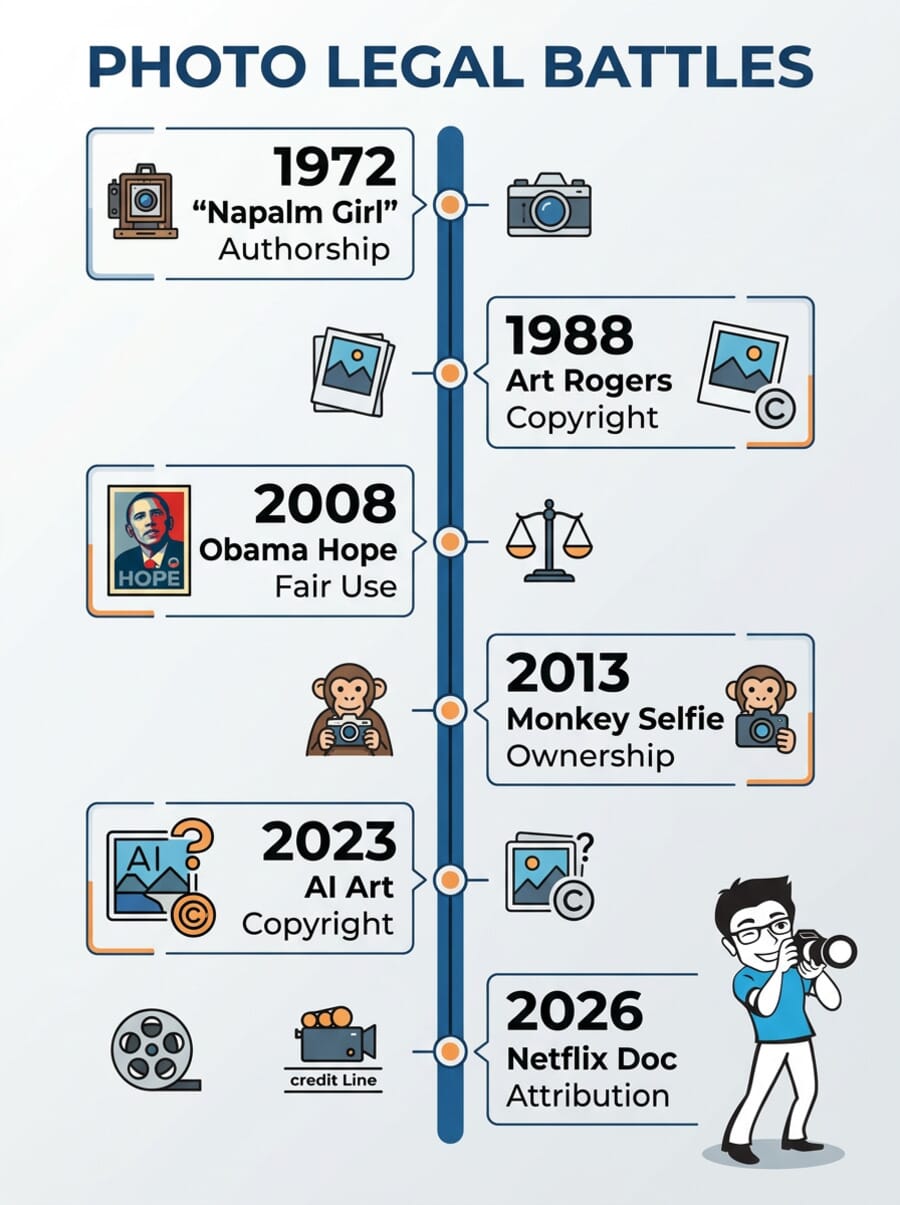
Why This Matters for Photographers
This lawsuit touches a nerve that extends far beyond one photograph or one photographer. Attribution – knowing and proving who created an image – is the foundation of professional photography. Every street photographer, war correspondent, and freelancer depends on proper credit for their livelihood and legacy.
The timing makes it even more significant. We are living through an era where AI-generated images can mimic real photographs, where deepfakes can fabricate events that never happened, and where the very concept of photographic truth is under pressure. The legal frameworks around image rights and AI are still being written.
If a Pulitzer Prize-winning photograph credited to one photographer for over 50 years can have its authorship successfully challenged, what does that mean for the millions of images produced daily? How do photographers protect their work when even film-era negatives and wire service records can be disputed decades later?
The case also raises uncomfortable questions about the power of documentaries to reshape historical narratives. The Stringer influenced the World Press Photo Foundation enough to suspend Ut’s credit before any court had examined the evidence. Whether or not the documentary’s claims hold up in court, the reputational damage is already done.
For working photographers, the takeaway is practical: metadata matters. Original RAW files, EXIF data, properly composed contact sheets, and secure archives are more than organizational tools – they are legal evidence. In 1972, the technology to embed authorship directly into an image file didn’t exist. That is no longer an excuse.
The French court proceedings will likely take months. But regardless of the verdict, this case has already become a landmark moment in the ongoing conversation about who owns a photograph – and who gets to decide.
Featured image: Photo by Matt Seymour on Unsplash.
Sources used for this article:
Related Posts
Get the Weekly Photography News Digest
Join photographers who get our top stories delivered every Monday morning. No spam, unsubscribe anytime.