


- Samyang displayed a 200mm f/1.8 FE OIS prototype at CP+ 2026 – the fastest 200mm autofocus lens ever designed for mirrorless.
- The lens is part of the Schneider Kreuznach x LK Samyang collaboration, alongside a 20-50mm f/2, 28-85mm f/2, and 300mm f/4.
- Still in early development with no confirmed production date – Samyang is gauging market interest before committing.
- If produced, it would be the first f/1.8 autofocus 200mm lens since Canon discontinued its legendary EF 200mm f/1.8L in 2003.
At CP+ 2026 in Yokohama, Samyang quietly showed off something that made telephoto lens enthusiasts do a double take: a 3D-printed mockup of a 200mm f/1.8 FE OIS autofocus lens for Sony E-mount mirrorless cameras. If it reaches production, it would be the fastest 200mm autofocus lens available for any mirrorless system – and the fastest 200mm AF lens made by anyone in over two decades.
The prototype was not on the public show floor. Instead, it was shown privately to select media, alongside three other ambitious lens concepts from the Schneider Kreuznach x LK Samyang partnership. Phototrend’s team was among those who got a close look, and they spoke directly with Kim Dubin, Samyang’s Product Planning Manager, who confirmed the lens concepts and the company’s strategy behind them.
What We Know So Far
Here is what has been confirmed about the Samyang AF 200mm f/1.8 FE OIS:
- Focal length: 200mm
- Maximum aperture: f/1.8
- Mount: Sony FE (full-frame E-mount)
- Autofocus: Yes (AF designation)
- Optical stabilization: OIS (optical image stabilization) – this would be Samyang’s first stabilized lens
- Current status: 3D-printed mockup only, not a working prototype
- Production timeline: Not confirmed – Samyang is gathering user feedback before deciding
It is worth stressing that these are concept mockups, not production-ready lenses. Samyang’s Kim Dubin was clear that the company is in an exploratory phase, using CP+ to gauge interest from photographers and media before committing resources to full development. Features, specifications, and even the decision to produce the lens at all remain subject to change.
The OIS designation is particularly noteworthy. Samyang has been developing optical stabilization technology internally, testing it on 135mm f/1.8 prototypes. If the system proves effective, it could debut on these longer telephoto designs where stabilization matters most.
Why a 200mm f/1.8 Matters: The Canon Legacy
The 200mm f/1.8 combination is not entirely new territory – but it is extremely rare. Canon produced the EF 200mm f/1.8L USM from 1988 to 2003, and it remains one of the most legendary lenses ever made. Nicknamed “The Eye of Sauron” for its massive front element, it was the fastest 200mm autofocus lens in existence.
Canon discontinued it in favor of the EF 200mm f/2L IS USM, which added image stabilization at the cost of one-third of a stop. The f/1.8L quickly became a collector’s item. Used copies now regularly sell for $5,000 to $6,000+ when they surface – a testament to how much photographers valued that extra speed at 200mm.
No manufacturer has attempted an f/1.8 autofocus lens at 200mm since. The closest modern alternatives are the Sigma 200mm f/2 DG OS Sports (around $3,000) and the Laowa 200mm f/2 AF FF (around $2,000), both excellent but still a third of a stop slower. A Samyang 200mm f/1.8 would reclaim territory that has been vacant for over twenty years.
What a 200mm f/1.8 Means for Photographers
The appeal of f/1.8 at 200mm comes down to two things: background separation and light gathering.
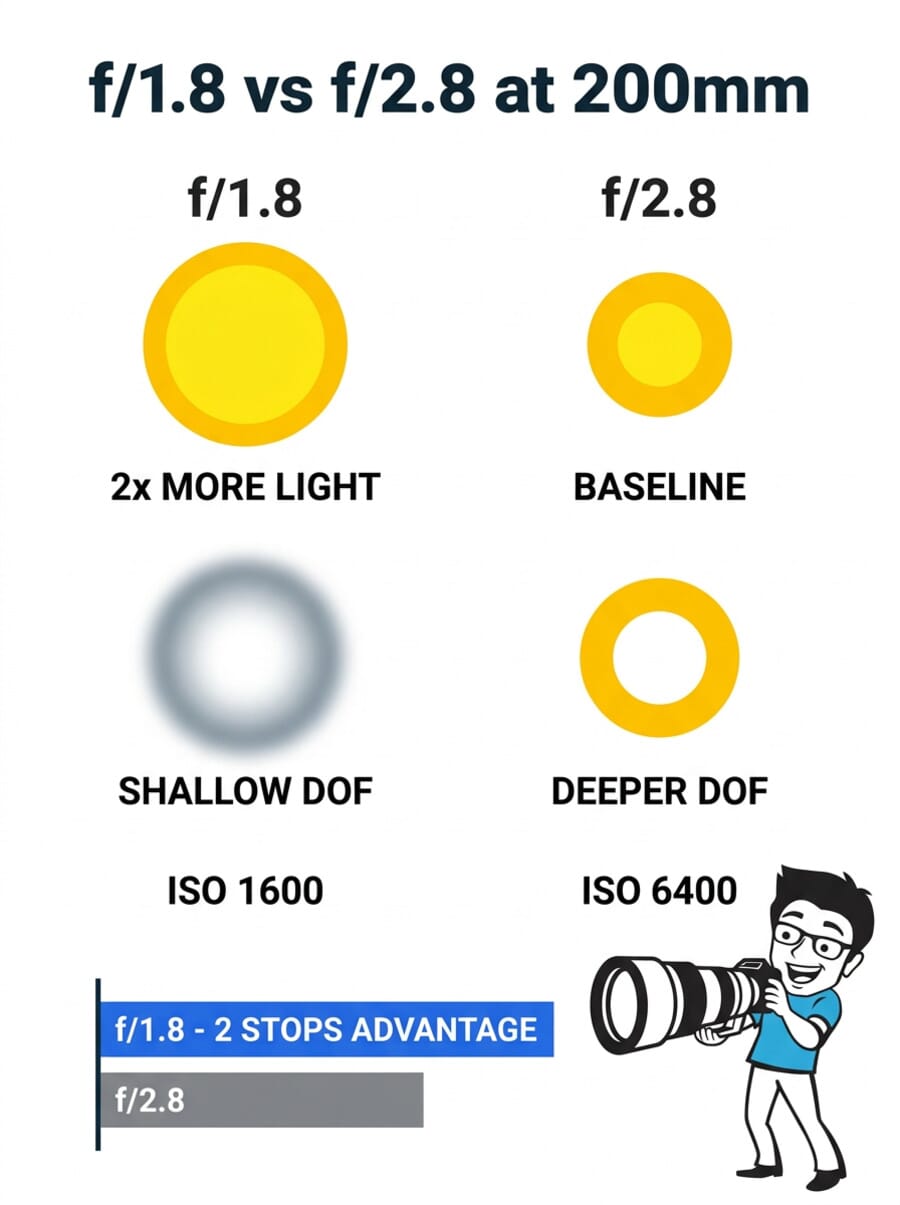
Portrait and event photography: At 200mm and f/1.8, background bokeh becomes almost painterly. Subjects separate from busy backgrounds in ways that even an 85mm f/1.4 cannot replicate, thanks to the compressed perspective and extremely thin depth of field. For wedding photographers shooting ceremonies from a distance, or portrait photographers working outdoors, this combination is uniquely powerful.
Sports and action: The extra light at f/1.8 compared to a typical f/2.8 telephoto means faster shutter speeds in challenging conditions. Stadium floodlights, overcast outdoor fields, indoor arenas – anywhere a sports photographer is fighting for shutter speed, that aperture advantage translates directly into sharper action shots at lower ISO values.
Wildlife and nature: While 200mm is short for dedicated wildlife work, it covers a sweet spot for larger animals, birds in parks, and environmental wildlife portraits where context matters as much as the subject. The f/1.8 aperture helps in the golden hour and shaded forest conditions where wildlife is often most active.
Low-light capability: Compared to a 70-200mm f/2.8 zoom (the workhorse telephoto for most professionals), an f/1.8 prime gathers roughly 1.3 stops more light. That is the difference between shooting at ISO 3200 versus ISO 6400 – meaningful for low-light image quality, especially when pushing modern sensors to their limits.
The Broader Samyang Roadmap
The 200mm f/1.8 is not an isolated concept. It is part of an ambitious lens roadmap that Samyang previewed at CP+ 2026 under the Schneider Kreuznach x LK Samyang branding (Samyang lenses are sold as Rokinon in some markets). The full lineup of prototypes shown includes:
- Samyang AF 20-50mm f/2 FE – An ultra-wide zoom with a constant f/2 aperture. Not expected before 2028-2029 to avoid cannibalizing the current 24-60mm f/2.8.
- Samyang AF 28-85mm f/2-2.8 FE – A versatile standard zoom. Originally planned as a constant f/2 but adjusted to variable aperture to manage size. Could arrive late 2027 or spring 2028.
- Samyang AF 300mm f/4 FE OIS – A stabilized telephoto prime aimed at wildlife and sports shooters. May include a built-in 1.4x teleconverter (becoming 420mm f/5.6) to sidestep third-party teleconverter licensing restrictions.
- Samyang AF 28-135mm f/2.8 FE – Already in production, expected late 2026. Will feature a new linear VCM autofocus motor.
This is a strikingly aggressive lineup from a manufacturer better known for affordable primes. The Schneider Kreuznach collaboration appears to be giving Samyang the optical engineering confidence to tackle lens categories historically dominated by Canon, Nikon, Sony, and Sigma.
We previously covered Samyang’s 60-180mm f/2.8 announcement at CP+ 2026, which was the lens shown publicly on the show floor. The 200mm f/1.8 and the rest of the roadmap were shared more discreetly – a sign that Samyang is serious about these concepts but wants to validate demand before committing to production.
The Bottom Line
A 200mm f/1.8 autofocus lens for mirrorless cameras would be a genuinely significant development – the kind of lens that photographers have been dreaming about since Canon killed off its legendary f/1.8L over twenty years ago. The addition of optical stabilization (OIS) would make it even more compelling.
But this is early days. What Samyang showed at CP+ 2026 was a 3D-printed shell, not a working lens. Turning that mockup into a shipping product involves years of optical engineering, manufacturing tooling, and market positioning decisions. Samyang has explicitly said production is not guaranteed.
Still, the fact that Samyang is publicly exploring this space – and backing it with the Schneider Kreuznach partnership – signals genuine intent. For more on what else was revealed at the show, check our complete CP+ 2026 lens roundup and our CP+ 2026 wrap-up.
Featured image: Samyang AF 200mm f/1.8 FE OIS mockup at CP+ 2026. Original photo by Phototrend, enhanced for product presentation.
Sources used for this article:
Related Posts
Get the Weekly Photography News Digest
Join photographers who get our top stories delivered every Monday morning. No spam, unsubscribe anytime.